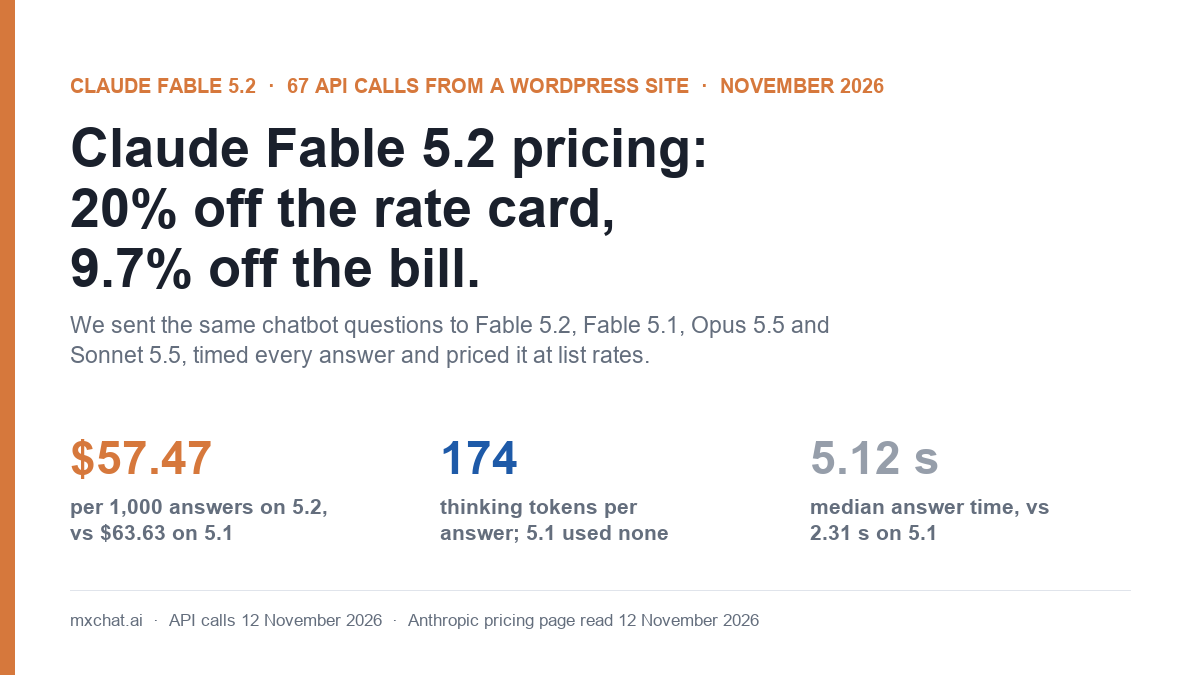
Claude Fable 5.2 Pricing: 20% Cut, 9.7% Saving (Tested)
Claude Fable 5.2 pricing is $8 per million input tokens and $40 per million output tokens on Anthropic’s API, down from $10 and $50 on Fable 5.1. That is 20% off every line of the rate card: cache writes, cache reads, batch and fast mode all fell by the same proportion. Fable 5.2 went on sale on 9 November 2026 under the model ID claude-fable-5-2.
A 20% cut sounds like a 20% smaller bill. On a WordPress chatbot it wasn’t. On 12 November 2026 we sent the same support questions from our own server to Fable 5.2, Fable 5.1, Claude Opus 5.5 and Claude Sonnet 5.5, then timed and priced every answer. That came to 67 API calls and cost about $3.45.
The short answer: 1,000 chatbot answers cost $57.47 on Fable 5.2 against $63.63 on Fable 5.1, a saving of 9.7%, not 20%. The reason is in the usage the API returned: Fable 5.2 thinks before every answer and Fable 5.1 did not, and those thinking tokens are billed at the $40 output rate. Thinking cannot be switched off on 5.2, and even at effort low it still spent 134 tokens thinking per answer. It also made answers slower: a median of 5.12 seconds against 2.31.
Claude Fable 5.2 pricing: the rate card
These are the rates on Anthropic’s pricing page, read on 12 November 2026, in US dollars per million tokens.
| Model | Input | Cache write (5 min) | Cache write (1 hour) | Cache read | Output |
|---|---|---|---|---|---|
| Claude Fable 5.2 | $8 | $10 | $16 | $0.20 | $40 |
| Claude Fable 5.1 | $10 | $12.50 | $20 | $0.25 | $50 |
| Claude Fable 5 | $10 | $12.50 | $20 | $1 | $50 |
| Claude Opus 5.5 | $4 | $5 | $8 | $0.20 | $20 |
| Claude Sonnet 5.5 | $2 | $2.50 | $4 | $0.10 | $10 |
The other Fable 5.2 prices on the same page:
| Fable 5.2 option | Input | Output | What it is for |
|---|---|---|---|
| Standard | $8 | $40 | Normal API requests |
| Fast mode | $16 | $80 | Faster output at twice the price |
| Batch API | $4 | $20 | Asynchronous jobs, results within 24 hours |
Three details on that page matter for a chatbot:
- Cache reads are 0.025x input on Fable 5.2 and 5.1, against the usual 0.1x. On 5.2 a cached token costs $0.20 per million, the same as Opus 5.5, so a long, mostly cached conversation is cheap to resend.
- The tokenizer is the same as 5.1’s. Both models counted our request as exactly 5,626 input tokens, so the rate cut is not offset by a change in token count. (Anthropic’s newer tokenizer, used by Claude 4.7 and later, produces about 30% more tokens for the same text than Sonnet 4.6 and earlier. Both Fable versions already use it.)
- Batch is no use for live chat. Half price, but results arrive within 24 hours. It suits overnight jobs such as summarising transcripts, not answering a visitor.
Claude Mythos 5.2 carries the same rates and is limited to verified organisations.
How we tested it
The test runs on our own WordPress site, from the same server that hosts it, with the request MxChat sends when a visitor asks a question:
- System prompt: our site’s real chatbot instructions, 1,212 tokens, marked for caching (so after the first request it is billed as a cache read).
- Knowledge base: four excerpts from our own documentation and blog, about 4,000 characters each, chosen the way retrieval would choose them for the question.
- Questions: three real support questions: whether the bot can look up a WooCommerce order status, whether Pinecone is needed for the knowledge base, and whether a visitor can be handed to a human on Slack or Telegram.
- Setups: Fable 5.2 at its default effort and at
mediumandlow; Fable 5.2 in fast mode; Fable 5.1 at its default; Opus 5.5 and Sonnet 5.5 at their defaults. Each setup answered all three questions twice.max_tokenswas 4,000, so no answer was cut off; all ended withend_turn. - Timing: wall-clock seconds from sending the request to receiving the complete answer, not streamed, from a US server to Anthropic’s API.
- Cost: the token counts in each response’s
usagefield, multiplied by the list prices above.
We also ran a longer request on four of the setups (twice each) and tried every thinking setting the API offers on Fable 5.2. All 42 short answers in the main grid were correct on the facts; we read them against our documentation.
Results: cost and speed per chatbot answer
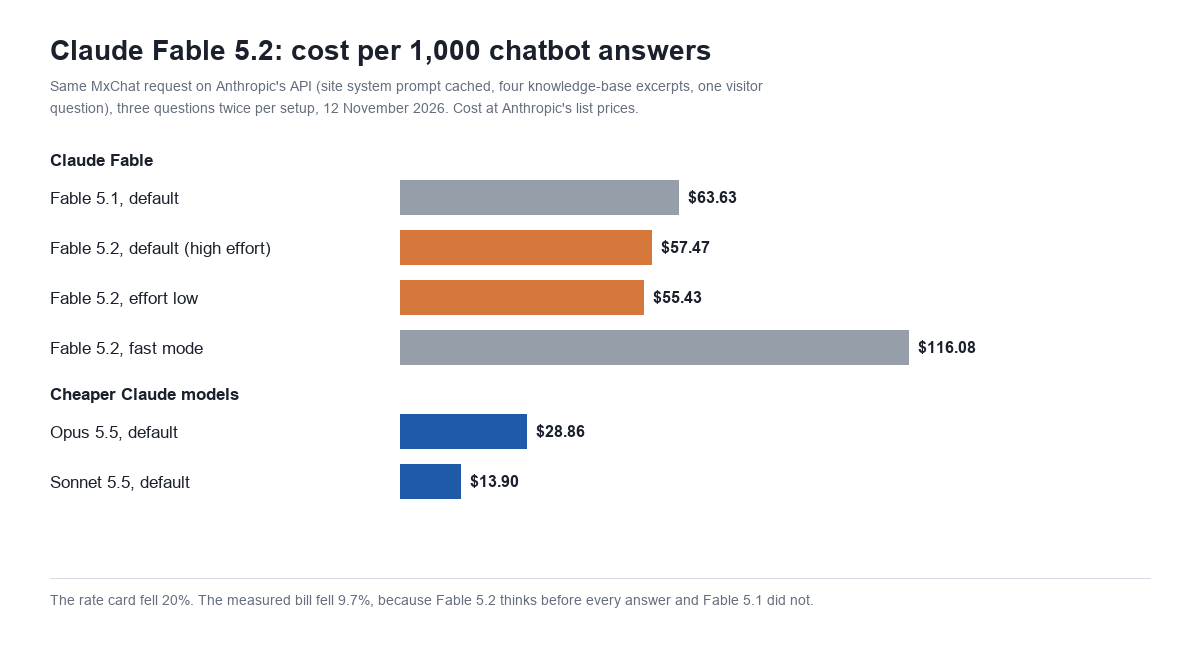
| Model and effort | Cost per 1,000 answers | Median time | Thinking tokens per answer | Output tokens per answer |
|---|---|---|---|---|
| Fable 5.1, default | $63.63 | 2.31 s | 0 | 141 |
| Fable 5.2, default (high) | $57.47 | 5.12 s | 174 (84 to 326) | 306 |
| Fable 5.2, effort medium | $56.00 | 4.70 s | 136 | 269 |
| Fable 5.2, effort low | $55.43 | 4.56 s | 134 (75 to 205) | 255 |
| Fable 5.2, fast mode | $116.08 | 1.59 s | 202 | 320 |
| Opus 5.5, default | $28.86 | 3.50 s | 141 | 306 |
| Sonnet 5.5, default | $13.90 | 2.17 s | 99 (0 to 332) | 252 |
Fable 5.2 is cheaper than Fable 5.1 on every setting. It is not 20% cheaper on any of them. At its default it saved $6.16 per 1,000 answers, 9.7%. At effort low it saved $8.20, 12.9%.
The visible answers were the same length on both models: 61 words on 5.2, 60 on 5.1. What changed is what came before them. Fable 5.1 answered these questions directly, with no thinking block. Fable 5.2 returned a thinking block on all 24 of its answers in the grid, and those tokens more than doubled its output: 306 output tokens per answer against 141.
To isolate the rate cut, we priced each model’s tokens at the other’s rates. Fable 5.2’s tokens at 5.1’s prices would have cost $71.84 per 1,000 answers. Fable 5.1’s tokens at 5.2’s prices would have cost $50.90. Either way the price cut is a real 20%; the extra thinking takes back about half of it.
Fable 5.2 always thinks, and you can’t turn it off
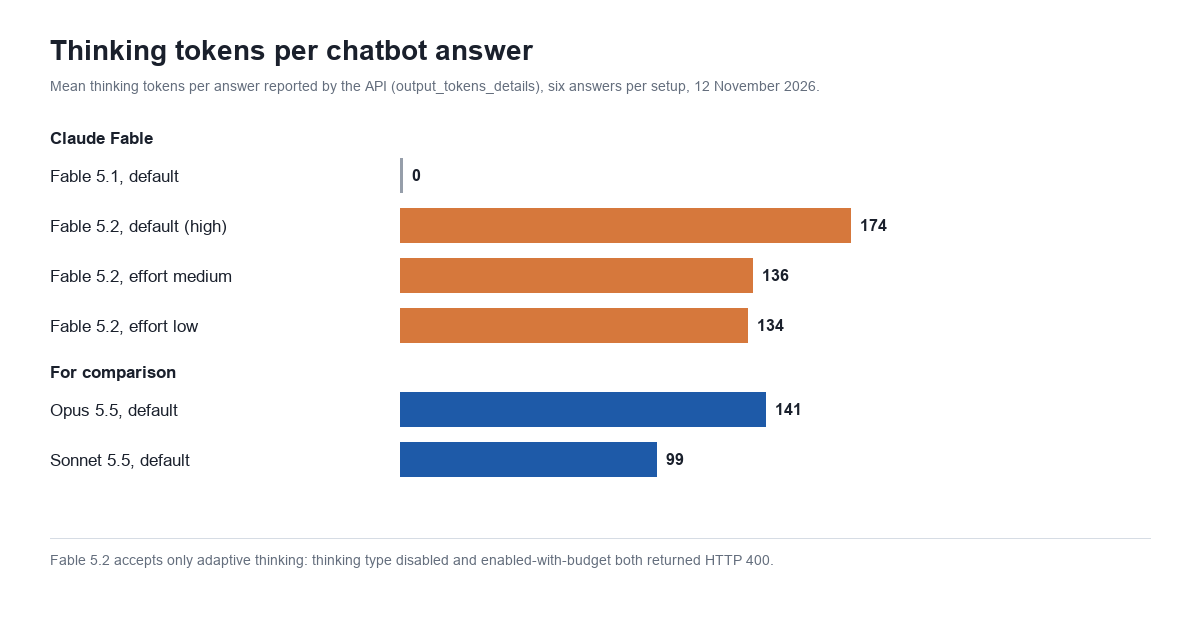
We tried every thinking setting on the Messages API with Fable 5.2 on the same three questions:
| Request setting | Result |
|---|---|
"thinking": {"type": "disabled"} | HTTP 400: not supported for this model |
"thinking": {"type": "enabled", "budget_tokens": 1024} | HTTP 400: not supported for this model |
"thinking": {"type": "adaptive"} | 200, thinking on every answer (98 to 274 tokens) |
| No thinking parameter (the default) | 200, thinking on every answer (84 to 326 tokens) |
"output_config": {"effort": "low"} | 200, thinking on every answer (75 to 205 tokens) |
Adaptive thinking is the only mode Fable 5.2 accepts, and on our questions adaptive meant “always”. The effort setting is the only control you have, and it does less than you’d hope: from the default (high) to low, mean thinking fell from 174 to 134 tokens, and the bill fell 3.5%, from $57.47 to $55.43. medium landed almost exactly on low.
Effort matters more for one reason: Anthropic’s API runs Fable 5.2 at high effort when you don’t set it, while the Claude apps and Claude Code default to medium. A plugin or script that sends a plain request gets the high-effort row.
Where the bill goes
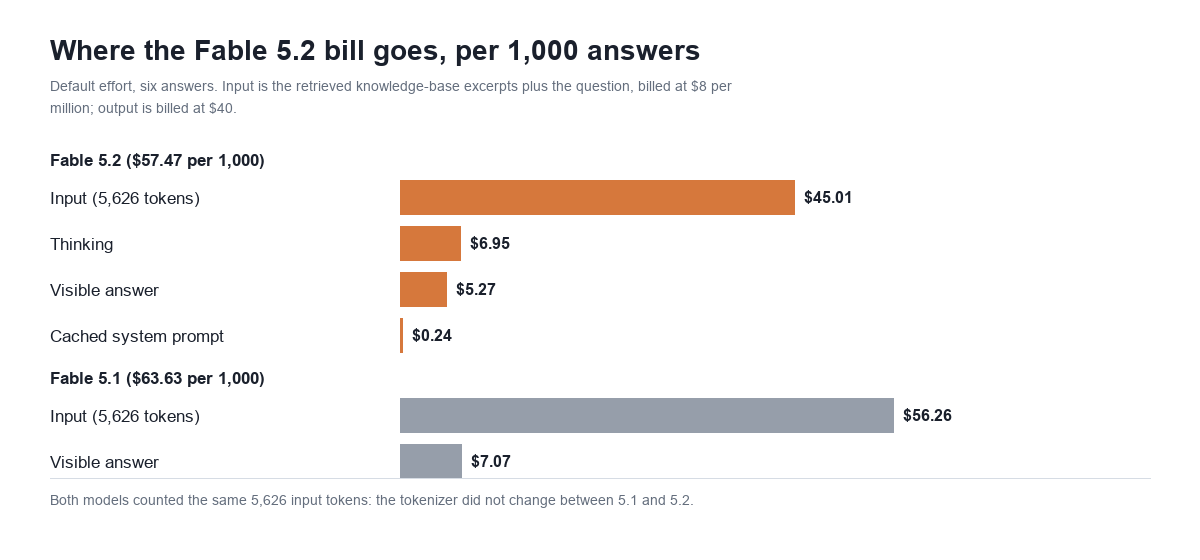
A chatbot answer on a flagship model is mostly input. On Fable 5.2 at default effort, $45.01 of the $57.47 per 1,000 answers (78%) was the retrieved knowledge-base excerpts and the question, which are different for every visitor and can’t be served from the cache. Thinking added $6.95, the visible answer $5.27, and the cached system prompt $0.24.
That shape tells you where Fable 5.2’s price cut helps most. Every input token is 20% cheaper, and input is most of the bill, so retrieval-heavy requests keep most of the saving. The thinking overhead is a roughly fixed number of output tokens per answer, so its share of the bill grows as the request gets smaller. On a short request with little context, the saving will be smaller than our 9.7%; on a request with a large knowledge base, larger.
A longer request: here 5.2 saves more
We also asked each Fable setup and Opus 5.5 for a full setup guide (install MxChat, connect an API key, build the knowledge base, test before launch) on top of the same context. Our site’s system prompt asks for short replies, so the answers stayed at 71 to 128 words, but the models thought much harder about what to include. Two runs each, so treat these as indicative:
| Model and effort | Thinking tokens (two runs) | Mean cost per 1,000 | Mean time |
|---|---|---|---|
| Fable 5.1, default | 373, 696 | $99.62 | 10.70 s |
| Fable 5.2, default (high) | 814, 653 | $83.35 | 10.75 s |
| Fable 5.2, effort low | 502, 428 | $72.33 | 8.73 s |
| Opus 5.5, default | 629, 414 | $38.99 | 8.45 s |
On this request Fable 5.1 thought too, so the comparison is closer to like for like. Fable 5.2 came out 16% cheaper at its default and 27% cheaper at low. The pattern is consistent: the harder a request already was for Fable 5.1, the more of the 20% cut you keep on 5.2.
What Fable 5.2 costs a real WordPress site
Scaling the measured per-answer costs, for a site whose chatbot gives 10,000 answers a month to new questions with a retrieved knowledge base:
| Model | Per month (10,000 answers) | Per year | Median wait |
|---|---|---|---|
| Fable 5.2, fast mode | $1,160.80 | $13,929.60 | 1.59 s |
| Fable 5.1, default | $636.30 | $7,635.60 | 2.31 s |
| Fable 5.2, default | $574.70 | $6,896.40 | 5.12 s |
| Fable 5.2, effort low | $554.30 | $6,651.60 | 4.56 s |
| Opus 5.5, default | $288.60 | $3,463.20 | 3.50 s |
| Sonnet 5.5, default | $139.00 | $1,668.00 | 2.17 s |
Follow-up turns in the same conversation cost less on every model, because the earlier turns can be read from the cache at 0.025x input on Fable. Our Fable 5.1 pricing test measured follow-ups at about a sixth of a first answer; 5.2’s cache read rate is 20% lower again.
For knowledge-base answers the honest conclusion hasn’t changed since 5.1: Fable is the wrong model. All four models answered our questions correctly. Sonnet 5.5 did it for a quarter of Fable 5.2’s price and in under half the time; Opus 5.5 for half the price and faster. Fable earns its price on long, multi-step work such as agents and coding, where its cheap cache reads cover most of the tokens. Our Claude API pricing test compares the whole Claude line-up on the same request.
Fast mode on Fable 5.2
Fable 5.2 is now on Anthropic’s fast mode list, at $16 input and $80 output: exactly twice standard. On our questions it answered in a median 1.59 seconds against 5.12, for $116.08 against $57.47 per 1,000 answers. It is the fastest way to get a Fable answer and the most expensive line in this test by a factor of four over Opus 5.5. It thought slightly more per answer than standard (202 tokens against 174), which is why the bill came out a little over 2x.
One cost doesn’t show on the price list: on Opus 5.5 we found that fast and standard requests keep separate prompt caches, so switching between them pays for a fresh cache write. See our Claude fast mode test for that measurement.
Should you move from Fable 5.1 to 5.2?
- If you use Fable 5.1 for long, hard tasks: yes. The price is 20% lower on every line, and on requests where 5.1 already thought, our test kept most of that saving. Anthropic’s prices for 5.1 have not changed, so there is no cost reason to stay.
- If you use Fable 5.1 for quick replies: check your latency first. On short chatbot questions 5.2 roughly doubled the wait, from 2.31 to 5.12 seconds, because it thinks first. Set effort to
lowto save a little time and money, but it will not get you back to 5.1’s speed. - If you send a
thinkingparameter: check it. A request with"type": "disabled"or a fixedbudget_tokensthat works on other Claude models returns HTTP 400 on Fable 5.2.
Does MxChat support Claude Fable 5.2?
MxChat connects to Anthropic’s API with your own Claude key, and you pay Anthropic directly at the rates above. In MxChat 3.2.28 the built-in Claude list goes up to Fable 5.1; Fable 5.2 is not in it yet. MxChat does not send a thinking parameter to Claude, so it avoids the 400 errors above, and it reads the answer text after the thinking block. For most WordPress support bots, our recommendation is Sonnet 5.5 or Opus 5.5 (see our Opus 5.5 pricing test), with prompt caching doing the work on long conversations (our caching test). MxChat Pro adds the knowledge-base, WooCommerce and live-agent features we used in this test; see MxChat Pro.
Claude Fable 5.2 pricing: frequently asked questions
How much does Claude Fable 5.2 cost?
$8 per million input tokens and $40 per million output tokens on Anthropic’s API. Cache writes are $10 (5 minutes) or $16 (1 hour) and cache reads $0.20 per million. Fast mode is $16 / $80 and the Batch API $4 / $20.
Is Fable 5.2 cheaper than Fable 5.1?
Per token, 20% cheaper on every line. Per chatbot answer in our test, 9.7% cheaper at default effort ($57.47 against $63.63 per 1,000), because 5.2 spends extra output tokens thinking.
Can I turn thinking off on Fable 5.2?
No. "thinking": {"type": "disabled"} and "enabled" with a token budget both return HTTP 400. Only adaptive thinking is accepted, and it thought on every answer we requested. Effort low reduces thinking but does not remove it.
What effort does Fable 5.2 use by default?
High on the API. The Claude apps and Claude Code default to medium. In our test medium and low cost about the same, 2.5% to 3.5% less than high.
Did the tokenizer change in Fable 5.2?
Not on our request: Fable 5.1 and 5.2 counted the same 5,626 input tokens.
How fast is Fable 5.2?
A median 5.12 seconds to a full, non-streamed chatbot answer at default effort, 4.56 at low and 1.59 in fast mode. Fable 5.1 took 2.31 seconds on the same questions.
What is the model ID?
claude-fable-5-2. Anthropic’s pricing page also covers it on Google Cloud and Microsoft Foundry, where some prices are set by the platform.
Is Fable 5.2 worth it for a WordPress chatbot?
Rarely. It answered our support questions correctly, but so did Sonnet 5.5 at a quarter of the price and in less than half the time. Use Fable for long, multi-step work.
Method note: 67 API calls from our WordPress server on 12 November 2026, Anthropic Messages API, non-streamed, costs from the usage the API returned at list prices read the same day. Per-setup figures are means of six answers (two for the longer request); times are medians. Prices change; check Anthropic’s pricing page before you budget.