
Claude Opus 5.5 Pricing: What 1,000 Chatbot Replies Cost
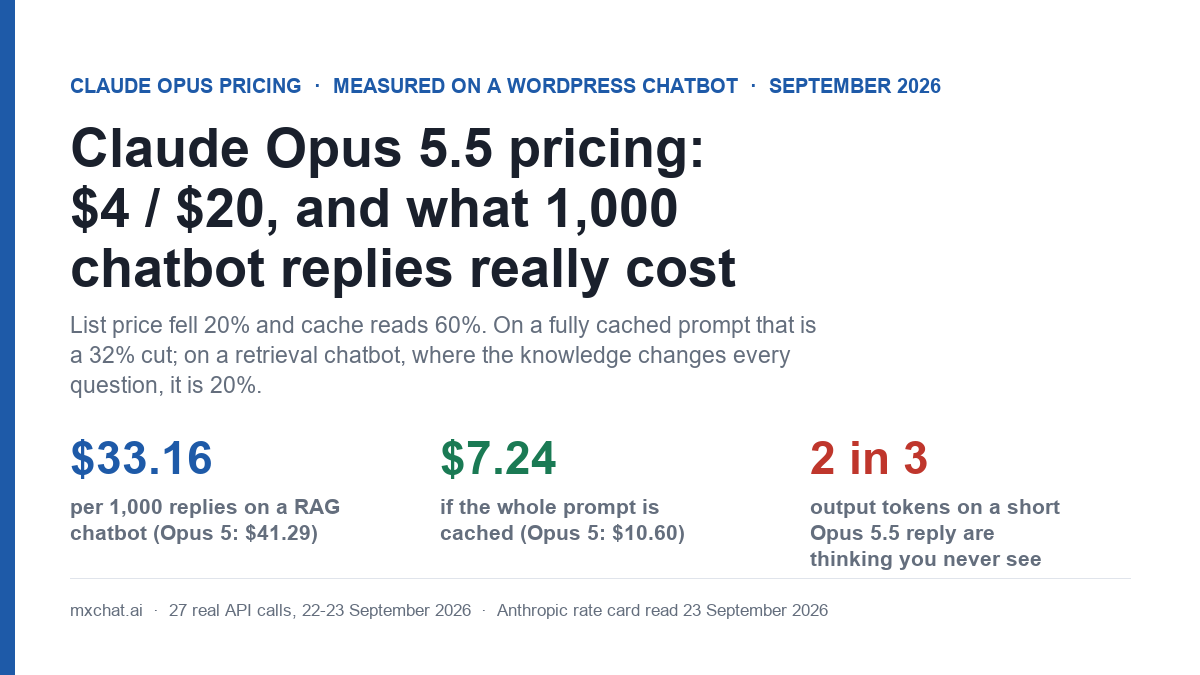
Anthropic released Claude Opus 5.5 on 22 September 2026 at $4 per million input tokens and $20 per million output tokens, down from Opus 5’s $5 and $25. Cache reads fell further, from $0.50 to $0.20 per million. The launch coverage repeated Anthropic’s own summary, that typical workloads cost about 40% less than on Opus 5. That is a claim about typical workloads, and a chatbot on a WordPress site is a specific one: a fixed system prompt, a block of retrieved knowledge that changes with every question, and short answers. So instead of multiplying list prices, we sent the same chatbot request to Opus 5.5, Opus 5, Sonnet 5 and Haiku 4.5 through the API, 27 calls in all, and priced what came back.
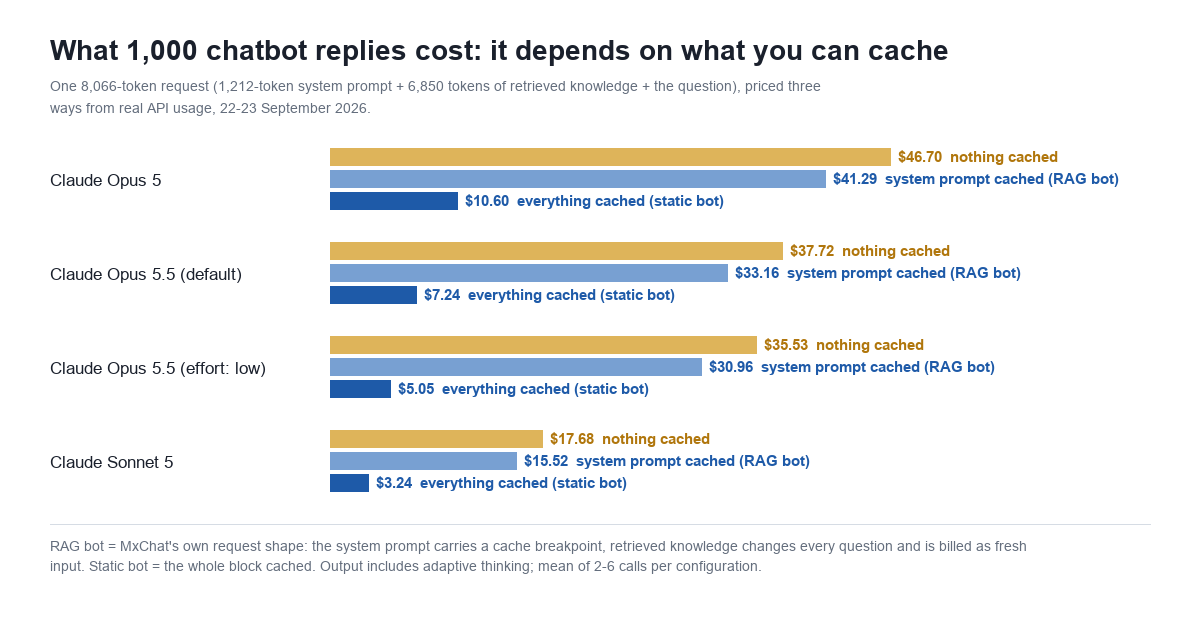
The short version. On a chatbot that retrieves knowledge per question, which is how MxChat and most WordPress AI chatbot plugins work, 1,000 replies on Opus 5.5 cost $33.16 against $41.29 on Opus 5: 20% cheaper, the list-price cut and very little more. On a bot whose whole prompt is static and cached, the same 1,000 replies cost $7.24 against $10.60, a 32% cut, because that is the shape where the cheaper cache reads do the work. Neither reached 40% on our request. And about two in every three output tokens on a short Opus 5.5 reply were thinking tokens we paid for and never saw, which is the one line item you can turn down.
Update, 29 September 2026: Claude Sonnet 5.5 shipped on 28 September at $2 / $10 per million tokens, half of Opus 5.5. On our retrieval chatbot test it cost $12.99 per 1,000 replies at medium effort, the same as Sonnet 5; its API default effort is high, one level above Opus 5.5’s medium. See our Claude Sonnet 5.5 measurement.
Update, 2 October 2026: Claude Fable 5.1 has an even lower cache-read rate, 2.5% of input against Opus 5.5’s 5%. On our chatbot request that cut saved 1.4% on a new question and 33% on a follow-up turn, and Fable 5.1 still cost $64.08 per 1,000 replies against $29.34 for Opus 5.5 on the same request. See our Claude Fable 5.1 pricing test.
Claude Opus pricing in September 2026: the full rate card
These are Anthropic’s published rates as of 23 September 2026, per million tokens, for the models a WordPress site owner is likely to weigh against each other. The cache-write columns are what you pay the first time a block is stored; the cache-read column is what every later request pays to reuse it.
| Model | Input | 5-min cache write | 1-hour cache write | Cache read | Output |
|---|---|---|---|---|---|
| Claude Opus 5.5 | $4.00 | $5.00 | $8.00 | $0.20 (0.05x) | $20.00 |
| Claude Opus 5 | $5.00 | $6.25 | $10.00 | $0.50 (0.1x) | $25.00 |
| Claude Fable 5.1 | $10.00 | $12.50 | $20.00 | $0.25 (0.025x) | $50.00 |
| Claude Sonnet 5 | $2.00 | $2.50 | $4.00 | $0.20 (0.1x) | $10.00 |
| Claude Haiku 4.5 | $1.00 | $1.25 | $2.00 | $0.10 (0.1x) | $5.00 |
Four details on that card matter more for a chatbot than the headline pair:
- The cache-read multiplier changed, not only the price. Every other current model reads cache at 10% of its input price. Opus 5.5 reads it at 5%. That is why the cache-read price fell 60% while input fell 20%.
- Batch is half price ($2 / $10 on Opus 5.5). A live chatbot cannot use it, since visitors want an answer now, but a nightly job that summarises transcripts or drafts FAQ answers can.
- Fast mode costs double ($8 / $40 on Opus 5.5). It is a research-preview option on Anthropic’s own API only. We did not test it, and nothing about a site chatbot needs it.
- US-only processing adds 10% on every token category if you set
inference_geotous. The default global routing carries no premium.
Two more changes on the same card deserve a line each. Claude Sonnet 5 stays at $2 / $10: the rise to $3 / $15 that Anthropic had scheduled for 1 September was cancelled, as we covered in our Sonnet 5 pricing post. And Claude Haiku 4.5, the cheapest current Claude model, now carries a retirement date on Anthropic’s models page of not sooner than 15 October 2026, three weeks from today. Anthropic has said Sonnet 5.5 and Haiku 5.5 will follow Opus 5.5 within weeks. If your bot runs on Haiku 4.5, do not rebuild your costing around it this month.
What Opus 5.5 is, in one table
| Property | Claude Opus 5.5 |
|---|---|
| Released | 22 September 2026 |
| API model ID | claude-opus-5-5 (same ID on Amazon Bedrock with an anthropic. prefix, and on Google Cloud and Microsoft Foundry) |
| Context window | 1M tokens at standard pricing (no long-context surcharge) |
| Max output | 128K tokens per synchronous request |
| Thinking | Adaptive, always on; default effort medium |
| Knowledge cutoff | June 2026 |
| Tokenizer | Same as Opus 5 (we counted 8,062 tokens against Opus 5’s 8,060 on an identical request) |
| Earliest retirement | Not sooner than 22 September 2027 |
The tokenizer line matters for comparing bills honestly. Anthropic’s newer tokenizer, introduced with Opus 4.7, produces roughly 30% more tokens for the same text than older models. On our request Haiku 4.5, which uses the older tokenizer, counted 6,053 tokens where Opus 5.5 counted 8,062, a third more. Opus 5.5 and Opus 5 share the newer tokenizer, so the comparison between those two is price against price. Comparisons against older models are not, which we measured in detail in our Claude tokenizer post.
How we measured it
We built one request that looks like a real chatbot turn on this site and sent it from our own server to Anthropic’s API:
- System prompt: the live instructions our own site assistant runs with, 3,478 characters, 1,212 tokens on Opus 5.5.
- Retrieved knowledge: six sources from this site, about 3,200 characters each, about 6,850 tokens. Our live bot is configured to retrieve six sources per question, so that is the realistic size.
- The question: a real pre-sales question, plus two others for the effort tests (“Does MxChat work with WooCommerce and can the bot look up an order status?”, “How much does MxChat Pro cost and is there a free version?”, “Can I train the chatbot on my PDFs and WordPress pages?”).
Then we priced the usage the API reported, line by line, in two shapes:
- Static bot: the system prompt and the knowledge sit in one block with a cache breakpoint, so from the second request on, all 8,022 tokens are read from cache. This is what a small FAQ bot with a fixed knowledge sheet looks like.
- Retrieval (RAG) bot: only the system prompt is cached. The knowledge goes in with the question, because it changes with every question, and is billed as fresh input. This matches how MxChat builds a Claude request: its code puts a cache breakpoint on the system prompt and skips it when the prompt embeds per-question knowledge, because paying a write premium on a block that is never reused loses money.
A caveat we owe you before the numbers. Our retrieval for the test was a crude keyword search, and on all three questions the bot answered some version of “I don’t have details on that in my knowledge base” and offered a support ticket. The sources it got did not contain the answers. That makes this a cost test, not a quality test: the token counts are real, the answers are not a fair sample of what Opus 5.5 writes.
Result 1: on a retrieval chatbot, Opus 5.5 is about 20% cheaper
| Model (default effort) | Fresh input | Cached | Output (mean) | 1,000 replies, RAG bot | 1,000 replies, static bot | Nothing cached |
|---|---|---|---|---|---|---|
| Claude Opus 5 | 6,852 | 1,212 | 257 | $41.29 | $10.60 | $46.70 |
| Claude Opus 5.5 | 6,854 | 1,212 | 275 | $33.16 | $7.24 | $37.72 |
Claude Opus 5.5, effort low | 6,854 | 1,212 | 165 | $30.96 | $5.05 | $35.53 |
| Claude Sonnet 5 | 6,852 | 1,212 | 157 | $15.52 | $3.24 | $17.68 |
| Claude Haiku 4.5 (older tokenizer) | 6,053 tokens in, 69 out | about $5.60 | $0.98 | $6.40 | ||
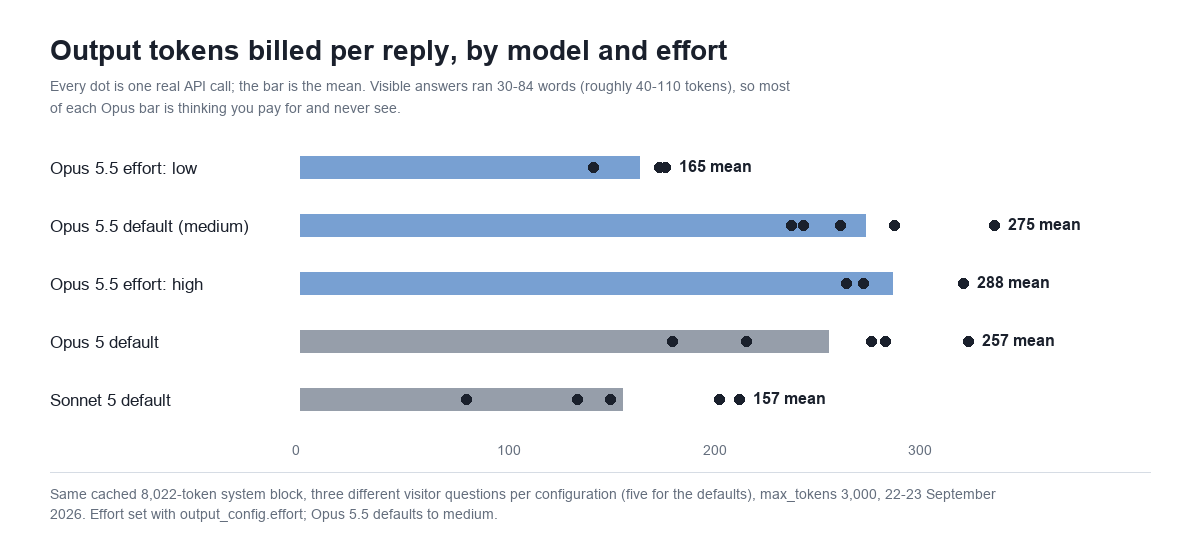
Opus 5.5 against Opus 5, then: 19.7% cheaper on the retrieval bot, 31.7% cheaper on the static bot, 19.2% cheaper with no caching at all. The retrieval figure is the one that applies to most WordPress chatbots, and it is essentially the 20% list-price cut. The cheaper cache reads barely register because only 1,212 of the 8,066 input tokens are cached. On Opus 5.5 the system-prompt cache saves $4.56 per 1,000 replies against caching nothing. Worth having, and MxChat does it by default, but it is not where the bill is.
Anthropic’s 40% figure describes workloads that reuse large prompts over and over, such as coding agents working through one big codebase. A chatbot answering strangers’ questions from a knowledge base is not that workload. Nobody misstated anything; the average just does not describe you.
Result 2: most of Opus 5.5’s output is thinking you do not see
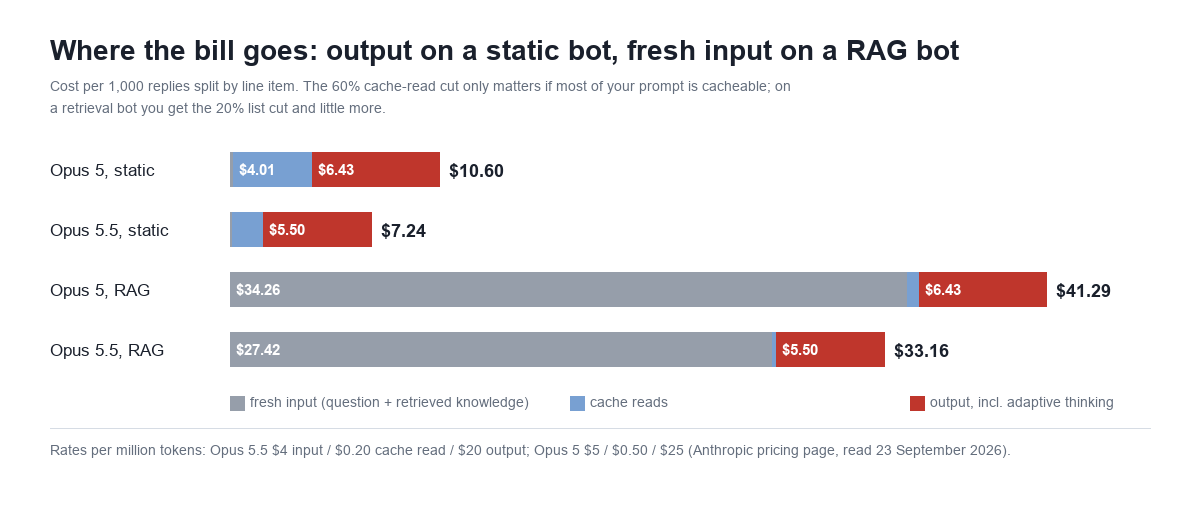
Opus 5.5 thinks on every request; you cannot switch that off, only steer it with the effort setting, which defaults to medium. Thinking tokens are billed as output at $20 per million. Our visible answers averaged about 47 words, roughly 90 tokens on this tokenizer with the markdown formatting included. The API billed a mean of 275 output tokens per reply. So on a short chatbot answer, about two thirds of the output bill is reasoning that never reaches the visitor.
| Configuration | Calls | Output tokens billed per reply | Mean | Mean wall time |
|---|---|---|---|---|
Opus 5.5, effort low | 3 | 143, 175, 178 | 165 | 2.9 s |
Opus 5.5, default (medium) | 5 | 245, 289, 338, 263, 239 | 275 | 3.9 s |
Opus 5.5, effort high | 3 | 323, 266, 274 | 288 | 4.0 s |
| Opus 5, default | 5 | 217, 285, 181, 325, 278 | 257 | 5.1 s |
| Sonnet 5, default | 5 | 151, 135, 204, 214, 81 | 157 | 3.1 s |
Three things stand out. Setting effort to low cut Opus 5.5’s output by 40% and made each reply about a second faster, and on these simple pre-sales questions the answers were no worse. Setting it to high changed almost nothing, because a short factual question gives the model little to think about at any setting. And Opus 5.5 answered faster than Opus 5 at every effort level, in line with Anthropic’s claim of more than 30% faster output. The samples are small, three to five calls each, so read the latencies as direction rather than a benchmark. They include the round trip from our server.
What this means for a WordPress chatbot
Take the retrieval bot on Opus 5.5 at $33.16 per 1,000 replies and look at where that money goes: $27.42 is fresh input, nearly all of it retrieved knowledge; $5.50 is output; $0.24 is cache reads. That ranks the levers for you.
- Send less knowledge. Retrieved sources are 83% of the bill. Six sources of about 1,140 tokens each is generous for a pre-sales bot. Dropping to three roughly halves the biggest line, worth about $13.70 per 1,000 replies on Opus 5.5, more than every other lever here put together. In MxChat this is the number of knowledge sources retrieved per question. Test answer quality before and after, because the right number depends on how your content is chunked.
- Pick the smallest model that answers well. Sonnet 5 answered our request for $15.52 per 1,000, less than half of Opus 5.5. For most site chatbots, a model that reads six paragraphs and answers a pricing question does not need Anthropic’s top tier. Opus earns its price on hard, multi-step work, and a chatbot is rarely that.
- Turn effort down if you do run Opus 5.5.
lowsaved $2.20 per 1,000 on the retrieval bot and $2.19 on the static one, and it was faster. It is the cheapest change to test. - Cache the system prompt, and keep it byte-stable so the cache actually hits. Anything that changes per request, such as today’s date or the visitor’s name, belongs after the cached block, not inside it.
- Cap the spend. None of these rates protects you from a script that sends ten thousand questions overnight. We covered per-visitor and per-day limits in denial of wallet on WordPress chatbots.
For scale: a site answering 3,000 chatbot questions a month on the retrieval shape pays about $99 a month on Opus 5.5, $124 on Opus 5, $47 on Sonnet 5, and about $93 on Opus 5.5 at low effort. Cut the retrieved sources to three and Opus 5.5 lands near $58. On a static FAQ bot the same 3,000 replies cost $22 on Opus 5.5.
Where GPT-6 Sol and Luna fit
OpenAI shipped GPT-6 Sol and GPT-6 Luna the same day, at $2 / $10 and $0.10 / $0.50 per million tokens, with cached input 90% off. Sol’s input price is half of Opus 5.5’s and its output price is half, too. We did not run GPT-6 through this test; a different tokenizer and a different API make a same-request comparison a separate job. As a rough guide, on the request shape we measured for our GPT-5.6 Luna post (7,000 input tokens and 150 output tokens), 1,000 replies come to about $15.50 on GPT-6 Sol and $0.78 on GPT-6 Luna before caching. If you already run a cloud setup, our Bedrock pricing comparison covers what the same models cost when a cloud provider bills you instead.
Can you use Opus 5.5 in MxChat today?
Not from the model picker yet. As of MxChat 3.2.22, the Anthropic list tops out at Claude Opus 5, alongside Sonnet 5, Opus 4.8 and Haiku 4.5. Everything in this post that applies to Opus 5 applies as measured: MxChat already caches the system prompt on Claude requests, and the retrieved-sources setting is the lever from the list above. For reference, our own site assistant currently runs on GPT-5.6 Luna, not on any Claude model, which tells you how we weigh price against capability for pre-sales questions. Setup details for every provider are in the MxChat documentation, and MxChat Pro adds the add-ons for WooCommerce, forms and knowledge import.
Frequently asked questions
How much does Claude Opus 5.5 cost?
$4 per million input tokens and $20 per million output tokens on Anthropic’s API, with cache reads at $0.20 per million, cache writes at $5 (5-minute) or $8 (1-hour), and the Batch API at half price. Fast mode costs $8 / $40.
Is Claude Opus 5.5 cheaper than Opus 5?
Yes, by 20% on input and output and 60% on cache reads. On our measured chatbot request that came to 20% cheaper for a retrieval bot and 32% cheaper for a fully cached one.
Does Opus 5.5 charge for thinking?
Yes. Thinking is always on and is billed as output tokens at $20 per million. On short chatbot answers we measured about two thirds of billed output as thinking at the default effort. Setting effort to low cut total output by 40%.
Did Claude Sonnet 5 go up to $3 / $15?
No. Anthropic cancelled the increase that was scheduled for 1 September 2026. Sonnet 5 stays at $2 / $10 per million tokens.
Is Opus 5.5 worth it for a website chatbot?
For most sites, no. On our request Sonnet 5 cost less than half as much, and a chatbot’s hard part is usually retrieving the right content, not reasoning about it. Opus 5.5 makes sense if your bot does multi-step work, such as reading an order and deciding what to do with it, and you have tested that a smaller model gets it wrong.
Method note: 27 Messages API calls and 6 token-count calls from mxchat.ai’s server on 22 and 23 September 2026. Costs are the reported usage multiplied by the rates on Anthropic’s pricing page as read on 23 September 2026, at standard global routing. Prices change; check the rate card before you budget.


