Claude Fast Mode Pricing: Opus 5.5 Tested at 2x the Cost
Claude fast mode is Anthropic’s paid speed setting: add "speed": "fast" to a Messages API request and Claude Opus generates its answer faster, at a higher price per token. On Claude Opus 5.5 it has left research preview, so it needs no beta header and no access request. On Opus 4.8 it is deprecated and will be removed on 30 November 2026, after which the same request returns an error.
Anthropic’s claim is “up to 2.5x” more output tokens per second. The price is a flat 2x: $8 input and $40 output per million tokens on Opus 5.5, against $4 and $20 at standard speed. We wanted to know what that buys on a real WordPress chatbot, so on 8 November 2026 we sent the same support questions from our own server to Opus 5.5 at both speeds, to Opus 4.8, Sonnet 5.5 and Haiku 5.5, and timed and priced all of them. It came to 69 API calls and cost $2.43.
The short answer: fast mode cut the median time to a complete chatbot answer from 3.08 to 1.62 seconds and doubled the bill, from $28.67 to $57.35 per 1,000 answers. On a longer answer the gap grew: 7.77 seconds down to 2.92. And it has a cost that isn’t on the price list: the two speeds don’t share a prompt cache, so every switch between them pays for a fresh cache write.
Claude fast mode pricing: the rate card
These are the rates on Anthropic’s pricing page and fast mode page, read on 8 November 2026, in US dollars per million tokens. Anthropic lists only input and output for fast mode and says the usual caching multipliers “apply on top”, so the cache columns for fast mode are our arithmetic (1.25x input for a 5-minute write, 0.05x input for a read, the same ratios as standard Opus 5.5).
| Model and speed | Input | Output | Cache write (5 min) | Cache read | Access |
|---|---|---|---|---|---|
| Claude Opus 5.5, standard | $4 | $20 | $5 | $0.20 | Everyone |
| Claude Opus 5.5, fast | $8 | $40 | $10 (derived) | $0.40 (derived) | Start, Build and Scale tiers, no header |
| Claude Opus 5, fast | $10 | $50 | $12.50 (derived) | $0.50 (derived) | Research preview, beta header, waitlist |
| Claude Opus 4.8, fast | $10 | $50 | $12.50 (derived) | $0.50 (derived) | Deprecated, removed 30 Nov 2026 |
| Claude Opus 4.8, standard | $5 | $25 | $6.25 | $0.50 | Everyone |
The fine print matters more than the headline numbers:
- Only Opus. Sonnet and Haiku have no fast mode. We sent
speed: "fast"toclaude-sonnet-5-5and got HTTP 400: “does not support the `speed` parameter”. - No discounts stack with it. Fast mode isn’t available on the Batch API or the Priority Tier. Data-residency pricing (1.1x for US-only inference) applies on top of it.
- Long prompts cost the same rate. Anthropic says fast pricing applies across the full context window, including requests over 200,000 input tokens.
- The speed gain is in output, not in the first token. Anthropic says the benefit is in output tokens per second, not time to first token, and that it shows most when you stream.
- It has its own rate limit. Fast mode has a separate token budget. When you run past it you get HTTP 429 with a
retry-afterheader, and Anthropic suggests catching that and retrying at standard speed.
How we tested it
All requests came from a PHP script on our WordPress server in the US, calling /v1/messages directly with the Anthropic key our site uses. Each request was shaped like a real MxChat chatbot call: the site’s system prompt (1,212 tokens, marked for caching), four knowledge-base excerpts from our documentation, and one visitor question. We asked three questions a store owner might ask (WooCommerce order lookups, whether Pinecone is required, and handing a chat to a human on Slack or Telegram), twice each, on five setups:
- Claude Opus 5.5 at standard speed and with
speed: "fast" - Claude Opus 4.8 at standard speed (and fast, which failed; see below)
- Claude Sonnet 5.5 and Claude Haiku 5.5, as cheaper reference points
We sent no effort or thinking settings, so every model ran at its API default. Both Opus 5.5 speeds and Haiku 5.5 chose to think briefly before answering, and those thinking tokens are billed as output. We also asked Opus 5.5 and 4.8 for a longer answer, a setup guide of about 700 words, and ran a separate cache test, described further down. Requests weren’t streamed, so our timings are the time to a complete answer, which is what a visitor waits for when a chatbot doesn’t stream. The usage.speed field in each response confirmed which speed actually ran: “fast” on every fast request, “standard” on every other.
Prices are our token counts multiplied by the list rates above. Anthropic didn’t show us a per-request bill, so treat the dollar figures as list-price arithmetic on measured tokens.
Results: cost and speed per chatbot answer

| Setup | Avg input tokens (+1,212 cached) | Avg output tokens (of which thinking) | Median time to full answer | Output tokens per second | Cost per 1,000 answers |
|---|---|---|---|---|---|
| Opus 5.5, standard | 5,626 | 296 (138) | 3.08 s | 84 | $28.67 |
| Opus 5.5, fast mode | 5,626 | 296 (145) | 1.62 s | 182 | $57.35 |
| Opus 4.8, standard | 5,624 | 116 (0) | 2.27 s | 52 | $31.64 |
| Opus 4.8, fast mode | HTTP 429: our organisation’s fast-mode limit on Opus 4.8 is 0 tokens a minute | $63.28 (estimate) | |||
| Sonnet 5.5 | 5,626 | 202 (68) | 1.83 s | 76 | $13.39 |
| Haiku 5.5 | 5,626 | 367 (262) | 2.37 s | 179 | $0.76 |
“Output tokens per second” here is output tokens divided by the whole request time, so it includes reading the prompt. It understates pure generation speed, but it’s the same yardstick for every row.
Four things stand out.
The bill doubled exactly. Fast mode used the same number of tokens as standard speed. Input was identical, and output averaged 296 tokens at both speeds (215 to 402 per answer on fast, 183 to 474 on standard). Fast mode doesn’t change what Claude writes or how long it thinks, it only changes the price per token. So the cost ratio is the rate ratio: 2.0x.
The speed-up was 1.9x on short answers. Median time to a full answer fell from 3.08 to 1.62 seconds, and the spread tightened: fast answers took 1.39 to 2.00 seconds, standard ones 2.26 to 5.42. On short chatbot replies a good part of the request is reading a 6,800-token prompt, which fast mode doesn’t speed up as much, so we didn’t see the full 2.5x.
Opus 4.8 fast mode was locked for us. Without the beta header, Anthropic returned 400: “To use the `speed` parameter with ‘claude-opus-4-8’, send the `anthropic-beta: fast-mode-2026-02-01` header.” With the header it returned 429, saying the request “would exceed your organization’s rate limit of 0 fast mode input tokens per minute”. Opus 4.8 fast mode was always a waitlist preview, and our account was never on it. The $63.28 figure is our measured Opus 4.8 token counts at its $10/$50 fast rates, not a measured bill.
The cheaper models were nearly as quick. Sonnet 5.5 answered in a median 1.83 seconds for $13.39 per 1,000 answers, less than a quarter of fast Opus. Haiku 5.5 took 2.37 seconds for $0.76. If what you want is a chatbot that feels fast, a smaller model gets you most of the way for far less than fast mode.
Longer answers: where fast mode earns its price

Because fast mode speeds up output, the more Claude writes, the more time it saves. We asked Opus 5.5 for a 700-word setup guide, twice at each speed:
| Longer answer | Output tokens (of which thinking) | Median time | Output tokens per second | Cost per 1,000 answers |
|---|---|---|---|---|
| Opus 5.5, standard | 748 (488) | 7.77 s | 96 | $37.92 |
| Opus 5.5, fast mode | 662 (386) | 2.92 s | 226 | $72.42 |
| Opus 4.8, standard | 1,564 (0) | 20.72 s | 76 | $68.10 |
That’s a 2.7x shorter wait and 2.4x the output speed, close to Anthropic’s 2.5x. One honest caveat: neither Opus 5.5 run actually wrote 700 words. Our site’s system prompt tells the chatbot to keep replies short, and Opus 5.5 followed it (one fast answer opened with “A full 700-word guide is beyond what I can provide here”) while Opus 4.8 wrote the full 638-word guide. So the longer test measures roughly 650 to 750 output tokens, most of them thinking. In a chatbot that shows its reply as it’s written, the gain shows up as text arriving more than twice as fast.
Did the faster answers read any worse? Not that we could see. On all three questions the fast and standard answers made the same claims from the same knowledge base: WooCommerce order lookups come with MxChat Pro, Pinecone is optional because embeddings can live in the WordPress database, and Slack and Telegram handoff is in the free plugin. Six answers per speed is a small sample, but nothing in Anthropic’s documentation suggests fast mode changes the model, only how fast it runs.
The hidden cost: fast and standard keep separate caches
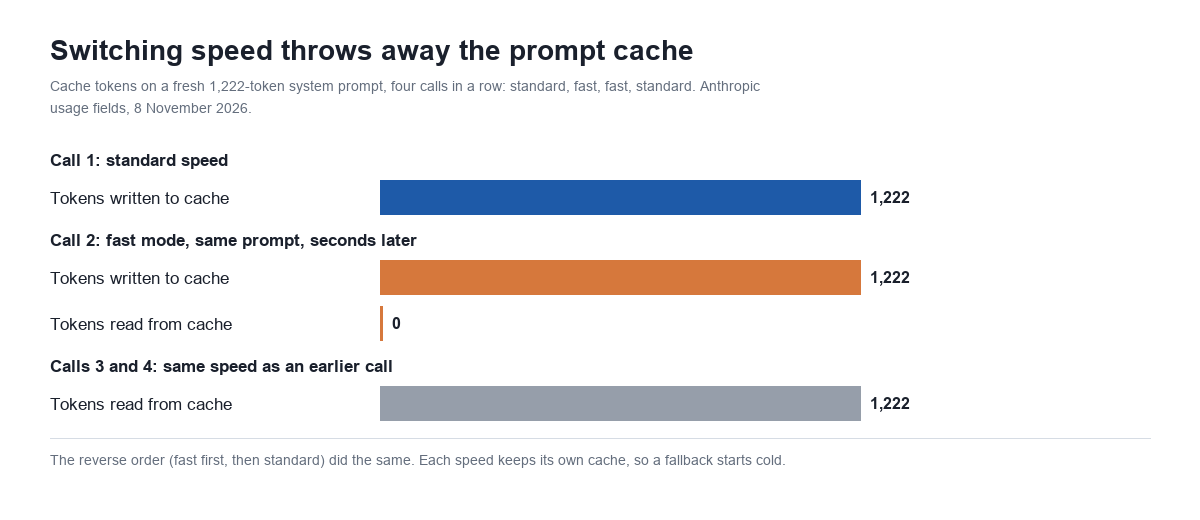
Anthropic’s fast mode page says it in one line: requests at different speeds “do not share cached prefixes”. We checked it. With a system prompt no earlier request had used, we sent four calls in a row (standard, fast, fast, standard) and then the reverse order with a different fresh prompt. The response usage fields told the story:
| Order | Call 1 | Call 2 | Call 3 | Call 4 |
|---|---|---|---|---|
| Standard first | Standard: wrote 1,222 | Fast: wrote 1,222, read 0 | Fast: read 1,222 | Standard: read 1,222 |
| Fast first | Fast: wrote 1,222 | Standard: wrote 1,222, read 0 | Standard: read 1,222 | Fast: read 1,222 |
Each speed has its own cache, and both stayed warm side by side. In money terms, on our 1,222-token system prompt a fast-mode cache write costs about $0.012 and a cache read about $0.0005, so each switch adds about a cent. That’s trivial for one prompt. It isn’t trivial when the cached part is a long conversation or a large knowledge base, and it matters most in the setup Anthropic recommends: try fast, and fall back to standard on a 429. Every fallback lands on a cold cache, and so does the first fast request after it, so the times you hit the fast-mode limit are exactly the times your cache does least for you.
If you cache heavily, there’s a simple rule: pick one speed per conversation and stay on it. If you need the fallback, retry the rest of that conversation at standard speed rather than flipping back and forth on every message.
What fast mode costs a real WordPress site
Here are our measured per-answer costs scaled to a month. 3,000 answers is a busy small-business support bot; 30,000 is a store with real traffic.
| Setup | Per answer | 3,000 answers a month | 30,000 answers a month | Median wait |
|---|---|---|---|---|
| Opus 5.5, fast mode | $0.0574 | $172.05 | $1,720.50 | 1.62 s |
| Opus 5.5, standard | $0.0287 | $86.01 | $860.10 | 3.08 s |
| Sonnet 5.5 | $0.0134 | $40.17 | $401.70 | 1.83 s |
| Haiku 5.5 | $0.0008 | $2.28 | $22.80 | 2.37 s |
Put another way, fast mode charged us about 2.9 cents per answer to save about 1.5 seconds. For a support chatbot answering “do you ship to Canada?”, that’s hard to justify when Sonnet 5.5 answers in about the same time for a quarter of the fast-mode price. Where it makes more sense:
- Long, Opus-quality answers, such as detailed product advice or long-form drafting, where fast mode cut a 7.8-second wait to 2.9.
- Agent loops where Claude calls several tools in a row and every step’s output adds to the wait.
- A small number of high-value conversations, like sales chats or logged-in customers, while everything else runs on a cheaper model.
If you’re watching cost first, the other direction is cheaper still: Opus 5.5 on the Batch API costs $2 / $10, a quarter of the fast-mode rate, for work that can wait. We covered how the Claude models compare on cost in our Claude API pricing test, and Opus 5.5 at standard speed in our Opus 5.5 pricing test.
Opus 4.8 fast mode ends on 30 November: what to do
Anthropic’s fast mode page says Opus 4.8 fast mode is deprecated and will be removed on 30 November 2026, and that after that date a claude-opus-4-8 request with speed: "fast" will return an error. Its recommended replacement is Opus 5.5 fast mode.
| If you use | After 30 November | What to change |
|---|---|---|
Opus 4.8 with speed: "fast" | The request fails | Switch the model to claude-opus-5-5. Fast mode works there without the beta header. |
| Opus 4.8 at standard speed | Unchanged | Nothing urgent. On our test Opus 5.5 standard was 9% cheaper per answer ($28.67 vs $31.64), but slower (3.08 s vs 2.27 s). |
Code that sends speed to every model | Sonnet and Haiku already return 400 | Only add speed for Opus models that support it. |
Moving from Opus 4.8 fast to Opus 5.5 fast is also a price cut: the rate drops from $10/$50 to $8/$40. On our token counts that’s an estimated $63.28 down to $57.35 per 1,000 answers (about 9% less), though Opus 5.5 writes longer answers and thinks before replying, so the gain is smaller than the 20% rate cut. We saw the same effect at standard speed in October, when moving from Opus 4.8 to Opus 5.5 cut the rate by 20% but the bill by only 9%: a lower price per token doesn’t always mean a lower bill.
Fast mode isn’t the only way to pay for speed. OpenAI sells something similar, and we measured it in our OpenAI fast mode pricing test.
Does MxChat use Claude fast mode?
No. MxChat 3.2.28 sends Claude requests without a speed field, so Opus 5.5 in MxChat always runs at standard speed and standard prices. You won’t be billed fast-mode rates by accident.
For a WordPress chatbot, our test points to a different lever: model choice. MxChat already caches your system prompt on Claude, streams replies, and lets you pick any current Claude model, so Sonnet 5.5 or Haiku 5.5 will usually feel quick enough at a fraction of the cost of fast Opus. Set it up from the MxChat documentation, and if you want WooCommerce order lookups and the other Pro features, they come with MxChat Pro. If you’re weighing cache costs across models, our Claude prompt caching test covers how the cache prices add up.
Claude fast mode: frequently asked questions
How much does Claude fast mode cost?
On Claude Opus 5.5, $8 per million input tokens and $40 per million output tokens, twice the standard $4 / $20. On Opus 5 and Opus 4.8 it’s $10 / $50. In our test that doubled the cost of a chatbot answer, from $28.67 to $57.35 per 1,000 answers.
How much faster is Claude fast mode?
Anthropic says up to 2.5x the output tokens per second. We measured 1.9x shorter waits on short chatbot answers (3.08 s to 1.62 s) and 2.7x on a longer answer (7.77 s to 2.92 s), with output speed rising from 96 to 226 tokens per second on the longer one.
Which Claude models support fast mode?
Only Opus. Opus 5.5 supports it without a beta header for organisations on the Start, Build or Scale tiers. Opus 5 and Opus 4.8 need the fast-mode-2026-02-01 beta header and waitlist access, and Opus 4.8 fast mode is removed on 30 November 2026. Sonnet 5.5 returned an error when we tried.
Do I need a beta header for Opus 5.5 fast mode?
No. We sent speed: "fast" to claude-opus-5-5 with and without the beta header and both worked; the response’s usage.speed field reported “fast” each time.
Does fast mode use the prompt cache?
Yes, but separately. Fast and standard requests don’t share cached prefixes, so the first fast request after a standard one (or the other way round) writes the cache again. In our test the same 1,222-token prompt was written once at each speed.
Does fast mode work with the Batch API?
No. It isn’t available on the Batch API or the Priority Tier. Opus 5.5 on the Batch API costs $2 / $10, a quarter of the fast-mode rate.
Does fast mode change Claude’s answers?
Not in our test. Fast and standard Opus 5.5 used the same number of tokens on average and gave the same facts on every question. Fast mode changes the speed and the price per token, not the model.