Claude API Pricing: 7 Models Tested on One Chatbot
Claude API pricing is per token, and in October 2026 the current models run from $0.10 to $10 per million input tokens. Claude Haiku 5.5 costs $0.10 per million input tokens and $0.50 per million output. Claude Sonnet 5.5 costs $2 and $10, Claude Opus 5.5 costs $4 and $20, and the flagship, Claude Fable 5.1, costs $10 and $50. The older models are still available, and some cost more than their replacements: Sonnet 4.6 is $3 and $15, and Opus 4.8 is $5 and $25.
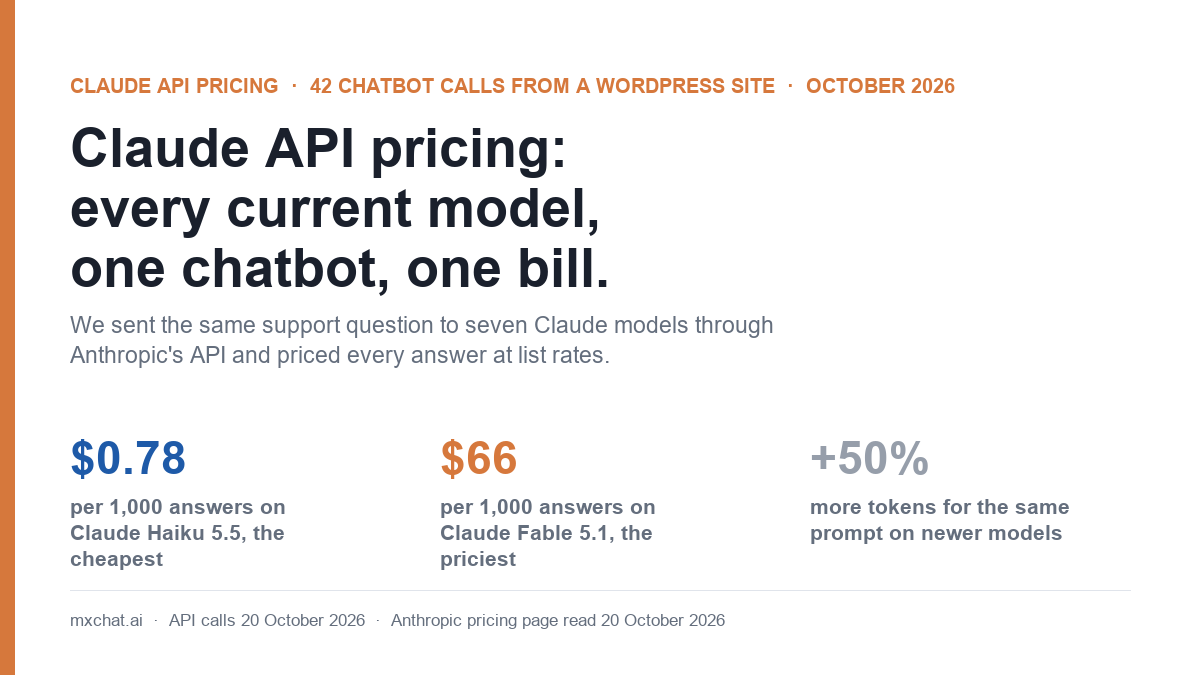
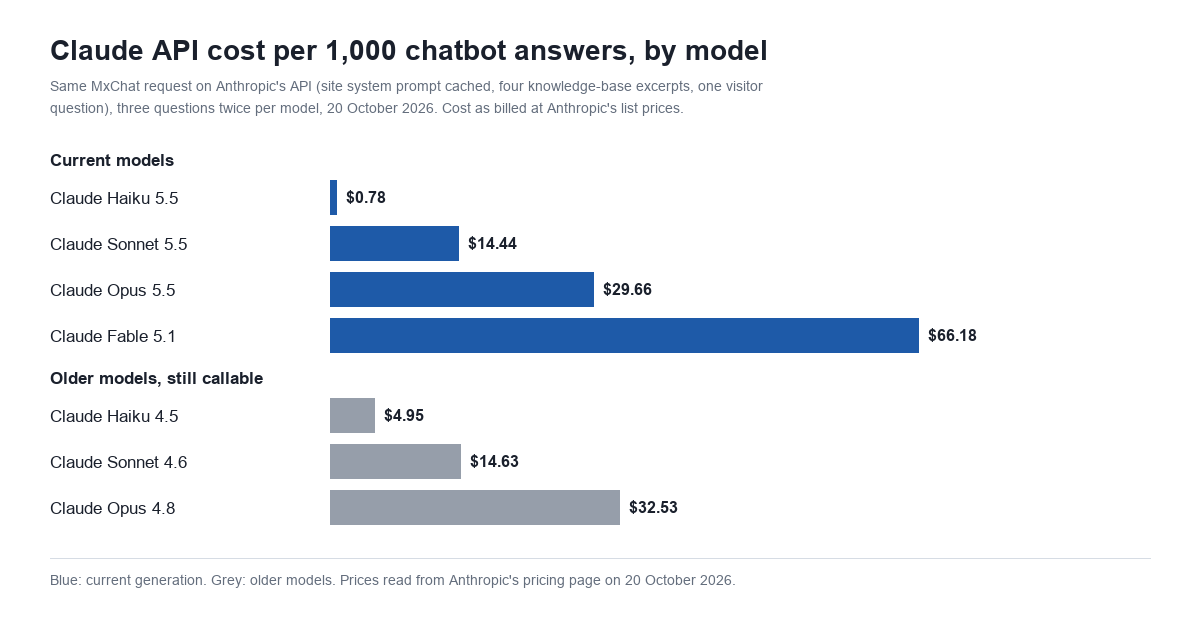
A chatbot is billed per answer, though, so we measured that as well. On 20 October 2026 we sent the same WordPress chatbot request to seven Claude models through Anthropic’s own API, from our production server. Each request carried the site’s system prompt, four knowledge-base excerpts and one visitor question, laid out the way MxChat sends them. That was 42 calls, and all 42 answers were correct. Haiku 5.5 cost $0.78 per 1,000 answers. Fable 5.1 cost $66.18, about 85 times as much, for answers that were no more accurate. Sonnet 5.5 cost $14.44, almost exactly what Sonnet 4.6 cost ($14.63), even though its per-token price is a third lower.
- Haiku 5.5 is the cheapest Claude model by a wide margin. At $0.78 per 1,000 answers it cost less than a sixth of Haiku 4.5 ($4.95) and about a nineteenth of Sonnet 5.5.
- Lower per-token prices did not always mean lower bills. The newer models counted our prompt as 6,838 tokens. The older ones counted it as 4,551, so the same text came out 50% longer. The 5.5 models also think briefly before answering, and those thinking tokens are billed as output.
- Input is most of the bill. On Sonnet 5.5, the knowledge-base excerpts and question accounted for about 80% of the cost of each answer. Caching the system prompt saved about 11%.
- The cheapest model was not the slowest. Median answer times ranged from 1.52 seconds (Haiku 4.5) to 4.58 seconds (Opus 5.5). Haiku 5.5 took 2.86 seconds.
Claude API pricing in October 2026
These are the list prices on Anthropic’s pricing page, read on 20 October 2026, per million tokens. “Cache write” is the five-minute cache, which is the default when a request marks part of the prompt for caching. A one-hour cache write costs twice the base input price on every model.
| Model | Input | Cache write (5 min) | Cache read | Output | Batch (input / output) |
|---|---|---|---|---|---|
| Claude Fable 5.1 | $10 | $12.50 | $0.25 | $50 | $5 / $25 |
| Claude Opus 5.5 | $4 | $5 | $0.20 | $20 | $2 / $10 |
| Claude Sonnet 5.5 | $2 | $2.50 | $0.10 | $10 | $1 / $5 |
| Claude Haiku 5.5 (prompts up to 100K tokens) | $0.10 | $0.125 | $0.01 | $0.50 | $0.05 / $0.25 |
| Claude Haiku 5.5 (prompts over 100K tokens) | $0.50 | $0.625 | $0.05 | $2.50 | $0.25 / $1.25 |
| Claude Opus 4.8 | $5 | $6.25 | $0.50 | $25 | $2.50 / $12.50 |
| Claude Sonnet 4.6 | $3 | $3.75 | $0.30 | $15 | $1.50 / $7.50 |
| Claude Haiku 4.5 | $1 | $1.25 | $0.10 | $5 | $0.50 / $2.50 |
Some details on that page change the bill:
- Cache reads are cheaper on the newest models. A cache read normally costs a tenth of the input price. On Fable 5.1 it costs a fortieth, and on Opus 5.5 and Sonnet 5.5 a twentieth. We tested what the Fable cut does for a chatbot in our Fable 5.1 pricing test, and the Sonnet cut in our Claude prompt caching test.
- Haiku 5.5 is priced by prompt length. Any request with more than 100,000 input tokens pays five times the normal rate for the whole request. A chatbot request with a few knowledge-base excerpts is nowhere near that. A bot that pastes a whole document into every prompt could cross it.
- US-only processing costs 10% more. Setting
inference_geoto"us"on Claude 4.6 and later models multiplies every token price by 1.1. The default, global routing, uses the list prices above. - Batch is half price but not for live chat. The Batch API returns results asynchronously, usually within hours. That suits overnight jobs such as summarising transcripts, not a visitor waiting for a reply.
- Newer models use a newer tokenizer. Anthropic says Claude 4.7 and later produce about 30% more tokens for the same text. Sonnet 4.6 and Haiku 4.5 use the older one. On our content the difference was 50%, as the next sections show.
How we tested Claude API pricing on a chatbot
We used the same test as our earlier Claude posts, so the numbers are comparable. Every call went from mxchat.ai’s production WordPress server in the US to Anthropic’s Messages API, using the site’s own Anthropic key.
- The request. The system message was mxchat.ai’s real chatbot system prompt (3,478 characters), marked for caching. The user message held four knowledge-base excerpts of about 4,000 characters each, taken from our own documentation pages, followed by the visitor’s question. MxChat sends Claude requests in this same layout.
- The questions. Whether MxChat works with WooCommerce and can look up a customer’s order status; whether Pinecone is required for the knowledge base; and whether a visitor can be handed to a human on Slack or Telegram.
- The models. Claude Fable 5.1, Opus 5.5, Sonnet 5.5 and Haiku 5.5, plus the older Opus 4.8, Sonnet 4.6 and Haiku 4.5. Each answered each question twice, which made 42 calls.
- The settings. Anthropic’s defaults: no effort setting and no thinking parameter, a 1,000-token output limit, and non-streamed requests. We timed each call from request to complete answer.
- The cost. We priced every call from the usage Anthropic returned (fresh input, cache writes, cache reads and output) at the list prices above. “No cache” assumes the whole prompt is billed at the base input price.
Results: cost per 1,000 chatbot answers
| Model | Input tokens per call | Output tokens (of which thinking) | Per 1,000 answers, as billed | Per 1,000 answers, no cache | Median answer time |
|---|---|---|---|---|---|
| Claude Haiku 5.5 | 6,838 | 355 (246) | $0.78 | $0.86 | 2.86 s |
| Claude Haiku 4.5 | 4,551 | 79 (0) | $4.95 | $4.95 | 1.52 s |
| Claude Sonnet 5.5 | 6,838 | 258 (97) | $14.44 | $16.25 | 2.46 s |
| Claude Sonnet 4.6 | 4,552 | 65 (0) | $14.63 | $14.63 | 3.23 s |
| Claude Opus 5.5 | 6,838 | 297 (144) | $29.66 | $33.29 | 4.58 s |
| Claude Opus 4.8 | 6,836 | 106 (0) | $32.53 | $36.82 | 2.42 s |
| Claude Fable 5.1 | 6,838 | 143 (0) | $66.18 | $75.52 | 3.00 s |
Input tokens, output tokens and times are averages over six calls (medians for time). “As billed” includes the cache write on the first call of each run and cache reads after that.
The spread is large. Fable 5.1 costs 100 times Haiku 5.5 per input token, and with fewer output tokens it came out at 85 times the cost per answer. Between those two, each step up the line roughly doubles the bill: Haiku 5.5 to Haiku 4.5 is about 6x, Haiku 4.5 to Sonnet 5.5 about 3x, Sonnet to Opus 2x and Opus to Fable a little over 2x.
Input dominates on every model. A chatbot answer is short, between 65 and 355 output tokens here, while the prompt is close to 7,000 tokens once the knowledge-base excerpts are in. On Sonnet 5.5, a typical call spent about $0.0113 on fresh input, $0.0026 on output and $0.0001 reading the cached system prompt. That is why a cheaper input price matters more for a chatbot than a cheaper output price.
Why a lower per-token price did not lower the bill
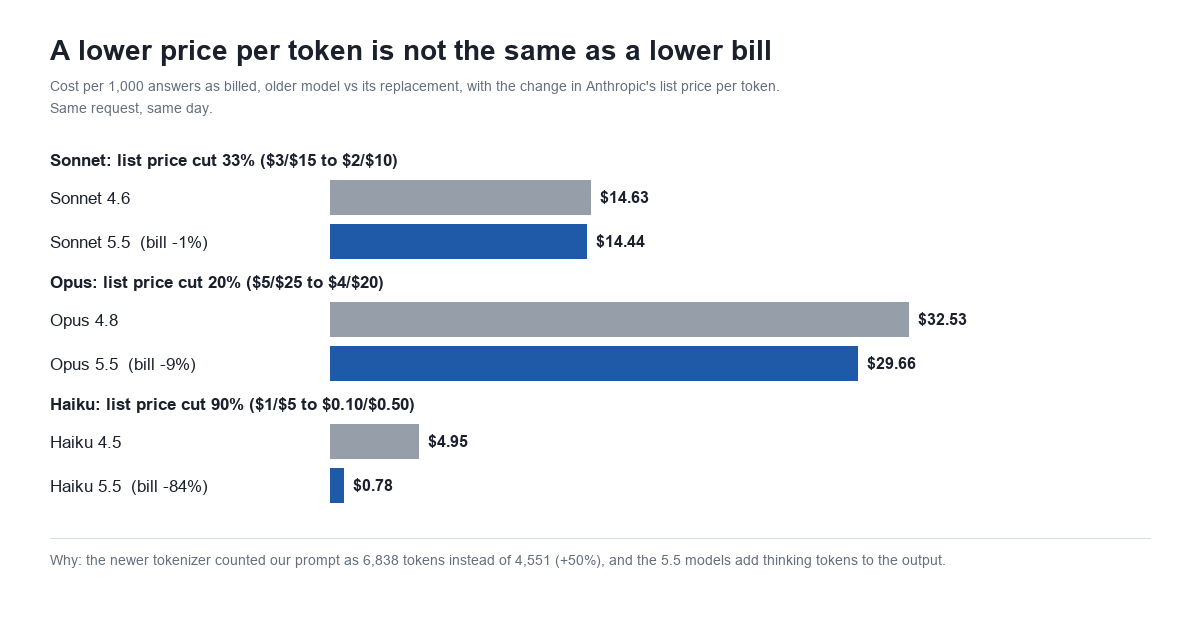
Sonnet 5.5 lists at a third less than Sonnet 4.6 per token. For our chatbot it cost 1% less per answer. Opus 5.5 lists at 20% less than Opus 4.8 and cost 9% less. Two things ate the difference.
The tokenizer. Our prompt was exactly the same text on every model. Sonnet 4.6 and Haiku 4.5 counted it as about 4,551 tokens; every model from Opus 4.8 onward counted it as 6,838. That is 50% more tokens, well above the “approximately 30%” Anthropic’s pricing page gives as a typical figure. Our content is English documentation with product names, URLs and settings paths, and Anthropic notes that the increase depends on the content. If you compare Claude prices across generations, count your own prompt with the token-counting endpoint on each model rather than trusting the rate card alone.
Thinking tokens. With no thinking setting, Opus 5.5, Sonnet 5.5 and Haiku 5.5 sometimes thought before answering. On average that added 97 thinking tokens per answer on Sonnet 5.5, 144 on Opus 5.5 and 246 on Haiku 5.5, all billed at the output price. Fable 5.1 and the older models answered directly. On Haiku 5.5 the thinking is cheap, about $0.12 per 1,000 answers. On Opus 5.5 it was about $2.90 per 1,000.
Caching made a smaller difference than either. The site’s system prompt is 1,212 tokens on the newer tokenizer, which is enough for Anthropic to cache, and every call after the first read it from cache. On Sonnet 4.6 and Haiku 4.5 the same prompt was too short to cache at all, so those calls paid full price for it. Even so, caching the system prompt saved only about 11% on Sonnet 5.5, because the knowledge-base excerpts change with every question and can’t be cached.
Haiku is the exception. Its list price fell 90% between 4.5 and 5.5, which is far more than the tokenizer and thinking add back, so the bill fell 84%.
Results: speed
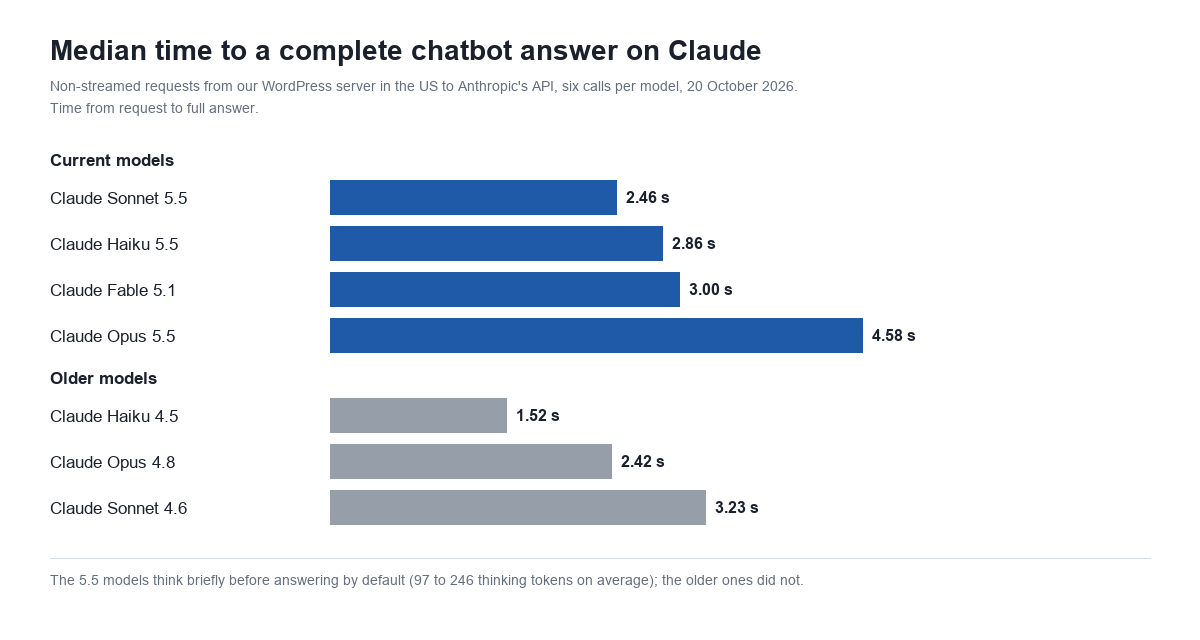
Every model answered in under five seconds at the median. Haiku 4.5 was the fastest at 1.52 seconds, because it writes short answers and does not think first. Opus 5.5 was the slowest at 4.58 seconds; it wrote the longest answers and thought before most of them. Sonnet 5.5 at 2.46 seconds was the quickest of the current models.
These times are for the complete answer, not the first word. With streaming turned on in MxChat, a visitor sees text appear sooner than this. Thinking delays the first visible word, though, since the model has to finish thinking before it starts writing the answer. In our Haiku 5.5 test on 8 October, turning thinking off cut its median answer time from 2.02 to 0.88 seconds and made it slightly cheaper.
Answer quality
All 42 answers were correct on the substance. Every model said that the WooCommerce add-on handles order lookups for logged-in customers and needs MxChat Pro, that Pinecone is optional because embeddings can live in the WordPress database, and that Slack and Telegram handoff is available. We read every answer and noted these slips:
- Haiku 4.5 said on one run that handoff happens “when the bot can’t answer”. The knowledge base only describes a visitor asking for a human, which Sonnet 5.5 and Haiku 5.5 both pointed out.
- Opus 4.8 once linked “add MxChat Pro to cart” to an empty
#link. - Fable 5.1 once linked the WooCommerce add-on to the documentation chatbot page instead of the add-on’s own page.
- Sonnet 4.6 added an emoji to two answers, which our system prompt doesn’t ask for.
The more expensive models gave longer, more detailed answers. Opus 5.5 and Fable 5.1 added useful context, such as the five-order limit in the order history and the last ten messages Telegram passes to the agent. Haiku 5.5’s answers were shorter, about 48 words, and covered what the visitor asked. For a support bot answering from a knowledge base, we did not see anything that justified 20 to 85 times the cost.
What the Claude API costs per month for a chatbot
Using the billed cost per answer from our test, here is what a month of chatbot traffic costs on each model. Your numbers will scale with prompt size: a bot that sends twice as much knowledge-base text per question pays roughly twice as much.
| Model | 1,000 answers a month | 5,000 a month | 20,000 a month | 100,000 a month |
|---|---|---|---|---|
| Claude Haiku 5.5 | $0.78 | $3.90 | $15.60 | $78 |
| Claude Haiku 4.5 | $4.95 | $24.75 | $99 | $495 |
| Claude Sonnet 5.5 | $14.44 | $72.20 | $289 | $1,444 |
| Claude Sonnet 4.6 | $14.63 | $73.15 | $293 | $1,463 |
| Claude Opus 5.5 | $29.66 | $148 | $593 | $2,966 |
| Claude Opus 4.8 | $32.53 | $163 | $651 | $3,253 |
| Claude Fable 5.1 | $66.18 | $331 | $1,324 | $6,618 |
Two things the table leaves out. Follow-up questions resend the earlier conversation, so a five-message chat costs more than five single answers; prompt caching recovers part of that, as we measured in our caching test. And with US-only processing, add 10% to every figure.
Claude API pricing vs other providers
On the same request, earlier tests on this site put Claude in context. Claude Sonnet 5.5 and GPT-6 Sol have the same rate card, $2 and $10 per million tokens, but Claude’s tokenizer made Sonnet the more expensive of the two per answer (our head-to-head). Claude models also run on Amazon Bedrock and Google’s Vertex AI. On Vertex’s global endpoint Sonnet 5.5 cost $16.54 per 1,000 answers without caching against $16.95 on Anthropic in our Vertex AI test, so going through a cloud provider is mainly about billing and data location, not price. Bedrock is covered in our Bedrock pricing test.
| Route to Claude Sonnet 5.5 | Per-token price | What changes |
|---|---|---|
| Anthropic API, global | $2 / $10 | The list price |
Anthropic API, inference_geo: "us" | $2.20 / $11 | Processing kept in the US, 1.1x |
| Anthropic Batch API | $1 / $5 | Asynchronous, not usable for live chat |
| Vertex AI, global endpoint | $2 / $10 | Billed through Google Cloud |
| Vertex AI, regional endpoints | About 10% more | Regional data location |
Which Claude model should a website chatbot use?
For most WordPress support bots, Claude Haiku 5.5. It answered every question correctly, at $0.78 per 1,000 answers and under three seconds. It is also the model MxChat now recommends for Claude in its model list.
Claude Sonnet 5.5 makes sense when answers have to reason across several pages, for example comparing plans or walking through a setup with conditions. It costs about 19 times as much as Haiku 5.5, but it was the fastest current model in our test.
Opus 5.5 and Fable 5.1 are hard to justify for a support chatbot. They are built for long, complex work such as agents and coding, and on short knowledge-base answers they cost 38 to 85 times as much as Haiku 5.5 without being more accurate.
If you are still on an older model, check the bill rather than the rate card. Moving from Haiku 4.5 to Haiku 5.5 cut our cost by 84%. Moving from Sonnet 4.6 to Sonnet 5.5 changed it by 1%. Both moves may still be worth making for answer quality, but only the Haiku one saves money. MxChat’s model list also marks Claude Sonnet 4.5 for retirement on 30 November 2026, with Sonnet 5.5 as the replacement.
How to use Claude with a WordPress chatbot
MxChat connects to Claude with your own Anthropic API key, so you pay Anthropic directly at the prices above and MxChat adds nothing per message.
- Create an API key in the Claude Console and add a payment method or credits.
- In WordPress, open MxChat → Settings, paste the key into the Claude API key field, and choose a Claude model. Haiku 5.5 is the recommended one.
- Build the knowledge base from your pages, posts and documents. MxChat retrieves the relevant excerpts for each question and sends them with the visitor’s message, which is the request we tested.
- Watch the usage page in the Claude Console for the first week, then estimate the month from the table above.
The setup is in the MxChat core documentation. Add-ons such as WooCommerce order lookups and live-agent handoff come with MxChat Pro.
Frequently asked questions
How much does the Claude API cost?
From $0.10 to $10 per million input tokens and $0.50 to $50 per million output tokens for the current models, read on 20 October 2026. Haiku 5.5 is the cheapest at $0.10 and $0.50, and Fable 5.1 the most expensive at $10 and $50. In our chatbot test that came to $0.78 and $66.18 per 1,000 answers.
What is the cheapest Claude model?
Claude Haiku 5.5, at $0.10 per million input tokens and $0.50 per million output for prompts up to 100,000 tokens. Above that the whole request is billed at five times those rates.
Is the Claude API cheaper than a Claude subscription?
They are billed separately. Claude Pro and Max plans cover use of the Claude apps. A chatbot on your website uses the API, which is billed per token from the Claude Console, so a subscription does not cover it.
Why is my Claude bill higher after switching to a newer model?
Claude 4.7 and later models use a newer tokenizer that produces more tokens for the same text: about 30% according to Anthropic, and 50% on our documentation content. The 5.5 models may also think before answering, and thinking is billed as output. A lower per-token price can be cancelled out, as it was for Sonnet 5.5 against Sonnet 4.6.
Does Claude prompt caching lower chatbot costs?
Somewhat. Caching the system prompt saved about 11% on Sonnet 5.5 in this test, because most of each prompt is knowledge-base text that changes with every question. Caching pays off more in long conversations, where earlier messages repeat.
Is Claude Batch API pricing usable for a chatbot?
Not for live replies. Batch requests cost half the list price but are processed asynchronously, usually within hours. They suit offline work such as summarising chat transcripts or tagging conversations.