how to increase website conversions: Simple, Proven Tips
Getting more conversions isn't just about throwing more traffic at your website and hoping for the best. It's about turning the visitors you already have into loyal customers. The best way to start is by zeroing in on two key things: making your site a pleasure to use (user experience) and digging into your data to see where people are getting stuck.
Why Website Conversions Matter More Than You Think

It’s easy to get obsessed with traffic numbers. More visitors must mean more sales, right? Not exactly. While getting people to your site is crucial, what really moves the needle is what happens once they arrive.
This is why we talk so much about conversion rate optimization (CRO). It’s not just some marketing buzzword; it's a smarter way to grow your business. Instead of constantly paying to get new people in the door, you're making the most of the audience you've already earned.
The Financial Impact of Small Improvements
Even a tiny bump in your conversion rate can have a huge effect on your revenue. Let’s run the numbers. Say your site gets 10,000 visitors a month and has a 1% conversion rate. That's 100 sales.
Now, what if you could double that to just 2%? Suddenly, you have 200 sales—without spending another dime on ads.
Key Takeaway: Focusing on conversions directly lowers your customer acquisition cost (CAC). Each person who converts makes your marketing spend work harder, building a much more sustainable path to growth.
Setting Realistic Benchmarks
So, what's a "good" conversion rate? It helps to know where you stand. Across the globe, eCommerce conversion rates usually fall somewhere between 1.9% and 3%, though this varies by industry.
Looking at data from 2024 and early 2025, the worldwide average is sitting around 1.89%. If you’re hitting above 3%, you’re doing great. The top-tier stores often see rates between 4% and 5%.
The goal isn't just to chase a number, but to see the potential for improvement. If you're looking for more ways to make this happen, these proven strategies to improve website conversion rates are a great starting point. Once you truly understand why conversions are so important, you're ready to start making real changes.
Build a High-Converting Foundation with Great UX
Think about the last time you rage-quit a website. Was it because the menu was a confusing mess? Or maybe you just couldn't find the "buy now" button. That feeling of frustration is the absolute enemy of conversions.
The antidote? A truly great user experience (UX). This isn't just about aesthetics or making things look pretty; it's about making your website effortless and intuitive. When someone lands on your page, they should instantly get it—what you do, what they can do, and how to do it. This smooth flow is what transforms a casual visitor into a paying customer.
Create an Intuitive Path for Users
Your website's navigation is its roadmap. If that map is poorly drawn, people will get lost and hit the back button. The key is to establish a clear visual hierarchy that naturally pulls your user’s eye toward the most important stuff, like your call-to-action (CTA).
Stick with familiar layouts and logical groupings. If you run an e-commerce store, this means obvious top-level menus like "Men," "Women," and "Sale." For a SaaS business, you’d want clear signposts like "Features," "Pricing," and "Request a Demo." Don't reinvent the wheel here.
A seamless user journey is the shortest distance between a visitor's intent and a completed conversion. By removing obstacles and clarifying the path forward, you're not just improving usability—you're directly boosting your bottom line.
This clarity goes beyond your main menu. Think about the structure of each page. A well-designed product page, for example, tells a story. It starts with compelling images, followed by a punchy description, social proof like customer reviews, and a can't-miss "Add to Cart" button. It's a conversation, not just a data dump. You can get more insights from our complete guide on how to optimize user experience for better results.
Design for Speed and Simplicity
In a world where attention spans are measured in seconds, speed is everything. A slow-loading site is one of the quickest ways to lose a potential customer before they even see what you're selling. The numbers here are pretty stark.
A site that loads in just one second can see e-commerce conversion rates 2.5 times higher than a site loading in five seconds. When you compare that to a ten-second load time, the one-second site can convert up to five times better. Speed isn't a feature; it's a prerequisite.
Simplicity is just as vital. One of the biggest conversion killers I see is the overly complicated form. Whether it's for checkout or a simple lead magnet, every extra field you ask someone to fill out is another reason for them to abandon the process.
Here are a few practical things you can do right now:
- Audit Your Forms: Be ruthless. Do you really need a phone number for a newsletter signup? Probably not. Cut every field that isn't absolutely essential for the transaction.
- Embrace Mobile-First Design: More than half of all web traffic comes from mobile devices, so your site needs to be perfect on a small screen. This means big, tappable buttons, fonts you can read without pinching to zoom, and a checkout process that doesn't require a magnifying glass.
- Use Strong, Action-Oriented CTAs: Your call-to-action buttons should be impossible to ignore. Use clear, compelling language that tells people exactly what will happen. Instead of a boring "Submit," try something like "Get Your Free Quote" or "Start My Trial." A high-contrast color that pops off the page works wonders.
By focusing on a clean, fast, and intuitive design, you're building a solid foundation that makes converting feel like the most natural next step for every single visitor.
Use Data to Uncover Hidden Conversion Opportunities
Stop guessing what makes your audience click. If you really want to boost your website conversions, you have to play detective, and your data is the scene of the crime. Tools like Google Analytics are so much more than traffic reports—they're treasure maps pointing to exactly where your website is leaking money.
By digging into your analytics, you can get past simple page views and start to truly understand how people behave on your site. Where are they coming from? Which pages do they see right before they bounce? Answering these questions turns a bunch of abstract numbers into a clear, actionable roadmap for improvement.
Pinpoint Your Biggest Drop-Off Points
One of the most eye-opening reports you can run is the user behavior flow. This visual guide shows the exact paths visitors take through your site, instantly highlighting pages with a high exit rate. It’s the fastest way to see where you’re losing people along their journey.
Is it your overly complicated checkout page? A product details page that's just plain confusing? Once you spot these weak links, you know exactly where to start fixing things. For example, you might discover that a staggering 70% of users who add an item to their cart ditch the process on the shipping information step. That tells you the problem isn't your product—it's the form. You can get more insights on improving forms with our guide on building a better lead capture form.
Segment Your Audience to Find What Works
Here’s a hard truth: not all traffic is created equal. Where your visitors come from has a massive impact on whether they’ll convert. Breaking down your conversion rates by channel can reveal some powerful truths about user intent and how well your campaigns are actually performing.
Understanding these differences helps you decide where to focus your marketing budget. Some channels just naturally bring in more motivated buyers.
Average Website Conversion Rates by Traffic Source
This table compares the typical conversion rates from different marketing channels to help prioritize optimization efforts.
| Traffic Source | Average Conversion Rate |
|---|---|
| SEO | 2.3% |
| Email Marketing | 2.8% |
| Direct Traffic | 3.3% |
Source: First Page Sage
As you can see, visitors who come to your site directly already know and trust your brand, so they convert at the highest rate, averaging 3.3%. Meanwhile, email marketing is also a strong performer at 2.8%. Knowing these nuances helps you double down on what’s already working.
See Your Website Through Your Customer's Eyes
Analytics tells you what is happening, but you also need to know why. That's where tools like heatmaps and session recordings come in. They let you step into your users' shoes.
- Heatmaps give you a quick visual summary of where people click, move their mouse, and scroll. You might find everyone is clicking on an image that isn't a link, which is a clear sign of a frustrating user experience.
- Session recordings are even better. They're literally video playbacks of real user sessions. You can watch someone navigate your site in real-time and see their hesitations, their "rage clicks" on broken elements, and the exact moment they just give up.
Watching just a handful of session recordings can be more insightful than staring at spreadsheets for hours. It builds empathy and shines a light on frustrating experiences that raw data alone will never show you.
When you combine quantitative data (from analytics) with this kind of qualitative feedback (from recordings), you get the full story. You can spot a high exit rate in your analytics, then pop over to a session recording to see the confusing design element that caused it. This evidence-based approach takes all the guesswork out of the equation and lets you fix the real problems holding your conversions back.
Run A/B Tests That Actually Drive Growth
Once you've dug into your analytics and pinpointed a few weak spots, it’s time to stop guessing and start testing. This is where A/B testing (or split testing) comes in. It’s a straightforward method: pit two versions of a webpage against each other to see which one performs better.
But this isn't about throwing spaghetti at the wall. Real growth comes from a scientific approach, one that’s built on the insights you just uncovered. A/B testing lets you make decisions backed by hard data, moving you out of the realm of opinion and into a cycle of consistent, measurable improvement.
Start with a Strong Hypothesis
Every solid A/B test begins with a strong hypothesis. And no, a hypothesis isn't just a vague idea like, "I bet a blue button would be better." It's a clear, testable statement rooted in the user behavior you’ve already observed.
Think of it like this: "If I change [X], then [Y] will happen, because [Z]."
Let’s walk through a real-world scenario. Say you've noticed a huge number of people abandoning your free trial signup page. After watching a few session recordings, you see them all pausing when they get to the credit card form.
- Your Hypothesis: "If we remove the credit card field from the trial signup form, then more users will complete the signup, because it eliminates the biggest source of friction and perceived risk."
See how specific that is? You know exactly what you’re changing, the metric you’re watching (trial signups), and the reasoning behind it.
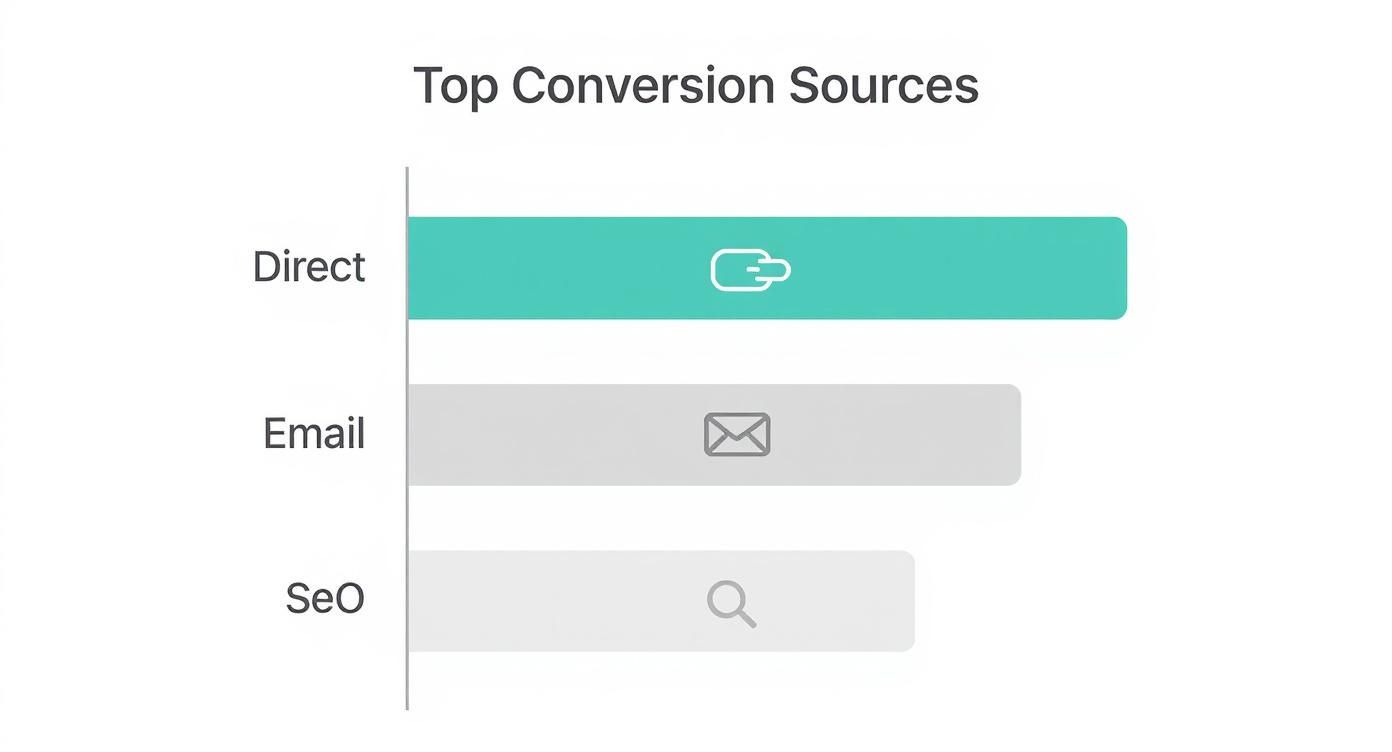
As you gather data, you’ll start to see where your most valuable traffic comes from. Often, direct traffic and email marketing prove to be heavy hitters, which just goes to show how important brand recognition and a loyal audience are.
Common A/B Testing Mistakes to Avoid
Even with a killer hypothesis, it’s surprisingly easy to mess up a test and get data you can’t trust. If you want results that are actually reliable, you have to run clean experiments.
Steer clear of these common pitfalls:
- Testing too many things at once. If you change the headline, the button color, and the main image, you’ll never know which change made the difference. Stick to one variable per test.
- Calling the test too early. You need enough data to reach statistical significance. A handful of conversions on day one means nothing. Let the test run until you have a large enough sample size and a confidence level of 95% or more.
- Ignoring outside factors. Did a big PR story drop mid-test? That sudden flood of new traffic can seriously skew your results. Always be aware of other marketing campaigns that are running.
The goal of A/B testing isn't just to find a "winner." It's to learn about your audience. Even a "failed" test gives you valuable insight into what doesn't resonate, helping you sharpen your next hypothesis and get one step closer to what your customers really want.
By taking a structured, methodical approach, you build a reliable system for improving your site’s performance over time. This kind of testing is a non-negotiable part of any serious strategy to figure out how to increase online sales and truly maximize your revenue.
Put AI Chatbots to Work and Watch Engagement Soar

What if you could have your best salesperson on your site 24/7? Someone who never sleeps, knows every product inside and out, and can chat with hundreds of visitors at once without breaking a sweat. That's not some futuristic dream anymore; it's exactly what a modern AI chatbot brings to the table.
These AI assistants have become a go-to tool for grabbing visitors' attention the second they land on your site. By offering instant, genuinely helpful answers, they can stop people from bouncing out of frustration or confusion. Instead of making someone dig for information, a chatbot guides them right where they need to go, smoothing out the path to a purchase.
Offer Instant Answers and Proactive Help
Friction is one of the biggest conversion killers out there. A visitor has a simple question, can't find the answer, and poof—they're gone, likely heading to a competitor. An AI chatbot acts as your instant, on-demand knowledge base, closing that gap immediately.
Let's say a potential customer is looking at your SaaS pricing page and wonders, "Does the basic plan include API access?" Rather than making them hunt through FAQs, the chatbot can give them a straight, accurate answer right then and there. That little bit of instant gratification keeps them on the page and in the funnel.
A well-trained chatbot doesn’t just sit and wait. It gets proactive. It can pop up on a product page if someone has been lingering for 30 seconds and ask, "Stuck between a few options? I can help you compare the features." That simple nudge is often all it takes to help a hesitant buyer make a decision.
This kind of responsive support does more than just answer questions—it builds trust. It shows you value your customer's time and gives them the confidence they need to buy from you. Learning to use effective chatbots for marketing can make your website a far more dynamic and convincing sales tool.
Guide Visitors to Their Perfect Solution
AI chatbots are more than just fancy FAQ machines; they're brilliant at qualifying leads and making personalized recommendations. By asking a few smart questions, they can figure out what a visitor really needs and point them to the right product, service, or blog post. It transforms passive browsing into an active, guided conversation.
Think about these real-world scenarios:
- E-commerce Site: A chatbot can act like a personal shopper. It might ask, "Shopping for a gift for a coffee lover?" and based on the answer, suggest your best-selling espresso machine or a new single-origin bean.
- SaaS Company: A bot can qualify a new visitor by asking about their company size and what they hope to achieve. If they're a good fit, the bot can book a demo right inside the chat window, completely removing the friction of scheduling.
By automating these first-touch interactions, you make sure every single visitor gets immediate attention. This frees up your human sales team to focus their energy on closing the high-value deals the chatbot has already warmed up.
Frequently Asked Questions About Boosting Website Conversions
Even after laying out a solid plan, it’s natural to have questions when you start digging into conversion rate optimization (CRO). Let's clear up some of the most common ones so you can move forward with confidence.
What’s a Good Conversion Rate, Anyway?
This is probably the number one question I hear, but there’s no magic number. A “good” conversion rate is all about context—it swings wildly depending on your industry, where your traffic is coming from, and what you’re actually trying to get users to do.
For example, an e-commerce store might celebrate a 2-3% conversion rate, but a B2B company could see a 5% conversion rate on a lead form as a massive win.
Instead of chasing some generic industry average, focus on improving your own numbers. The real goal here is steady, measurable growth. Aiming to improve your current rate by 10% each month gives you a much more meaningful target to hit. If you want to go deeper on this with more examples, check out a comprehensive guide on increasing website conversions.
How Long Until I See Real Results?
Patience is key here, as the timeline for seeing a real impact can vary. It really comes down to the size of your changes and how much traffic you’re working with.
- Quick Tweaks: Small, focused changes—like A/B testing a new headline or button color on a popular page—can show a clear winner in just a week or two if you have enough traffic.
- Major Overhauls: Bigger projects, like redesigning your entire checkout process or rolling out a new user experience strategy, will naturally take longer. You might need a couple of months to see stable, measurable improvements.
The best way to think about CRO is as a marathon, not a sprint. It’s an ongoing cycle of analyzing, testing, and learning that builds on itself over time.
What's the Difference Between UX and CRO?
It’s easy to confuse User Experience (UX) and Conversion Rate Optimization (CRO) because they work so closely together, but they serve different purposes.
Imagine you're building a car. UX is the core design and engineering. It's about making the ride smooth, the seats comfortable, and the controls easy to understand. It ensures the entire journey is a good one. You simply can't have a good product without a solid UX foundation.
CRO, then, is the fine-tuning. It's about testing specific elements—like the grip on the steering wheel or the responsiveness of the accelerator—to make the car perform at its peak and get you to your destination faster. You need great UX first, then you use CRO to optimize it.
Can I Do This on a Shoestring Budget?
You absolutely can. Some of the most effective tools for improving conversions are completely free or have very generous free versions. The biggest investment you’ll make isn't cash—it's your time and a willingness to get curious about your data.
Here’s where you can start without spending a dime:
- Google Analytics: This is non-negotiable and it’s free. It gives you all the essential data you need to understand how people are using your site.
- Free Heatmap Tools: Many services offer free plans that let you see exactly where users are clicking, tapping, and scrolling. These visual insights are pure gold.
- Google Optimize: This is a powerful, free platform for running A/B tests that connects right to your Analytics data.
With just these three tools, you have everything you need to start finding opportunities, creating hypotheses, and testing your way to better results.
Ready to turn more visitors into customers with a 24/7 AI assistant? MxChat helps you build intelligent, no-code chatbots that answer questions, capture leads, and guide users to purchase. Get MxChat for WordPress and start boosting your conversions today.