how to improve website conversion rates: 7 proven wins
If you want to get more conversions, you need to stop guessing and start measuring. The process is pretty straightforward: first, use data to figure out how people actually use your site, then use those insights to make smart, targeted improvements. This means digging into analytics and heatmaps to see where your visitors are getting stuck before you touch a single landing page or call-to-action.
Build Your Conversion Strategy on a Data Foundation
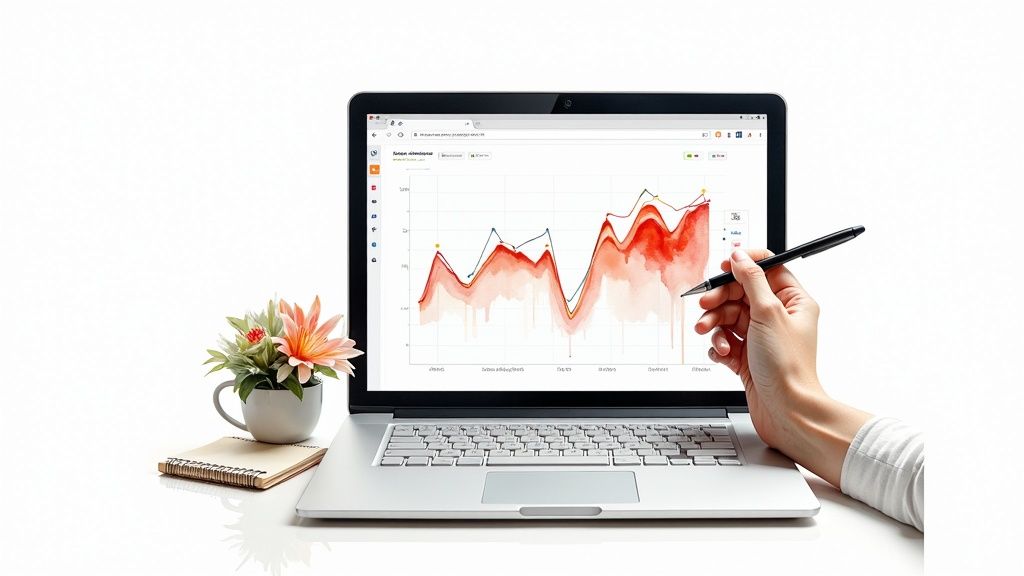
Before you change a single button or rewrite a headline, your journey to higher conversions has to start with data. Making changes based on a whim is like driving blind—you might get lucky, but you’ll probably end up lost. A data-driven approach takes the guesswork out of the equation, making sure every optimization you make is strategic and has the best possible shot at succeeding.
The whole point is to see your website through your visitors' eyes. This goes way beyond just looking at traffic numbers. You need to get into the weeds and understand how people interact with your site to find the exact friction points that are killing your conversions.
Pinpoint Conversion Blockers with Analytics
Your first stop should always be your website analytics, like Google Analytics. This is where you uncover the "what" and "where" of user behavior. Don't get overwhelmed by all the reports; just zero in on a few key areas that show you where users are struggling.
Start with your conversion funnels. If you’re running an eCommerce site, that means looking at your checkout process. Where's the biggest drop-off point? It’s a well-known stat that a staggering 70% of online shopping carts are abandoned. Your data will tell you if it's a clunky shipping form or a surprise fee that’s sending people away.
Next, look at your high-exit pages. These are the pages that are literally driving people off your site. Is a popular blog post not giving readers a clear next step? Is a key product page just plain confusing? High bounce rates here are a massive red flag that you’re not meeting user expectations.
Uncover User Intent with Behavior Analytics
While traditional analytics tells you what happened, behavior analytics tools show you why. They give you visual proof of the user experience, turning abstract numbers into clear, actionable insights.
- Heatmaps: These tools give you a visual map of where users click, move, and scroll. A heatmap might show you that everyone is clicking on an image that isn't a link—a clear design flaw. Or, you might discover that 90% of users never scroll far enough to even see your main call-to-action.
- Session Replays: Honestly, one of the best ways to build empathy is to watch recordings of actual user sessions. You can see, in real-time, a user rage-clicking a broken button, struggling with a confusing menu, or just giving up on a form that asks for too much information.
Combining the hard numbers from analytics with the visual stories from session replays and heatmaps gives you the full picture. This is the foundation that lets you form solid, evidence-based ideas for A/B testing down the road.
For a deeper look at proven CRO and UX methods, this practical guide on increasing conversion rates is a great resource.
Ultimately, this deep dive into data is about mapping the entire customer journey. By keeping a close eye on key https://mxchat.ai/customer-experience-metrics/, you can spot the patterns that lead to sales and get rid of the roadblocks. This initial work turns conversion optimization from a series of random tweaks into a repeatable system for growth.
Turn Your Landing Pages into Conversion Engines
Think of your landing pages as your digital storefronts. It doesn't matter how brilliant your ads are if the destination falls flat. This is where visitors make the split-second decision to either engage or bounce, so turning these pages into high-performance conversion machines is non-negotiable. It’s a craft that blends smart psychology, clear communication, and a relentless focus on the user.
At the end of the day, every single element—from the headline to the button text—must work together to answer one simple question for the visitor: "What's in it for me?" If your page can't nail that answer almost instantly, you've lost them.
Craft Headlines and Value Propositions That Connect
Your headline is your first impression. Often, it's the only impression. It has to instantly grab attention and reassure visitors they’ve landed in the right spot. A truly great headline bridges the gap between their problem and your solution in one powerful, easy-to-digest statement.
For example, a vague headline like "Powerful Marketing Software" is forgettable. But what about, "Stop Guessing and Start Growing with Data-Driven Marketing Insights"? Now you're speaking directly to a user's goal.
Your value proposition should immediately follow, acting as a quick, compelling elevator pitch.
- Be Specific: Don't just promise to "save time." Tell them they can "Launch your campaigns 50% faster."
- Focus on Outcomes: Forget listing features. Describe the tangible results those features deliver.
- Use Their Language: Echo the exact words and phrases your ideal customers use to talk about their struggles.
This kind of clarity builds immediate confidence and smoothly guides the user toward your call-to-action.
Build Instant Trust with Social Proof
Let's be honest—people are skeptical online. You can shout from the rooftops that your product is the best, but it means so much more coming from someone else. That’s the magic of social proof, and it's an absolute must-have for any landing page that’s serious about converting.
Placing testimonials, case studies, and trust badges (like industry awards or "as seen in" logos) at just the right moments can dramatically lower a visitor's guard. The trick is to make them relevant and believable.
A single, authentic testimonial that highlights a specific, measurable result is worth more than a dozen generic "Great product!" comments. Pick quotes that tackle common objections or paint a clear picture of a desirable outcome.
For an email marketing tool, a testimonial saying, "We increased our open rates by 25% in the first month using their A/B testing feature" is pure gold. It offers concrete proof that builds credibility and makes it far easier for a new visitor to take that next step.
Streamline Forms to Reduce Friction
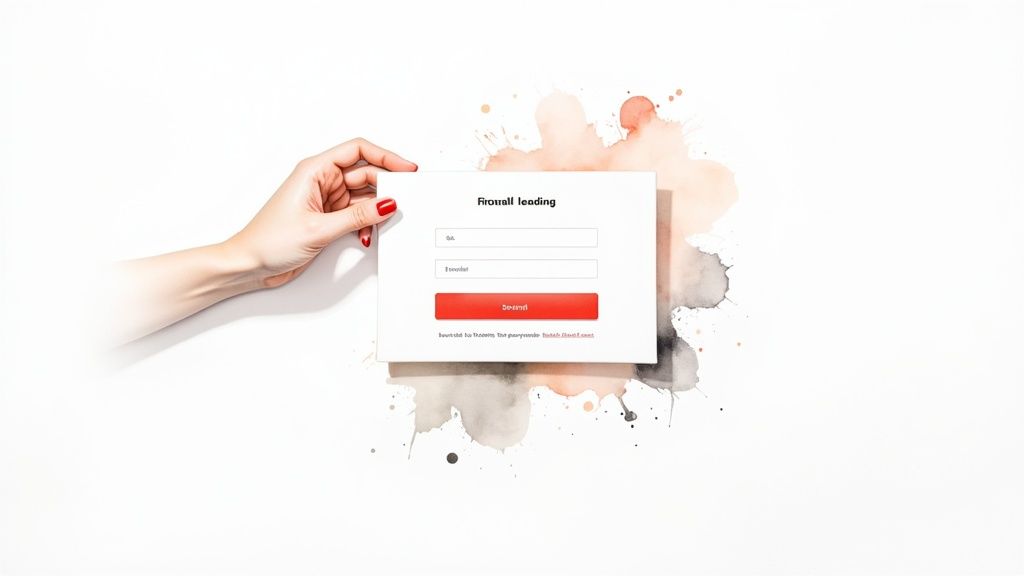
Your form is the final hurdle. It's often the last barrier standing between you and a valuable new lead. I've seen it a thousand times: every extra field you add chips away at your conversion rate. The goal here is to make the process feel completely effortless.
Only ask for what you absolutely need right now. If you're offering a simple ebook download, do you really need their phone number? Probably not. A name and email will do just fine. You can always gather more details later on.
A chatbot can be a fantastic way to handle this. For instance, MxChat can use an in-chat lead capture form that feels more like a natural conversation than a tedious chore, breaking down the questions one by one.
The Power of the Call-to-Action
Your Call-to-Action (CTA) is easily the most important button on the page. Tiny tweaks to its design and wording can have an outsized impact on your results. It's time to ditch generic, uninspired words like "Submit" or "Click Here."
Instead, use action-oriented language that spells out the value of the click. This is where small changes can lead to huge wins.
Landing Page Element Testing Priorities
When you're not sure where to start A/B testing, it helps to prioritize. Some changes have a much higher potential to move the needle than others. This table breaks down where you'll likely get the most bang for your buck.
| Element to Test | Potential Impact | Example Test Idea |
|---|---|---|
| Call-to-Action Text | Very High | Test "Get My Free Guide" vs. "Download Now" |
| Headline | Very High | Test a benefit-focused headline vs. a question-based one |
| Form Length | High | Test a 3-field form vs. a 5-field form |
| Page Layout | Medium | Test a single-column layout vs. a two-column design |
| Social Proof Placement | Medium | Test testimonials above the CTA vs. below the CTA |
As you can see, the words you use in your headline and CTA are mission-critical. Changing a button's text from "Submit" to "Get My Free Plan" works because it reinforces what the user gets, not just what they have to do.
On top of these universal principles, getting specific to your campaign type can give you another advantage. For local businesses, learning the nuances of building high-converting location landing pages is a game-changer. By carefully optimizing each of these core elements, your landing pages will stop being just pages and start becoming the powerful conversion engines your business needs.
A Slow Website Is a Conversion Killer

Let’s be honest: in a world of instant gratification, a slow website is one of the fastest ways to lose a potential customer. Every second a visitor waits for your page to load is another opportunity for them to get frustrated and leave.
This isn't just a minor annoyance—it's a direct hit to your sales. A laggy site creates friction and plants a seed of doubt about your brand’s credibility before a visitor even sees what you have to offer. Speed isn't just a technical problem; it's a fundamental part of building a high-converting user experience.
The numbers don't lie. Websites that load in just one second have been shown to have conversion rates up to three times higher than those that take five seconds to appear. For e-commerce sites, the difference is even more stark, with a one-second load time boosting conversions by 2.5 times.
Figure Out What’s Slowing You Down
Before you can fix the problem, you need a proper diagnosis. Luckily, you don't need to be a performance engineer to find the culprits. There are some fantastic—and free—tools that can give you a detailed report card on your site's health.
I always recommend starting with Google's PageSpeed Insights. Just pop in your URL, and it will give you a performance score for both mobile and desktop. More importantly, it provides a list of "Opportunities" and "Diagnostics" that pinpoint exactly what’s causing the slowdown.
Keep an eye out for these usual suspects:
- Massive Image Files: This is the big one. Uncompressed, high-resolution images are often the single heaviest part of a webpage.
- Render-Blocking Resources: A fancy term for scripts and style sheets that force the browser to wait before it can show your page.
- Slow Server Response: If your server takes a while to respond to the initial request, it could mean your hosting plan isn't cutting it anymore.
These reports give you a clear, actionable roadmap to follow.
How to Actually Make Your Site Faster
Once you know what’s broken, it’s time to fix it. You probably don’t need a complete site overhaul. I’ve found that focusing on a few high-impact areas can make a world of difference.
Tackle Your Images First
This is the low-hanging fruit of site performance. Large images are heavy and take forever to download, so shrinking their file size should be your top priority.
- Compress everything: Use tools like TinyPNG or an image optimization plugin to drastically reduce file sizes without sacrificing much quality.
- Use modern formats: Switch to next-gen formats like WebP, which offer much better compression than old-school JPEGs and PNGs.
- Turn on lazy loading: This clever trick tells the browser not to load images until the user is about to scroll to them. It makes the initial page load feel lightning-fast.
A fast, smooth experience signals reliability and professionalism. It tells the user you value their time, which is the first step in building the trust required to make a sale.
Put Caching to Work for You
Browser caching is a game-changer. It stores parts of your website—like images, CSS, and JavaScript—on a visitor's device. When they come back, their browser can load those files locally instead of downloading them all over again.
If you’re on WordPress, this is incredibly easy to set up. There are several of the best free cache plugins for WordPress that handle all the technical details for you. Installing one is a simple fix that dramatically improves the experience for your most important visitors—the ones who keep coming back.
Use AI Chatbots to Guide Visitors and Drive Conversions
Let's be honest, your visitors have questions. And in a world where attention spans are measured in seconds, they want answers now. This is precisely where modern AI chatbots have completely changed the game for website conversion, leaving the clunky, robotic FAQ bots of the past in the dust.
Think of a well-designed chatbot as your 24/7 digital concierge. It’s there to meet visitors exactly where they are in their journey. It can answer a quick question about shipping, explain a tricky feature, or even offer a personalized discount to a hesitant shopper—all in real-time. That one helpful interaction can be the tipping point that turns a bounce into a sale.
Place Chatbots on Your High-Intent Pages
The secret to getting real value from a chatbot isn't just having one; it's putting it in the right place at the right time. Don't just slap a chat widget on your homepage and call it a day. You need to think strategically about which pages signal that a visitor is close to making a decision.
These are the moments when a visitor is seriously considering your offer, and a gentle nudge can make all the difference.
- Pricing Pages: Someone looking at your pricing is doing the math. This is the perfect moment for a chatbot to proactively ask, "Have any questions about our plans?" It's a simple way to clear up confusion about features or billing that might be holding them back.
- Product Pages: On a product page, a chatbot can act like your best salesperson. It can answer detailed questions, compare specs with another model, or even suggest a matching accessory, directly boosting your average order value.
- Checkout Pages: A chatbot here can be your last line of defense against cart abandonment. It can instantly address last-minute worries about shipping times, return policies, or payment security—those final hurdles that trip up so many sales.
By placing your AI assistant at these critical junctures, you transform it from a passive support tool into an active conversion driver. It’s about being there to provide the right information at the exact moment a customer needs it most.
Design Conversations That Actually Feel Human
The fastest way to fail with a chatbot is to make it sound like a machine. For this to work, the conversation needs to feel natural, helpful, and even a little empathetic. Your goal is to build a connection, not just fire off pre-programmed responses.
Start by digging into the most common questions and objections you hear from real customers. Then, write out responses in a friendly, conversational tone.
- Keep it simple. Ditch the corporate jargon. Write like you speak.
- Give it some personality. A chatbot with a name and a consistent voice that matches your brand feels much more approachable.
- Always offer a next step. Guide the user toward a solution or a goal, whether that’s adding an item to their cart or booking a demo call.
Integrate and Analyze to Keep Getting Better
A chatbot working in a silo is helpful, but an integrated one is a true powerhouse. When you connect your chatbot to your CRM, every qualified lead it generates gets captured and funneled straight to your sales team. This seamless handoff ensures no potential customer ever falls through the cracks.
But the real gold is hidden in the chat logs. Diving into these conversations gives you raw, unfiltered feedback on what your customers are really thinking and asking. You’ll uncover common pain points, spot gaps in your website's content, and maybe even get ideas for your next product.
Using chatbots for marketing is a powerful strategy for anyone serious about improving website conversion rates. You can learn more by reading our guide on using chatbots for marketing. By guiding visitors, qualifying leads, and providing instant answers, an AI chatbot like MxChat doesn't just improve the user experience—it actively turns more of your traffic into real business results.
Optimize Your Highest Converting Traffic Channels
Getting people to your site is great, but it's really only half the job done. To actually get good at converting those visitors into customers, you have to accept a simple truth: not all traffic is the same. Someone who clicks a link in a hyper-targeted email you sent is in a completely different mindset than someone who stumbles upon your site from a random social media ad.
Instead of casting a wide net and hoping for the best, the real goal is to figure out which channels are bringing you the right kind of people. I'm talking about the visitors who don't just browse—they buy, they sign up, they convert. It all starts with digging into your analytics to see where your actual sales and best leads are coming from.
Figure Out Which Channels Are Actually Working
Before you can double down on your winners, you need a clear, honest look at where your traffic is coming from. Jump into your analytics platform and start segmenting your audience by source: organic search, direct traffic, paid ads, social media, email campaigns, and referrals.
But don't just look at the raw number of visitors. A channel sending you thousands of people is completely useless if none of them stick around. The real story is in the metrics that matter, like conversion rate, bounce rate, and how long people stay on your pages. This data will quickly show you what's working and what's just wasting your time and money.
For example, you might find that your organic search traffic has a solid 5% conversion rate, but your paid social campaigns are barely hitting 1%. That doesn’t necessarily mean you should kill your social ads, but it’s a massive sign telling you where your optimization efforts will pay off the most.
Match Your Message to Your Landing Page
One of the fastest ways to kill a conversion is to create a jarring disconnect between your ad and your landing page. When someone clicks a link, they have an expectation. If the page they land on doesn't instantly meet that expectation, they’re gone. It’s that simple.
This is especially true for any paid campaigns you’re running. Let's say you have a Google Ad that screams, "50% Discount on All Winter Coats." If a potential customer clicks that ad and lands on your generic homepage instead of a page filled with discounted coats, you've just created a frustrating dead end. The message is broken, and you've almost certainly lost that sale.
Your marketing channel and landing page must tell the same story. The headline on your landing page should directly reflect the ad copy or link text that brought the visitor there, creating a seamless and reassuring user journey.
This is where you can get really smart with your on-page experience. Once a visitor lands, tools like AI-powered chatbots can step in to qualify leads, handle common questions, and guide them toward a purchase, boosting conversions for each specific channel.
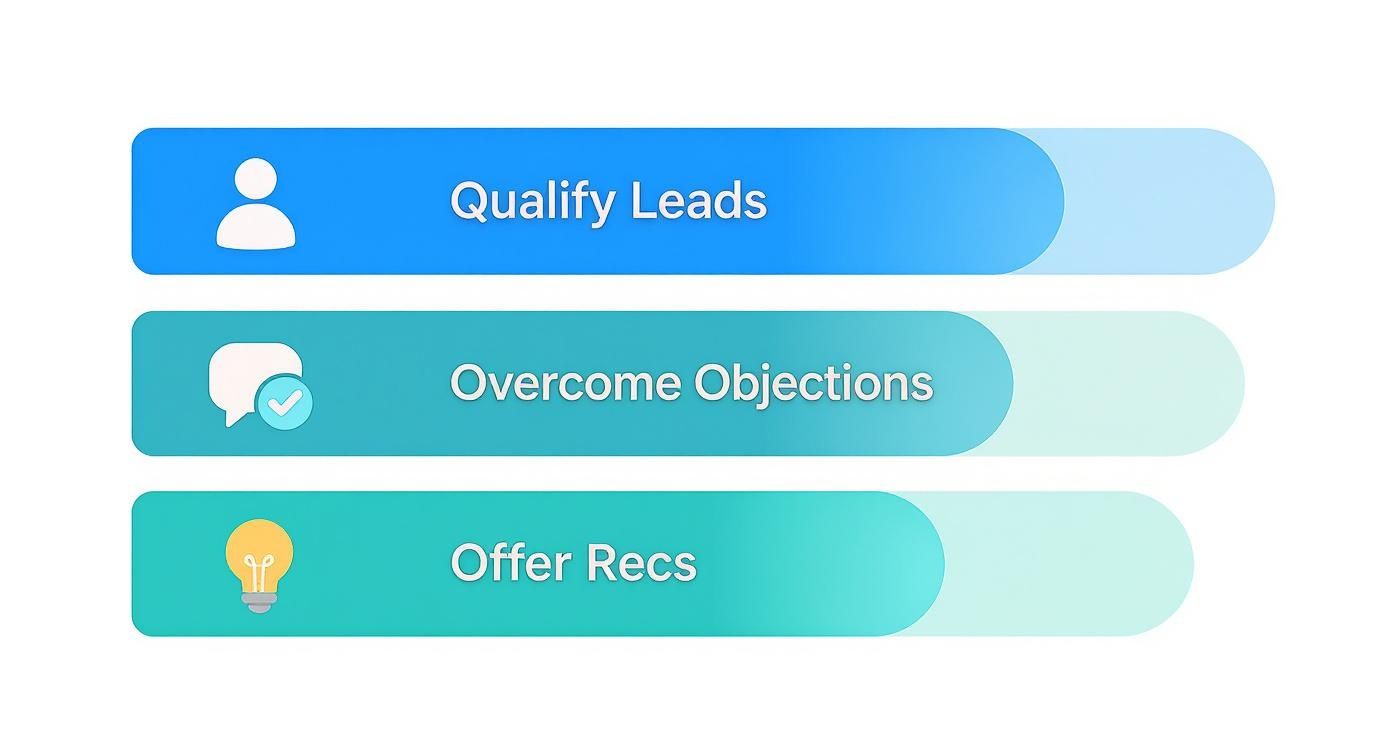
As you can see, a well-placed chatbot becomes a powerful assistant, helping guide visitors from different sources toward the specific goal that brought them to your site in the first place.
Fix Your Underperforming Channels
Just because a channel isn't performing well doesn't mean you should give up on it. Most of the time, a few smart adjustments can make a huge difference.
- Low-Converting SEO Traffic? Look at the keywords bringing people to your site. Are you accidentally attracting informational searchers to a sales page? If so, try creating targeted, bottom-of-funnel content like "Best [Product] for [Use Case]" to capture people who are ready to buy.
- High-Bounce-Rate Paid Ads? The fix is almost always tightening the alignment between your ad copy and your landing page headline. Make sure the value proposition is crystal clear the second the page loads.
- Disengaged Email Traffic? Stop blasting your entire list with the same message. Segment your subscribers into smaller, more engaged groups and send them offers that are actually relevant to them. A targeted email to a few hundred people will always outperform a generic one sent to thousands.
Some channels just naturally bring in higher-intent visitors. Direct traffic (people typing in your URL or using a bookmark) consistently converts at the highest rate, around 3.3%. Email marketing is right behind it at 2.8%, with organic search at 2.3%. Paid channels like PPC and social media tend to convert lower, at 1.5% and 1.6% respectively, which just shows how crucial precise targeting is. For more benchmarks, you can dig into the latest industry research from First Page Sage.
By taking a methodical approach to analyzing and optimizing each channel, you stop throwing money at traffic that goes nowhere and start investing your resources where they’ll actually grow your business.
Got Questions About Conversion Rates? We've Got Answers.
When you dive into conversion optimization, a lot of questions pop up. It's totally normal. Getting straight answers is the first step to making changes that actually work. We've put together some of the most common ones we hear to help you sharpen your strategy.
What’s a Good Website Conversion Rate, Really?
This is the million-dollar question, but the honest answer is: it depends. There’s no single number that works for everyone. A "good" conversion rate is all about context—your industry, your business model, and what you’re trying to achieve. An e-commerce site selling t-shirts will have a completely different benchmark than a B2B software company trying to book demos.
As a general ballpark figure, anything between 2% and 5% is usually considered pretty solid. The top players in any given industry might see higher numbers, but don't get hung up on that.
The best benchmark is yourself. Are you doing better this quarter than last quarter? That’s the real goal. Chasing continuous improvement is far more valuable than obsessing over an arbitrary industry average.
Focusing on those incremental wins is how you build momentum and achieve real growth over time.
How Do I Calculate My Conversion Rate?
Fortunately, this part is simple. The math is straightforward and gives you a powerful snapshot of how well your website is doing its job.
Here’s the formula:
(Number of Conversions / Total Number of Visitors) x 100 = Conversion Rate %
Let’s put it into a real-world scenario. Imagine your landing page got 5,000 visitors last month, and out of those, 150 filled out your contact form.
The math would look like this:
(150 leads / 5,000 visitors) x 100 = 3%
That one little number tells you so much about your site's performance.
What Are the Fastest Ways to Get More Conversions?
Big, data-heavy strategies are fantastic for long-term growth, but sometimes you just need a quick win. If you’re looking for a few high-impact tweaks you can make right now, here’s where I’d start:
- Rethink Your Call-to-Action (CTA): Stop using generic words like "Submit" or "Click Here." Get specific and highlight the value. Something like "Get Your Free Quote" or "Download My Cheatsheet" works much better because it tells the user exactly what they're getting.
- Speed Up Your Site: Seriously. A slow site kills conversions. Even a one-second delay can make a huge difference. Start by compressing your images and making sure browser caching is turned on. These are often the easiest fixes.
- Show Off Your Social Proof: Find your best customer testimonial and stick it right next to your "Buy Now" or "Sign Up" button. Seeing that someone else had a great experience builds instant trust right when people are on the fence.
These smaller adjustments can often give you a nice little boost while you map out your more comprehensive A/B testing plans.
Ready to turn more of your website visitors into customers with real-time, helpful conversations? MxChat allows you to build intelligent AI chatbots that answer questions, qualify leads, and guide users to conversion 24/7. Discover how MxChat can transform your user engagement and boost your bottom line at https://mxchat.ai.