How to Increase Online Sales Proven Strategies for Growth
If you're serious about increasing online sales, you can't just throw things at the wall and see what sticks. Real growth comes from focusing on what actually moves the needle: making your site a pleasure to use, earning genuine customer trust, and using the right tech to make it all happen.
It’s not about finding one secret trick. Instead, it’s about strategically combining proven tactics that work together to turn visitors into loyal customers.
Your Framework for Sustainable Sales Growth

Let's move past the generic advice and build a sales engine that's built to last. The real goal is a solid framework that covers every part of your customer's journey, from the moment they first hear about you to when they come back for their tenth purchase. Forget chasing trends—a durable strategy is built on fundamentals.
This guide is your roadmap. We'll break down the often-overwhelming process of boosting sales into clear, manageable actions. You'll see how a smooth user experience, smart technology like AI, and authentic customer trust all lock into place to create a powerful ecommerce machine.
Core Pillars of Ecommerce Success
We're going to dig into the key areas that deliver the biggest impact on your bottom line. These aren't just theories; they're battle-tested strategies that get results.
Here’s a sneak peek at what we'll cover:
Creating a Flawless User Experience: This is about more than just a pretty design. We're talking about everything from lightning-fast mobile performance to a checkout process so simple it's almost invisible. A frictionless journey is no longer a luxury—it's a requirement.
Harnessing Powerful Technology: I'll show you how tools like AI chatbots and personalization engines can do the heavy lifting, guiding users, answering questions 24/7, and serving up offers that feel like they were made just for them.
Building Unbreakable Trust: Learn how to use customer reviews, authentic testimonials, and transparent policies to transform skeptical visitors into buyers who feel confident hitting that "purchase" button.
The way people shop today is all over the place—they might see you on Instagram, visit your site on a laptop, and then buy from their phone. Your sales strategy has to connect all those dots into one seamless, satisfying experience.
Understanding how all these pieces fit together is the key. A well-structured sales funnel, for instance, is absolutely essential for leading customers from one stage to the next. If you're using common tools, it's worth learning how to integrate ClickFunnels with your WordPress site to create seamless funnels and make sure no lead is left behind. This kind of holistic approach is what separates the pros from the amateurs.
To put it all into perspective, here’s a quick summary of the core strategies we'll be focusing on and why they matter so much.
Core Pillars for Increasing Online Sales
| Strategy Pillar | Key Actions | Expected Sales Impact |
|---|---|---|
| User Experience (UX) | Optimize mobile view, simplify checkout, improve site speed. | Higher conversion rates, lower cart abandonment. |
| Technology & AI | Implement an AI chatbot, personalize product recommendations. | Increased average order value, improved customer support. |
| Customer Trust | Showcase reviews, testimonials, and clear return policies. | Higher repeat purchases, improved brand loyalty. |
By focusing your efforts on these foundational pillars, you're not just aiming for a temporary sales spike—you're building a resilient business that can grow consistently over time.
Mastering the Mobile Shopping Experience
Let’s face it, your customers aren’t sitting at a desk to shop anymore. They’re browsing in line for coffee, on their commute, and from the comfort of their couch. If your store isn’t built for a small screen, you're not just creating a minor inconvenience—you're actively turning away paying customers.
A clunky mobile experience is one of the fastest ways to lose a sale before it even begins.
The shift to mobile commerce is impossible to ignore. In fact, by 2025, mobile ecommerce sales are projected to hit an incredible $2.51 trillion, which will account for nearly 59% of all online transactions worldwide. This isn't a future trend; it's the present reality. A huge chunk of your customers are already trying to buy from you on their phones.
For a deeper dive into these numbers, you can explore more ecommerce statistics on Netguru.
Beyond “Mobile-Friendly”: Why You Need to Be Mobile-Optimized
There’s a massive difference between a "mobile-friendly" site and a truly "mobile-optimized" one. A mobile-friendly site just shrinks down to fit a smaller screen, often leaving you with tiny text and buttons that are impossible to tap accurately. Frankly, it’s a lazy approach that leads to frustration and sky-high bounce rates.
A mobile-optimized experience, on the other hand, is completely re-imagined for the device. Think large, tappable buttons, simplified navigation menus, and forms that are actually easy to fill out with a thumb. The entire journey is designed with the mobile user's context in mind—it needs to be fast, intuitive, and completely frictionless.
This visual shows how a responsive design fluidly adapts its layout across different screen sizes, from a wide desktop monitor to a narrow smartphone display.
Notice how the content elements stack vertically and the navigation changes to a compact menu on the smaller screens. This is what ensures the user experience stays smooth, regardless of the device they're on.
The Need for Speed and Simplicity
On mobile, every single second counts. I've seen firsthand how a one-second delay in page load time can cause a 7% reduction in conversions. Shoppers are impatient and won't wait around for slow-loading images or clunky layouts. Your first job is to audit your site's mobile speed and ruthlessly trim anything that slows it down.
Beyond speed, you have to nail the navigation. A mobile user should never have to pinch and zoom to find your menu or search bar.
- Sticky Header: Keep your navigation bar, search icon, and cart icon visible at the top of the screen as the user scrolls. This simple trick prevents them from having to scroll all the way back up to take the next step.
- Thumb-Friendly Design: Place critical buttons—like "Add to Cart" or "Checkout"—in the areas a thumb can easily reach. That usually means the center or bottom of the screen.
- Streamlined Checkout: This is where so many stores bleed money. Cut out every unnecessary field. Offer one-click payment options like Apple Pay, Google Pay, and PayPal. The goal is to get the customer from cart to confirmation with the fewest taps possible.
Key Takeaway: Don't make your customers work to give you their money. A mobile-optimized checkout should feel effortless, almost invisible. If a customer has to stop and think about where to tap next, you've already added too much friction.
The Power of a Dedicated Shopping App
While a blazing-fast mobile website is non-negotiable, a dedicated shopping app can take your sales to a whole new level. The data doesn't lie: app-based shopping experiences deliver conversion rates that are three times higher than mobile websites.
So, why are apps so effective?
- Push Notifications: You can reach customers directly with personalized offers, new product alerts, and abandoned cart reminders, pulling them right back into your store.
- Stored Information: Payment and shipping details are saved, making a true one-tap checkout possible. It’s the ultimate convenience.
- Enhanced Personalization: Apps can use device features to create a richer, more tailored shopping journey that a website just can't match.
Of course, developing an app is a serious investment. But for businesses with a loyal, returning customer base, it can be an absolute game-changer for driving repeat purchases and increasing lifetime value. If an app isn't on the table right now, you can still create a more guided experience on your site. It's worth learning how to boost conversions with intelligent chat funnels, which can mimic that app-like feel without the hefty development overhead.
Using AI and Personalization to Drive Conversions
The days of a one-size-fits-all online store are long gone. Today's customers don't just appreciate a personalized experience—they expect it. If your store feels generic, you're practically inviting shoppers to click away and leaving a huge amount of money on the table. This is where AI and personalization stop being buzzwords and start becoming your most effective sales tools.
A store full of generic product grids and irrelevant offers just creates friction. It makes shoppers work too hard, causing them to lose interest and bounce. By bringing AI into the mix, you can create a dynamic, responsive shopping journey that actually anticipates what your customers want, guiding them smoothly toward making a purchase. This isn't about some far-off sci-fi concept; it's about using practical tools to get real results, right now.
Moving Beyond Basic Recommendations
Ever wonder how Amazon seems to know exactly what you want to buy next? That’s the magic of a sophisticated recommendation engine, and it’s a strategy you can absolutely use in your own store to increase online sales.
These systems are powered by machine learning that analyzes everything a user does—the products they click, the items they add to their cart, and what they’ve bought before. With that data, it serves up hyper-relevant suggestions that feel incredibly personal. The impact is hard to ignore. Retailers that embrace this level of AI-driven personalization see a 20-30% increase in sales compared to those who don’t. For a giant like Amazon, this isn't small change; their recommendation engine is credited with driving 35% of its total sales. You can dig into more digital commerce trends at Cimulate.ai.
This image gives a simplified look at how these systems work, using a customer's past interactions to predict what they'll be interested in next.
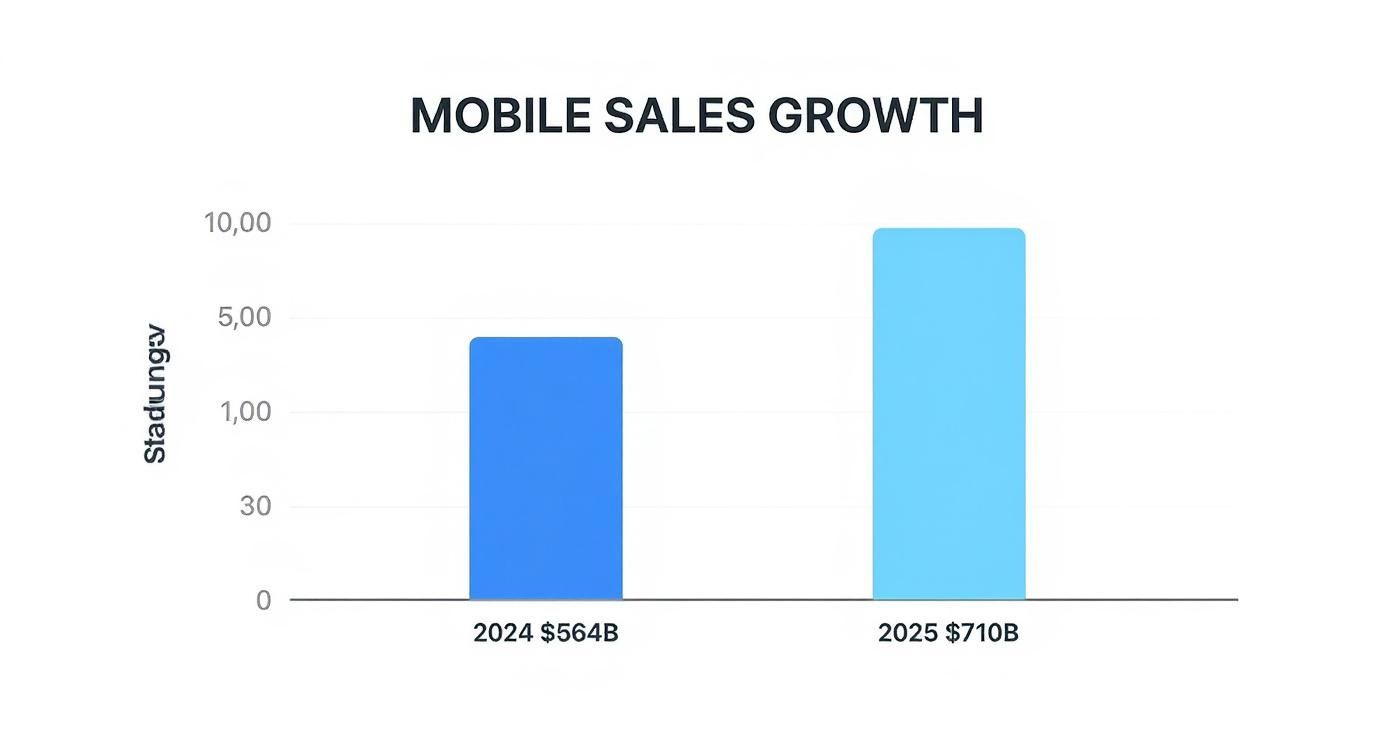
The real power here is the feedback loop. The system is constantly learning from new data, meaning its suggestions get more accurate and persuasive over time. It’s a self-improving sales machine.
Deploying Intelligent Chatbots for Instant Support
I've seen it happen countless times: an unanswered question kills a sale. When a customer is on the fence about sizing, shipping, or a specific product feature, they need an answer immediately. Making them wait for an email response is a surefire way to send them straight to a competitor.
This is exactly where an AI-powered chatbot like MxChat can be a game-changer. Forget those clunky, old-school bots that only spit out pre-written answers. A modern AI assistant can:
- Offer 24/7 Support: Instantly answer customer questions around the clock. You'll never lose a potential sale just because someone had a simple question after hours.
- Act as a Personal Shopper: Guide users to the right products by asking smart, qualifying questions based on their needs and preferences.
- Automate Routine Tasks: Handle things like order tracking and return requests, which frees up your human support team to focus on more complex, high-value conversations.
An AI chatbot isn't just a support tool; it's a proactive sales assistant. By resolving friction points in real-time, it keeps the customer's journey moving smoothly toward the checkout button.
Putting a smart chatbot in place is one of the most direct ways to slash cart abandonment. It gives customers the confidence they need to click "buy" by providing instant gratification and support.
Creating Truly Personal Customer Journeys
Let's be clear: real personalization is so much more than just plugging a customer's first name into an email. It’s about using data to make every single touchpoint feel like it was created just for them, from the ads they see to the promotions they receive.
Different AI tools excel at different personalization goals. Some are great for boosting average order value, while others are designed to improve engagement.
Comparing AI Personalization Tactics
| AI Tactic | Primary Goal | Average Performance Uplift |
|---|---|---|
| Dynamic Content | Increase on-site engagement | 15-25% lift in time-on-page |
| Product Recommendations | Boost Average Order Value (AOV) | 10-30% increase in AOV |
| AI Chatbots (e.g., MxChat) | Improve Conversion Rate | 5-15% increase in conversions |
| Personalized Promotions | Drive repeat purchases | 20% higher customer retention |
Choosing the right tactic depends on where you want to see the most improvement. For many stores, a combination of these is what truly moves the needle.
To start creating these tailored experiences, you can zero in on a few key areas:
- Dynamic On-Site Content: Use AI to show different homepage banners or product carousels to different people. A first-time visitor could see a "Welcome" discount, while a loyal customer is shown new arrivals in their favorite category.
- Segmented Email Campaigns: Ditch the generic newsletter blasts. Send targeted emails based on past purchases, abandoned carts, or even just browsing behavior. For example, if someone bought running shoes, follow up a few weeks later with an email about new running apparel.
- Personalized Promotions: Instead of offering the same 10% discount to everyone, let AI figure out the best offer for each person. A price-sensitive shopper might get a bigger discount, while a VIP customer might get early access to a new collection.
By adopting these kinds of AI-driven strategies, you stop being just another online catalog and become a responsive, adaptive sales environment. This level of personalization isn’t just a nice-to-have anymore—it’s absolutely essential if you’re serious about how to increase online sales and build a customer base that keeps coming back.
Building Trust with Social Proof and Reviews

In the world of online shopping, trust is everything. A skeptical visitor will never become a paying customer, plain and simple. Building that confidence isn't just a "nice to have"—it's one of the most direct ways to increase online sales and turn hesitant browsers into loyal buyers.
This is where the psychology of social proof comes in. When we're unsure about a decision, our natural instinct is to see what others are doing. By showcasing positive feedback and signs of credibility, you're essentially telling a new customer, "Look, people just like you bought this and loved it. You will too."
The Unmistakable Power of Customer Reviews
Modern shoppers are savvy. Before they even think about adding an item to their cart, they're on the hunt for reviews. The data doesn't lie: by 2025, a staggering 99% of online shoppers will check out product reviews before they buy.
Products with positive reviews can see their conversion rates jump by up to 270% compared to products with no reviews at all. These aren't just numbers; they represent real people feeling confident enough to click "buy." Reviews are hands-down your most authentic and powerful sales tool.
To really make them work for you, you need a system.
- Automate Your Requests: Set up an automated email to go out a week or two after a customer’s order arrives. This timing is perfect—it gives them a chance to actually use the product while the experience is still fresh in their mind.
- Make It Easy: The review process needs to be completely frictionless. A simple star rating with an optional comment box is all you need. If it feels like a chore, they won't do it.
- Display Them Prominently: Don't bury your hard-earned reviews on a separate page. Place them directly on your product pages, right under the product title or description, where they'll have the biggest impact.
For anyone running on WordPress or WooCommerce, implementing a great review system is easier than ever. You can explore some of the best WordPress product review plugins that automate the whole process from collection to display.
Expanding Beyond Traditional Reviews
While star ratings are a must, social proof comes in many different forms. Each one adds another layer of credibility to your brand, chipping away at a potential customer's hesitation. Think of it as building a comprehensive case for why your store is the right choice.
Key Insight: Social proof works because it's authentic. A genuine photo of a customer enjoying your product is often more persuasive than the most polished, professional advertisement.
Here are a few other powerful trust signals you should be using:
User-Generated Content (UGC): Encourage your customers to share photos or videos of them using your products. Create a unique hashtag for Instagram and feature the best submissions on your homepage and product pages. It’s a real-world endorsement that feels genuine and relatable.
Influencer Mentions: A shout-out from a respected voice in your niche can be a game-changer. Even collaborating with a smaller, micro-influencer can introduce your brand to a highly engaged and trusting audience.
Trust Badges: These little logos can have a huge impact on a shopper’s confidence, especially at checkout. Displaying familiar payment options (like Visa, PayPal, Apple Pay) and security seals reassures customers that their information is safe. This one simple addition has been shown to reduce cart abandonment by as much as 15%.
The Importance of a Clear Return Policy
Finally, let's talk about one of the biggest silent deal-killers: "buyer's remorse." A customer is always wondering, what if it doesn't fit? What if I don't like it? A confusing or hard-to-find return policy just amplifies that fear.
To combat this, make your return policy incredibly easy to find and understand. Link to it in your footer, on product pages, and even during checkout. Use simple, clear language—no jargon. A generous and transparent return policy acts as a safety net, removing that last bit of risk and giving shoppers the final push they need to complete their purchase.
Sharpening Your Digital Marketing and SEO Strategy
Having an amazing product is a great start, but let's be honest—if the right people never see it, you don't have a business. Driving high-quality traffic is the real engine of online sales, and that takes a smart, cohesive marketing and SEO plan. If your current approach is to just sprinkle in a few keywords and cross your fingers, you're definitely leaving money on the table.
To really increase online sales, you have to move beyond isolated tactics. This means building a multi-channel plan where every single piece, from your SEO to your social media ads, works in harmony to guide customers from that first "hello" all the way to checkout.
Advanced SEO for Ecommerce
Landing on the first page of Google isn't a happy accident; it's the result of precision and hard work. For any ecommerce store, this means focusing your energy on the pages that actually make you money: your product and category pages.
Generic SEO simply won't cut it. Your goal is to attract visitors who are already pulling out their wallets.
Optimize Your Product Descriptions: Don't just list features. Your product descriptions should anticipate and answer every single question a potential customer might have. Weave in long-tail keywords that a serious buyer would type in, like "waterproof hiking boots for wide feet" instead of just "hiking boots."
Build Compelling Category Pages: Think of your category pages as more than just a grid of products. They should be mini-landing pages, complete with helpful introductions, quick buying guides, and smart filters that let shoppers effortlessly find what they need. This not only boosts the user experience but also gives search engines a ton of valuable context.
Pursue Strategic Backlinks: High-quality backlinks from reputable websites are like a vote of confidence for your store. Concentrate on earning links from product review sites, respected industry blogs, and even businesses that sell complementary products. A strong backlink profile is a massive signal to Google that your site is an authority worth ranking.
Building a Cohesive Multi-Channel Strategy
Your customers are everywhere, so your marketing needs to be, too. An integrated strategy ensures your message is consistent and reinforcing, no matter where someone stumbles upon your brand. The idea is to create a seamless journey that feels helpful, not disjointed.
A customer might first discover your product through a targeted Facebook ad, later search for reviews on Google, and finally make a purchase after getting a promo email. If those channels aren't talking to each other, that journey breaks down, and you lose the sale.
This is where you connect all the dots. A paid search ad can grab immediate traffic for a competitive term, while your organic SEO works in the background to build long-term, sustainable visibility for that exact same keyword. Then, your social media can retarget those site visitors, keeping your brand fresh in their minds.
Identifying Your Most Profitable Channels
Here’s a hard truth: not all traffic is created equal. To get the best return on your investment (ROI), you need to know which channels aren't just sending visitors, but are actually delivering paying customers. This all comes down to careful tracking and analysis.
Start by digging into your analytics to look at conversion paths. You might be surprised to find that while organic search doesn't lead to many direct sales, it’s the main way new customers are introduced to your brand before they eventually convert through another channel.
Here’s a practical way to break down your traffic sources:
- Track Everything with UTMs: Slap unique UTM parameters on every single campaign—every email, every social post, every paid ad. This is the only way to accurately trace sales back to their origin.
- Analyze Assisted Conversions: Pay close attention to which channels pop up in the middle of a customer's journey, even if they aren't the final click. This reveals the hidden value of top-of-funnel activities like your blog or social media presence.
- Calculate Channel-Specific ROI: Figure out the customer acquisition cost (CAC) and the lifetime value (LTV) for customers coming from each channel. This data paints a crystal-clear picture of where to double down on your budget and where to pull back.
For example, you might discover that your email marketing campaigns are consistently generating the highest ROI. That's a huge green light to invest more in building your email list. A fantastic way to do this is by optimizing your on-site lead capture forms, and you can pick up some powerful techniques by learning how to master the Constant Contact WordPress plugin for high-converting landing pages.
By taking the time to sharpen your marketing and SEO, you can finally stop wasting money on tactics that don't work and start investing in the strategies that will reliably bring profitable customers to your digital doorstep.
Common Questions About Boosting Online Sales
It's natural to have questions when you're trying to grow your online sales. Everyone from brand-new shop owners to seasoned veterans runs into the same roadblocks. Let's cut through the noise and tackle some of the most common questions I hear with some straight-to-the-point advice.
"What's the Fastest Way to Get More Sales?"
Everyone wants a quick win, and while lasting growth comes from long-term strategies like SEO, there are absolutely ways to get a fast revenue bump. The secret is to focus on the traffic you already have. You just need to make it easier and more compelling for them to buy right now.
A few tactics can deliver surprisingly quick results:
- Slash your checkout steps: Look at your checkout process with a critical eye. Is every single field absolutely necessary? Can you get it all on one page? Adding a guest checkout option is one of the easiest ways to stop shoppers from bailing at the last second.
- Use a smart pop-up: I know, I know—pop-ups can be annoying. But a well-timed offer for 10% off or free shipping in exchange for an email address still works wonders. You get a lead and you push them toward making their first purchase.
- Run a flash sale: There's nothing like a little urgency to get people moving. A quick, time-sensitive sale promoted to your email list or social followers can create an immediate and very satisfying spike in orders.
The quickest wins almost always come from fixing the leaks in your existing sales funnel, not from digging for a whole new source of traffic. Start with what you've got.
"How Can My Small Business Increase Sales on a Tight Budget?"
When you're a small business, every penny counts. You can't just throw money at advertising and hope for the best. The key is to be strategic and focus on low-cost, high-impact activities that build momentum.
Think about building assets you own—like your email list and your reputation.
- Get serious about email: Email marketing still delivers one of the best ROIs out there. It's your direct line to people who have already shown interest. Give them a good reason to sign up, then treat them like VIPs with exclusive content and offers.
- Showcase social proof everywhere: Don't just ask for reviews; make them the star of the show. Display customer photos and testimonials on your product pages and share them on social media. Real-world proof from happy customers is more convincing than any ad you could ever run.
- Go niche with your SEO: Trying to rank for broad keywords is a losing battle against the big guys. Instead, focus on super-specific, long-tail keywords. Writing blog posts that answer detailed questions about your products will attract shoppers who are much closer to making a purchase.
"How Do I Know Which Strategies Are Actually Working?"
If you're not measuring, you're just guessing. This is what truly separates the stores that scale from the ones that stagnate. You need to connect every action you take to a real result so you can do more of what works and stop wasting time on what doesn't.
Get comfortable with your analytics tools.
- Know your big three KPIs: At a minimum, you should be obsessively tracking your conversion rate, average order value (AOV), and cart abandonment rate in a tool like Google Analytics 4. These three numbers give you a high-level health check on your store.
- Tag everything with UTMs: Any link you share—in an email, a social post, a paid ad—should have unique UTM parameters. This is how you trace a sale all the way back to the exact source and know precisely where your money is coming from.
- A/B test your changes: Don't assume you know what your customers will prefer. Test it! Want to change a button color or rewrite a product description? Run an A/B test to see which version actually converts better. Data always beats opinion.
Regularly checking this data is how you stop guessing and start making informed decisions that consistently drive growth.
Ready to turn more of your website visitors into paying customers? The MxChat AI agent platform for WordPress helps you provide instant support, guide shoppers to the right products, and capture leads 24/7. Discover how MxChat can transform your customer experience and boost your sales today.