MiniMax M3.1 Flash Pricing: 8 Routes Tested on a Chatbot
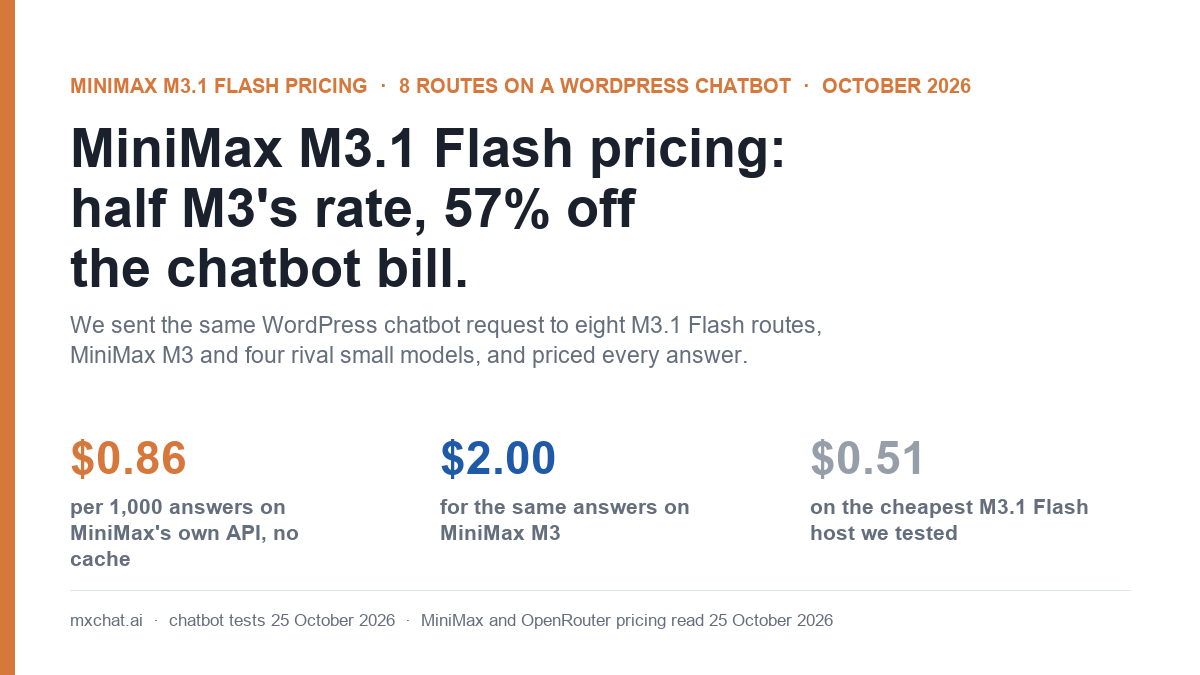
MiniMax M3.1 Flash pricing is $0.15 per million input tokens and $0.60 per million output tokens on MiniMax’s own API. That is exactly half of what MiniMax charges for M3. MiniMax released M3.1 Flash on 19 October 2026, and six days later OpenRouter listed thirteen hosts serving it, from $0.09 input on the cheapest to $0.30 on the dearest. We sent the same WordPress chatbot request to seven of those hosts, to MiniMax M3, and to four rival small models, from our own server. At list price with no cache, 1,000 chatbot answers cost $0.86 on MiniMax’s API with M3.1 Flash and $2.00 with M3: 57% less, not 50%. The extra saving comes from M3.1 Flash spending fewer tokens on reasoning.
This post covers MiniMax’s current price list, what M3.1 Flash costs per chatbot answer on each host, why the same model gave 30-word answers on one host and 112-word answers on another, what the reasoning setting does to the bill (you can lower it but not switch it off), and how M3.1 Flash compares with GPT-6 Luna, Claude Haiku 5.5, DeepSeek V4.1 Flash and GLM-5.3 Flash on the same request.
MiniMax M3.1 Flash pricing in October 2026
These are the rates on MiniMax’s pricing page, read on 25 October 2026. MiniMax shows M3 with a struck-through list price and a “permanent 50% off” label, so we show both.
| MiniMax model and tier | Input / 1M | Cached input / 1M | Output / 1M |
|---|---|---|---|
| MiniMax-M3.1-Flash | $0.15 | $0.015 | $0.60 |
| MiniMax-M3, up to 512K input tokens | $0.30 (list $0.60) | $0.06 | $1.20 (list $2.40) |
| MiniMax-M3, over 512K input tokens | $0.60 | $0.12 | $2.40 |
| MiniMax-M3, Priority tier, up to 512K | $0.45 | $0.09 | $1.80 |
Both models have a context window of about one million tokens. M3 doubles its price once a request goes past 512,000 input tokens; MiniMax publishes no such surcharge for M3.1 Flash. A chatbot request is nowhere near that line. Ours were about 4,200 tokens, so the long-context tier is irrelevant to anyone running a site assistant. The Priority tier is 1.5 times standard and is switched on per request with service_tier: priority.
Cached input on M3.1 Flash is a tenth of the normal rate. For a chatbot that sends the same system prompt with every message, that matters, and we come back to it below. MiniMax lists no free tier for its language models.
M3.1 Flash on other hosts
MiniMax publishes the weights of its models, so inference companies host them and set their own prices. These are the hosts we tested, with the prices OpenRouter showed on 25 October 2026. The weights column is how each host stores the model; lower-precision formats such as fp4 are cheaper to serve.
| Host (as listed on OpenRouter) | Weights | Input / 1M | Output / 1M | Cached input / 1M |
|---|---|---|---|---|
| MiniMax (first party) | not stated | $0.15 | $0.60 | $0.015 |
| Relace | fp4 | $0.09 | $0.50 | $0.01 |
| InferenceNet | fp4 | $0.10 | $0.55 | $0.01 |
| GMICloud | fp8 | $0.1425 | $0.57 | $0.01425 |
| Together | not stated | $0.15 | $0.60 | $0.015 |
| Novita | fp16 | $0.15 | $0.60 | $0.015 |
| SambaNova | not stated | $0.30 | $1.20 | $0.03 |
Most hosts simply match MiniMax. Relace and InferenceNet undercut it by about a third on input. SambaNova charges double, the same as M3 itself. Six other hosts were listed at MiniMax’s price (DigitalOcean, Nebius, Wafer, ModelRun, Parasail and InferenceNet’s US-only endpoint); we did not test those.
How we tested
We built each request the way MxChat builds a chatbot reply. The system message holds our site’s own system prompt plus four knowledge-base passages from mxchat.ai pages, and the user message is the visitor’s question. That came to about 4,200 input tokens. The four questions are ones our own chatbot gets:
- Does MxChat work with WooCommerce, and can the bot look up an order status for a logged-in customer?
- Do I need Pinecone to use the knowledge base, or can I store embeddings in WordPress?
- Can a visitor be handed over to a human on Slack or Telegram when the bot cannot answer?
- Can I use my own OpenRouter or OpenAI API key, and which models can I choose from?
Each question went twice to each of 15 routes: seven M3.1 Flash hosts pinned one at a time with fallbacks off, M3.1 Flash with OpenRouter choosing the host, two reduced-reasoning settings on MiniMax’s own endpoint, MiniMax M3, and four comparison models. That is 120 calls, sent through OpenRouter from our WordPress server in the US on 25 October 2026. 112 returned HTTP 200 on the first try. The other eight were the “reasoning off” route, which failed every time for a reason covered below.
We recorded OpenRouter’s billed cost, token counts including reasoning tokens and cached tokens, and the time to a complete (non-streamed) answer. Sending the same request twice warms each host’s prompt cache, which makes billed costs hard to compare between hosts. So the main cost figures are modelled at each host’s list price from the measured token counts, with no cache: what a first-time question costs. The warm-cache numbers are in their own section.
What MiniMax M3.1 Flash costs per 1,000 chatbot answers
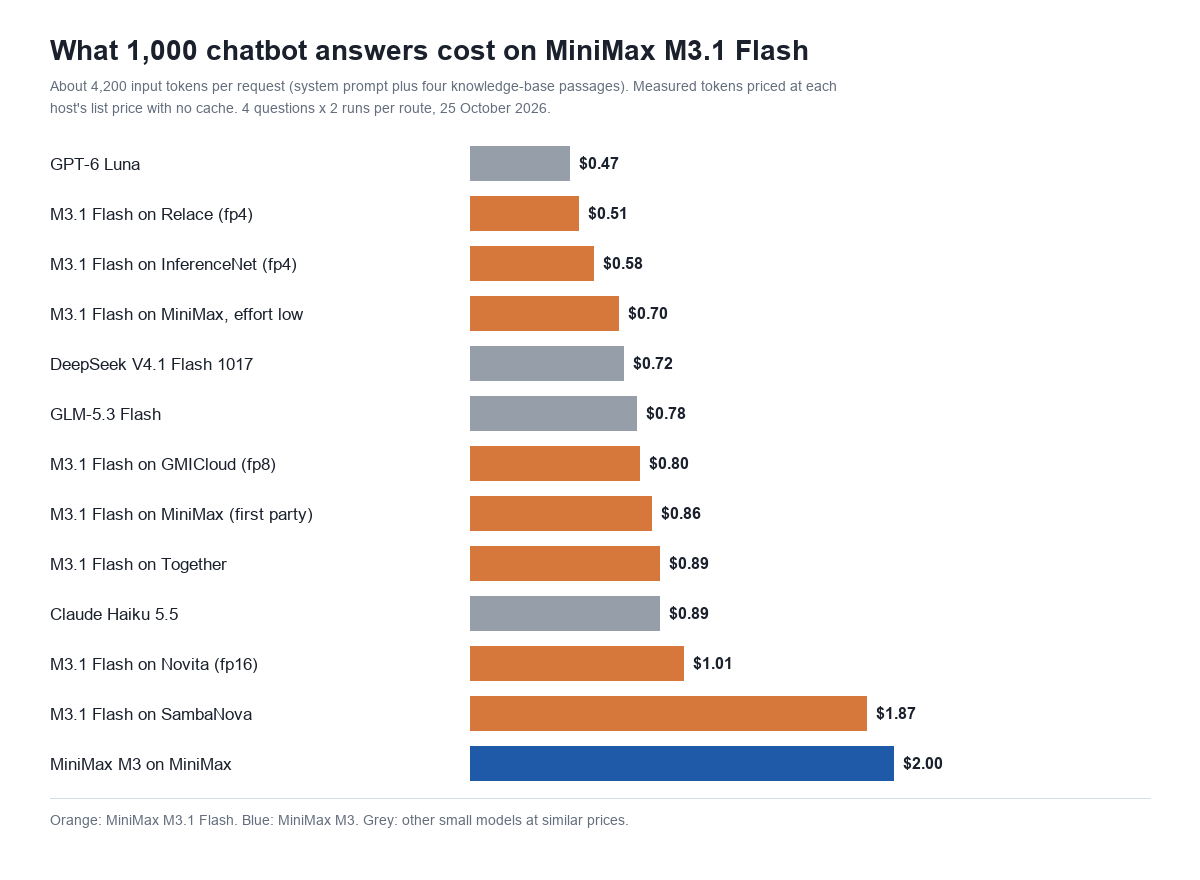
| Route | Per 1,000 answers, no cache | Output tokens per answer (reasoning) | Words in the answer | Median time |
|---|---|---|---|---|
| M3.1 Flash on Relace (fp4) | $0.51 | 256 (93) | 112 | 1.17 s |
| M3.1 Flash on InferenceNet (fp4) | $0.58 | 286 (not reported) | 99 | 5.11 s |
| M3.1 Flash on MiniMax, effort low | $0.70 | 100 (47) | 31 | 1.81 s |
| M3.1 Flash on GMICloud (fp8) | $0.80 | 342 (292) | 32 | 3.79 s |
| M3.1 Flash on MiniMax (first party) | $0.86 | 363 (313) | 30 | 4.07 s |
| M3.1 Flash on Together | $0.89 | 432 (338) | 58 | 1.73 s |
| M3.1 Flash on Novita (fp16) | $1.01 | 613 (553) | 37 | 4.14 s |
| M3.1 Flash on SambaNova | $1.87 | 499 (404) | 62 | 3.92 s |
| MiniMax M3 on MiniMax | $2.00 | 604 (514) | 55 | 7.00 s |
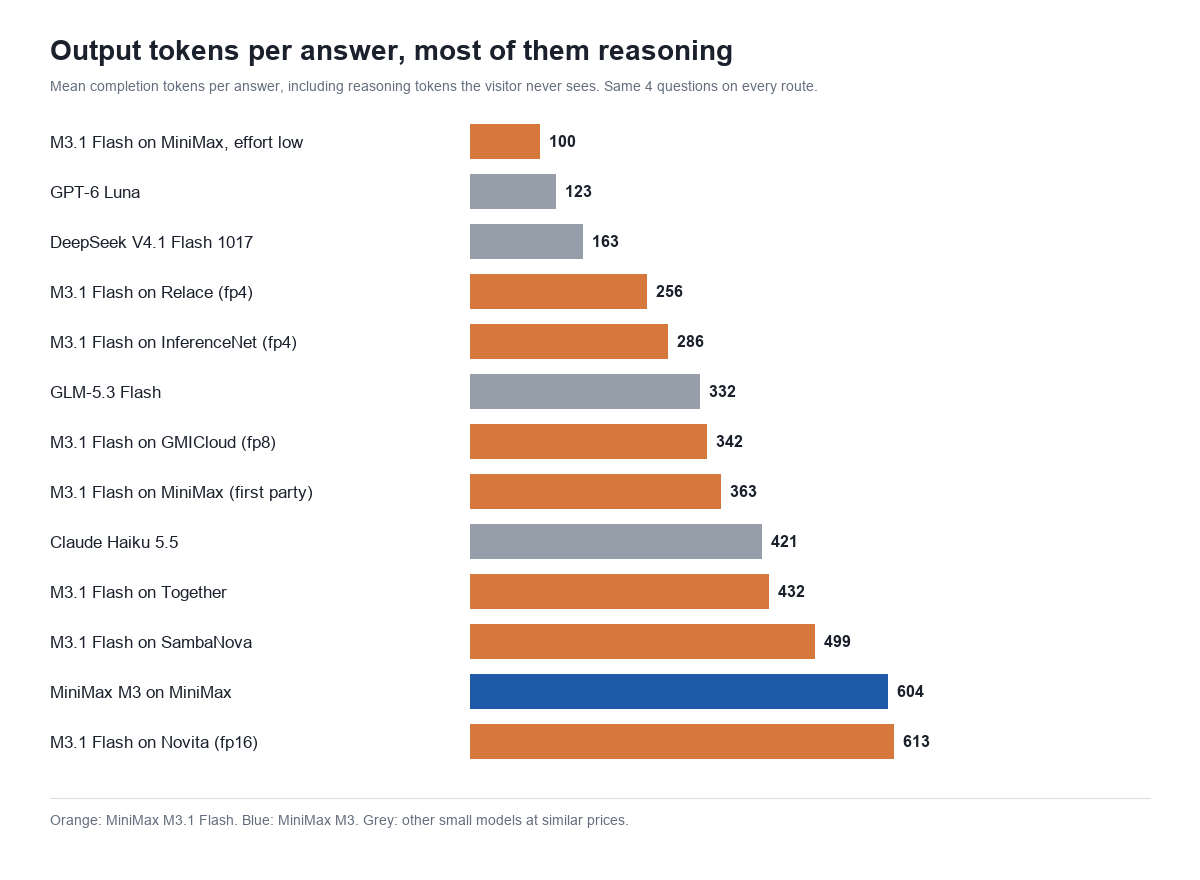
On MiniMax’s own endpoint, M3.1 Flash cost $0.86 per 1,000 answers against $2.00 for M3. The token price halved, and M3.1 Flash also produced 40% fewer output tokens: 363 per answer against 604. That is how a 50% price cut became a 57% cut in the bill.
Input is most of the bill. On MiniMax’s endpoint about three quarters of each answer’s cost was the 4,200 tokens of prompt and knowledge-base context, and a quarter was output. That is why the hosts that cut input price, Relace and InferenceNet, came out cheapest. SambaNova’s doubled price put it level with M3: if your OpenRouter traffic lands there, you lose the whole point of the cheaper model.
When we let OpenRouter choose, our eight requests went to five different hosts: InferenceNet, Relace, Together, GMICloud and Nebius. It never picked SambaNova, and the median wait was 1.44 seconds. Default routing was a reasonable choice here, but it is not guaranteed to be the cheapest one. We explain how OpenRouter’s routing and fees work in our OpenRouter pricing test.
Same model, very different answers
The most useful finding in this test has nothing to do with price per token. The hosts did not run M3.1 Flash the same way.
On MiniMax’s own endpoint, GMICloud and Novita, the model spent 290 to 550 tokens reasoning and then gave a short reply of 30 to 37 words. On Relace it reasoned for about 90 tokens and wrote 112 words. InferenceNet reported no separate reasoning tokens at all, though the reasoning text was in its response, and wrote 99 words. Same weights, same prompt, same temperature: a threefold difference in answer length.
Both styles were correct. We checked every answer against the four facts it had to contain: the WooCommerce add-on comes with MxChat Pro and order lookups are for logged-in customers only; Pinecone is optional because embeddings can live in the WordPress database; handoff to a human works on Slack and Telegram; and API keys go in MxChat’s settings. All 112 completed answers across all 14 working routes got their question right. The difference is tone. The first-party answers read like a terse support agent, and the Relace and InferenceNet answers like a helpful one that adds the setup steps.
Which you want depends on your chatbot. But it does mean that a host change on OpenRouter can change how your bot sounds, not just what it costs. If your answers suddenly get longer or shorter, check which host served them.
Reasoning: you can turn it down, not off
M3.1 Flash always reasons. When we sent OpenRouter’s reasoning: {enabled: false} to MiniMax’s endpoint, all eight requests came back with HTTP 400 and the message “Reasoning is mandatory for this endpoint and cannot be disabled.” If you are used to turning thinking off on other small models to save money, that switch does not exist here.
Setting the effort to low does work, and it is worth doing for a chatbot:
| MiniMax endpoint, M3.1 Flash | Default effort | Effort low | Change |
|---|---|---|---|
| Reasoning tokens per answer | 313 | 47 | -85% |
| Output tokens per answer | 363 | 100 | -72% |
| Cost per 1,000 answers, no cache | $0.86 | $0.70 | -18% |
| Median time to answer | 4.07 s | 1.81 s | -56% |
| Questions answered correctly | 8 of 8 | 8 of 8 | same |
| Words in the answer | 30 | 31 | same |
Low effort cut the reasoning by 85% and the wait by more than half, with the same answers. The cost saving is smaller, 18%, because output was only a quarter of the bill to begin with. For a site chatbot the latency gain is the bigger win: a 4-second pause before every reply is noticeable, and 1.8 seconds is not.
Compare that with Kimi K3, which we tested the same way. K3 defaults to maximum effort and spent three quarters of its output on reasoning; lowering it cut the bill by a quarter. M3.1 Flash reasons less to begin with, so there is less to save, but the advice is the same. For answering questions from a knowledge base, low effort is enough.
Prompt caching: the warm price
Every route except SambaNova and Claude Haiku 5.5 cached part of our prompt automatically, typically 2,100 to 2,900 of the 4,200 input tokens on a repeat request. This is what OpenRouter actually billed us, averaged over both runs:
| Route | No cache (list price) | Actually billed, both runs | Saving |
|---|---|---|---|
| M3.1 Flash on MiniMax | $0.86 | $0.49 | 43% |
| M3.1 Flash on Relace | $0.51 | $0.32 | 37% |
| M3.1 Flash on InferenceNet | $0.58 | $0.32 | 44% |
| M3.1 Flash on SambaNova | $1.87 | $1.87 | none |
| MiniMax M3 on MiniMax | $2.00 | $1.48 | 26% |
Caching only helps when the start of the prompt is identical from one request to the next. In a chatbot, the system prompt usually is, and the knowledge-base passages vary with the question. So the real bill for a busy site lands somewhere between the two columns. Keep the fixed instructions at the top of the system prompt and the retrieved passages after them, so the cacheable part is as long as possible.
How M3.1 Flash compares with other small models
We sent the same four questions to four models in the same price band. Each ran on whichever host OpenRouter chose, and the cost below uses each model maker’s own list price.
| Model | List price in / out per 1M | Input tokens counted | Per 1,000 answers, no cache | Median time | Correct |
|---|---|---|---|---|---|
| GPT-6 Luna | $0.10 / $0.50 | 4,067 | $0.47 | 2.92 s | 8 of 8 |
| MiniMax M3.1 Flash, effort low | $0.15 / $0.60 | 4,252 | $0.70 | 1.81 s | 8 of 8 |
| DeepSeek V4.1 Flash (17 Oct snapshot) | $0.15 / $0.60 off-peak | 4,169 | $0.72 | 1.71 s | 8 of 8 |
| GLM-5.3 Flash | $0.15 / $0.50 | 4,120 | $0.78 | 2.04 s | 8 of 8 |
| MiniMax M3.1 Flash, default | $0.15 / $0.60 | 4,252 | $0.86 | 4.07 s | 8 of 8 |
| Claude Haiku 5.5 | $0.10 / $0.50 | 6,838 | $0.89 | 2.71 s | 8 of 8 |
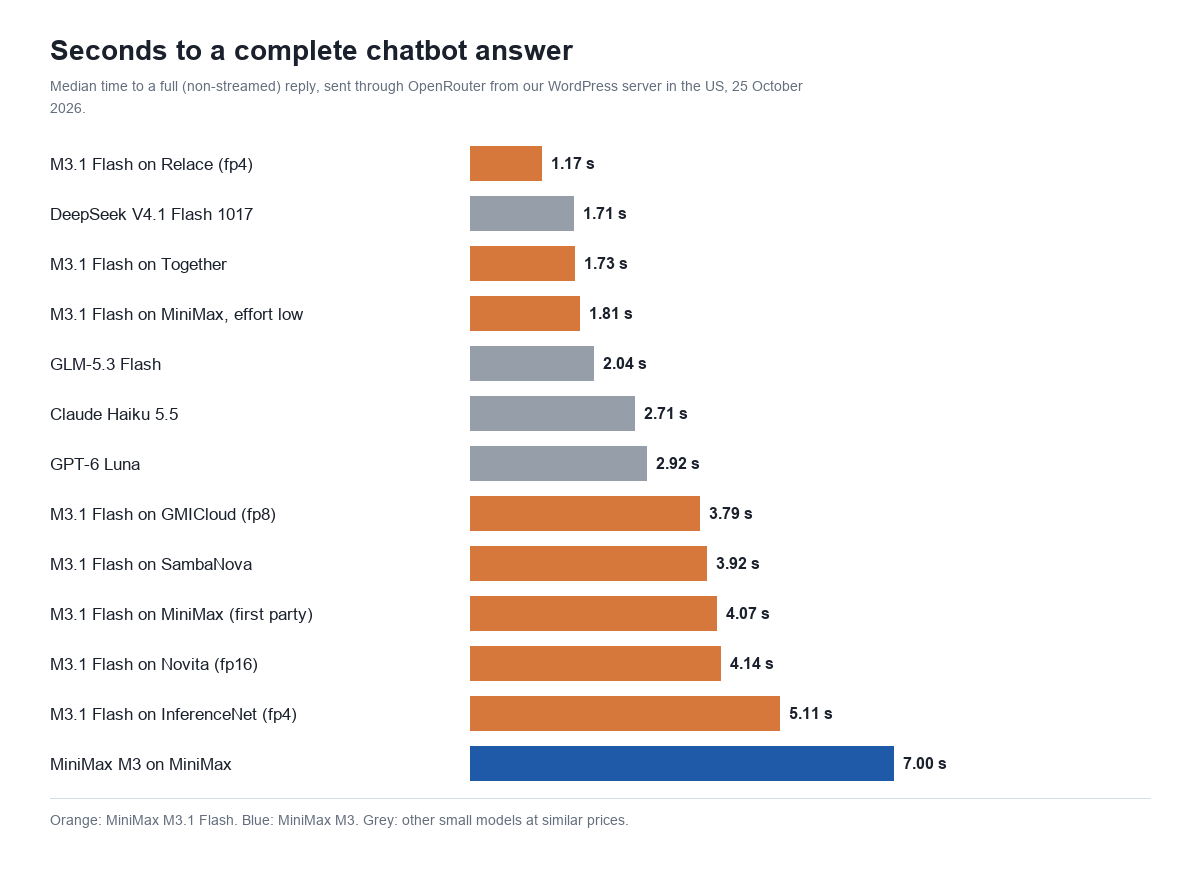
GPT-6 Luna was the cheapest model in the test. It has the lowest token price and wrote the shortest answers, 28 words on average. M3.1 Flash on low effort and DeepSeek’s new Flash snapshot are close behind and were the two fastest. Note that DeepSeek doubles its price during its weekday peak hours (01:00 to 04:00 and 06:00 to 10:00 UTC), and we tested on a Sunday. We covered that schedule in our DeepSeek Flash pricing post.
Claude Haiku 5.5 shows why price per token is not the whole story. Anthropic’s tokenizer counted our 4,200-token prompt as 6,838 tokens, 61% more than the others. That cancelled its low list price. Haiku also cached nothing here, because Anthropic only caches when the request marks a cache point, and our request did not. Our Claude Haiku 5.5 pricing test covers its caching in detail.
All six answered every question correctly. On a knowledge-base chatbot, any of these small models is good enough. The choice comes down to price, speed and how long you want the answers to be.
What this means for a WordPress chatbot’s monthly bill
Take a store whose chatbot handles 5,000 conversations a month at three answers each: 15,000 answers. At the no-cache rates from our test:
| Setup | 15,000 answers a month, no cache | Per year |
|---|---|---|
| M3.1 Flash on Relace | $7.64 | $91.73 |
| M3.1 Flash on MiniMax, effort low | $10.47 | $125.65 |
| M3.1 Flash on MiniMax, default | $12.83 | $154.00 |
| M3.1 Flash on SambaNova | $28.03 | $336.41 |
| MiniMax M3 on MiniMax | $29.95 | $359.38 |
None of these are large numbers. The model bill for a small-model chatbot is now well under the price of the hosting it runs on. The bigger costs are the time you spend writing a good knowledge base, and the answers a cheap model gets wrong. On our test, M3.1 Flash got none wrong.
Using MiniMax M3.1 Flash with MxChat
MxChat does not have a direct MiniMax connection, but it supports OpenRouter, and M3.1 Flash is on OpenRouter as minimax/minimax-m3.1-flash:
- Create an OpenRouter account, add credit and create an API key.
- In WordPress, go to MxChat, then Settings, then API Keys, and paste the key into the OpenRouter field.
- In the chat model setting, choose MiniMax M3.1 Flash from the OpenRouter model list.
- Ask your bot a few real questions and check the answer length. If you want the longer, step-by-step style, the host matters, as shown above.
MxChat sends the model name to OpenRouter but not a host preference or a reasoning effort, so requests use OpenRouter’s default routing and M3.1 Flash’s default effort. You can steer the host from your OpenRouter account’s provider preferences, for example by ignoring SambaNova so your traffic never lands on the double-price host. The MxChat documentation covers the OpenRouter setup, and the WooCommerce, Slack and Telegram features our test questions asked about are part of MxChat Pro.
Frequently asked questions
How much does MiniMax M3.1 Flash cost?
$0.15 per million input tokens, $0.015 per million cached input tokens and $0.60 per million output tokens on MiniMax’s API, as of 25 October 2026. Some hosts on OpenRouter charge less, from $0.09 input, and SambaNova charges double.
Is MiniMax M3.1 Flash cheaper than MiniMax M3?
Yes. Its token prices are exactly half of M3’s standard rates. On our chatbot test it cost 57% less per answer, because it also used fewer reasoning tokens: $0.86 per 1,000 answers against $2.00.
Can you turn off reasoning on MiniMax M3.1 Flash?
No. MiniMax’s endpoint rejected every request that tried to disable reasoning with HTTP 400. You can set the effort to low, which in our test cut reasoning tokens by 85% and the response time from 4.07 to 1.81 seconds with the same answers.
Is MiniMax M3.1 Flash good enough for a website chatbot?
On our test, yes. It answered all four knowledge-base questions correctly on every host, 72 answers in all. We tested factual questions answered from supplied context. We did not test long multi-step tasks or code.
Which host is cheapest for MiniMax M3.1 Flash?
Relace, at $0.09 input and $0.50 output per million tokens on OpenRouter, cost $0.51 per 1,000 answers in our test and was also the fastest at a 1.17-second median. It runs fp4 weights and wrote longer answers than MiniMax’s own endpoint.
Does MiniMax M3.1 Flash have a long-context surcharge?
MiniMax publishes none for M3.1 Flash. M3 doubles its price above 512,000 input tokens. A chatbot request of a few thousand tokens never reaches that threshold on either model.