OpenAI Whisper Pricing: 9 Setups Tested Before Feb 26
OpenAI Whisper pricing stops mattering on 26 February 2027. That is the day OpenAI removes whisper-1 from its API, along with the three newer models that replaced it in most apps: gpt-4o-transcribe, gpt-4o-mini-transcribe and gpt-4o-transcribe-diarize. The /v1/audio/translations endpoint goes the same day. OpenAI names two replacements: gpt-transcribe for recorded audio at $0.0045 a minute, and gpt-live-transcribe for live audio at $0.017 a minute.
Those prices are easy to compare with whisper-1’s $0.006 a minute. The models in between are harder, because gpt-4o-mini-transcribe and gpt-4o-transcribe bill by the token, and OpenAI’s per-minute figures for them are estimates. So on 24 October 2026 we measured all of them on the kind of audio a website chatbot would actually get: 12 short spoken questions a visitor might ask a store’s chat widget, each recorded clean and again with background noise through a phone-quality filter. Every model transcribed every clip, 384 transcriptions in all, and we logged what each call billed, how long it took and every word it got wrong.
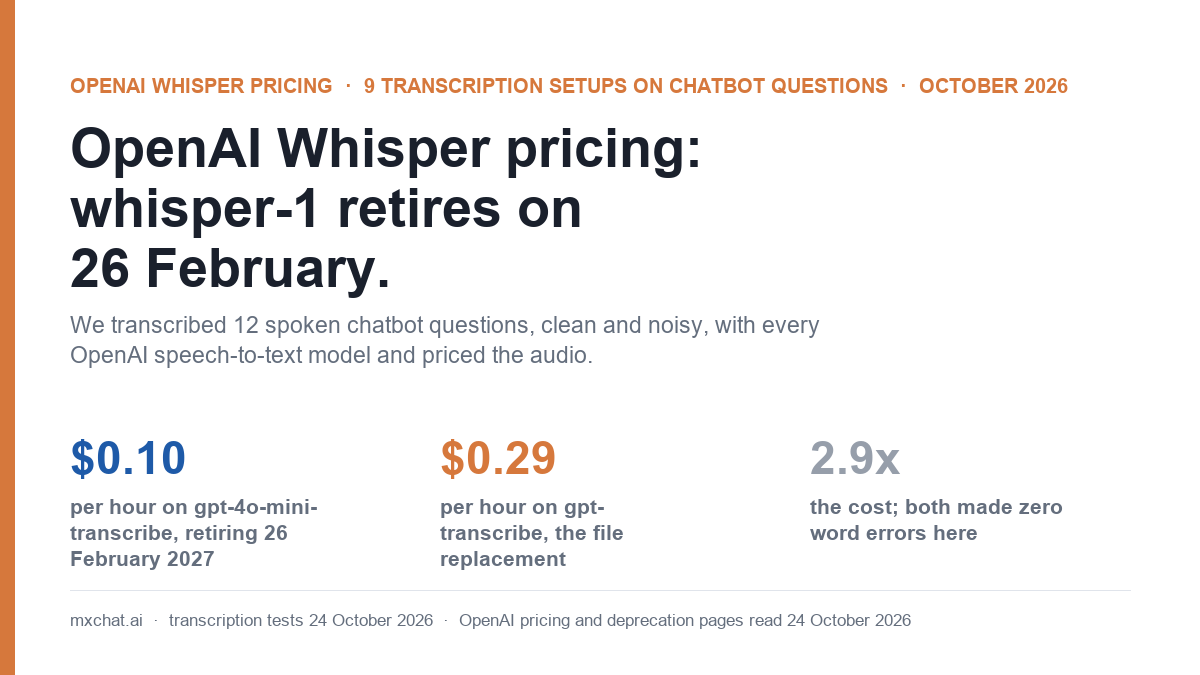
- An hour of short chatbot questions cost $0.10 to transcribe on gpt-4o-mini-transcribe, $0.20 on gpt-4o-transcribe and $0.39 on whisper-1. On gpt-transcribe, the replacement for recorded audio, it cost $0.29.
- So the replacement is 2.9 times the cost of gpt-4o-mini-transcribe and 1.4 times gpt-4o-transcribe on this kind of audio. It is 25% cheaper than whisper-1. Measured, the token-billed models came in well under OpenAI’s own per-minute estimates for them.
- Accuracy is not where you pay for the switch. gpt-transcribe made no word errors on any of our clips, clean or noisy, in 48 transcriptions; neither did gpt-4o-mini-transcribe. With five product names passed as keywords, gpt-transcribe also got all 44 exact items right, the only setup that did.
- Every per-second model rounds each request up to a whole second. On clips averaging 5.4 seconds, that added about 9% to the bill for whisper-1, gpt-transcribe and both live models.
- The live replacement costs 3.8 times the file one. gpt-live-transcribe was accurate and started returning words within half a second, but at $1.11 an hour it only makes sense if your bot really needs to show words while the visitor is still speaking.
What shuts down on 26 February 2027
OpenAI notified developers on 26 August 2026, and its deprecations page lists everything below with one shutdown date. Until then, existing code keeps working.
| Model or endpoint | Shutdown date | OpenAI’s recommended replacement |
|---|---|---|
| whisper-1 | 26 February 2027 | gpt-live-transcribe or gpt-transcribe |
| gpt-4o-transcribe | 26 February 2027 | gpt-live-transcribe or gpt-transcribe |
| gpt-4o-mini-transcribe (and the 2025-12-15 snapshot) | 26 February 2027 | gpt-live-transcribe or gpt-transcribe |
| gpt-4o-transcribe-diarize | 26 February 2027 | gpt-live-transcribe or gpt-transcribe |
/v1/audio/translations | 26 February 2027 | Realtime translations (gpt-realtime-translate) |
This is a gentler retirement than the one OpenAI announced for its voices. When tts-1 and gpt-4o-mini-tts shut down on 6 January 2027, their replacement only runs on the Realtime API, as we found in our OpenAI TTS pricing test. gpt-transcribe stays on the familiar /v1/audio/transcriptions endpoint, so for recorded audio the migration is mostly a model name and a couple of parameters. We cover those below.
How we tested
The 12 questions are the kind a store or SaaS chatbot gets every day: shipping to Canada, a WooCommerce return after 30 days, an order number (48213), plugin compatibility with WordPress 7.1 and PHP 8.2, connecting a Pinecone index, a hoodie size, a 3:30 appointment, a $49 double charge, a question that switches into Spanish, using your own OpenAI API key, and a zip code (30309). Each was spoken by an OpenAI voice told to sound like an ordinary visitor rather than a narrator, using 11 different voices, and ran 4.1 to 7.0 seconds, 5.4 on average.
Each question was saved twice: once clean, and once with pink background noise mixed in and the voice squeezed through a 300 to 3,400 Hz phone band at 16 kHz, which is roughly what a laptop microphone in a busy room or a phone call delivers. That gives 24 clips.
- File models (whisper-1, gpt-4o-mini-transcribe, gpt-4o-transcribe, gpt-4o-transcribe-diarize, gpt-transcribe) were sent each clip as a WAV file to
/v1/audio/transcriptions, twice. whisper-1 was also run with a short prompt naming our products, and gpt-transcribe with five product names askeywords. - Live models (gpt-live-transcribe and gpt-realtime-whisper) were streamed each clip once as 24 kHz PCM over a Realtime transcription WebSocket with turn detection off; then the buffer was committed and we waited for the final transcript.
- Cost comes from each response’s own
usagefield: billed seconds for the per-minute models, input and output tokens for the token models, at the list prices below. - Errors are counted as word error rate against what was said. We ignored capitals, punctuation, spacing inside brand names and number style (thirty and 30 count as the same). Separately, we checked 11 exact items, such as the order number, the zip code, “$49” and the brand names, for whether each came out usable as written.
Two caveats. The voices are synthetic, so they are clearer than many real visitors, and the noise is added rather than recorded; treat the error rates as a ranking, not a forecast. And chatbot questions are short. On long recordings, such as an hour-long call, the per-second rounding disappears and the token models’ cost per minute changes with how fast people talk.
OpenAI Whisper pricing against what each model actually billed
| Model | List price | OpenAI’s estimate per minute | Measured per minute | Measured per hour | Per 1,000 questions |
|---|---|---|---|---|---|
| whisper-1 | $0.006 / minute | $0.006 | $0.0065 | $0.39 | $0.59 |
| gpt-4o-mini-transcribe | $1.25 / 1M audio tokens in, $5 / 1M text tokens out | $0.003 | $0.0017 | $0.10 | $0.15 |
| gpt-4o-transcribe | $2.50 / 1M audio tokens in, $10 / 1M text tokens out | $0.006 | $0.0034 | $0.20 | $0.31 |
| gpt-4o-transcribe-diarize | $2.50 / 1M audio tokens in, $10 / 1M text tokens out | $0.006 | $0.0221 | $1.33 | $2.00 |
| gpt-transcribe | $0.0045 / minute | $0.0045 | $0.0049 | $0.29 | $0.44 |
| gpt-live-transcribe | $0.017 / minute | $0.017 | $0.0185 | $1.11 | $1.68 |
| gpt-realtime-whisper | $0.017 / minute | $0.017 | $0.0185 | $1.11 | $1.68 |
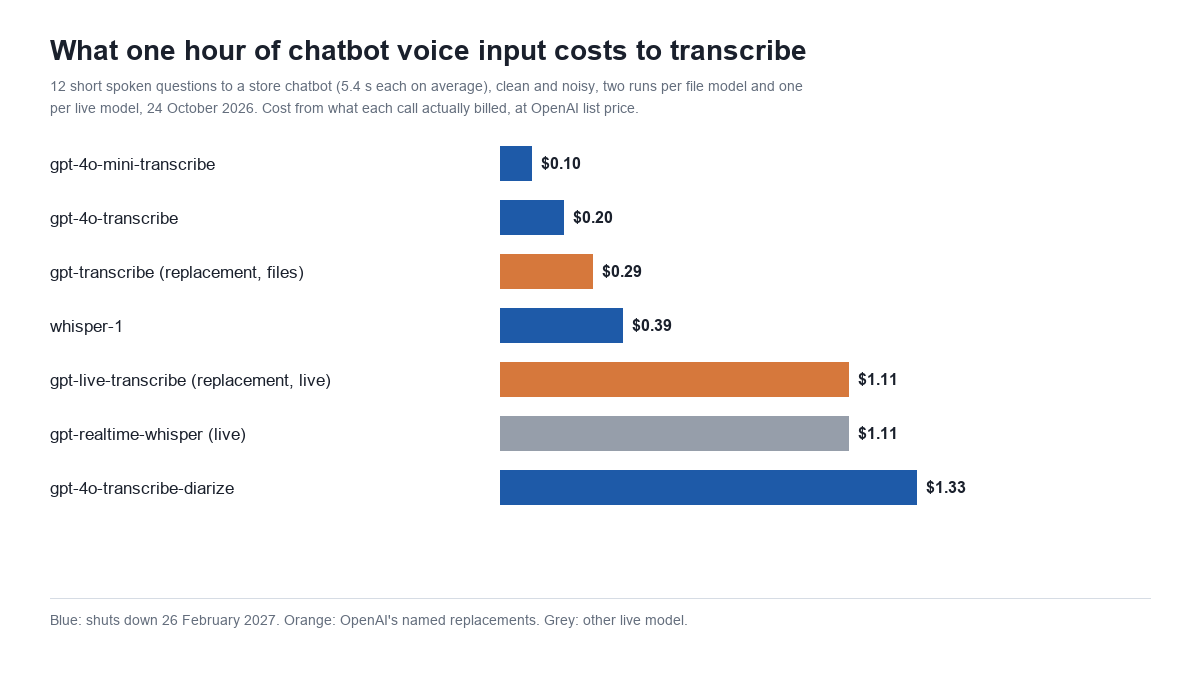
Three things stand out.
The token-billed models are cheaper than OpenAI says. Both gpt-4o models billed 10 audio tokens per second of speech in our test, so an hour of audio is about 36,000 input tokens: $0.045 on mini and $0.090 on the full model. The transcript is the other half of the bill, a median 17 output tokens per question. Together that came to $0.0017 and $0.0034 a minute, a little over half of OpenAI’s $0.003 and $0.006 estimates. If your visitors talk faster or longer than ours, the output side grows.
Per-second billing rounds up. whisper-1, gpt-transcribe and both live models returned a usage in whole seconds, always rounded up: a 4.4-second clip was billed as 5. Across our clips that came to about 9% more than the audio’s real length. It is negligible on a podcast and noticeable on a chatbot, where most voice messages last a few seconds.
Diarization is expensive for single-speaker audio. gpt-4o-transcribe-diarize returned a median 182 output tokens per question, against 17 for gpt-4o-transcribe on the same audio, because its output carries speaker segments. That made it the most expensive model in the test at $1.33 an hour, for a chatbot that only ever hears one person.
Accuracy: which model heard the questions right
| Model | Word errors per 100, clean | Word errors per 100, noisy | Transcriptions with zero errors | Exact items usable as written |
|---|---|---|---|---|
| whisper-1 | 0.7 | 1.3 | 42 of 48 | 36/44 |
| whisper-1 with a prompt | 0.7 | 2.0 | 40 of 48 | 40/44 |
| gpt-4o-mini-transcribe | 0.0 | 0.0 | 48 of 48 | 40/44 |
| gpt-4o-transcribe | 0.7 | 5.0 | 43 of 48 | 40/44 |
| gpt-4o-transcribe-diarize | 2.0 | 8.6 | 38 of 48 | 34/44 |
| gpt-transcribe | 0.0 | 0.0 | 48 of 48 | 40/44 |
| gpt-transcribe with keywords | 0.0 | 0.0 | 48 of 48 | 44/44 |
| gpt-live-transcribe | 0.0 | 0.7 | 23 of 24 | 20/22 |
| gpt-realtime-whisper | 0.0 | 0.7 | 23 of 24 | 20/22 |
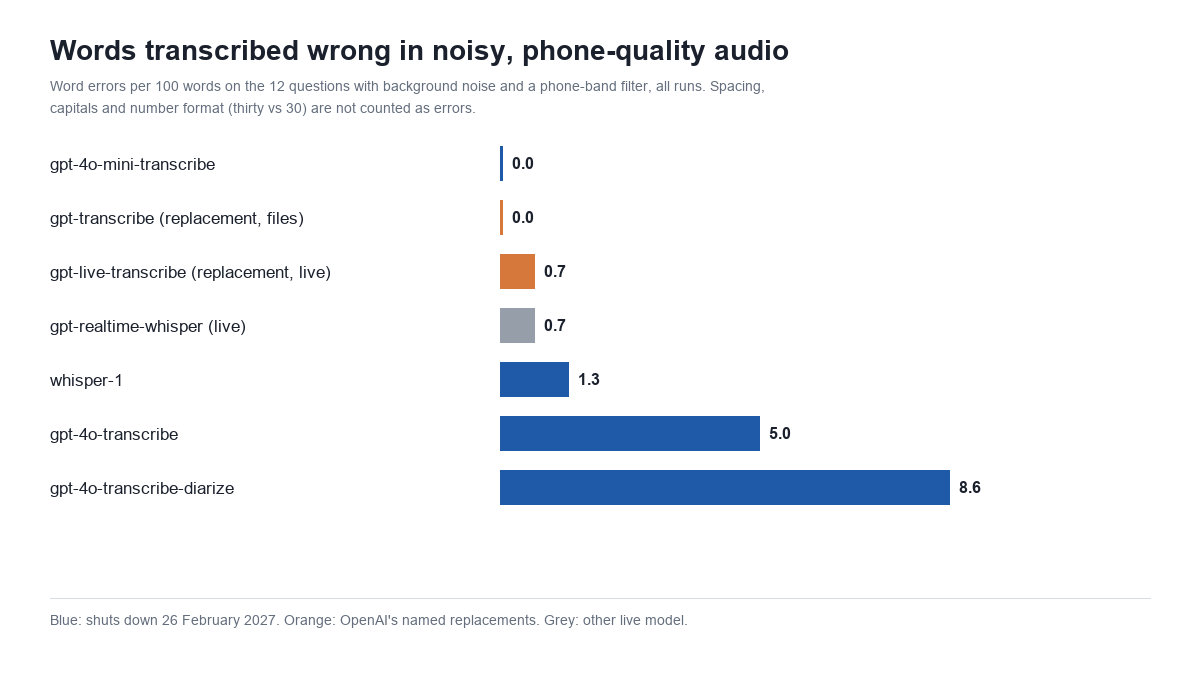
On audio this clean, every model was usable, and the differences come down to a handful of specific mistakes worth knowing about:
- whisper-1 wrote the appointment time as “3.30” on all four tries, British style. A person reads it fine; a booking flow that looks for 3:30 would not. In noise it also heard “Does the chatbot” as “What does the chatbot”, and with a prompt it once heard “hoodie” as “hooding”.
- gpt-4o-transcribe turned the noisy question that switches into Spanish entirely into Spanish (“¿El chatbot contesta en español?”), dropping the English half. On the clean version it wrote “Does” as “Das”. On the noisy Pinecone question it wrote “chatbox”.
- gpt-4o-transcribe-diarize spelled out letters and numbers in noise (“M_X_ Chat”, “P_H_P_”, “seven point one”), split Pinecone and chatbot into two words each, and wrote “$49” as “forty nine dollars”.
- The live models each slipped once in noise: gpt-live-transcribe heard “chatbox”, gpt-realtime-whisper heard “hoodies”.
- gpt-4o-mini-transcribe and gpt-transcribe made no word errors in 48 transcriptions each. Their only misses were writing MxChat as “MX Chat” or “MXChat”.
The exact-items column is where keywords earn their place. Without help, most models wrote “MX Chat” or “MXChat” for MxChat at least once. Given keywords of MxChat, WooCommerce, Pinecone, WordPress and PHP, gpt-transcribe got 44/44 items right. whisper-1’s prompt helped too (40/44 against 36/44 without it). For a chatbot, where product names, plan names and SKUs are exactly what visitors say, that is worth setting up.
Speed
| Model | Median time to final transcript | 90th percentile |
|---|---|---|
| whisper-1 | 1.85 s | 2.17 s |
| gpt-4o-mini-transcribe | 0.97 s | 1.10 s |
| gpt-4o-transcribe | 1.06 s | 1.23 s |
| gpt-4o-transcribe-diarize | 3.13 s | 3.54 s |
| gpt-transcribe | 0.91 s | 1.05 s |
| gpt-live-transcribe | 1.81 s | 2.13 s |
| gpt-realtime-whisper | 1.48 s | 1.79 s |
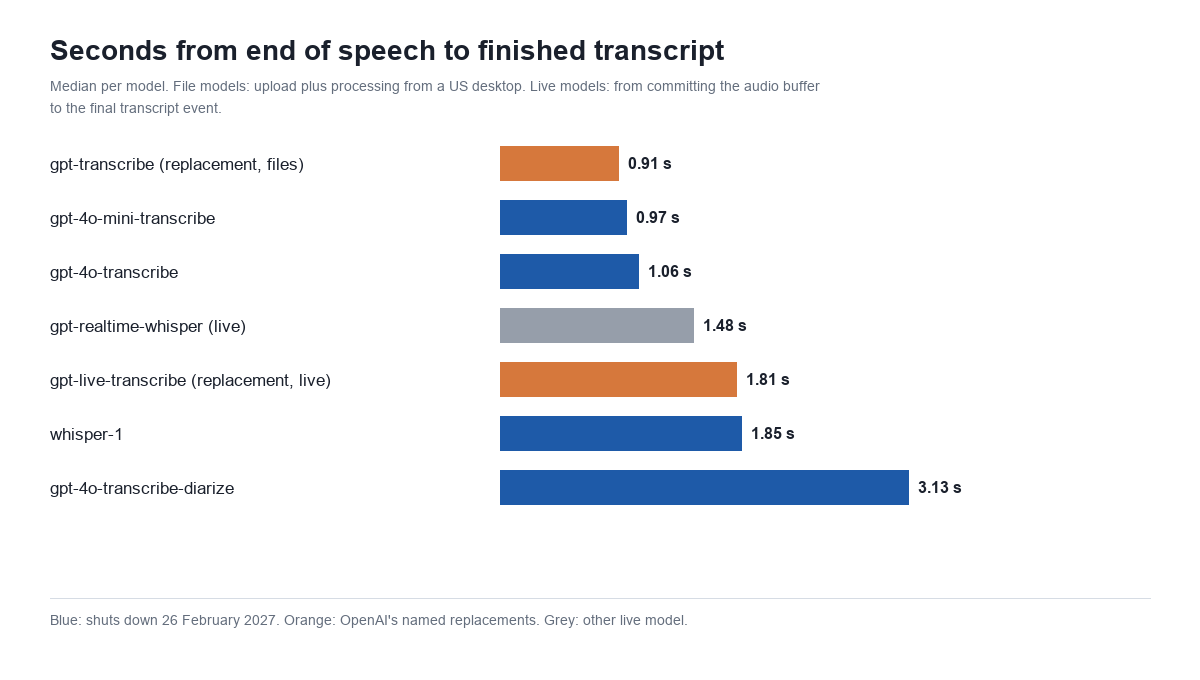
gpt-transcribe was the fastest file model, at a median 0.91 seconds including the upload, against 1.85 s for whisper-1. Diarization roughly tripled the wait. The live models’ figure is measured differently, from the moment the audio buffer is committed, but it is the number a visitor feels: how long after they stop talking the text is ready. gpt-live-transcribe also streamed its first words a median 0.45 seconds after the commit, which matters only if you display a live caption.
What voice input costs a WordPress chatbot
Take a site whose chatbot gets spoken questions about as long as ours.
| Setup | Transcription per 1,000 questions | Per 10,000 questions |
|---|---|---|
| gpt-4o-mini-transcribe (until 26 February) | $0.15 | $1.54 |
| whisper-1 (until 26 February) | $0.59 | $5.92 |
| gpt-transcribe | $0.44 | $4.44 |
| gpt-live-transcribe | $1.68 | $16.76 |
Even after the switch, transcription is a small line next to the answer itself. In our Claude API pricing test, generating 1,000 chatbot replies cost from $0.78 on Haiku 5.5 to $66 on the largest model, and reading them aloud adds more again, as the TTS test above shows. For most sites, the move from gpt-4o-mini-transcribe to gpt-transcribe is cents a month. It only becomes a budget item at call-centre volumes, and those are long recordings where the rounding effect fades.
Other providers price speech-to-text in a similar range, with their own billing rules:
| Provider and model | List price | Per hour | Billing note |
|---|---|---|---|
| OpenAI gpt-transcribe | $0.0045 / minute | $0.27 | Whole seconds, rounded up (measured) |
| Groq whisper-large-v3-turbo | $0.04 / hour | $0.04 | 10-second minimum per request |
| AssemblyAI Universal-2 (recorded) | $0.15 / hour | $0.15 | $50 free credit |
| AssemblyAI Universal-3.5 Pro (recorded) | $0.21 / hour | $0.21 | Streaming is billed on connection time |
| Deepgram Nova-3 (recorded, monolingual) | $0.0043 / minute | $0.26 | $200 free credit |
| Deepgram Nova-3 (streaming, monolingual) | $0.0048 / minute | $0.29 | Promotional streaming rate |
Minimums change the ranking on short audio. Groq’s 10-second minimum means our average 5.4-second question would be billed as 10 seconds, so its effective price on chatbot audio is closer to $0.07 an hour than $0.04, still the cheapest here by a distance. We covered Groq’s other models in our Groq and Cerebras pricing test. Prices in this table are from each provider’s pricing page on 24 October 2026; we did not test their accuracy.
Migrating from whisper-1 or gpt-4o-transcribe
For recorded audio the change is small, but not quite a rename. From the transcription guide and our own calls:
- Change the model to
gpt-transcribe. Same endpoint, same multipart upload, same formats (mp3, mp4, mpeg, mpga, m4a, wav, webm) and the same 25 MB limit. - Replace
languagewithlanguages. gpt-transcribe takes a list of language hints, and the guide says not to send both fields. Its response also returns alanguagesarray; for our English-and-Spanish question it reported English only, while transcribing both parts correctly. - Move product names into
keywords. One term per entry, with no angle brackets or line breaks, or the API rejects the whole request. Keep a shortpromptfor context if you used one. - Check what you read from the response. The guide documents
textandlanguagesfor gpt-transcribe, plus streaming withstream=true. It does not document whisper-1’sverbose_json, SRT or VTT output, or word timestamps, so if you build subtitles from whisper-1, test that path before February. - Replace translations.
/v1/audio/translationshas no file-based successor. OpenAI points to Realtime translation with gpt-realtime-translate, listed at $0.034 a minute, which means a WebSocket session. - For live audio, plan for client-side turn detection. gpt-live-transcribe runs on the Realtime transcription WebSocket and does not support server VAD, so your code decides when the visitor has stopped speaking and commits the buffer, as we did in the test.
Which one to pick
- A chatbot with a microphone button: gpt-transcribe, with your product names as keywords. It was the fastest, the most accurate, and it is the only file model that survives February.
- Until February, on a tight budget: gpt-4o-mini-transcribe was just as accurate here at about a third of the cost, so there is no rush to switch early. Put the change in your calendar for January rather than leaving it to the shutdown week.
- Live captions while the visitor talks: gpt-live-transcribe, or gpt-realtime-whisper at the same price. Expect about 3.8 times the cost of uploading the clip when they stop.
- The lowest price on any audio: Groq’s Whisper turbo, accepting the 10-second minimum and a separate account.
FAQ
How much does OpenAI Whisper cost?
whisper-1 is $0.006 per minute of audio, billed in whole seconds rounded up. In our test of short chatbot questions that came to $0.39 per hour of audio. whisper-1 shuts down on 26 February 2027.
When is whisper-1 being shut down?
26 February 2027, along with gpt-4o-transcribe, gpt-4o-mini-transcribe, gpt-4o-transcribe-diarize and the /v1/audio/translations endpoint. OpenAI notified developers on 26 August 2026.
What replaces whisper-1?
gpt-transcribe for recorded audio ($0.0045 a minute) and gpt-live-transcribe for live audio ($0.017 a minute). gpt-transcribe uses the same transcription endpoint, with languages instead of language and an optional keywords list.
Is gpt-transcribe cheaper than whisper-1?
Yes, by 25% in our test: $0.29 against $0.39 per hour. It is more expensive than gpt-4o-mini-transcribe, which cost $0.10 per hour on the same audio, so teams moving off the mini model will pay about 2.9 times as much.
How much does gpt-4o-mini-transcribe cost per minute?
OpenAI lists $1.25 per million audio tokens in and $5 per million text tokens out, and estimates $0.003 a minute. We measured $0.0017 a minute on short chatbot questions, with each second of speech billed as 10 audio tokens.
Does MxChat accept voice questions?
Not today; visitors type their questions. If you are working out what a chatbot costs to run, the reply side is in our Claude API pricing test and the MxChat documentation, and MxChat Pro lists what the paid plan adds.
Prices from OpenAI’s API pricing page and model pages, shutdown dates from its deprecations page and speech-to-text guide, all read on 24 October 2026. Other providers’ prices from their pricing pages the same day. Measurements taken on 24 October 2026; your bill will follow your own audio lengths.