Perplexity API Pricing: Sonar Tested on a WordPress Chatbot
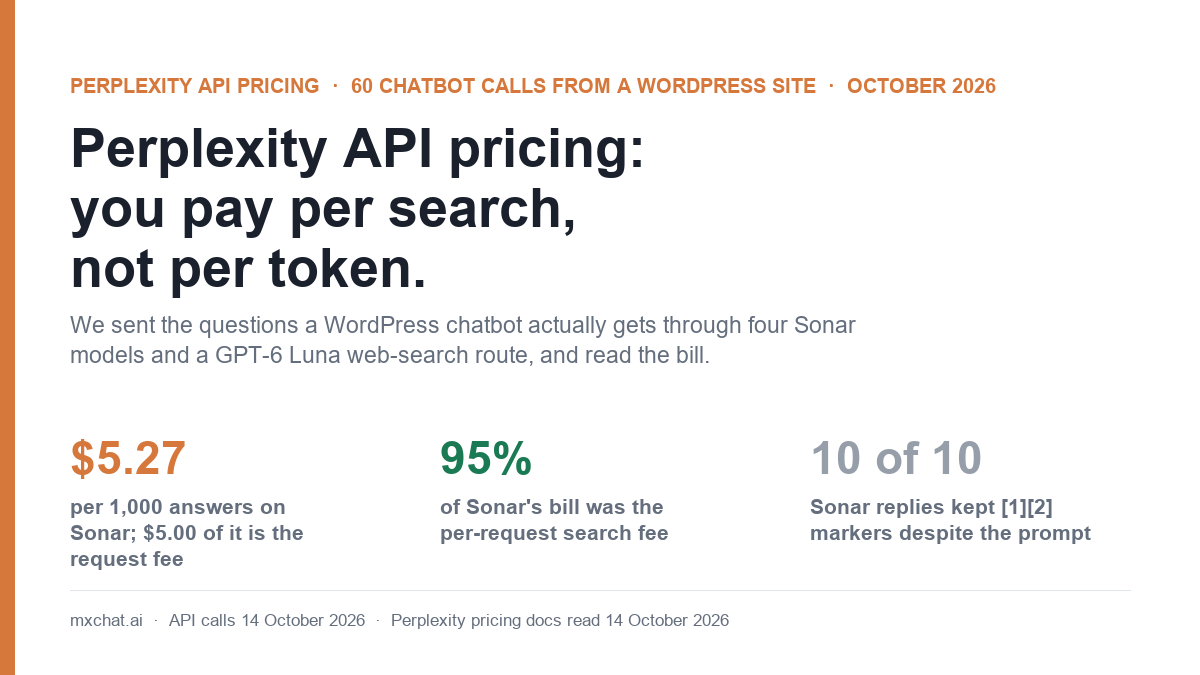
Perplexity API pricing looks like token pricing, but for a chatbot it mostly isn’t. The base Sonar model lists at $1 per million input tokens and $1 per million output tokens. It also charges a flat request fee of $5 to $12 per 1,000 searches. We sent the questions a WordPress chatbot actually gets through four Sonar models from our own server on 14 October 2026. $5.00 of every $5.27 we spent per 1,000 Sonar answers was that request fee. The tokens barely registered.
This post sets out what each Perplexity model really costs per answer, how the bill compares with giving an ordinary model a web-search tool, and the one formatting problem that showed up in every Sonar reply. It also covers what changes as Perplexity moves developers from the Sonar API to its new Agent API.
Perplexity API pricing in October 2026
Perplexity bills its Sonar models in two parts: tokens, plus a fee per request that depends on the search context size. “Low” context retrieves less of each web page, and “high” retrieves more. Our calls were billed at the low-context fee. These are the rates on Perplexity’s pricing documentation, read on 14 October 2026:
| Model | Input / 1M tokens | Output / 1M tokens | Request fee per 1,000 (low / medium / high context) |
|---|---|---|---|
| Sonar | $1 | $1 | $5 / $8 / $12 |
| Sonar Pro | $3 | $15 | $6 / $10 / $14 |
| Sonar Reasoning Pro | $2 | $8 | $6 / $10 / $14 |
| Sonar Deep Research | $2 | $8 | No request fee; $5 per 1,000 search queries, plus $2 / 1M citation tokens and $3 / 1M reasoning tokens |
Two things follow from that table. A chatbot question is short and so is a good chatbot answer, so the token side of the bill is tiny. And the fee is per request, not per token, so a one-line question costs as much in fees as a long one. When you estimate a Perplexity bill for a website chatbot, start by counting searches. Token counts come second.
The Sonar API is being replaced by the Agent API
Perplexity now steers new projects to its Agent API. The migration guide recommends moving existing Sonar Chat Completions code to it, and calls it “more performant and cost-effective.” Perplexity staff told developers on its community forum that the Sonar chat completions endpoint would retire on 27 September 2026. Third-party gateways reported that sonar-pro and sonar-reasoning-pro would stop being routable that day. On 14 October 2026, all four Sonar models were still available through OpenRouter, and every one of our 40 Sonar calls succeeded. OpenRouter also still billed them at the old Sonar rates in the table above. We could not test Perplexity’s own endpoint directly: our site’s Perplexity key had lapsed and returned a 401. If you call api.perplexity.ai/chat/completions yourself, send one test request before you assume it still works.
The Agent API is priced differently. Here are the rates that matter for a chatbot, from the same documentation page:
| Agent API item | Price |
|---|---|
perplexity/sonar model tokens | $0.25 / 1M input, $2.50 / 1M output, $0.0625 / 1M cached |
| Web search tool | $0.0025 per invocation ($2.50 per 1,000) |
| Fast web search | $0.001 per invocation |
| Fetch URL tool | $0.0005 per invocation |
Third-party models (for example openai/gpt-6-luna, anthropic/claude-sonnet-5-5) | Passed through at the provider’s list rate |
| Search API (results only, no answer) | $5 per 1,000 requests standard, $1 fast |
So the Agent API halves the per-search fee, from $5 to $2.50 per 1,000 for a standard web search. Output tokens go up, from $1 to $2.50 per million. For a chatbot answer of about 120 words, that trade comes out well in your favour. We cover the modelled numbers further down.
How we tested
MxChat’s Perplexity add-on gives a WordPress chatbot live web search. When a visitor flips the search toggle, or a message matches the “Perplexity Research” intent, the add-on sends a Sonar request. We copied that request exactly: same system prompt from the add-on’s default conversational mode, same message layout, and the visitor’s question as the user turn.
We asked five questions of the kind a WordPress site visitor might put to a chatbot. Each needs information from the last few weeks:
- What is the latest version of WordPress and when was it released? (Answer: 7.1.3, released 6 October 2026.)
- What is the latest version of WooCommerce? (Answer: 11.2.1, released 9 October 2026.)
- How much does OpenAI charge for GPT-6.1 Sol? (Answer: $2 input, $10 output per million tokens.)
- What does Anthropic charge for Claude Sonnet 5.5? (Answer: $2 input, $10 output per million tokens.)
- When is Google shutting down Gemini 2.5 Flash-Lite on the Gemini API? (Answer: no date announced; the model is closed to new projects.)
We sent each question twice through six routes, from our WordPress server via OpenRouter, for 60 calls in total. The routes were the four Sonar models, GPT-6 Luna with OpenRouter’s web search turned on, and GPT-6 Luna with no search. All 60 returned HTTP 200. Costs are what OpenRouter reported in each response’s usage.cost field. We checked them against the rate cards: the Sonar costs match token rates plus the low-context request fee to the fourth decimal place.
What each answer cost
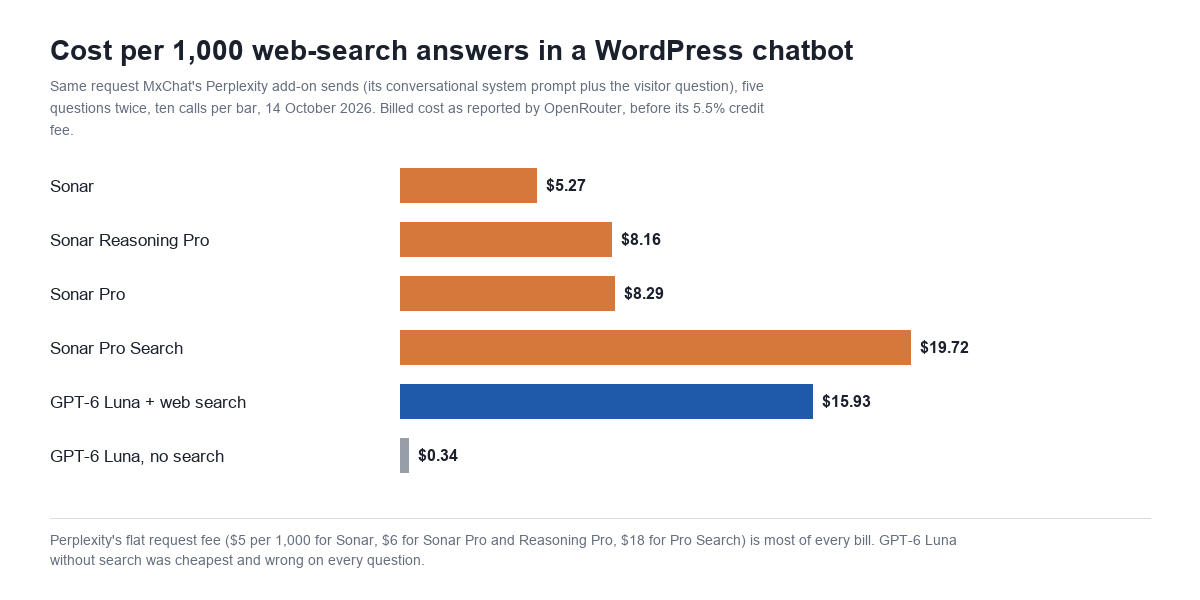
| Route | Cost per 1,000 answers | Of which request or search fee | Median time | Correct on 4 checkable questions |
|---|---|---|---|---|
| Sonar | $5.27 | $5.00 | 1.55 s | 8 of 8 |
| Sonar Pro | $8.29 | $6.00 | 1.62 s | 8 of 8 |
| Sonar Reasoning Pro | $8.16 | $6.00 | 7.58 s | 8 of 8 |
| Sonar Pro Search | $19.72 | $18.00 | 3.21 s | 8 of 8 |
| GPT-6 Luna + web search | $15.93 | about $14.65 | 5.81 s | 8 of 8 |
| GPT-6 Luna, no search | $0.34 | none | 8.61 s | 0 of 8 |
Plain Sonar is the cheapest route that gives a right answer: about half a cent per question. Sonar Pro costs 57% more. Its higher token prices ($3 in and $15 out per million, against $1 and $1) add about $2 per 1,000 answers, and its request fee is $1 per 1,000 higher. Sonar Reasoning Pro cost about the same as Sonar Pro, but it was five times slower, and one call took 29.2 seconds. Sonar Pro Search is Perplexity’s multi-step search mode. It charges $18 per 1,000 requests and came out nearly four times the price of Sonar. On these questions it gave no better answers.
OpenRouter’s model listing shows a $5 per 1,000 web-search price for every Sonar model, but that is not what Sonar Pro and Reasoning Pro were billed. Their bills only reconcile at $6 per 1,000, which is Perplexity’s own low-context fee for those models. If you budget from the OpenRouter listing, you will be about 12% short on Sonar Pro.
The do-it-yourself route was not cheaper
The obvious alternative to Perplexity is to give a cheap model a search tool. GPT-6 Luna costs $0.10 per million input tokens. With OpenRouter’s web search turned on, each request pulled in about 11,800 tokens of search results. That is roughly $1.28 per 1,000 answers in tokens. The search charge on top was about $14.65 per 1,000. Altogether, Luna with search cost three times as much as Sonar and took nearly four times as long. Its one advantage was the answers themselves: short, plain sentences with a source link and no stray numbers.
GPT-6 Luna without search is the trap. It was cheap and confident, and wrong on every question. It said the latest WordPress was 6.8.3, released 30 September 2025. It said “Claude Sonnet 5.5” does not exist. And it gave two different invented shutdown dates for Gemini 2.5 Flash-Lite. This is why a chatbot needs a search route for anything time-sensitive. A model’s training data can’t tell a visitor what shipped last week. For background on how MxChat decides when to search, see giving your AI chatbot real-time web search.
Accuracy: every search route got the facts right
All five web-search routes answered all four checkable questions correctly in both runs. They also handled the Gemini question, which has no clean answer, the same sensible way. Each said Google had announced no shutdown date and that the model is limited to projects that already use it. Several also flagged a separate retirement date on Google’s enterprise platform. Our own direct test of the Gemini API agrees: the model returns “no longer available to new users.”
The only errors were in extra detail nobody asked for. In at least four of the Sonnet 5.5 answers, from Sonar, Sonar Pro and GPT-6 Luna + web search, the cache-read price was given as $0.20 per million tokens. That was the rate before Anthropic cut it to $0.10, which we measured in our Sonnet 5.5 prompt caching test. One answer cited Anthropic’s product page as its source, which suggests the search found a page that hadn’t been updated. The headline price was right in all 20 web-search answers to the two pricing questions.
The formatting problem: citation numbers in a conversational chatbot
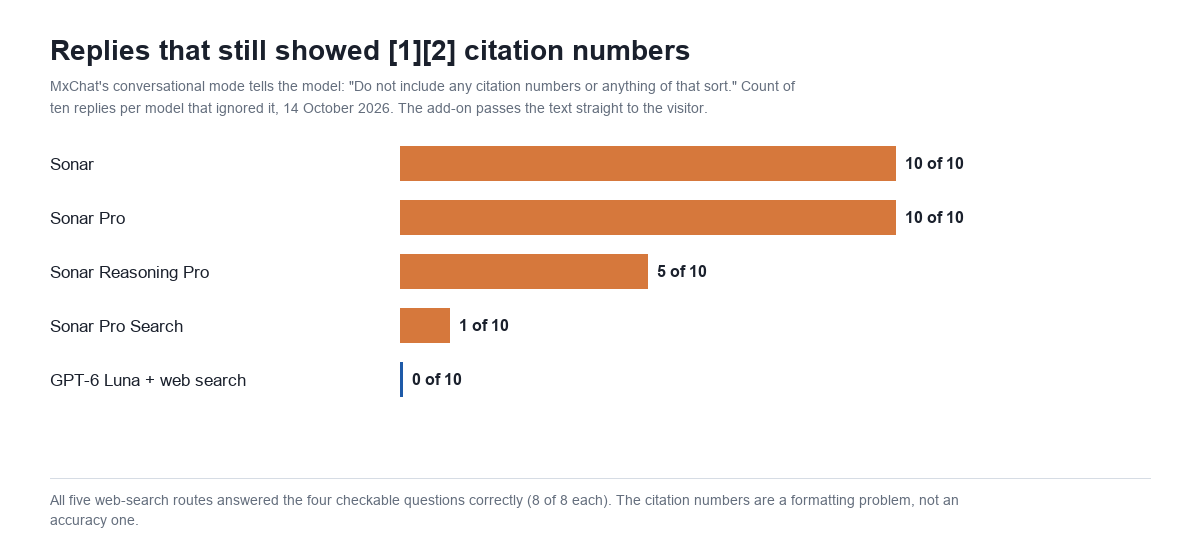
MxChat’s Perplexity add-on has two response modes. Structured mode returns a formatted answer with a list of sources. Conversational mode, the default, is meant to sound as if the chatbot simply knew the answer. Its system prompt says plainly: “Do not include any citation numbers or anything of that sort.”
Sonar and Sonar Pro ignored that line in every one of their 20 replies. Answers came back like “The latest WordPress version is 7.1.3, and it was released on October 6, 2026.[1][2][3]”. Reasoning Pro did it in half its replies, and Pro Search in one. GPT-6 Luna never did, because OpenRouter returns its sources as separate link annotations, not text in the answer.
On a website, those bracketed numbers point at nothing. In conversational mode no source list appears below the answer, so a visitor sees “[1][2][3]” and can’t click anything. There are two practical fixes today:
- Use structured mode if your visitors benefit from sources. The numbers then match a source list. For most support and pre-sales bots that is a fair trade, because a visitor checking a price wants to see where it came from.
- Strip the markers if you want conversational answers. A one-line filter that deletes bracketed numbers such as
[1]from the reply before display does it. Note this is not the same as asking the model to stop: we asked, and the model ignored it 20 times out of 20.
Setup for both modes is covered in the MxChat Perplexity integration docs.
Speed
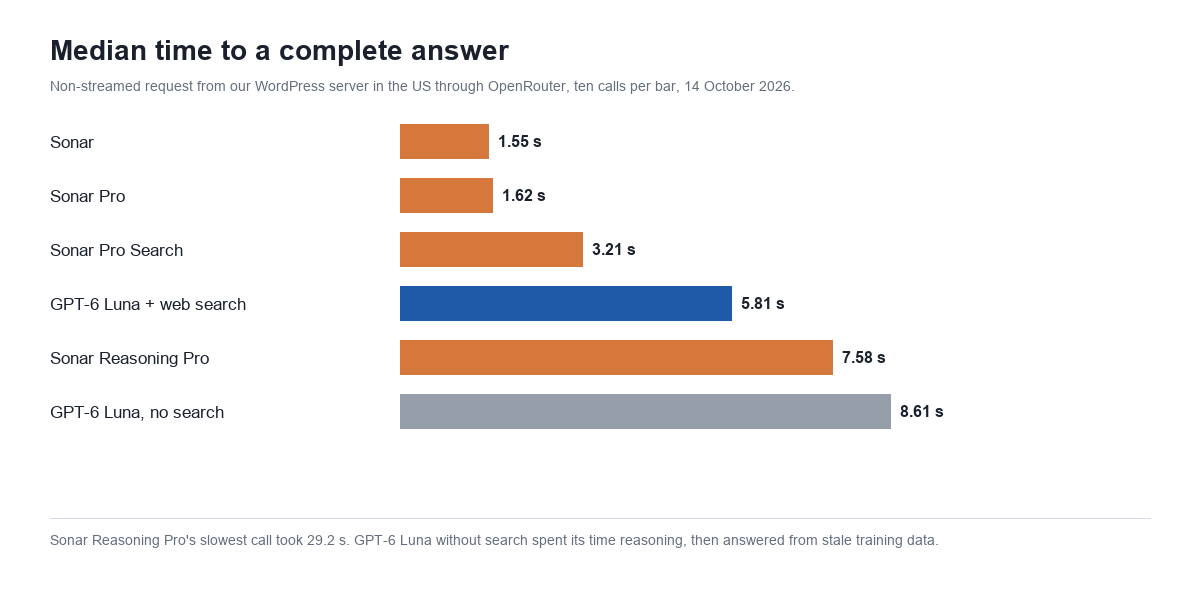
Sonar and Sonar Pro returned complete answers in about 1.6 seconds, faster than any non-Perplexity route we tested, including GPT-6 Luna with no search at all. That is quick enough for a chat window. Reasoning Pro’s 7.6-second median and 29-second worst case are not, and MxChat’s add-on allows reasoning models up to 120 seconds before it gives up. Pro Search took about twice as long as Sonar. The GPT-6 Luna web-search route spent most of its 5.8 seconds fetching and reading search results.
What the Agent API would cost for the same questions
We could not run these questions through Perplexity’s Agent API, because that needs a direct Perplexity key. So we modelled the cost from our measured token counts and the Agent API rate card. Treat the following as arithmetic, not measurement.
Using perplexity/sonar with one web search per answer, the fixed part is $2.50 per 1,000 for the search. Our Sonar answers averaged 148 input and 117 output tokens, which adds about $0.33 per 1,000. That gives roughly $2.83 per 1,000 answers if retrieved web content is not billed as input. If it is, at about the 11,800 tokens per answer the Luna route pulled in, add about $2.95, for roughly $5.78. The Agent API documentation we read does not say which applies, so the honest answer is somewhere between about half of today’s Sonar price and slightly more than it. If a preset fires more than one search per question, each extra search adds $2.50 per 1,000.
Agent API presets also map Sonar models to configurations rather than one-to-one. Perplexity’s guide suggests the fast preset for both sonar and sonar-pro, and low for sonar-reasoning-pro. One gateway warned that the presets run a different underlying model with different search behaviour. So don’t assume Agent API answers will match the Sonar answers above. Run your own questions before you switch.
Monthly cost for a WordPress chatbot
The number that matters is how many messages actually trigger a search. In MxChat that happens only when the visitor turns on the search toggle or a message matches the research intent. Most messages are answered from your own knowledge base and never touch Perplexity. Here is the monthly bill at the measured per-answer cost, before OpenRouter’s 5.5% credit fee:
| Web-search answers per month | Sonar | Sonar Pro | Sonar Pro Search | GPT-6 Luna + web search |
|---|---|---|---|---|
| 500 | $2.64 | $4.15 | $9.86 | $7.97 |
| 2,000 | $10.54 | $16.58 | $39.44 | $31.86 |
| 10,000 | $52.70 | $82.90 | $197.20 | $159.30 |
| 50,000 | $263.50 | $414.50 | $986.00 | $796.50 |
Through OpenRouter, add 5.5% for the card fee on credits. We break that fee down in our OpenRouter pricing test. For comparison, the chatbot’s ordinary replies are far cheaper. A GPT-6 Luna conversation from the knowledge base costs well under a cent; see our GPT-6 Luna pricing breakdown. Web search is the expensive part of a chatbot, so it should be something the visitor asks for, not the default for every message.
Which Perplexity model to use for a website chatbot
- Sonar for almost everyone. It was the cheapest correct route, the fastest, and as accurate as the Pro models on these questions. Pair it with structured mode or a marker-stripping filter.
- Sonar Pro if your questions need more sources than Sonar returns, for example product comparisons across several vendors. Expect to pay 57% more for little difference on simple lookups.
- Sonar Pro Search only for genuine multi-step research. At $18 per 1,000 in fees alone, it is hard to justify for a chatbot.
- Sonar Reasoning Pro: not for live chat. It costs the same as Sonar Pro and its latency is unpredictable.
- Agent API if you’re building something new and can test against it. The per-search fee is half Sonar’s, and it is where Perplexity is putting its development.
To add web search to your own WordPress chatbot, the Perplexity add-on is included with MxChat Pro. You supply your own Perplexity API key, so the costs above are paid directly to Perplexity.
FAQ
How much does the Perplexity API cost per request?
For a typical chatbot question on Sonar, about $0.0053, or $5.27 per 1,000 answers in our test. $5 of that is the low-context request fee, and the rest is tokens at $1 per million in and out. Sonar Pro came to about $0.0083 per answer.
Is the Perplexity API free?
No. There is no free API tier; you buy credits and every request is billed. Perplexity Pro subscribers have historically received a small monthly API credit. Check your account’s billing page for the current amount.
What is the Perplexity request fee?
It is a flat charge per API request for the web search, separate from token pricing. It depends on the model and on the search context size: $5, $8 or $12 per 1,000 requests for Sonar at low, medium or high context, and $6, $10 or $14 for Sonar Pro and Sonar Reasoning Pro.
Is the Sonar API being shut down?
Perplexity is moving developers to the Agent API. Its staff gave 27 September 2026 as the retirement date for the Sonar chat completions endpoint. On 14 October 2026 all four Sonar models still answered through OpenRouter at the old prices. Test your own endpoint, and plan the move to the Agent API.
Is Perplexity cheaper than using GPT with web search?
In our test, yes. Sonar cost $5.27 per 1,000 answers. GPT-6 Luna with OpenRouter’s web search cost $15.93, because the search charge and the roughly 11,800 tokens of retrieved pages added up. Both were accurate. Sonar was also nearly four times faster.
Why does my Perplexity chatbot show [1][2] in its answers?
Sonar adds citation markers even when the system prompt tells it not to; it did in 20 of 20 Sonar and Sonar Pro replies in our test. Either show a source list (structured mode in MxChat), or remove the markers with a filter before the reply is displayed.