Groq Pricing: We Timed 7 Hosts on a WordPress Chatbot
Groq pricing for its main chat model, gpt-oss-120b, is $0.15 per million input tokens and $0.60 per million output tokens. Groq’s own docs list it at 500 tokens per second. Cerebras charges $0.35 and $0.75 for the same model and advertises about 3,000 tokens per second. Ordinary GPU hosts sell it for as little as $0.03 and $0.15. So the question for anyone running a website chatbot is simple: how much do you pay for the speed, and do your visitors notice?
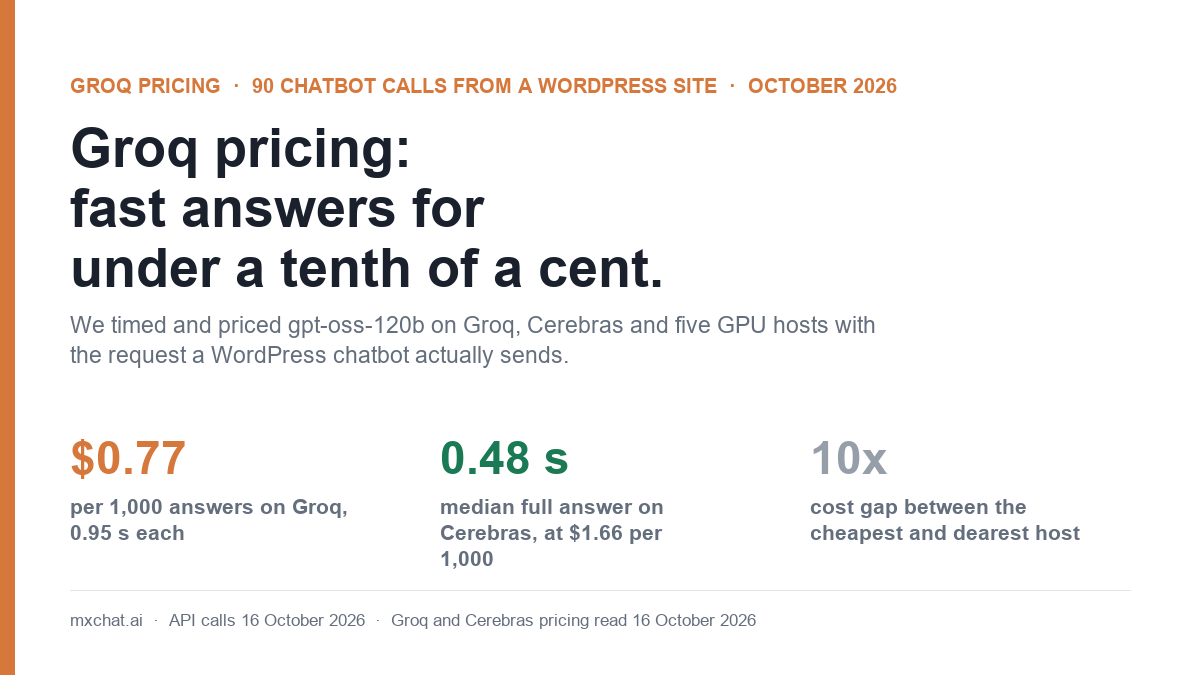
We measured it. On 16 October 2026 we sent the same WordPress chatbot request to gpt-oss-120b on seven hosts, plus Llama 3.3 70B and Qwen 3.8 27B on the speed chips, from our own production server: 90 streamed calls in all. 1,000 answers cost $0.77 on Groq and took 0.95 seconds each. Cerebras was twice as fast, at 0.48 seconds, and more than twice the price, at $1.66. The cheapest GPU host cost $0.16 and took more than five seconds. Every host answered every question correctly.
Groq pricing in October 2026
These are the rates and speeds on Groq’s models page, read on 16 October 2026. Prices are per million tokens. The speed column is Groq’s own figure.
| Model on Groq | Input / 1M | Output / 1M | Speed (Groq’s figure) |
|---|---|---|---|
GPT-OSS 120B (openai/gpt-oss-120b) | $0.15 | $0.60 | 500 tokens/s |
GPT-OSS 20B (openai/gpt-oss-20b) | $0.075 | $0.30 | 1,000 tokens/s |
Qwen 3.8 27B (qwen/qwen3.8-27b) | $0.80 | $4.00 | not listed |
| Llama 3.3 70B Versatile | $0.59 | $0.79 | 280 tokens/s |
| Llama 3.1 8B Instant | $0.05 | $0.08 | 560 tokens/s |
| Whisper Large V3 Turbo (speech to text) | $0.04 per hour of audio | – | |
The Llama 3.3 70B and Llama 3.1 8B prices are the ones OpenRouter showed for Groq on the same day. Groq’s models page did not print them.
Three other things on Groq’s price list matter for a chatbot:
- Prompt caching: 50% off cached input tokens, automatic, no extra fee. Right now it only covers the gpt-oss models. Cache entries expire after two hours without use.
- Batch API: 50% off, with results within 24 hours to 7 days. It does not stack with the caching discount. Good for back-office jobs, useless for a visitor waiting for a reply.
- Flex processing: same price as on-demand, ten times the rate limits, but requests fail fast with a 498 error when capacity runs short. Paid plans only.
Groq free tier limits
Groq has a free plan. Its rate-limit page lists gpt-oss-120b at 30 requests a minute, 1,000 a day, 8,000 tokens a minute and 200,000 tokens a day. That is fine for testing and not much else. A knowledge-base chatbot request in our test was about 4,150 input tokens, so 8,000 tokens a minute is roughly two visitor questions a minute, and 200,000 tokens a day is under 50 answers. Groq does say cached tokens don’t count towards the limits. For a live site you’ll want the paid Developer plan.
Cerebras pricing in October 2026
Cerebras lists two models on its public pricing page, read on 16 October 2026:
| Model on Cerebras | Input / 1M | Output / 1M | Speed (Cerebras’s figure) |
|---|---|---|---|
| GPT OSS 120B | $0.35 | $0.75 | ~3,000 tokens/s |
| Qwen 3.8 27B | $0.99 | $1.49 | ~1,850 tokens/s |
Self-serve access is pay-as-you-go. Adding a payment method gives a one-time $5 credit that expires after 30 days, and Cerebras says you will not be charged or enrolled in paid usage automatically when it runs out. Its entry tier is marked as being for development and evaluation, not production. On OpenRouter, Cerebras’s cached-input price for both models was the same as its normal input price, so caching saves nothing there.
The same model on GPU hosts
gpt-oss-120b is an open-weight model, so anyone can serve it. OpenRouter listed 24 endpoints for it on 16 October 2026. These are the ones we tested:
| Host | Hardware | Weights | Input / 1M | Output / 1M |
|---|---|---|---|---|
| Near AI | GPU | fp4 | $0.03 | $0.15 |
| DeepInfra | GPU | bf16 | $0.037 | $0.17 |
| SambaNova | SambaNova RDU | not stated | $0.14 | $0.95 |
| Groq | Groq LPU | not stated | $0.15 | $0.60 |
| Together | GPU | not stated | $0.15 | $0.60 |
| Amazon Bedrock | not stated | not stated | $0.15 | $0.60 |
| Cerebras | Cerebras wafer-scale | fp16 | $0.35 | $0.75 |
How we tested
We built the request the way MxChat builds it: the site’s real system prompt, then four excerpts from our own knowledge base pasted in as context, then the visitor’s question. That came to about 4,150 input tokens per call. We asked three questions a WordPress site owner might ask our support bot, about WooCommerce order lookups, whether Pinecone is required, and handing visitors to Slack or Telegram.
Each question went to each route twice, 6 calls per route and 90 in total. The calls went out from our WordPress server in the US through OpenRouter, with the host pinned and fallbacks turned off, so each answer really came from the host named. We streamed every response and recorded three things: when the first token arrived, when the first visible word arrived, and when the answer finished. Cost is what OpenRouter billed for each call, before its 5.5% fee on credit purchases.
All 90 calls returned an answer, five of them after a retry. Every answer to every question was correct. These were easy questions with the facts in the prompt, so this test says nothing about harder reasoning.
Results: cost and speed per 1,000 answers
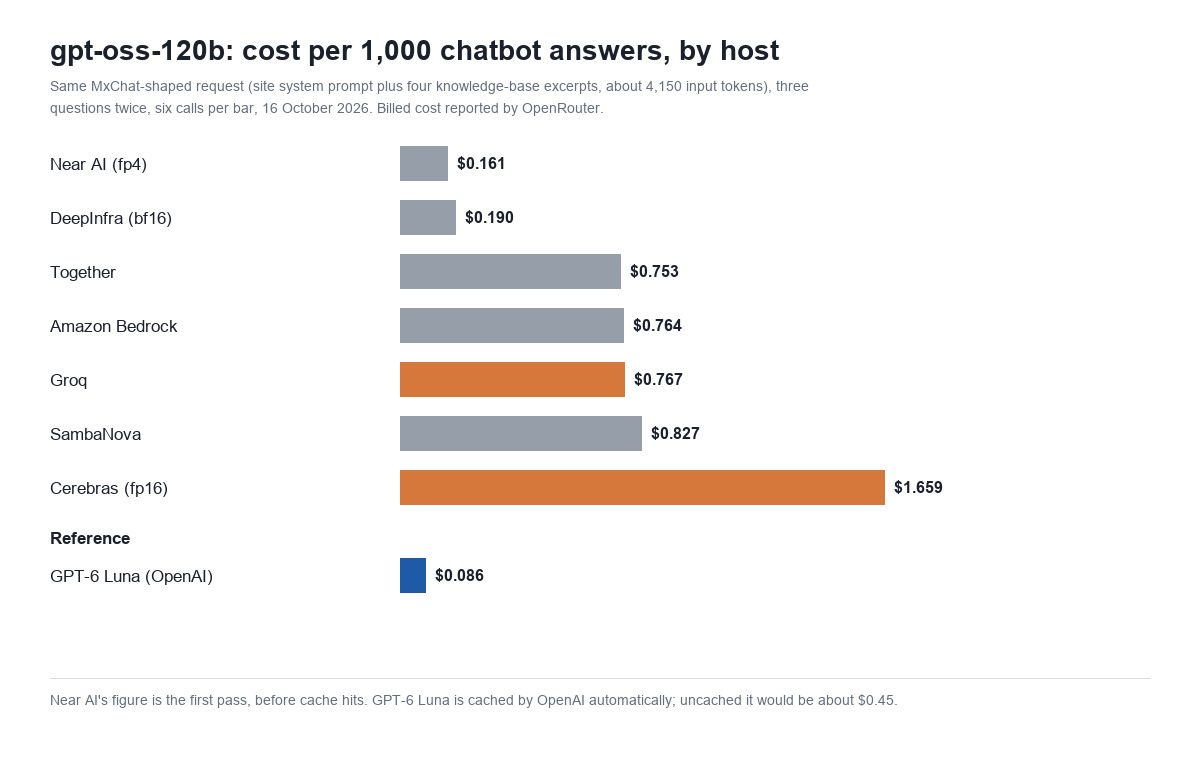
| gpt-oss-120b host | Cost per 1,000 answers | Median full answer | Median first visible word |
|---|---|---|---|
| Near AI (fp4) | $0.16 | 5.26 s | 4.66 s |
| DeepInfra (bf16) | $0.19 | 4.27 s | 3.67 s |
| Together | $0.75 | 1.65 s | 1.37 s |
| Amazon Bedrock | $0.76 | 0.65 s | 0.65 s |
| Groq | $0.77 | 0.95 s | 0.82 s |
| SambaNova | $0.83 | 0.98 s | 0.97 s |
| Cerebras (fp16) | $1.66 | 0.48 s | 0.46 s |
| OpenRouter’s own pick (unpinned) | $0.10 | 5.76 s | 4.68 s |
| GPT-6 Luna (OpenAI), for reference | $0.09 | 2.50 s | 2.24 s |
Near AI’s cost is the first run. On the repeat run it read most of the prompt from cache and fell to $0.11. OpenRouter’s unpinned pick also went to Near AI and got cache hits on most calls, which is why it shows $0.10. GPT-6 Luna is cached automatically by OpenAI, so most of its input was billed at the cached rate. Without the cache it would have been about $0.45.
What the numbers say:
- Groq costs the same as an ordinary GPU host at the same list price. Together, Bedrock and Groq all charge $0.15 and $0.60, and all came in at $0.75 to $0.77 per 1,000 answers. Groq was 0.7 seconds faster than Together.
- Cerebras doubles the bill for half a second. It was the fastest host we tested, but its $0.35 input price is more than twice Groq’s, and input is most of a chatbot’s bill.
- The cheapest hosts are four to ten times cheaper, and five times slower. DeepInfra and Near AI delivered the same correct answers for $0.16 to $0.19, but visitors waited four to five seconds for the first word.
- Amazon Bedrock surprised us. At Groq’s price, it finished in 0.65 seconds. Its stream seemed to arrive in large blocks rather than token by token: the first visible word and the finished answer came at almost the same moment.
Does the speed matter for a chatbot?
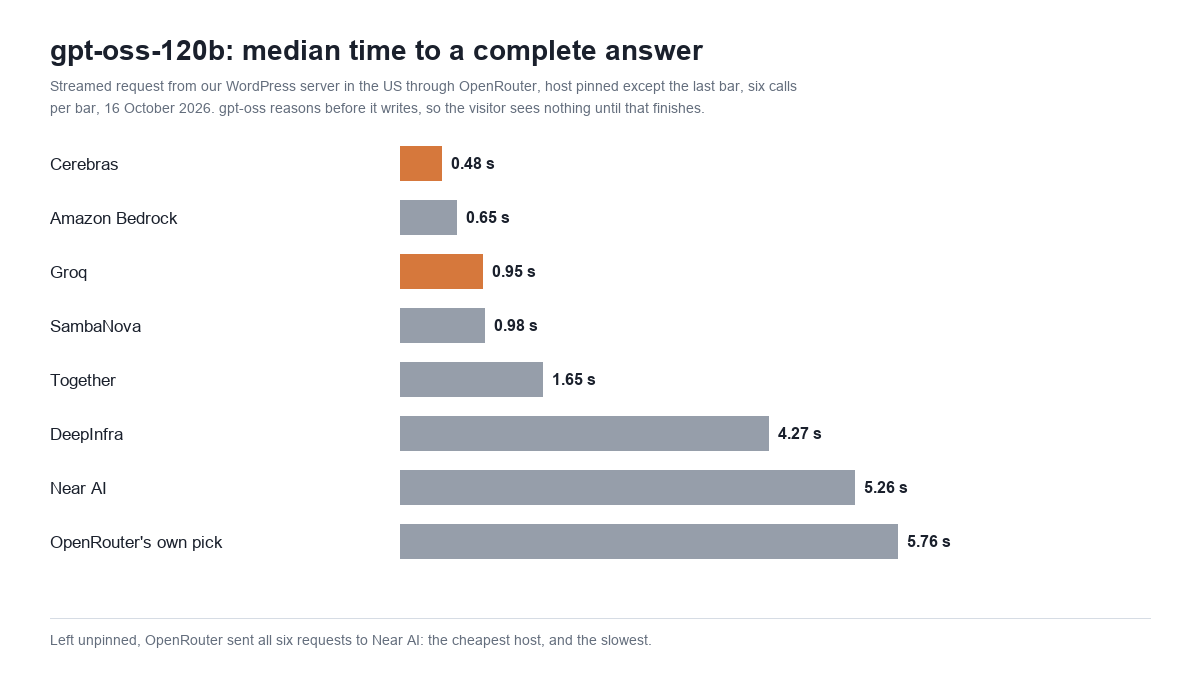
For gpt-oss-120b it matters more than you’d think, because the model reasons before it answers. On default settings it spent about 155 to 225 tokens reasoning on each of our questions, more than the 25 to 35 words it then wrote. The visitor sees none of that reasoning. They just see a typing indicator until it’s done.
On a slow GPU host generating around 55 to 70 tokens a second, that hidden reasoning alone takes three or four seconds. On Groq, at the roughly 480 tokens a second we measured, it takes under half a second. On Cerebras, less again. Streaming doesn’t fix this, because there is nothing to stream until the reasoning finishes. That’s the real case for a speed host: it hides the cost of a reasoning model.
Groq’s 500 tokens per second claim held up in our test. We measured a median of 480 tokens a second once generation started. Cerebras measured about 1,650 on our short answers, well under its ~3,000 figure, but with answers this short the network and setup time dominate anyway.
If speed matters but cost does too, turn the reasoning down. On Groq with reasoning: {effort: "low"}, gpt-oss-120b spent about 22 tokens reasoning instead of 185. The answer arrived in 0.59 seconds instead of 0.95, the bill fell from $0.77 to $0.65 per 1,000, and all six answers were still correct. That’s faster than default Groq and close to Cerebras, at 40% of Cerebras’s price.
Groq vs Cerebras on other models
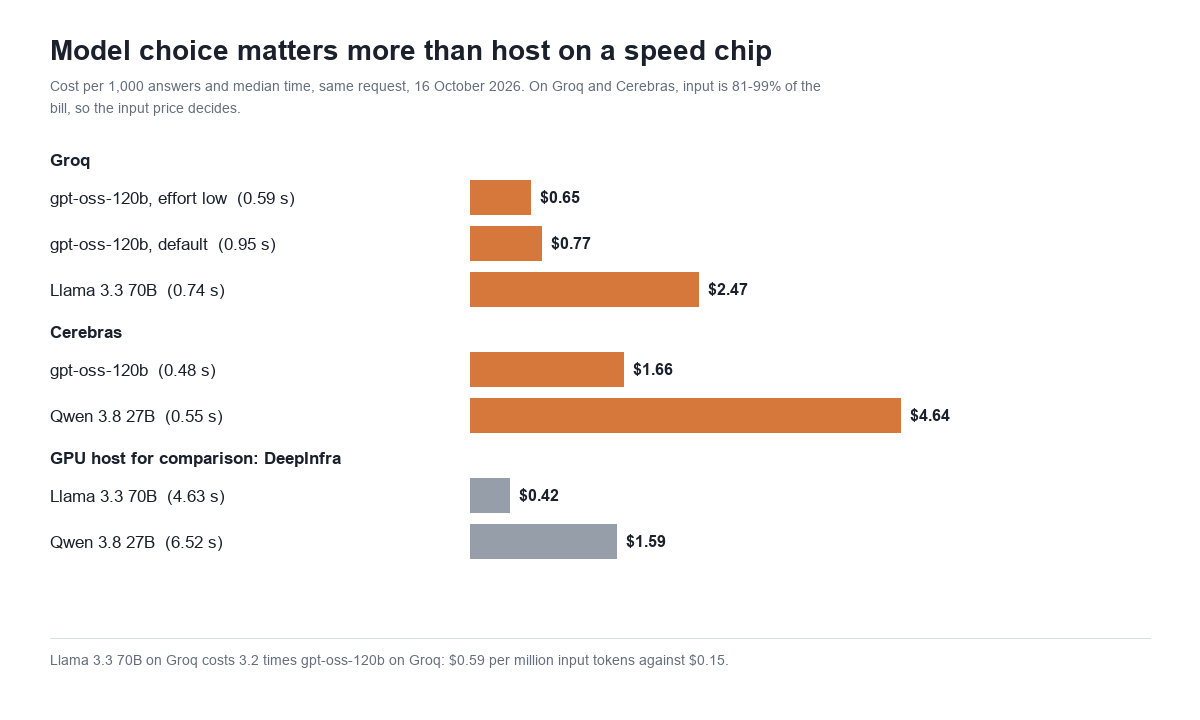
| Model and host | Input / Output per 1M | Cost per 1,000 answers | Median full answer |
|---|---|---|---|
| Llama 3.3 70B on Groq | $0.59 / $0.79 | $2.47 | 0.74 s |
| Llama 3.3 70B on SambaNova | $0.45 / $0.90 | $1.90 | 1.20 s |
| Llama 3.3 70B on DeepInfra | $0.10 / $0.32 | $0.42 | 4.63 s |
| Qwen 3.8 27B on Cerebras | $0.99 / $1.49 | $4.64 | 0.55 s |
| Qwen 3.8 27B on DeepInfra | $0.15 / $1.875 | $1.59 | 6.52 s |
The lesson here is about input price. Our chatbot requests carried about 4,100 tokens of input and produced roughly 40 to 500 tokens of output. On Groq and Cerebras, input was 81% to 99% of every bill. Llama 3.3 70B doesn’t reason, so it writes far fewer tokens than gpt-oss-120b. It still cost 3.2 times as much on Groq, because its input price is $0.59 rather than $0.15. Qwen 3.8 27B on Cerebras was the most expensive route we tested, at nearly $5 per 1,000 answers.
For a retrieval chatbot, compare hosts on input price first. The output price and the advertised tokens-per-second both matter less than they look.
What a month costs
Here’s our measured cost per answer scaled up to typical monthly volumes for a small business site. These are model costs only, before OpenRouter’s fee on credit purchases.
| Route | 1,000 answers / month | 10,000 / month | 50,000 / month |
|---|---|---|---|
| gpt-oss-120b on DeepInfra | $0.19 | $1.90 | $9.50 |
| gpt-oss-120b on Groq, effort low | $0.65 | $6.54 | $32.70 |
| gpt-oss-120b on Groq, default | $0.77 | $7.67 | $38.35 |
| gpt-oss-120b on Cerebras | $1.66 | $16.59 | $82.95 |
| Llama 3.3 70B on Groq | $2.47 | $24.66 | $123.30 |
| Qwen 3.8 27B on Cerebras | $4.64 | $46.45 | $232.25 |
Even the dearest route is cheap next to a hosted chatbot subscription. The useful comparison is the gap: at 10,000 answers a month, Cerebras’s extra half-second over Groq costs about $9 a month, and Groq’s speed over DeepInfra costs about $6.
How to use Groq or Cerebras with a WordPress chatbot
MxChat doesn’t have a dedicated Groq or Cerebras setting. You reach both through OpenRouter: add your OpenRouter API key in MxChat, then pick openai/gpt-oss-120b or another model they serve. Our OpenRouter pricing test covers what the router itself costs.
There’s a catch. MxChat’s OpenRouter connection doesn’t tell OpenRouter which host to use, so OpenRouter chooses. In our test it sent all six unpinned gpt-oss-120b requests to Near AI, the cheapest host and also the slowest. If you want Groq’s speed, you need to steer the routing yourself. OpenRouter lets you ignore providers for every request from your account in its privacy settings, so you can block the slow hosts there. The same thing happened, in reverse, in our Kimi K3 host test, where the unpinned route picked three of the four most expensive hosts.
Two more settings are worth knowing:
- Turn streaming on in MxChat if you use a fast host. Answers from Groq and Cerebras arrive fast enough that a visitor reads the reply as it’s written.
- Reasoning effort. gpt-oss-120b defaults to medium reasoning. MxChat’s OpenRouter path doesn’t send a reasoning setting, so you get the default. In our test, low was faster and cheaper with the same answers. We saw the same pattern with GPT-6 Luna’s reasoning effort.
OpenRouter support and the streaming setting are both in the free MxChat core plugin. Setup steps for every provider are in the MxChat documentation, and add-ons such as WooCommerce order lookups come with MxChat Pro.
Which should you choose?
| If you want… | Use | Why |
|---|---|---|
| Fast answers at a normal price | gpt-oss-120b on Groq, effort low | 0.59 s, $0.65 per 1,000 answers, all correct in our test |
| The fastest answer you can buy | gpt-oss-120b on Cerebras | 0.48 s, but $1.66 per 1,000, about 2.5 times Groq on low effort |
| The lowest bill | gpt-oss-120b on DeepInfra or Near AI | $0.16 to $0.19 per 1,000, but four to five seconds per answer |
| A big-lab model with no routing to manage | GPT-6 Luna on OpenAI | About $0.09 per 1,000 with automatic caching, 2.5 s |
| Llama specifically | Llama 3.3 70B on SambaNova or DeepInfra | Groq is fastest, but its $0.59 input price makes it the dearest Llama host we tested |
If you are paying for speed, also look at what OpenAI charges for it. Our OpenAI Ultrafast pricing test found a 6x price premium for 0.3 seconds. Groq is the cheaper way to make a chatbot feel instant.
Frequently asked questions
How much does Groq cost?
Groq charges per token. gpt-oss-120b is $0.15 per million input tokens and $0.60 per million output, gpt-oss-20b is $0.075 and $0.30, and Qwen 3.8 27B is $0.80 and $4.00, as listed on 16 October 2026. Cached input on the gpt-oss models is half price, and the Batch API is half price too. In our WordPress chatbot test, gpt-oss-120b on Groq cost $0.77 per 1,000 answers.
Is Groq free?
There’s a free plan with low rate limits: for gpt-oss-120b, 30 requests a minute, 1,000 a day and 8,000 tokens a minute. With a knowledge-base chatbot sending about 4,000 tokens per question, that’s about two questions a minute. It’s enough for testing. A live site needs the paid Developer plan.
Is Groq cheaper than Cerebras?
Yes, for the same model. gpt-oss-120b is $0.15 input on Groq and $0.35 on Cerebras. On our chatbot requests that made Groq $0.77 per 1,000 answers and Cerebras $1.66. Cerebras was faster: 0.48 seconds to a finished answer against 0.95 on Groq.
Is Groq really faster than other hosts?
Yes, compared with ordinary GPU hosts. On gpt-oss-120b we measured about 480 tokens a second on Groq, close to the 500 it advertises, against 54 to 171 on the GPU hosts we tested. Cerebras was faster still, and Amazon Bedrock and SambaNova matched Groq on our short answers.
Does Groq support prompt caching?
Groq says it caches automatically on the gpt-oss models, with a 50% discount on cached input and a two-hour expiry. In our test through OpenRouter, Groq reported almost no cached tokens, even on repeated identical requests a minute apart, so we billed it at the full rate. Together, Near AI and Cerebras did report cache hits.
Can I use Groq with a WordPress chatbot?
Yes. In MxChat you can reach Groq through OpenRouter by choosing a model Groq serves, such as openai/gpt-oss-120b. OpenRouter picks the host unless you tell it otherwise, so ignore the slower providers in your OpenRouter privacy settings if you want Groq’s speed.