
Intercom Fin Pricing vs Raw Tokens: I Measured the Gap
Intercom charges $0.99 every time Fin resolves a conversation. Tidio charges roughly $0.65 for every conversation Lyro replies to at all. Both numbers come straight off the vendors’ own pricing pages, and both are perfectly defensible prices for a finished product.
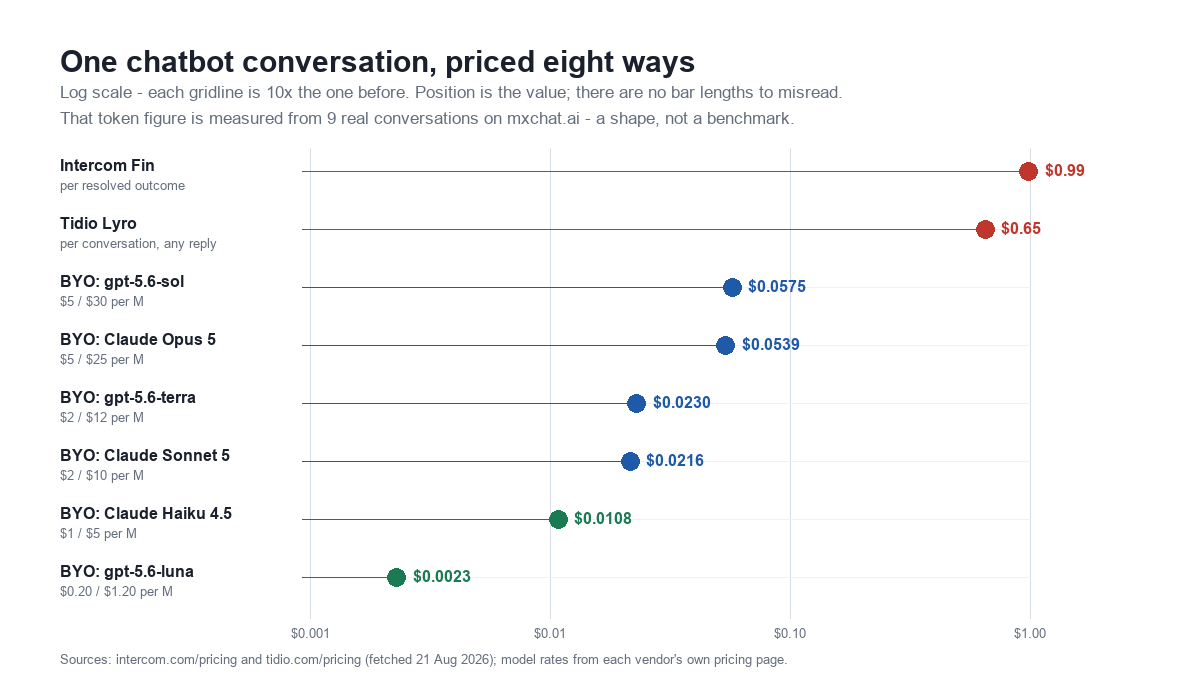
What almost nobody puts next to them is the raw cost of the thing being sold. I measured nine real conversations on this site, worked out the token bill at August 2026 list prices, and the same conversation costs between $0.0023 and $0.0575 depending on which model answers it.
That is a gap of roughly 430× at the cheap end and 17× at the expensive end. This post is about what sits inside that gap — because some of it is real value you are buying, and some of it is just margin.
The two meters, and what they actually count
Per-unit AI pricing has quietly become the default across the support-desk market, but the vendors are not metering the same event, and the difference matters more than the headline rate.
Intercom bills per “Fin outcome.” Their pricing page defines an outcome as any of three things: the customer confirms their issue is resolved, or they don’t ask for more help after Fin responds, or Fin completes a workflow including handoffs. They also state you are “only charged once per conversation, even if multiple questions are answered,” and that existing helpdesk customers carry a minimum monthly commitment — their example is 50 outcomes.
Read that middle clause again, because it is the one that decides your bill: a visitor who reads Fin’s answer, sighs, and closes the tab is billed as an outcome. Silence is scored as success. That is not a gotcha — it is a reasonable proxy, since most genuinely resolved users do simply leave — but it means the meter counts abandonment and satisfaction identically.
Tidio bills per Lyro conversation. Their definition: “A Lyro conversation is a customer interaction initiated through any channel integrated with Tidio that has at least one reply from our AI Agent.” Multiple AI replies inside one conversation still count once. Lyro starts at $32.50/mo for 50 conversations — about $0.65 each — and only their Premium tier (from 3,000 conversations a month) switches to pay-per-resolution with a guaranteed 50% resolution rate.
So on the standard tiers, Tidio bills you whether the bot helped or not. A conversation where Lyro replies “I’m not sure, let me get a human” is a billable conversation. Intercom’s meter is the more customer-aligned of the two, and it is also the more expensive.
| Vendor | Billable event | Rate | Billed on failure? |
|---|---|---|---|
| Intercom Fin | Resolution, silence, or completed workflow | From $0.99 / outcome | Not for an explicit escalation |
| Tidio Lyro (standard) | Any conversation with ≥1 AI reply | ~$0.65 / conversation | Yes |
| Tidio Lyro (Premium) | Resolution | Custom, 3,000+/mo | No |
| Bring-your-own API key | Tokens in and out | $0.0023–$0.0575 / conversation | Yes — you pay for every call |
What one conversation actually costs in tokens
Vendor comparisons usually stop at the rate card. The number that decides your bill is how many tokens one of your conversations burns, so I pulled it from this site’s own chat transcript table rather than estimating.
The sample is nine sessions and 64 messages, logged between 17 and 21 August 2026. That is small, and I am not going to dress it up as a benchmark — it is a shape, and your own numbers will differ. But the shape is the interesting part:
- 7.11 messages per session, averaging 3.67 calls to the model
- 796 characters of what the visitor actually typed, per session
- 2,866 characters of bot replies
- 15,255 characters of retrieved context (RAG) attached across the session
- 3,478 characters of system prompt — resent on every single call
At the widely used approximation of four characters per token, that is about 7,201 input tokens and 716 output tokens, or 7,917 tokens for a complete conversation.
For a sanity check against someone with vastly more data: Anthropic’s own pricing documentation works an example at “~3,700 tokens per conversation” for customer support tickets. Ours is roughly double that, which is what you would expect from a RAG-heavy setup. Same order of magnitude, which is the most you should ask of a nine-session sample.
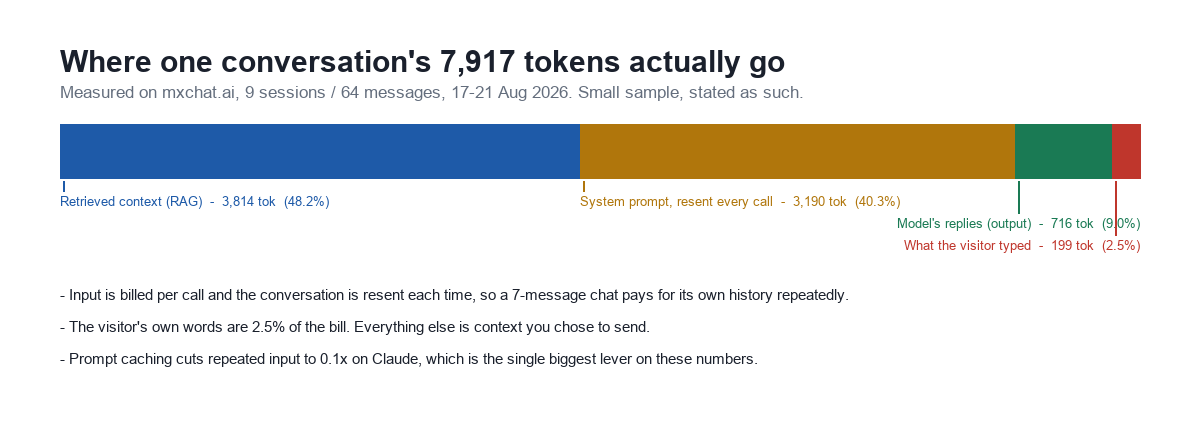
The breakdown is the actionable part. The visitor’s own words are 2.5% of the bill. Retrieved context is 48% and the resent system prompt is another 40%. Nearly nine-tenths of what you pay for is context you chose to send, which means your token bill is mostly a configuration decision, not a traffic decision.
The per-conversation numbers
Applying current list prices to that measured footprint:
| Model | Input / output per 1M | Cost per conversation | Per 1,000 | vs. Fin |
|---|---|---|---|---|
| gpt-5.6-luna | $0.20 / $1.20 | $0.0023 | $2.30 | 430× cheaper |
| Claude Haiku 4.5 | $1.00 / $5.00 | $0.0108 | $10.78 | 92× cheaper |
| Claude Sonnet 5 | $2.00 / $10.00 | $0.0216 | $21.57 | 46× cheaper |
| gpt-5.6-terra | $2.00 / $12.00 | $0.0230 | $23.00 | 43× cheaper |
| Claude Opus 5 | $5.00 / $25.00 | $0.0539 | $53.92 | 18× cheaper |
| gpt-5.6-sol | $5.00 / $30.00 | $0.0575 | $57.50 | 17× cheaper |
Two of those rates are newer than most comparison posts have caught up with. OpenAI’s gpt-5.6-luna sits at $0.20/$1.20 following the 30 July price reduction. And Claude Sonnet 5 is $2/$10 permanently — the increase to $3/$15 that was scheduled for 1 September was cancelled, which we covered when Anthropic updated their docs. If you are budgeting off a comparison article written in July, both of those numbers are wrong in your favour.
What this does to a monthly bill
| Conversations / month | Intercom Fin | Tidio Lyro | BYO Sonnet 5 | BYO luna |
|---|---|---|---|---|
| 500 | $495.00 | $325.00 | $10.78 | $1.15 |
| 2,000 | $1,980.00 | $1,300.00 | $43.13 | $4.60 |
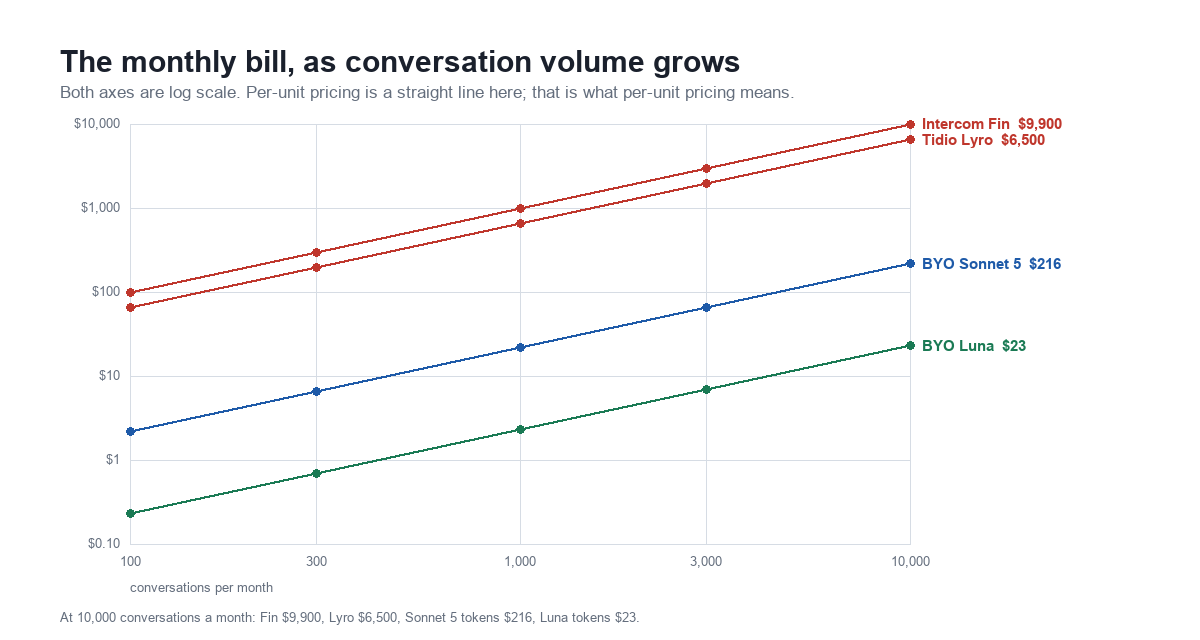
| 10,000 | $9,900.00 | $6,500.00 | $215.67 | $23.00 |
On a log-log chart every one of those is a straight line, which is the honest visual summary of per-unit pricing: the gap never closes as you grow, it multiplies. A store doing 10,000 support conversations a month is looking at a five-figure annual difference on the same underlying inference.
Where Intercom and Tidio genuinely earn the difference
Now the part that comparison posts usually skip, and the reason the 430× number is not the whole story. You are not buying tokens from Intercom. You are buying a support operation. The difference pays for real things:
- The product around the model. Ticketing, inboxes, routing, human handoff, SLAs, reporting, audit trails, team permissions. Building any one of these properly is months of work.
- Answer quality engineering. Fin and Lyro are tuned systems with retrieval, guardrails and evaluation pipelines behind them. A raw API key gives you a model, not a support agent.
- Predictable cost per result. This is the underrated one. Token billing charges you for failure exactly as much as success — a bot that answers badly ten times bills ten times. Intercom’s outcome meter at least ties spend loosely to value delivered.
- Someone to call. Compliance paperwork, uptime commitments, a support contract, an account manager. If your chatbot going down is a revenue event, that has a price.
- Multi-channel reach. Tidio’s conversation definition covers any integrated channel. Replicating email, Messenger, Instagram and WhatsApp yourself is not a weekend.
And the BYO side has costs the token table does not show: your own hosting, a plugin licence, the time to build and maintain a knowledge base, no vendor SLA on answer quality, your own rate-limit and abuse handling, and full ownership of the bill when something loops. The honest framing is not “$0.99 versus $0.02.” It is “$0.99 for a managed outcome, versus $0.02 plus your own labour.”
Where that trade lands depends almost entirely on volume and on who is doing the work. Below a few hundred conversations a month, the SaaS agents are frequently the rational purchase — the absolute saving is small and the setup time is real. Somewhere in the low thousands, the arithmetic starts to look very different, and by 10,000 conversations a month it is not close.
Three levers that move your number
If you are running your own key, the measured breakdown above points at exactly where the money is:
- Prompt caching. That 3,190-token system prompt is resent on every call. Anthropic prices cache hits at 0.1× the base input rate, so caching a stable system prompt cuts the largest repeated line item by 90%. This is the single biggest lever available and it costs one API parameter.
- Trim retrieved context. RAG is 48% of the bill. Retrieving eight chunks when three would answer the question is a 60% cut to the largest component. Measure your retrieval hit rate before you widen it.
- Route by difficulty. Most support questions are not hard. Running everything through a frontier model is the equivalent of couriering every letter. Luna and Haiku handle routine FAQ traffic at 5–20% of the cost of the top tier.
Do all three and the $0.0216 Sonnet 5 conversation lands closer to half a cent — without changing which model answers the questions that actually need answering.
One more variable belongs in that calculation: which endpoint you call. The per-token rates are usually identical whether you go direct or through AWS Bedrock or Azure, but the meters wrapped around them are not — this breakdown of AWS Bedrock pricing against the direct API works through what that adds per 1,000 replies.
Working out your own number
The measurement is genuinely simple, and you should do it on your own traffic rather than trusting anyone’s nine-session sample:
- Take a month of chat transcripts and count distinct sessions.
- For one representative session, add up: system prompt characters × number of model calls, plus retrieved context characters, plus what the visitor typed. Divide by four for input tokens.
- Add up the bot’s replies, divide by four, for output tokens.
- Multiply by your model’s per-million rates and divide by a million.
- Multiply by monthly sessions. Compare against what a per-unit vendor would charge for the same count.
If the answer is under about $50 a month, the token cost is not your decision variable and you should choose on features. If it is over a few hundred, the pricing model is now a strategic choice and worth an afternoon.
FAQ
Is $0.99 per resolution expensive? Compared to a human agent, no — it is dramatically cheaper than a support salary, which is the comparison Intercom is actually making. Compared to the inference underneath it, it is a large multiple. Both things are true.
Does the 4-characters-per-token rule hold? It is a documented approximation for English and it is fine for budgeting. Tokenizers differ between vendors and some newer models tokenize more densely, so treat any figure derived this way as ±25%, not exact.
Do I still pay per conversation with a bring-your-own-key plugin? You pay the model provider directly for tokens, and you pay for the plugin separately. There is no per-conversation markup in between, which is the entire structural difference.
What about failed conversations? Token billing charges for all of them. Tidio’s standard tiers bill for all of them. Intercom’s outcome meter is the only one of the three that can, in principle, not bill — but only when the customer explicitly asks for more help.
The short version
Per-unit AI pricing is not a rip-off, but it is a product price wearing a usage price’s clothing, and the two get conflated constantly. At $0.99 per outcome you are buying an entire support platform. At $0.0216 per conversation you are buying inference and supplying the platform yourself.
The mistake is not picking one. The mistake is picking without knowing that the number underneath is two cents — because that is the number that tells you what the rest of the money is actually for.
Related reading: Self-Hosted AI Chatbot Costs: I Measured Every Token breaks down the infrastructure side of running your own. How much does it cost to add a chatbot to your website? covers the wider pricing landscape, and Intercom vs MxChat compares the two approaches feature by feature. MxChat is bring-your-own-key by design — see MxChat Pro or the documentation for how the key configuration works.
The token prices underneath a comparison like this one do not hold still. Google has since halved Gemini 3.7 Flash and attached an expiry date to the cut, which changes the per-conversation arithmetic above in one direction now and the other direction in January — we ran the same measured token shape against every vendor’s current and scheduled prices.
The same point cuts the other way when a vendor drops its prices. OpenAI cut GPT-5.6 Sol on 21 August, but the headline number was the output cut — and a retrieval chatbot sends far more tokens than it returns, so the smaller input cut is what actually moved the bill.
That same 47:1 ratio is why the tier you pick matters more than any single price cut: measured across the GPT-5.6 family, one reply costs 19.6x more on Sol than on Luna.
Update, 1 September 2026: DeepSeek’s 16 August repricing turns that ratio into a threshold you can actually solve for. Its V4-Flash now charges more than GPT-5.6 Luna on input and less on output, so the cheaper model flips at a precise point — output equal to 3.7% of input volume. A retrieval chatbot sits at about 2%, on the wrong side of it. The full DeepSeek peak-hour breakdown is here.


