Claude Opus 4.5 Pricing: Retires 22 Jan, Cost Tested
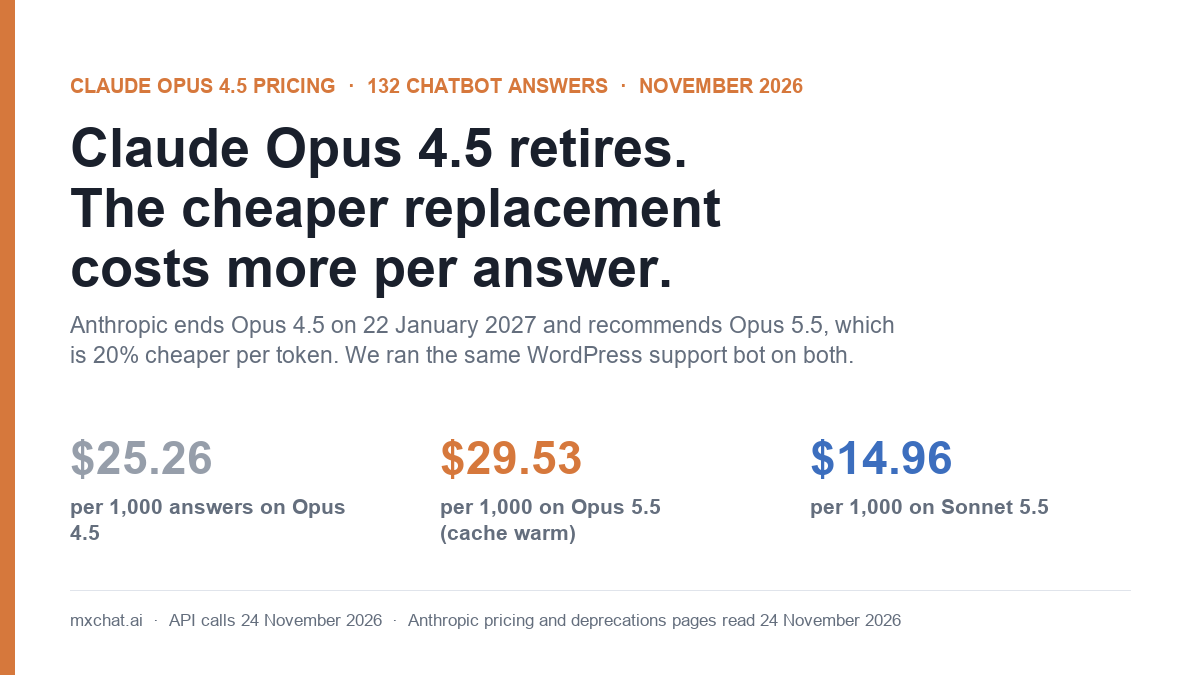
Claude Opus 4.5 pricing has not moved: it still costs $5 per million input tokens and $25 per million output tokens, with cached input at $0.50. What changed is how long you can buy it. On 23 November 2026 Anthropic deprecated the model and set its retirement on the Claude API for 22 January 2027. The recommended replacement is Claude Opus 5.5 at $4 and $20, which looks like a 20% price cut for doing nothing but changing a model name.
We ran the same WordPress support bot on both. 1,000 answers cost $25.26 on Opus 4.5 and $29.53 on Opus 5.5, so the model with the lower price list cost 17% more. The newer tokenizer counts the same request as 52% more tokens, and Opus 5.5 thinks before it answers and bills for it. Sonnet 5.5 did the same job for $14.96 and Haiku 5.5 for $0.73. Below are the numbers, what breaks when you change the model ID, and what to do if your chatbot is still on Opus 4.5.
Claude Opus 4.5 pricing and key dates
These are Anthropic’s list prices per million tokens, read on 24 November 2026.
| Model | Input | Output | Cache read | Cache write (5 min) | Batch in / out | Retirement on the Claude API |
|---|---|---|---|---|---|---|
| Claude Opus 4.5 | $5 | $25 | $0.50 | $6.25 | $2.50 / $12.50 | 22 January 2027 |
| Claude Opus 4.6 | $5 | $25 | $0.50 | $6.25 | $2.50 / $12.50 | Not before 5 February 2027 |
| Claude Opus 4.8 | $5 | $25 | $0.50 | $6.25 | $2.50 / $12.50 | Not before 28 May 2027 |
| Claude Opus 5.5 | $4 | $20 | $0.20 | $5 | $2 / $10 | Not before 22 September 2027 |
| Claude Sonnet 5.5 | $2 | $10 | $0.10 | $2.50 | $1 / $5 | Not before 28 September 2027 |
| Claude Haiku 5.5 (prompts up to 100,000 tokens) | $0.10 | $0.50 | $0.01 | $0.125 | $0.05 / $0.25 | Not before 7 October 2027 |
Three details from Anthropic’s deprecations page are easy to miss:
- Both model names retire.
claude-opus-4-5-20251101and the undatedclaude-opus-4-5stop on the same day. The undated name does not roll forward to a newer Opus. - The date covers Anthropic’s own platforms: the Claude API, Claude Platform on AWS, Anthropic-managed Claude on Google Cloud, and Microsoft Foundry. Amazon Bedrock and Google-managed Claude set their own schedules. Google’s Opus 4.5 page still said “not sooner than” 24 November 2026 when we read it today.
- Retired means the request fails. We called Opus 4.1, which retired in August. The API returned HTTP 404 with
not_found_error. There is no quiet redirect, unlike what Google does with Gemini 2.5 in December.
Opus 4.5 still answers normally. Our test call to it returned 200, with no deprecation header or warning in the response, so nothing in your logs will tell you the clock is running.
How we tested
We sent every request on 24 November 2026 from the mxchat.ai WordPress server, in the layout MxChat uses for Claude: the bot’s system prompt as one block marked for caching, and the visitor’s question plus four knowledge-base excerpts as the user message. The four questions are ones real visitors ask (WooCommerce order lookups, Pinecone or WordPress storage, handing a chat to Slack or Telegram, and using your own API key). Each model answered all four questions three times. GPT-6.2 Sol and Gemini 4 Hydrogen got the same material in the layout MxChat uses for OpenAI and Gemini.
MxChat sends temperature only to models that accept it and never sends a thinking or effort setting to Claude, so each Claude model ran on its own default. We added one extra row with Opus 5.5 at effort: low, which MxChat does not send, to see what it would save. On top of those 108 answers we ran 24 more with the knowledge base pasted into the system prompt, 23 small compatibility calls, and token counts on ten pieces of text. All 132 answers contained the fact the question was about. The answers cost $2.47 in total.
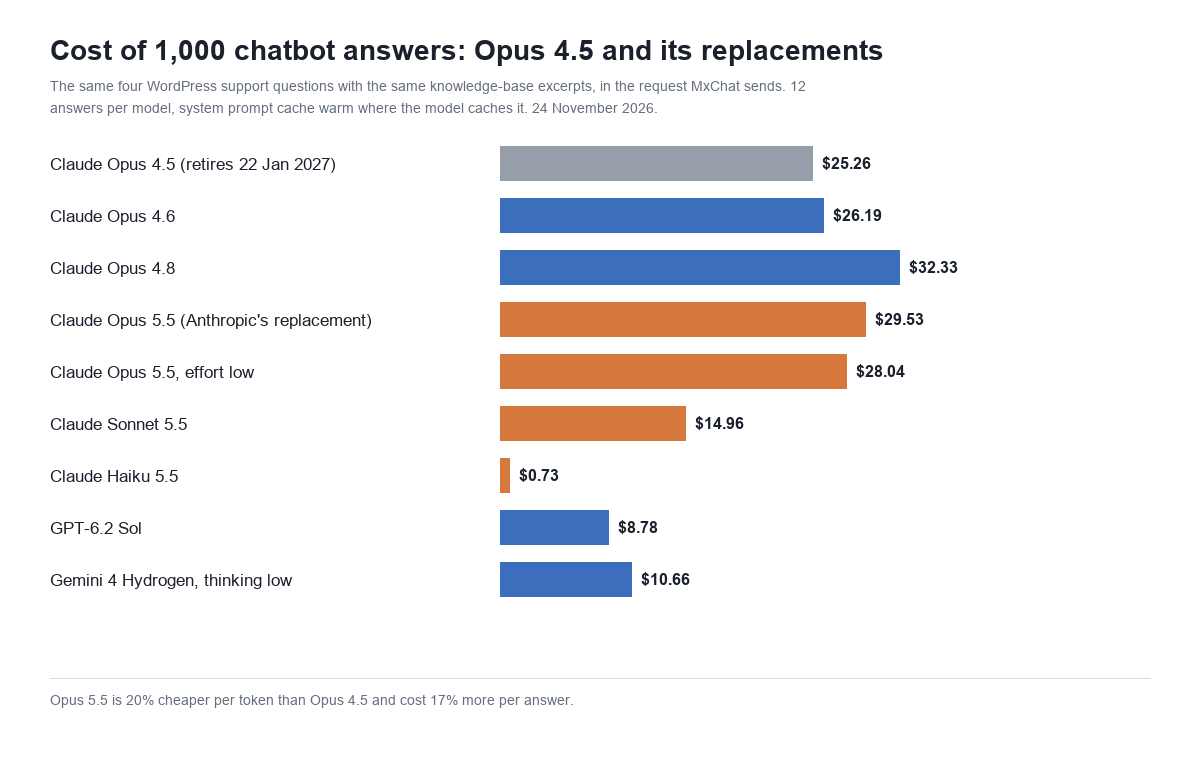
Results: cost per 1,000 chatbot answers
“Cache warm” means the system prompt was already cached from an earlier visitor. “No cache” prices the same tokens at the full input rate.
| Model | Input tokens | Output tokens (thinking) | Per 1,000, cache warm | Per 1,000, no cache | Median time | Key fact present |
|---|---|---|---|---|---|---|
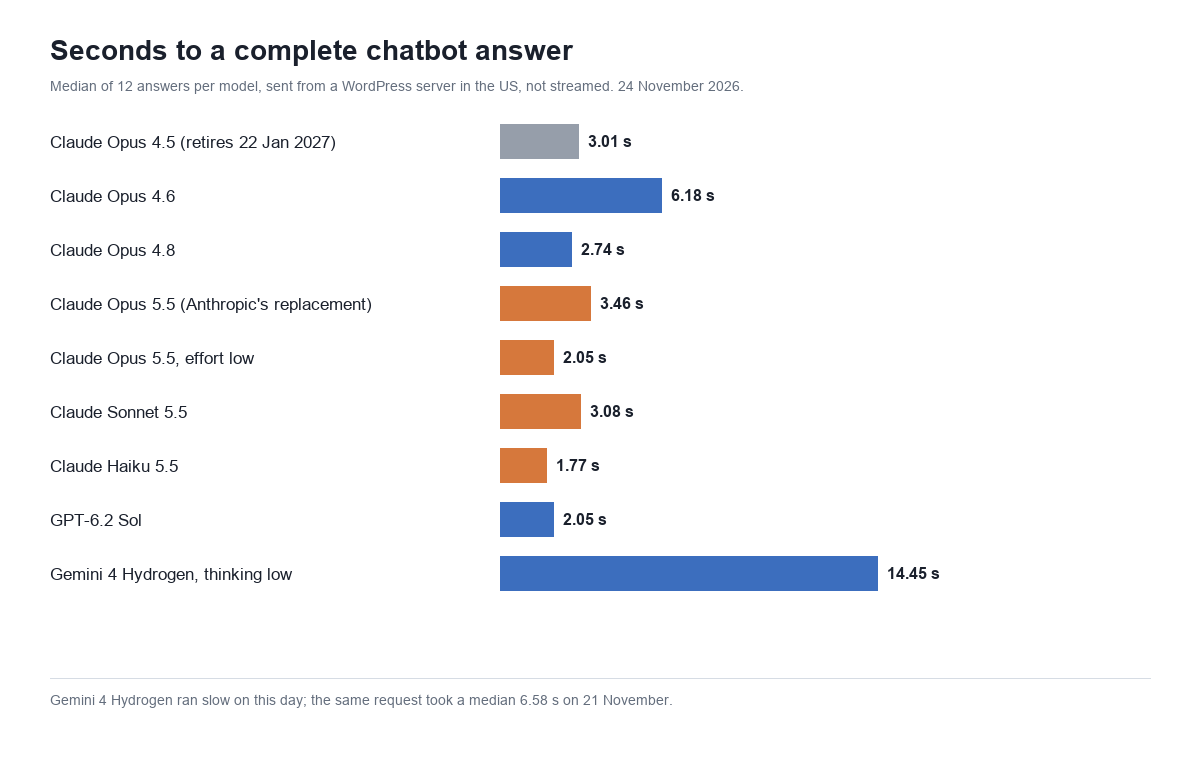
| Claude Opus 4.5 | 4,547 | 101 (0) | $25.26 | $25.26 | 3.01 s | 12 / 12 |
| Claude Opus 4.6 | 4,548 | 138 (0) | $26.19 | $26.19 | 6.18 s | 12 / 12 |
| Claude Opus 4.8 | 6,907 | 129 (0) | $32.33 | $37.76 | 2.74 s | 12 / 12 |
| Claude Opus 5.5 | 6,909 | 325 (160) | $29.53 | $34.13 | 3.46 s | 12 / 12 |
| Claude Opus 5.5, effort low | 6,909 | 244 (66) | $28.04 | $32.52 | 2.05 s | 12 / 12 |
| Claude Sonnet 5.5 | 6,909 | 335 (174) | $14.96 | $17.17 | 3.08 s | 12 / 12 |
| Claude Haiku 5.5 | 6,909 | 303 (184) | $0.73 | $0.84 | 1.77 s | 12 / 12 |
| GPT-6.2 Sol | 4,115 | 52 (0) | $8.78 | $8.75 | 2.05 s | 12 / 12 |
| Gemini 4 Hydrogen, thinking low | 4,227 | 782 (689) | $10.66 | $12.20 | 14.45 s | 12 / 12 |
For GPT-6.2 Sol and Hydrogen the “cache warm” column is the first time each question was asked; exact repeats were cheaper. Hydrogen was slow today: the same request took a median 6.58 seconds when we ran it on 21 November.
At site scale, with the system prompt cached throughout:
| Answers per month | Opus 4.5 | Opus 5.5 | Sonnet 5.5 | Haiku 5.5 |
|---|---|---|---|---|
| 1,000 | $25.26 | $29.53 | $14.96 | $0.73 |
| 5,000 | $126.30 | $147.65 | $74.80 | $3.65 |
| 20,000 | $505.20 | $590.60 | $299.20 | $14.60 |
Why the cheaper model costs more
The tokenizer ate the discount
Anthropic changed its tokenizer with Opus 4.7, and its pricing page says the new one produces about 30% more tokens for the same text. On our requests the increase was 52% (4,547 tokens against 6,909). To see how much depends on the content, we ran ten pieces of text through Anthropic’s token-counting endpoint for Opus 4.5 and Opus 5.5.
| Text | Characters | Opus 4.5 tokens | Opus 5.5 tokens | Increase |
|---|---|---|---|---|
| WordPress help article, English | 6,000 | 1,273 | 2,018 | +59% |
| Blog post text, English | 6,000 | 1,286 | 1,944 | +51% |
| Support paragraph, German | 586 | 206 | 301 | +46% |
| This site’s chatbot system prompt | 3,478 | 835 | 1,217 | +46% |
| Product list as JSON (small sample) | 581 | 229 | 321 | +40% |
| Support paragraph, English | 518 | 111 | 146 | +32% |
| Support paragraph, Spanish | 587 | 169 | 220 | +30% |
| Post HTML with markup | 6,000 | 1,982 | 2,518 | +27% |
| PHP code | 6,000 | 1,505 | 1,876 | +25% |
| Support paragraph, Japanese | 201 | 187 | 187 | 0% |
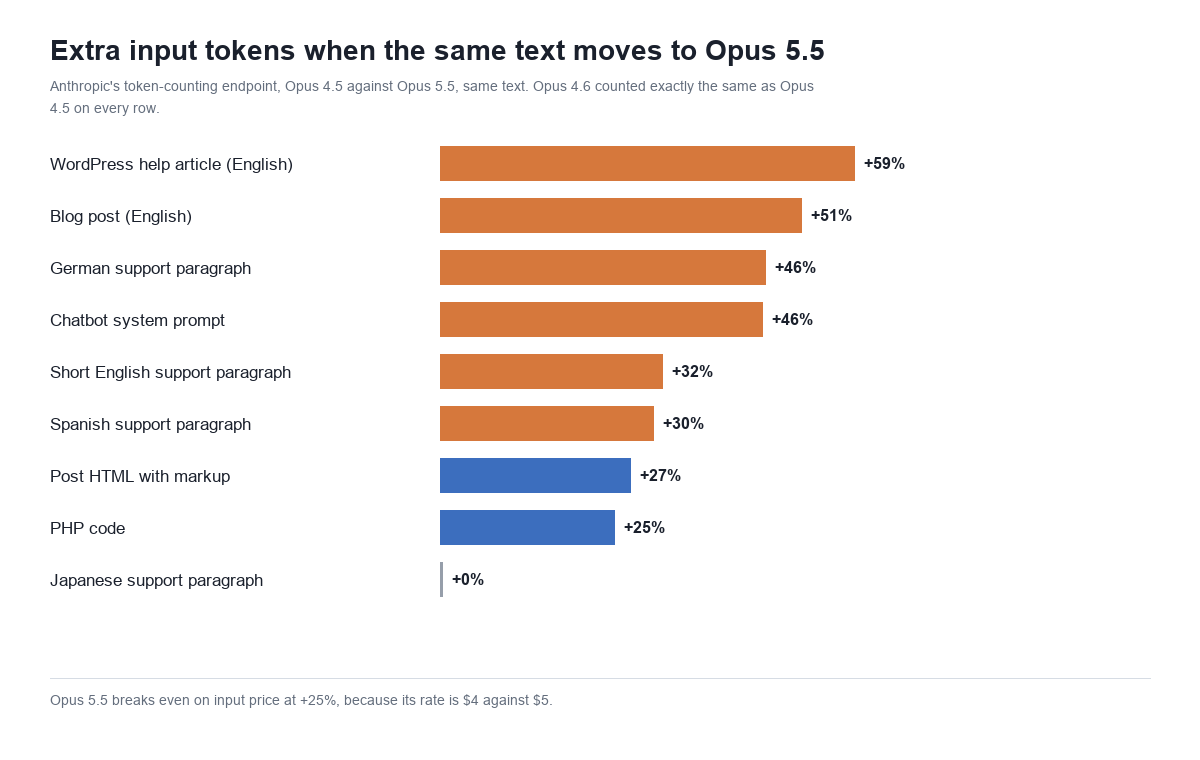
The break-even is +25%, because $4 is four fifths of $5. Any text that grows by more than a quarter costs more to send to Opus 5.5. In our sample, the English prose a chatbot retrieves was the worst case and Japanese was the best. Code and HTML landed close to break-even, which is why a coding bill and a chatbot bill can move in opposite directions on the same migration. Opus 4.6 gave exactly the same count as Opus 4.5 on all ten. Our Claude tokenizer post covers the change in more depth.
Opus 5.5 thinks, and you cannot turn it off
Opus 4.5 answers directly unless you ask it to think. Opus 5.5 decides for itself. In our run it spent a mean of 160 thinking tokens per answer, about half of its 325 output tokens, and the visible answers were nearly the same length (63 words against 56). Output cost $6.50 per 1,000 answers on Opus 5.5 and $2.53 on Opus 4.5. Setting effort to low cut the thinking to 66 tokens and the time to 2.05 seconds, but the bill only fell to $28.04, still above Opus 4.5.
Caching helps Opus 5.5, up to a point
Opus 4.5 will not cache a prompt shorter than 4,096 tokens. Opus 5.5 caches from 512. Our system prompt is about 835 tokens on the old tokenizer, so Opus 4.5 never cached it in any of the 12 answers, while Opus 5.5 read 1,212 cached tokens in every one. That saved $4.60 per 1,000 answers, and without it the gap would be 35% instead of 17%. On a quiet site where the five-minute cache expires between visitors, Opus 5.5 pays a cache write each time instead, and by our arithmetic the cost is about $35.35 per 1,000.
That points to the one common layout where Opus 5.5 does win: a longer system prompt that is still under Opus 4.5’s 4,096-token floor. Using our measured numbers, the two models break even at a system prompt of roughly 1,750 old-tokenizer tokens (around 7,300 characters) on a busy bot. Between there and 4,096 tokens, Opus 5.5 is cheaper. Above 4,096, Opus 4.5 starts caching too and most of the advantage goes away.
What if the whole knowledge base is in the system prompt?
Some owners paste their FAQ into the bot’s instructions instead of using a knowledge base. We tested that shape as well: about 10,300 tokens of instructions and FAQ on the old tokenizer, all cached, with only the question changing. Eight answers per model, the first of which wrote the cache.
| Model | Cached tokens | Output tokens | Per 1,000, cache warm | One answer with the cache cold | Median time |
|---|---|---|---|---|---|
| Claude Opus 4.5 | 10,326 | 101 | $7.82 | $0.067 | 3.07 s |
| Claude Opus 4.6 | 10,327 | 137 | $8.72 | $0.068 | 5.99 s |
| Claude Opus 5.5 | 15,938 | 358 | $10.49 | $0.086 | 3.87 s |
Opus 5.5’s cache reads are cheaper ($3.19 against $5.16 per 1,000 answers), even with 54% more tokens. It loses on output: $7.15 against $2.52, again because of thinking. Two things are still worth taking from this table. A cached FAQ cost about a third as much as retrieved excerpts on both models. And an answer with a cold cache costs about eight times as much as one with a warm cache, so this layout suits a busy site with a short, stable FAQ.
What breaks when you change the model ID
If you have your own code calling Opus 4.5, swapping the name may not be enough. We sent the same seven small requests to Opus 4.5, Opus 4.6 and Opus 5.5, without any beta headers.
| Request | Opus 4.5 | Opus 4.6 | Opus 5.5 |
|---|---|---|---|
| Plain message | 200 | 200 | 200 |
temperature: 0.8 | 200 | 200 | 400, temperature is deprecated for this model |
thinking enabled with budget_tokens | 200 | 200 | 400, use adaptive thinking and effort |
thinking: disabled | 200 | 200 | 400, not supported |
| Prefilled assistant message | 200 | 400 | 400, must end with a user message |
Forced tool (tool_choice: tool) | 200 | 200 | 400, “tool” and “any” not supported |
Old output_format field | 400 | 400 | 400, use output_config.format |
Five of the six requests that work on Opus 4.5 fail on Opus 5.5. The prefill change catches people who stop at Opus 4.6. The forced-tool change catches order-lookup bots that insist on a tool call. Also check your max_tokens: thinking counts against it, so a limit that fitted an Opus 4.5 answer can cut an Opus 5.5 answer short.
If your MxChat bot is on Opus 4.5
MxChat already leaves out temperature on Opus 5.5, never sends a thinking setting, and gives the Opus 5 models a larger output allowance, so switching is a menu choice and not a code change. Three things to know:
- You need to switch it yourself. MxChat has an automatic replacement list for retired models, and Claude Sonnet 4.5, which retires on 30 November, is on it. As of version 3.2.29, Opus 4.5 is not, so choose the new model before 22 January.
- Opus 4.5 and 4.6 are only listed on sites that already use them. Both are marked as older models, so MxChat does not offer them for a new choice. Opus 4.6 would also buy you very little: its earliest retirement is two weeks after Opus 4.5’s, and it was twice as slow in our test.
- Check each bot. If you run several bots, each one can have its own model, and add-ons that generate content have their own model setting too.
| What you use Opus 4.5 for | Where to go | Effect on 1,000 answers in our test |
|---|---|---|
| A support or pre-sales bot answering from a knowledge base | Haiku 5.5 | $25.26 to $0.73, and faster |
| The same, with fuller answers or harder questions | Sonnet 5.5 | $25.26 to $14.96, same speed |
| You want to stay on Opus | Opus 5.5 | $25.26 to $29.53; budget 17% to 40% more, depending on traffic |
| You are open to another vendor | GPT-6.2 Sol | $25.26 to $8.78, shorter answers |
Our pick for most WordPress sites is Haiku 5.5. All 12 of its answers had the key fact, and Opus-level reasoning is hard to notice when the task is to find the right paragraph and restate it. Its answers were a little shorter (49 words against 56), and in one run it sent the visitor to the documentation for the full model list. If your bot handles multi-step requests, try Sonnet 5.5 first. Our Haiku 5.5 and Sonnet 5.5 tests have more on each, and the Opus 5.5 test covers effort levels.
After switching, ask the bot your five most common visitor questions and read the answers. A new model changes tone and length even when the facts stay right. The MxChat documentation covers the model settings, and MxChat Pro lists what the paid version adds. For the other changes arriving before the end of the year, see our December 1 price-change round-up and the GPT-6.2 test.
Limits of this test
Twelve answers per model is enough to price the request, since input tokens barely vary, but the output figures would shift a little on another run. Costs depend on your own prompt length, knowledge-base excerpts and language: a Japanese bot could well be cheaper on Opus 5.5. We tested factual support questions, not coding or long agent tasks, where Opus 5.5’s reasoning may finish work in fewer steps. “Key fact present” means the answer named the thing the question was about; we did not grade style. The break-even and quiet-site figures are computed from measured tokens and list prices.
FAQ
How much does Claude Opus 4.5 cost?
$5 per million input tokens and $25 per million output tokens on the Claude API. Cache reads are $0.50, five-minute cache writes $6.25, one-hour cache writes $10, and Batch is half price at $2.50 and $12.50. In our chatbot test that came to $25.26 per 1,000 answers.
When is Claude Opus 4.5 being retired?
On 22 January 2027 on the Claude API. Anthropic announced it on 23 November 2026. Amazon Bedrock and Google-managed Claude on Google Cloud set their own dates.
What replaces Claude Opus 4.5?
Anthropic recommends Claude Opus 5.5 (claude-opus-5-5). For a website chatbot, Sonnet 5.5 and Haiku 5.5 handled our questions for 41% and 97% less than Opus 4.5.
Is Claude Opus 5.5 cheaper than Opus 4.5?
Per token, yes: $4 and $20 against $5 and $25. Per chatbot answer, it was not. The same request counted as 52% more input tokens and Opus 5.5 billed three times the output because it thinks first, so 1,000 answers cost $29.53 against $25.26.
Will requests to Opus 4.5 be redirected after it retires?
Not on the Claude API. Anthropic says requests to retired models fail, and our call to the already retired Opus 4.1 returned a 404 error.
Should I move to Opus 4.6 instead?
It is a short stopgap. It has the same prices and the same tokenizer as Opus 4.5, so the bill barely changes ($26.19 per 1,000), but Anthropic only commits to it until 5 February 2027. It also rejects prefilled assistant messages, and it took twice as long to answer in our test.
Does Claude Opus 4.5 support prompt caching?
Yes, but only for prompts of at least 4,096 tokens. Shorter prompts are processed without caching and without an error. Opus 5.5 caches from 512 tokens and charges $0.20 per million for a cache read.
Can I still pick Opus 4.5 in MxChat?
Only if your site already uses it. MxChat no longer offers it for new selections. Sites still on it should choose another model before 22 January 2027.