December 1 AI API Price Changes, Tested on a Chatbot
Five AI API price changes land between 30 November and 1 December 2026, and every one of them touches a model people run WordPress chatbots on. Gemini 4 Carbon and Gemini 4 Argon double from $2 / $10 to $4 / $20 per million tokens. GPT-5.6 Sol’s promotional price ends on 30 November, and OpenAI has not said what replaces it. Claude Sonnet 4.5 retires on 30 November, and so does fast mode on Claude Opus 4.8. On 1 December Google also starts sending Gemini 2.5 Pro and 2.5 Flash requests to newer models and billing them at those models’ rates.
A price per million tokens does not tell you what your bot will cost. So on 21 November 2026 we sent the same four support questions, with the same knowledge-base excerpts, to all thirteen models involved, in the exact request layout the MxChat plugin uses for each vendor. Then we priced every answer at the November rate and at the December rate.
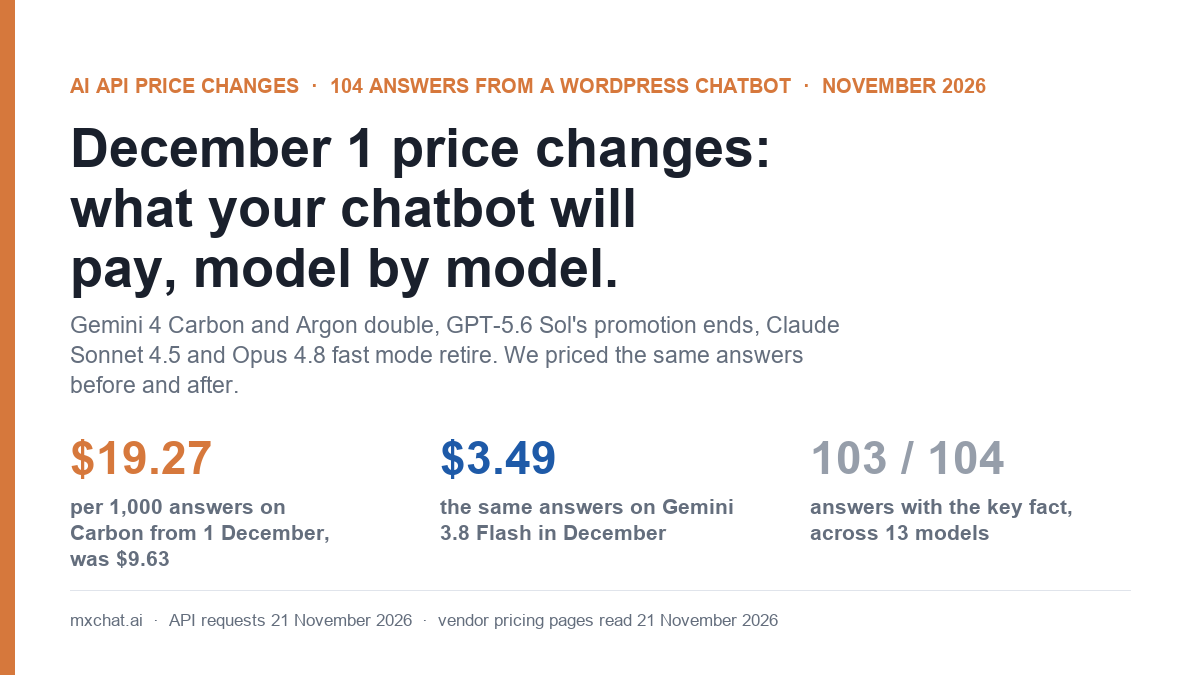
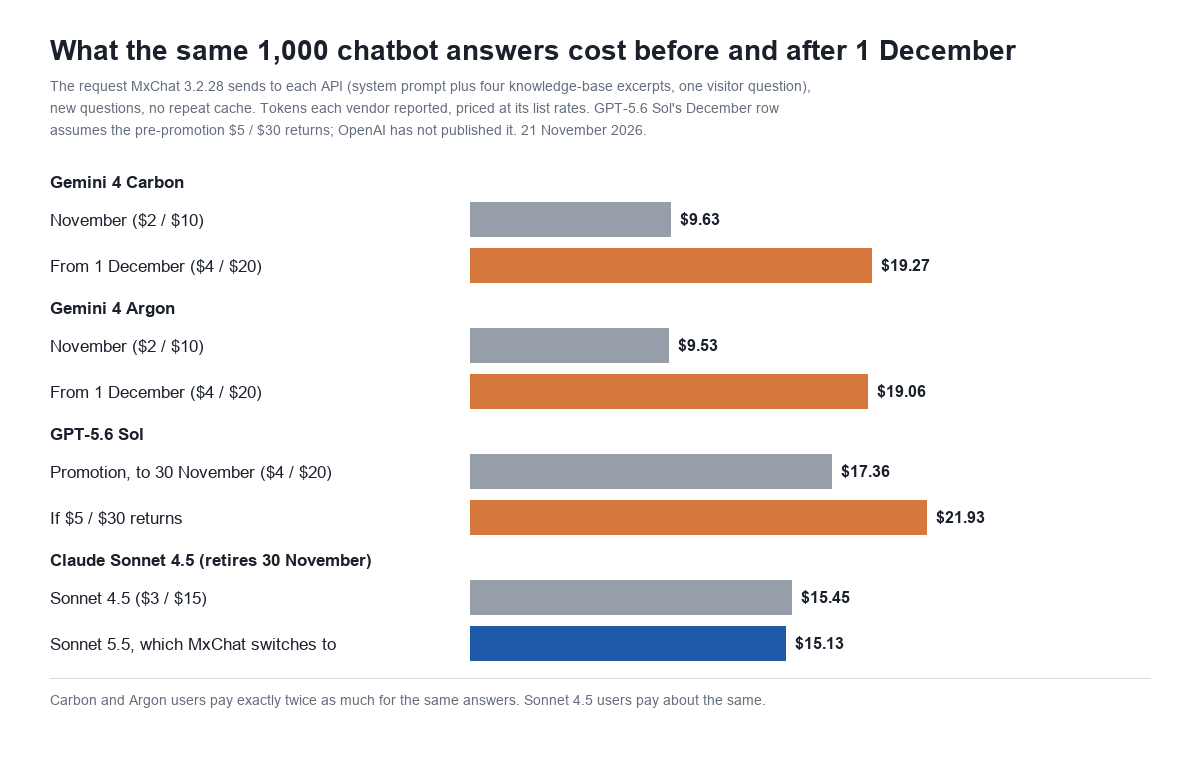
The short answer: if your chatbot runs on Gemini 4 Carbon, 1,000 answers go from $9.63 to $19.27. Argon goes from $9.53 to $19.06. The same answers on Gemini 3.8 Flash cost $3.49 and arrived faster, and even after Flash’s own increase on 1 January they cost $6.98. If you use Claude Sonnet 4.5, MxChat moves you to Sonnet 5.5 by itself on 30 November and the bill barely moves: $15.45 to $15.13. GPT-5.6 Sol users should switch to GPT-6.2 Sol now: $8.80 for the same answers, half the promotional price.
The calendar: every change on 30 November and 1 December
We read each vendor’s pricing, deprecation and changelog pages on 21 November 2026. Prices are per million tokens, standard tier, input / output.
| Date | Model or feature | Before | After | What happens on an MxChat site |
|---|---|---|---|---|
| 30 Nov | Claude Sonnet 4.5 (claude-sonnet-4-5-20250929) | $3 / $15 | Retired. Anthropic names Sonnet 5.5 ($2 / $10) as the replacement | MxChat 3.2.28 sends the request to Sonnet 5.5 from 00:00 UTC. No setting to change |
| 30 Nov | Claude Opus 4.8 fast mode | $10 / $50 | Requests with speed: "fast" return an error | None. MxChat does not send fast mode |
| 30 Nov | GPT-5.6 Sol promotional price | $4 / $20 | Not published. Before the promotion it was $5 / $30 | Your saved model keeps working at whatever OpenAI charges |
| 30 Nov | OpenAI /v1/prompts, Agent Builder, Evals | – | Deprecated; Evals becomes read-only | None. The plugin does not use them |
| 1 Dec | Gemini 4 Carbon | $2 / $10 | $4 / $20 | Same model, double the bill |
| 1 Dec | Gemini 4 Argon | $2 / $10 | $4 / $20 | Same model, double the bill |
| 1 Dec | Gemini 2.5 Pro | $1.25 / $10 | Routed to Gemini 3.8 Flash, billed at $0.75 / $3.75 | Cheaper, but a different model answers |
| 1 Dec | Gemini 2.5 Flash | $0.30 / $2.50 | Routed to Gemini 3.5 Flash-Lite, billed at $0.30 / $2.50 | Same price, a different model answers |
| 1 Dec | OpenAI gpt-image-1-mini, gpt-image-1.5, chatgpt-image-latest | – | Shut down; replacements are gpt-image-2.6-sunburst or gpt-image-2.6-flare | Only matters if you generate images with them |
| 1 Jan 2027 | Gemini 3.8 Flash | $0.75 / $3.75 | $1.50 / $7.50 | Next month’s change, shown here because it is the cheapest escape from Carbon |
Two of these are price rises on a model you keep using (Carbon, Argon). One is a price that may or may not rise (GPT-5.6 Sol). The rest are retirements, where the question is what answers in the old model’s place and what it costs.
How we tested
We ran every request from the mxchat.ai WordPress server on 21 November 2026, using the request each vendor receives from MxChat 3.2.28. That detail matters, because the plugin does not send the same layout to every API:
- OpenAI: one system message holding the system prompt and the knowledge-base block between the
===== OFFICIAL KNOWLEDGE DATABASE CONTENT =====markers, then the visitor’s question as the user message.reasoning_effortcomes from the plugin’s model catalog:lowon GPT-5.6 Sol, nothing on GPT-6.2 Sol or GPT-6.1 Terra. - Anthropic: the system prompt as one cached block, and the knowledge-base context as the user turn.
- Gemini: a first user turn starting
[System Instructions]with the prompt and knowledge base, a short model acknowledgement, then the question, withthinkingLevel: lowon the Gemini 4 models and Gemini 3.8 Flash.
Four questions a real MxChat visitor asks (WooCommerce order lookups, Pinecone versus WordPress storage, handing a chat to Slack or Telegram, using your own API key), each with four excerpts from our documentation as the knowledge base. That comes to roughly 4,100 to 6,900 input tokens per answer, depending on the tokenizer. Each model answered all four questions twice. The second pass is an exact repeat, which shows what the vendor’s cache saves on a question your visitors ask often.
We priced the tokens each API reported at the list rates on its pricing page. Thinking tokens are billed as output. In all, 107 requests: 104 answers, two 404s from Gemini 2.5 and one rejected fast-mode request. The run cost $1.13.
Results: the same answers in November and December
Cost is per 1,000 answers. “New” means a question the cache has not seen. “Repeat” means an identical question asked again within minutes. Claude’s cache covers only the system prompt in MxChat’s layout, so Claude has no separate repeat price.
| Model | Input tokens | Output tokens | New, November | New, December | Repeat, December | Median time | Key fact present |
|---|---|---|---|---|---|---|---|
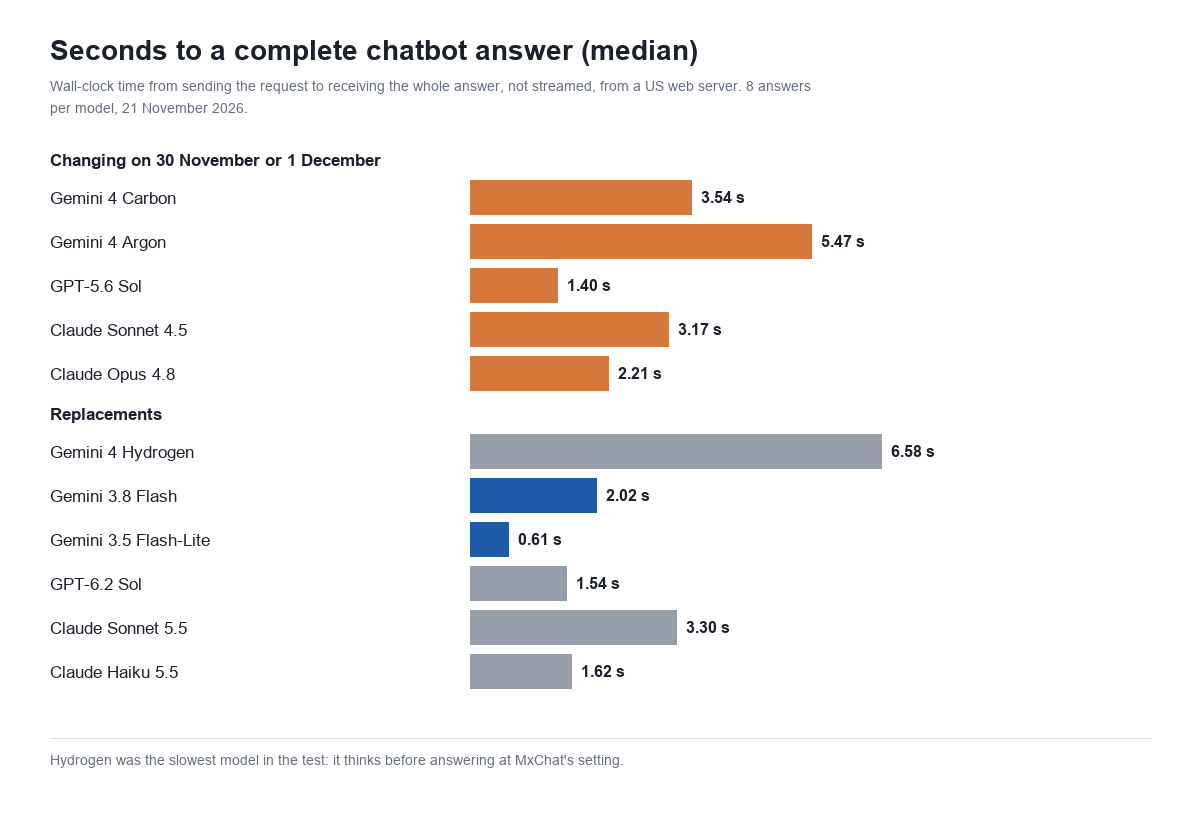
| Gemini 4 Carbon | 4,227 | 118 | $9.63 | $19.27 | $12.94 | 3.54 s | 8 / 8 |
| Gemini 4 Argon | 4,227 | 108 | $9.53 | $19.06 | $10.88 | 5.47 s | 8 / 8 |
| Gemini 4 Hydrogen | 4,227 | 91 + 514 thinking | $10.88 | $10.88 | $7.52 | 6.58 s | 7 / 8 |
| Gemini 3.8 Flash | 4,189 | 93 | $3.49 | $3.49 | $2.03 | 2.02 s | 8 / 8 |
| Gemini 3.5 Flash-Lite | 4,189 | 46 | $1.37 | $1.37 | $0.83 | 0.61 s | 8 / 8 |
| GPT-5.6 Sol | 4,115 | 45 | $17.36 | $21.93* | $3.48* | 1.40 s | 8 / 8 |
| GPT-6.2 Sol | 4,115 | 57 | $8.80 | $8.80 | $0.96 | 1.54 s | 8 / 8 |
| GPT-6.1 Terra | 4,115 | 47 | $4.35 | $4.35 | $0.51 | 1.69 s | 8 / 8 |
| Claude Sonnet 4.5 | 4,555 | 119 | $15.45 | Retired | – | 3.17 s | 8 / 8 |
| Claude Sonnet 5.5 | 6,921 | 359 | $15.13 | $15.13 | – | 3.30 s | 8 / 8 |
| Claude Opus 4.8 | 6,919 | 117 | $32.06 | $32.06 | – | 2.21 s | 8 / 8 |
| Claude Opus 5.5 | 6,921 | 352 | $30.12 | $30.12 | – | 3.52 s | 8 / 8 |
| Claude Haiku 5.5 | 6,921 | 307 | $0.74 | $0.74 | – | 1.62 s | 8 / 8 |
* GPT-5.6 Sol’s December figures assume the pre-promotion $5 / $30 returns, with cached input at $0.50. OpenAI has not published the December price. At the promotional rate a repeat cost $2.60. Output tokens on Sonnet 5.5, Opus 5.5 and Haiku 5.5 include hidden thinking, which those models do by default; their visible answers were about as long as the others’.
“Key fact present” means the answer named the thing the question was about (the order lookup, Pinecone, Slack, OpenRouter). It checks that the model used the knowledge base, not that the answer was well written. Every model passed except one Gemini 4 Hydrogen request, which returned HTTP 200 after 35 seconds with no text and no tokens. A plugin shows that to the visitor as an empty reply, so it counts as a miss.
Gemini 4 Carbon and Argon: double from 1 December
Google priced both models at $2 / $10 as an introductory rate through 30 November, and its pricing page lists $4 / $20, with cached input at $0.20, from 1 December. Nothing about the model changes, so every token costs exactly twice as much. On our request that is $9.63 to $19.27 per 1,000 new answers on Carbon and $9.53 to $19.06 on Argon. At 10,000 answers a month, a Carbon bot goes from about $96 to about $193.
At MxChat’s thinkingLevel: low, neither model reported any thinking tokens in this run. That is the cheap way to use them. Carbon’s default (high) setting spent 709 thinking tokens per answer in our Gemini 4 Carbon test, which roughly doubles the bill again. In December that comes to about $33 per 1,000.
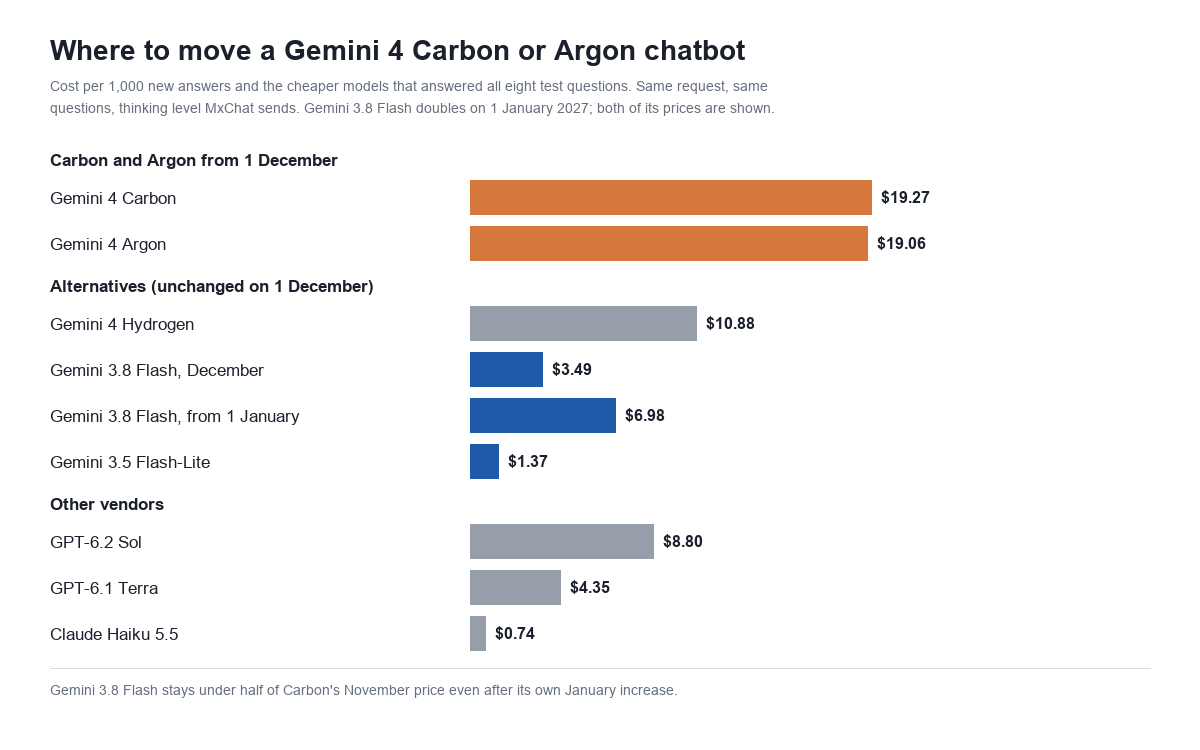
Where to move a Carbon or Argon bot
| Move to | Per 1,000 new answers, December | Versus Carbon in December | Median time | Catch |
|---|---|---|---|---|
| Stay on Carbon | $19.27 | – | 3.54 s | Double November’s bill |
| Gemini 4 Hydrogen | $10.88 | -44% | 6.58 s | Thinks at MxChat’s setting; slowest model here; 1 empty reply in 8 |
| Gemini 3.8 Flash | $3.49 | -82% | 2.02 s | Doubles to $6.98 on 1 January 2027 |
| Gemini 3.5 Flash-Lite | $1.37 | -93% | 0.61 s | Answers are about half as long |
For a support bot that answers from your own content, Gemini 3.8 Flash is the obvious move. It answered all eight questions, it was faster than Carbon, and it stays under Carbon’s November price even after its own January increase. Hydrogen was the surprise here: at the setting MxChat sends it thought for 514 tokens per answer, and it ended up slower and barely cheaper than Carbon at the November rate. Our Hydrogen test found the same pattern at launch.
Flash-Lite is the budget choice. Its answers averaged 46 tokens against Flash’s 93, which is fine for a short FAQ bot and thin for anything that needs a paragraph of explanation. If you want Gemini 4 quality without the thinking, our Gemini 4 Neon test rules Neon out: at $22.94 per 1,000 answers it costs more than Carbon does in December.
Gemini 2.5 Pro and 2.5 Flash: rerouted, not repriced upward
From 1 December Google sends every gemini-2.5-pro request to Gemini 3.8 Flash and bills it at Flash’s rates. gemini-2.5-flash requests go to Gemini 3.5 Flash-Lite at Flash-Lite’s rates. For 2.5 Pro users that is a price cut, from $1.25 / $10 to $0.75 / $3.75. For 2.5 Flash users the price stays $0.30 / $2.50. In both cases a different model writes the answers.
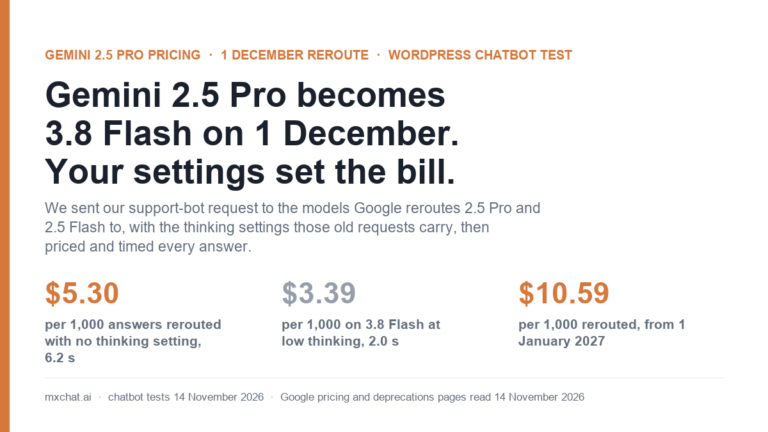
We could not call either model today. Our API key got HTTP 404 on both: “no longer available to new users”. The reroute only affects projects that were already using them. Our Gemini 2.5 Pro reroute test worked out what those projects will pay: about $5.30 per 1,000 answers if the request sends no thinking setting, and $3.39 at thinkingLevel: low. If you are still on a 2.5 model, choose Gemini 3.8 Flash yourself now. You get the same model, and you can pick its thinking setting instead of inheriting one.
GPT-5.6 Sol: the promotion ends, the new price is unknown
OpenAI’s pricing page says GPT-5.6 Sol’s promotional pricing “is available until November 30, 2026”. It lists $4 / $20 with cached input at $0.40, and it does not say what applies from 1 December. Before the August cut, Sol was $5 / $30, the history our GPT-5.6 Sol pricing post tracks. If that price returns, our 1,000 new answers go from $17.36 to $21.93, a 26% rise.
The better move does not depend on what OpenAI decides. GPT-6.2 Sol received the same 4,115 input tokens, answered all eight questions, took 1.54 seconds against 1.40, and cost $8.80 per 1,000 new answers. That is half the promotional price. On repeats, OpenAI’s cache served 4,026 of 4,029 tokens and the cost fell to $0.96. GPT-6.1 Terra did the same job for $4.35. Our GPT-6.2 test has the full comparison, including how strictly 6.2 Sol follows a prompt that tells it to answer only from the knowledge base.
Claude Sonnet 4.5: retired, and MxChat moves you automatically
Anthropic retires claude-sonnet-4-5-20250929 on 30 November 2026 and names Claude Sonnet 5.5 as its replacement. An API call to a retired model fails. MxChat 3.2.28 already carries the retirement date in its model catalog, and from 00:00 UTC on 30 November it sends any saved Sonnet 4.5 selection to claude-sonnet-5-5. We checked this on our own site by moving the plugin’s lifecycle clock to 30 November: the request went out as Sonnet 5.5. You do not need to change a setting, although choosing Sonnet 5.5 yourself makes the admin screen match what is being billed.
The bill barely changes: $15.45 per 1,000 answers on Sonnet 4.5 and $15.13 on Sonnet 5.5. That is not because the two models use the same tokens. Three things shift at once:
- The price per token falls by a third, from $3 / $15 to $2 / $10.
- The same request counts as 52% more input tokens: 6,921 on Sonnet 5.5 against 4,555 on Sonnet 4.5. The newer models use a different tokenizer. Opus 4.8, Opus 5.5 and Haiku 5.5 counted the same request at 6,919 to 6,921.
- Sonnet 5.5 bills three times the output: 359 output tokens per answer against 119, for visible answers of the same length (66 words on average for both). The difference is hidden thinking. Sonnet 5.5 reasons before it answers by default and bills that as output; on a separate probe it spent 243 of 347 output tokens thinking. Sonnet 4.5 and Opus 4.8 reported no thinking at all.
Sonnet 4.5 also never reported a cache read in our eight requests, while every Claude 5.5 model read the 1,212-token system prompt from cache from the second request on. If you were on Sonnet 4.5 for cost, Claude Haiku 5.5 answered every question for $0.74 per 1,000. For the Sonnet 5 increase Anthropic announced and then cancelled in September, see our Sonnet 5 pricing post.
Claude Opus 4.8 fast mode: removed, with no effect on MxChat
Anthropic’s fast-mode page gives 30 November 2026 as the removal date for Opus 4.8 fast mode. After that, a request to claude-opus-4-8 with speed: "fast" returns an error. Fast mode cost $10 / $50, twice the standard $5 / $25. MxChat never sends the speed parameter, so an MxChat bot on Opus 4.8 is unaffected and keeps running at standard speed.
We could not time fast mode today. Our API organisation has a fast-mode rate limit of zero and the request came back 429, so we did not measure it. On the standard tokens we did measure, fast mode would have cost about $64 per 1,000 answers. For speed and price, the comparison that matters is Opus 4.8 standard at $32.06 and 2.21 seconds against Opus 5.5 at $30.12 and 3.52 seconds. Opus 5.5 is cheaper per token but billed three times the output (352 tokens against 117), almost all of it hidden thinking, for visible answers of about the same length. For fast mode on Opus 5.5, see our Claude fast mode test.
What to change in MxChat before 1 December
| If your chatbot model is | Do this | Effect on 1,000 answers |
|---|---|---|
| Gemini 4 Carbon or Argon | Switch to Gemini 3.8 Flash | $19.27 → $3.49 in December, $6.98 from January |
| Gemini 2.5 Pro or 2.5 Flash | Pick Gemini 3.8 Flash or 3.5 Flash-Lite yourself | Same model Google would route you to, with a thinking setting you choose |
| GPT-5.6 Sol | Switch to GPT-6.2 Sol | $17.36 now (up to $21.93 in December) → $8.80 |
| Claude Sonnet 4.5 | Nothing required; select Sonnet 5.5 so the admin screen matches | $15.45 → $15.13 |
| Claude Opus 4.8 | Nothing required | Unchanged at $32.06 |
| OpenAI image models in a custom workflow | Move to gpt-image-2.6-sunburst or gpt-image-2.6-flare | See our GPT Image 2.6 test |
In MxChat, switching model is a choice in the plugin’s model settings, using your own API key for each vendor. The knowledge base, system prompt and live-agent handoff stay as they are. A new model does change wording and answer length, so after switching, ask your bot the five questions your visitors ask most and read the answers. The MxChat documentation covers the model settings, and MxChat Pro lists what the paid version adds.
If you call Gemini through Vertex AI, Argon’s doubling applies there too. Our Vertex AI pricing test has the Vertex rates. For the Gemini 3.8 Flash change on 1 January, see our Gemini 3.8 Flash pricing post.
FAQ
Which AI API prices change on 1 December 2026?
Gemini 4 Carbon and Gemini 4 Argon go from $2 / $10 to $4 / $20 per million tokens. Gemini 2.5 Pro requests are routed to Gemini 3.8 Flash and billed at $0.75 / $3.75. Gemini 2.5 Flash requests are routed to Gemini 3.5 Flash-Lite at the same $0.30 / $2.50. On 30 November, GPT-5.6 Sol’s $4 / $20 promotion ends, and Claude Sonnet 4.5 and Opus 4.8 fast mode retire.
How much more will a Gemini 4 Carbon chatbot cost?
Exactly twice as much, because every rate doubles. On our request (about 4,200 input tokens, a short answer) 1,000 new answers go from $9.63 to $19.27, and 1,000 repeated answers from $6.47 to $12.94.
What is the cheapest replacement for Gemini 4 Carbon?
Gemini 3.5 Flash-Lite cost $1.37 per 1,000 answers but writes short answers. Gemini 3.8 Flash cost $3.49, answered every question and was faster than Carbon. It rises to $6.98 on 1 January 2027, still a third of Carbon’s December price.
What will GPT-5.6 Sol cost after 30 November?
OpenAI has not published it. Its pricing page says only that the promotional price is available until 30 November 2026. Before the promotion the model cost $5 / $30. GPT-6.2 Sol costs $2 / $10 and answered the same questions for about half the promotional price.
Will my chatbot break when Claude Sonnet 4.5 retires?
Not in MxChat 3.2.28. The plugin sends a saved Sonnet 4.5 selection to Claude Sonnet 5.5 from 00:00 UTC on 30 November. Other plugins and custom code that call claude-sonnet-4-5-20250929 directly will get an error from that date.
Why does Claude Sonnet 5.5 use more tokens than Sonnet 4.5 for the same prompt?
The newer Claude models use a different tokenizer. Our request counted 6,921 input tokens on Sonnet 5.5 and 4,555 on Sonnet 4.5. Sonnet 5.5 also thinks before it answers, billed as output. The lower per-token price roughly cancels both out: $15.13 against $15.45 per 1,000 answers in our test.
Does MxChat use Claude fast mode?
No. The plugin does not send the speed parameter, so the removal of Opus 4.8 fast mode on 30 November does not affect an MxChat chatbot.
Is Gemini 2.5 Pro getting more expensive?
No, cheaper. From 1 December, requests to gemini-2.5-pro are answered by Gemini 3.8 Flash and billed at $0.75 / $3.75 instead of $1.25 / $10. The catch is that a different model is answering. New API projects already get a 404 for both 2.5 models.