What Is Conversational AI Explained Simply
Conversational AI is the secret sauce that lets computers actually talk with us—understanding what we mean, not just the specific words we type. It’s what powers the smart chatbots and voice assistants that can hold a real back-and-forth conversation, a world away from those old, rigid command-based systems.
What Is Conversational AI in Simple Terms?
Remember those frustrating phone menus? "Press one for sales, press two for support…" They don't understand you; they just listen for a specific command. Conversational AI is the exact opposite of that.
Imagine talking to a genuinely helpful expert. They get the nuances of what you’re saying, remember what you talked about a few minutes ago, and give you answers that actually make sense. That's the goal. Instead of just matching keywords, this technology figures out your intent—what you're really trying to do.
This makes the whole experience feel less like talking to a machine and more like a natural chat, whether you’re on a website or asking your smart speaker about the weather.
The Brains Behind the Conversation
So, how does it all work? At its heart, conversational AI blends a few powerful technologies to pull off this human-like magic. It’s not just following a script.
- Natural Language Processing (NLP): This is the engine that lets the AI read and make sense of human language, typos, slang, and all.
- Machine Learning (ML): The system learns from every single interaction. The more it talks to people, the smarter it gets at figuring out what they need and how to help.
- Contextual Awareness: This is a big one. It remembers the conversation's history. If you ask, "What’s the weather in Sydney?" and then follow up with "How about tomorrow?", it knows you’re still asking about the weather in Sydney.
Much of the technology's ability to create original, human-like text responses comes from Generative AI, which uses massive datasets to learn how to produce new and relevant content from scratch.
Conversational AI isn’t just about spitting out answers. It’s about understanding a user's entire journey, anticipating what they might need next, and guiding them to the right solution in a way that feels effortless and helpful.
Key Differences Between Standard Chatbots and Conversational AI
It's easy to lump all "chatbots" together, but the difference between a basic, rule-based bot and a true conversational AI platform is night and day. Think of it as the difference between a vending machine and a skilled barista. One follows a rigid set of instructions, while the other understands your request and can even offer personalized suggestions.
Here’s a quick breakdown of what sets them apart:
| Feature | Standard Chatbot | Conversational AI |
|---|---|---|
| Interaction Style | Follows a strict script or decision tree. | Engages in flexible, natural-sounding dialogue. |
| Understanding | Relies on keyword matching. | Understands user intent, context, and nuance. |
| Learning Ability | Static; requires manual updates. | Learns and improves from every conversation. |
| Context Memory | No memory of past interactions. | Remembers conversation history for a seamless flow. |
| Complexity | Can only handle simple, predictable queries. | Manages complex, multi-turn conversations. |
| User Experience | Often rigid and can be frustrating. | Personal, helpful, and highly engaging. |
Ultimately, while standard chatbots have their place for simple tasks, conversational AI delivers a far more sophisticated and satisfying experience that truly feels like a conversation.
More Than Just a Chatbot
This isn't just a niche technology; it's rapidly becoming a core part of how we interact with businesses. The global conversational AI market, currently valued at around $12 billion, is expected to explode to over $41 billion by 2030. That's a huge leap.
This growth shows a fundamental shift. We're moving away from clunky, impersonal interfaces and toward genuine, dialogue-driven experiences that build relationships and deliver real value. People prefer talking over clicking, and businesses are clearly taking note.
How Conversational AI Understands and Responds
The magic behind a great conversation with an AI isn't a single trick. It’s a rapid, four-part process humming along in the background, moving from simply hearing your words to truly understanding what you mean and crafting the perfect reply.
Think of it like a skilled librarian. You might mumble something about a "blue book about space," but they don't just point you to a random blue book. They use context, ask clarifying questions, and access their vast knowledge to figure out exactly which book you’re looking for. Conversational AI follows a similar, lightning-fast journey.
This visual breaks down that core journey from user input to the AI's intelligent response.
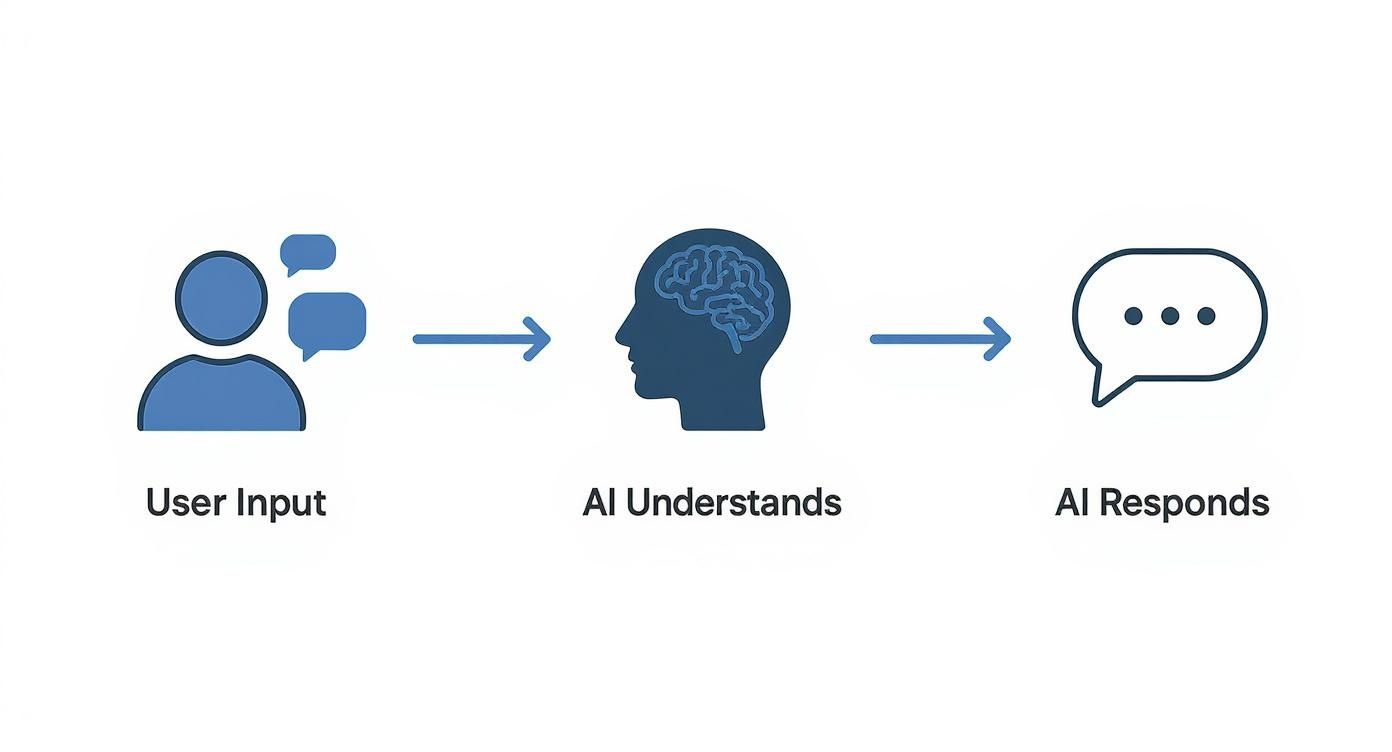
As you can see, the AI doesn't just react. It meticulously processes information through distinct stages to make sure its reply is both accurate and makes sense in the context of the conversation.
Step 1: Automatic Speech Recognition (ASR)
First things first, the AI has to listen. If you're talking to a voice assistant like Siri or Alexa, Automatic Speech Recognition (ASR) technology is the first thing that kicks in. Its only job is to translate the sound waves of your voice into text that a computer can read.
This is a lot harder than it sounds. ASR algorithms have to cut through background noise, make sense of different accents, and figure out the natural rhythm of speech. A solid ASR model is the bedrock of any voice interaction—if it gets this part wrong, the whole conversation falls apart before it even starts.
Step 2: Natural Language Understanding (NLU)
Once your words are converted to text, the AI's real "thinking" begins. This next stage, Natural Language Understanding (NLU), is where the system goes from just reading words to actually grasping their meaning. Think of NLU as a detective, carefully analyzing the text to figure out what you’re trying to do.
To pull this off, NLU focuses on two key things:
- Intents: This is your main goal. Are you trying to book a flight, check your order status, or ask for a product recommendation?
- Entities: These are the specific details that give your intent context. If your intent is to "book a flight," the entities would be the crucial bits of information like the destination ("New York"), the date ("next Tuesday"), and the number of passengers ("two").
By correctly pinpointing both intents and entities, NLU creates the structured data the AI needs to do something useful. It’s the difference between seeing the phrase "weather in Paris" and understanding that the user wants a real-time forecast for that specific city.
NLU is what lets an AI handle the messy, ambiguous nature of human language. It can tell the difference between "book a table" and "a book about tables," recognizing that the underlying goal is completely different in each case.
Step 3: Dialogue Management
With the user's intent now crystal clear, the Dialogue Management system takes the reins. This is the AI's brain, deciding what to do next. It keeps the conversation flowing, remembers what you said earlier, and figures out the most logical response.
For example, if NLU identifies the intent to book a flight but realizes the date is missing, the Dialogue Manager steps in. It will generate a clarifying question like, "I can help with that. For which date would you like to fly?" This component is also responsible for plugging into other systems—like checking a database for flight availability—to get the information it needs.
Basically, Dialogue Management is what makes the conversation feel like a cohesive, goal-oriented chat instead of a series of random, disconnected questions.
Step 4: Natural Language Generation (NLG)
Finally, once the Dialogue Manager has decided on a response, Natural Language Generation (NLG) turns that decision back into human-like language. It’s the final polish that makes the interaction feel natural.
Instead of just spitting out raw data like "flight_789, status: confirmed," NLG crafts a complete, conversational sentence. It builds grammatically correct phrases that are easy to understand, whether it's text for a chatbot or a synthesized voice for an assistant. This is how you get a friendly, helpful reply like, "Okay, your flight to New York on Tuesday is confirmed!"
The Core Technologies Powering the Conversation
Ever wonder what’s actually happening under the hood of a sophisticated chatbot? It’s not just one piece of tech, but a whole suite of powerful tools working in concert. These are the components that elevate a simple, scripted bot into an intelligent partner that can actually hold a conversation.
At the very foundation is Machine Learning (ML). This is what gives the AI the ability to learn from experience. Instead of a developer trying to hard-code an answer for every possible question, ML algorithms are fed huge volumes of real-world conversations. The AI sifts through this data, spotting patterns and learning what makes a good or bad response.
It’s a bit like training a new sales rep. You wouldn't just hand them a script and hope for the best. You'd have them shadow your top performers, listen to their calls, and absorb how they handle tricky situations. ML does the same thing for the AI, allowing it to learn the art of conversation by observing, not just by following rigid rules.

The Rise of Large Language Models
Layered on top of ML, we have Large Language Models (LLMs)—and this is where things get really interesting. LLMs are a newer, far more powerful type of AI trained on an absolutely staggering amount of text and code from the internet. This massive training exercise gives them an incredible, almost intuitive, command of language, from grammar and style to subtlety and nuance.
Thanks to LLMs, modern conversational AI can do some amazing things:
- Write like a person: They can generate completely new sentences that are coherent, relevant, and sound natural.
- Grasp complex questions: They look past simple keywords to figure out what you really mean.
- Summarize long texts: They can read a dense document and give you the key takeaways in seconds.
- Translate with accuracy: Their deep understanding of language structure makes them powerful translators.
If ML provides the ability to learn, the LLM is the super-intelligent brain that results from all that learning. It brings the raw linguistic talent and world knowledge to the table.
Think of an LLM as a combination of an enormous library and a language expert who has read every single book inside. It doesn't just recall facts; it understands the connections between ideas, allowing it to generate truly insightful responses.
Fueling the Engines with High-Quality Data
Here's the catch: both ML and LLMs are completely reliant on data. The quality of the information you feed the AI directly dictates how well it will perform. It’s the fuel for the engine. Put in bad fuel, and the engine will sputter. But give it premium, high-octane fuel, and it will run beautifully.
For a business, this “fuel” usually consists of its own internal information:
- Past customer service chats and emails
- Internal knowledge bases and product guides
- Website FAQs and help articles
- Company-specific documentation
By training the AI on this specific information, it becomes a true expert on your business. More advanced platforms use special techniques to ensure the AI's answers are always based on verified company facts. This process is often supercharged by systems that can pull in real-time information, which you can learn more about here: https://mxchat.ai/what-is-retrieval-augmented-generation/
Getting the most out of these technologies isn't just about having the data, though. It also requires skillful communication with the AI. Using specific prompt engineering techniques is crucial for guiding the model to give you the exact type of response you're looking for. By carefully crafting how you ask the question, you can steer the AI’s output to match the perfect tone, style, and content for any task.
Seeing Conversational AI in the Real World
The power of conversational AI isn't some far-off concept; it's a practical tool that's already reshaping how businesses operate and how we get things done every day. From banking to shopping, this technology is solving real problems in ways that just feel natural and helpful. Let's look at where it's already making a difference.

Chances are, you’ve already used it without a second thought. When you ask a smart speaker for the weather, track a package through a website's chat window, or get a fraud alert via text, you're interacting with conversational AI. These simple tasks show off its core strength: giving you instant, accurate information through a simple back-and-forth.
But its potential goes way beyond these basics, offering some really smart solutions across major industries.
Transforming the Customer Experience in E-commerce
Online shopping can feel like searching for a needle in a haystack. With thousands of products, finding the right one is a huge challenge. Conversational AI is stepping in to act like a skilled personal shopper, guiding customers through all that noise to find exactly what they need.
Instead of a generic search bar, e-commerce sites now use AI assistants that ask smart, clarifying questions. Let’s say you’re looking for running shoes. An AI might ask:
- "What kind of surface will you be running on? Trail or road?"
- "Are you looking for a specific brand or feature, like extra cushioning?"
- "What's your weekly mileage like?"
Based on your answers, it serves up a handful of perfect recommendations. It turns a frustrating search into a personalized consultation. This not only makes for a better shopping experience but also drives sales, because customers feel understood and confident in their purchase. It's like having an in-store expert on call, 24/7.
By understanding a customer's needs and preferences through natural conversation, businesses can move beyond simple transactions and start building genuine relationships. This shift is crucial for fostering loyalty in a crowded marketplace.
Streamlining Operations in Healthcare
The healthcare industry is bogged down with administrative tasks that eat up valuable time for both patients and providers. Conversational AI is taking over many of these routine jobs, freeing up staff to focus on what matters most: patient care.
Appointment scheduling is a perfect example. A virtual assistant can sync with a patient's calendar, find open slots with the right doctor, and book an appointment—all within a simple chat. It can also handle pre-visit tasks like filling out intake forms or answering common questions about insurance.
On top of that, AI-powered systems can send out automated appointment reminders and follow-up care instructions. This makes sure patients have the info they need, which dramatically reduces no-show rates and smooths out the entire operational flow for clinics and hospitals.
Modernizing Financial Services
Banks and other financial institutions are using conversational AI to offer secure, personalized support at any hour. No more waiting on hold to handle simple tasks or get answers to urgent questions.
Here are just a few ways banking AI assistants are making an impact:
- 24/7 Account Support: Instantly check your balance, review recent transactions, or report a lost card.
- Personalized Financial Insights: The AI can analyze your spending habits and offer genuinely helpful tips, like, "You've spent $200 on subscriptions this month. Would you like to review them?"
- Fraud Detection: An AI can spot unusual activity and immediately start a conversation with you to verify if a transaction is legitimate.
These tools provide the immediate help customers now expect, all while adding a layer of proactive, personalized guidance. For larger organizations, figuring out how to implement these systems is the next big step. You can learn more about deploying advanced chatbots for enterprise and see how they scale to meet complex business needs. This technology has moved past being a novelty and is now a core part of any modern customer service strategy.
Why Businesses Are Adopting Conversational AI
Beyond the cool technology, the real question is always about the bottom line. What can conversational AI actually do for a business? Its rapid adoption isn't just a fad; it's a smart response to what customers now expect and the constant pressure to work more efficiently.
Companies are quickly learning that a well-built conversational AI system delivers real, measurable value everywhere. From customer support agents on the front lines all the way to back-office operations, the benefits are too good to ignore. This isn't just about sticking a chat widget on your website—it’s about fundamentally changing how you connect with, help, and understand your customers.
Let's break down the four key advantages that are making this technology a must-have.
Delivering an Exceptional Customer Experience
In today's market, customer experience is the main battleground. People want answers now, not tomorrow, and they expect solutions without any friction. Conversational AI delivers exactly that by providing 24/7, on-demand support that solves problems the moment they happen.
Think about it: instead of sitting on hold or digging through a clunky FAQ page, a customer gets an immediate, correct answer just by asking. A properly trained AI can handle a massive range of questions, from "Where's my order?" to "How does this feature work?" with perfect consistency every time.
The end result? A quicker, smoother interaction that tells customers you respect their time. This instant gratification doesn't just improve satisfaction scores; it builds the kind of trust that turns a first-time buyer into a loyal fan.
Achieving Significant Operational Efficiency
One of the most powerful, immediate wins is automating all the routine, repetitive stuff. Every support team knows the feeling of answering the same five questions over and over, all day long.
Conversational AI becomes your first line of defense, automatically handling that high volume of common inquiries. This frees up your human agents to focus their brainpower on the tricky, high-stakes issues that require real empathy and creative problem-solving. By letting the AI handle the basics, your team becomes far more productive and can focus on the work that actually moves the needle. To see how this works in practice, check out our guide on how to automate customer service, which details the strategies behind it.
Gaining Invaluable Customer Insights
Every single conversation you have with a customer is a treasure trove of data. But let's be realistic—no one has the time to manually read thousands of chat transcripts to find patterns. Conversational AI totally changes the game by capturing and making sense of these interactions automatically and at scale.
The technology can spot recurring frustrations, common questions, and new customer needs that you might have otherwise missed. These insights are pure gold for improving your entire business.
- Product Teams: Find out which features are confusing people or what new ideas they're begging for.
- Marketing Teams: Hear the exact words customers use to describe their problems, which helps you create much better messaging.
- Support Teams: See where your help articles are falling short or where agents need more training.
Scaling Support Capabilities Effortlessly
Finally, conversational AI lets you grow your customer support without your costs or team size spiraling out of control. When you launch a new product or hit a busy season, the number of customer questions can explode overnight.
Instead of rushing to hire and train temporary help, an AI system can handle thousands of conversations at the same time without blinking. This flexibility means your service quality stays high, even when things get hectic. It’s a super cost-effective way to grow and handle whatever comes your way, making sure you’re always there for your customers, no matter how big you get.
Getting Started with Conversational AI
Bringing conversational AI into your business is more achievable than ever, but a smart strategy is what separates a successful project from a frustrating one. The journey doesn't start with the tech—it starts with a clear business problem you need to solve.
A common pitfall is trying to build something overly complex right out of the gate. A better approach? Pinpoint a high-impact, low-complexity starting point.
Look for a common, high-volume task that’s bogging down your team. Is your support staff drowning in the same five questions every day? Are your sales reps spending more time qualifying leads than actually selling? These are perfect candidates for your first conversational AI project.
By automating answers to frequently asked questions or creating a simple lead qualification bot, you get a quick, measurable win. This early success not only proves the value of the investment but also gives you crucial insights for more ambitious projects down the road.
Choosing Your Implementation Path
Once you’ve locked in a use case, the next big question is how to build it. You have two main routes to consider, each with its own pros and cons.
Build from Scratch: This means hiring developers to code a completely custom solution using complex AI frameworks. It offers total control, but it also demands a massive investment in time, technical talent, and ongoing maintenance. This path really only makes sense for large enterprises with truly unique, niche requirements.
Use a Platform: For the vast majority of businesses, a no-code platform like MxChat is the way to go. These tools give you all the building blocks you need to design, train, and launch a powerful AI assistant without ever touching a line of code. It’s a game-changer for speed and cost.
The platform approach opens up powerful AI to everyone, not just developers. It allows the people who know the business best—your marketing, sales, or support teams—to build and manage their own conversational agents. This shrinks deployment timelines from months to just a few days.
Platforms also take care of all the tricky backend stuff for you, making sure your AI is secure, can handle growing traffic, and is always running on the latest technology. If you’re curious about what that process looks like, our guide on how to build a chatbot breaks it down step-by-step.
At the end of the day, success starts with a well-defined problem and the right build path. From there, it’s all about training your AI with good data and embracing a mindset of continuous improvement, making sure your new assistant gets smarter and more helpful over time.
Got Questions About Conversational AI? We've Got Answers.
As you start to explore conversational AI, a few questions always pop up. It's natural to wonder how this tech is different from the tools we're used to, whether it's secure, and how it fits in with a human team. Let's tackle those head-on.
How Is Conversational AI Different From a Regular Chatbot?
The simplest way to think about it is intelligence. A regular chatbot is like a rigid phone tree; it operates on a very strict script and keyword matching. If you ask something it wasn't programmed for, it hits a dead end.
Conversational AI, on the other hand, is more like talking to a seasoned expert. It uses sophisticated AI to grasp the intent and context behind what you're saying. This allows it to handle nuanced questions, learn from conversations, and carry on a genuinely natural dialogue.
Can We Trust Conversational AI With Sensitive Customer Data?
Absolutely, provided you choose the right platform. Enterprise-level conversational AI is built from the ground up with security in mind. Think robust measures like end-to-end encryption, data anonymization, and strict adherence to regulations like GDPR.
When you're evaluating solutions, make security a non-negotiable part of the conversation. A provider that takes these protocols seriously ensures that all your sensitive customer information stays locked down.
The goal isn't replacement but collaboration. Conversational AI excels at handling high-volume, repetitive questions instantly, which frees up human agents to focus on what they do best—solving complex, emotionally charged problems that require empathy and critical thinking.
Will Conversational AI Replace Human Customer Service Agents?
This is a common concern, but the reality is much more of a partnership. The technology handles the predictable so your team can manage the exceptional.
This creates a powerful dynamic where AI fields routine inquiries around the clock, letting your human experts step in for higher-value, more complex situations. Ultimately, this teamwork boosts both your team's efficiency and your customers' happiness. For example, 73% of users report higher satisfaction when an AI resolves their issue instantly, which in turn frees up the queue for agents to tackle the tougher cases.
Ready to see how a powerful, no-code AI assistant can transform your WordPress site? MxChat lets you deploy intelligent chatbots that automate support, capture leads, and boost sales 24/7.
Build your first AI agent today