Gemini 4 Neon Pricing: $3/$15, Tested on a Chatbot
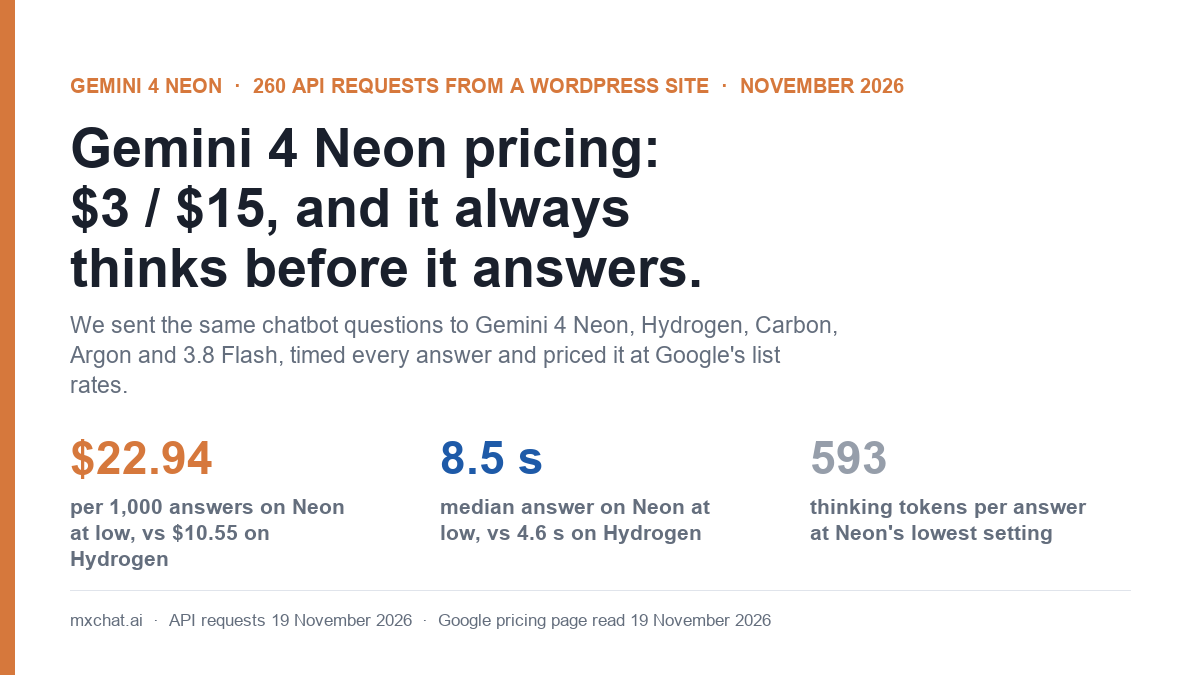
Gemini 4 Neon pricing on the Gemini API is $3.00 per million input tokens and $15.00 per million output tokens, with thinking tokens billed as output. Google released the model on 18 November 2026 as the middle of the Gemini 4 family, between Hydrogen and Carbon. Batch and Flex requests cost half, Priority costs 80% more, cached input is $0.15, and there is no free tier.
The rate card tells you what a token costs. It does not tell you how many tokens the model spends on one answer. On 19 November 2026, the day after release, we sent the request our own WordPress chatbot sends to Gemini 4 Neon at every thinking level and service tier it accepts, beside Gemini 4 Hydrogen, Carbon, Argon and Gemini 3.8 Flash. We timed every answer and priced the tokens Google reported.
The short answer: Neon thinks before every answer, at every setting. At thinkingLevel: low, which is what MxChat sends, it cost $22.94 per 1,000 answers and took a median of 8.5 seconds. Gemini 4 Hydrogen at the same setting cost $10.55 in 4.6 seconds, and Gemini 4 Carbon cost $9.46 in 3.5 seconds. All of them answered every question correctly. Neon is built for long coding and analysis jobs, and on a short support answer you pay for reasoning the visitor does not need.
Gemini 4 Neon pricing: the rate card
These are the prices on Google’s Gemini API pricing page as we read it on 19 November 2026, per million tokens. The model ID is gemini-4-neon. The price is flat across the whole 1M-token context window, and Google lists no introductory period or scheduled change.
| Tier | Input | Output (incl. thinking) | Cached input | Free tier |
|---|---|---|---|---|
| Standard | $3.00 | $15.00 | $0.15 | No |
| Batch | $1.50 | $7.50 | $0.075 | No |
| Flex | $1.50 | $7.50 | $0.075 | No |
| Priority | $5.40 | $27.00 | $0.27 | No |
Six details in the small print matter for a chatbot:
- Output includes thinking tokens. The reasoning the model does before it answers is billed at $15 per million. Visitors never see it.
- Paid tier only. Hydrogen has a rate-limited free tier. Neon, Carbon and Argon do not.
- Implicit caching only. Google discounts cached input by 95% when a request starts with a prefix it has seen recently, on prompts of at least 4,096 tokens. You cannot create an explicit cache: the model list our key returned shows
generateContent,countTokensandbatchGenerateContentfor Neon, but notcreateCachedContent. - Google Search grounding is 5,000 free requests a month, shared across all Gemini 3 and newer models, then $14 per 1,000. One visitor question can trigger more than one search.
- Context window: 1,048,576 tokens shared between input, thinking and output, with up to 65,536 output tokens per synchronous request. Carbon and Argon cap output at 32,768.
- Four thinking levels: low, medium, high (the default) and xhigh. Carbon and Argon default to medium and stop at high.
Where Neon sits in the Gemini lineup
Google describes Neon as sitting between Hydrogen and Carbon. On price that is only true from 1 December. Today Neon is the most expensive Gemini 4 model per token, because Carbon and Argon are still on their introductory rates.
| Model (Standard tier) | Input / output today | From 1 Dec 2026 | From 1 Jan 2027 |
|---|---|---|---|
| Gemini 3.8 Flash | $0.75 / $3.75 | $0.75 / $3.75 | $1.50 / $7.50 |
| Gemini 4 Hydrogen | $1.50 / $7.50 | $1.50 / $7.50 | $1.50 / $7.50 |
| Gemini 4 Neon | $3.00 / $15.00 | $3.00 / $15.00 | $3.00 / $15.00 |
| Gemini 4 Argon | $2.00 / $10.00 | $4.00 / $20.00 | $4.00 / $20.00 |
| Gemini 4 Carbon | $2.00 / $10.00 | $4.00 / $20.00 | $4.00 / $20.00 |
How we tested it
The request was the one MxChat builds for a Gemini model. We read it from the plugin’s source (version 3.2.28) before writing the test: the site’s system prompt and the knowledge-base excerpts go in a first user turn that begins [System Instructions], with the excerpts between the ===== OFFICIAL KNOWLEDGE DATABASE CONTENT ===== markers the prompt names. A short model turn acknowledges it, and the visitor’s question follows. The plugin also sends temperature: 0.7, topP, topK and maxOutputTokens: 8192. The whole request is about 4,200 input tokens.
- Four real questions from our support inbox: WooCommerce order lookups, whether Pinecone is required for the knowledge base, human handoff to Slack or Telegram, and which API keys and models can be used. Each has four knowledge-base excerpts of about 4,000 characters.
- Calls went to the Gemini API
generateContentendpoint with our site’s paid key, from our WordPress server in the US, not streamed, between 09:09 and 09:23 UTC. - Fifteen setups: Neon at default, low, medium and xhigh, on Flex at default and low, and on Priority; Hydrogen, Carbon and Argon at default and low; Gemini 3.8 Flash at default and low.
- Neon at default and low and Hydrogen at default ran three passes (12 answers each). Neon at xhigh and on Priority ran one pass (4 answers each). Everything else ran two (8 answers each). The first pass of a question is a new answer; later passes repeat it and can read Google’s implicit cache.
- 124 answers in this layout. We also ran 116 answers with the prompt in Gemini’s
systemInstructionfield, which is what our first pass used before we checked the plugin source, and 14 short probe calls. 260 requests in total, 250 answered, about $3.72 at list prices. - Cost is the token counts Google returned, priced at the list rate for the tier Google said it served. “New answer” prices ignore the cache; “repeat” prices use the cached tokens Google reported. Google’s API reports tokens, not charges.
- Every answer was checked for the one fact its question turns on, and we read a sample of Neon’s answers in full.
What 1,000 answers cost
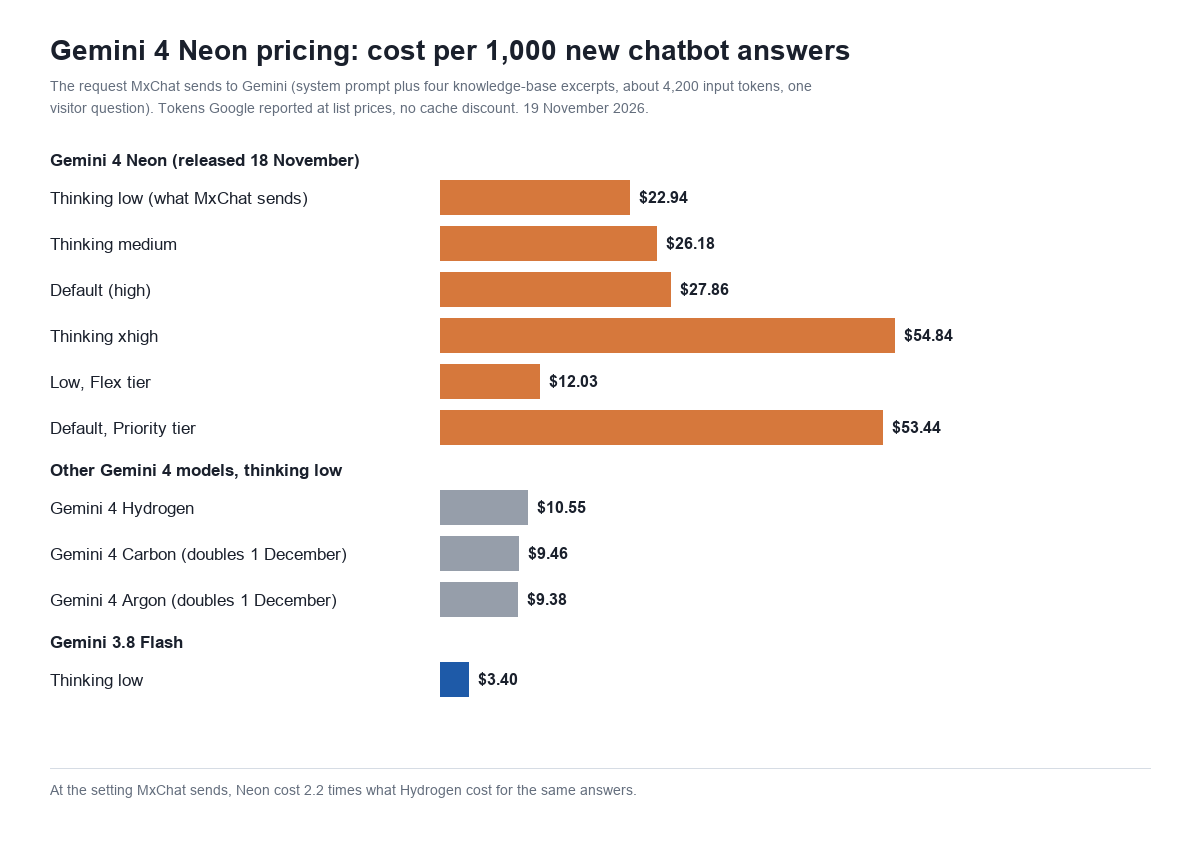
| Setup | Per 1,000 new answers | Per 1,000 repeats | Median time | Thinking tokens per answer |
|---|---|---|---|---|
| Neon, thinking low | $22.94 | $17.29 | 8.47 s | 593 (408 to 988) |
| Neon, thinking medium | $26.18 | $20.11 | 9.67 s | 806 (534 to 1,344) |
| Neon, default (high) | $27.86 | $20.75 | 11.99 s | 915 (527 to 1,505) |
| Neon, thinking xhigh | $54.84 | not run | 23.53 s | 2,713 (1,413 to 3,844) |
| Neon, low, Flex tier | $12.03 | $9.51 | 15.92 s | 669 |
| Neon, default, Flex tier | $14.22 | $11.11 | 12.67 s | 957 |
| Neon, default, Priority tier | $53.44 | not run | 9.99 s | 1,045 |
| Hydrogen, thinking low | $10.55 | $7.32 | 4.64 s | 477 (338 to 661) |
| Hydrogen, default (high) | $17.71 | $14.66 | 8.55 s | 1,420 (865 to 2,512) |
| Carbon, thinking low | $9.46 | $5.41 | 3.47 s | 0 |
| Carbon, default (medium) | $17.28 | $13.45 | 12.57 s | 789 (466 to 1,259) |
| Argon, thinking low | $9.38 | $5.26 | 9.53 s | 0 |
| Argon, default (medium) | $9.42 | $5.39 | 13.72 s | 0 |
| Gemini 3.8 Flash, thinking low | $3.40 | $1.97 | 2.28 s | 0 |
| Gemini 3.8 Flash, default | $5.44 | $3.73 | 7.00 s | 544 (370 to 712) |
Where Neon’s money goes at low: of $22.94, the 4,200-token prompt costs $12.60, the visible answer of about 96 tokens costs $1.43, and the thinking costs $8.90. At the default level the prompt and answer cost about the same and the thinking rises to $13.72, for $27.86.
Compare that with Carbon at low. Carbon’s input rate is two-thirds of Neon’s today, and it reported no thinking tokens at all on these questions, so its bill is the prompt ($8.40) plus the answer ($1.05). Neon charges a higher rate and then adds about 600 thinking tokens on top.
The answers themselves were hard to tell apart. Neon at low wrote 61 words on average, Hydrogen 57, Carbon 65 and Flash 51. All 124 contained the fact the question turns on, none was cut off, and none refused. On the one question our knowledge base only half covers (which models can be chosen), every model named the providers and said it did not have a complete model list, which is the correct behaviour.
Neon thinks at every setting
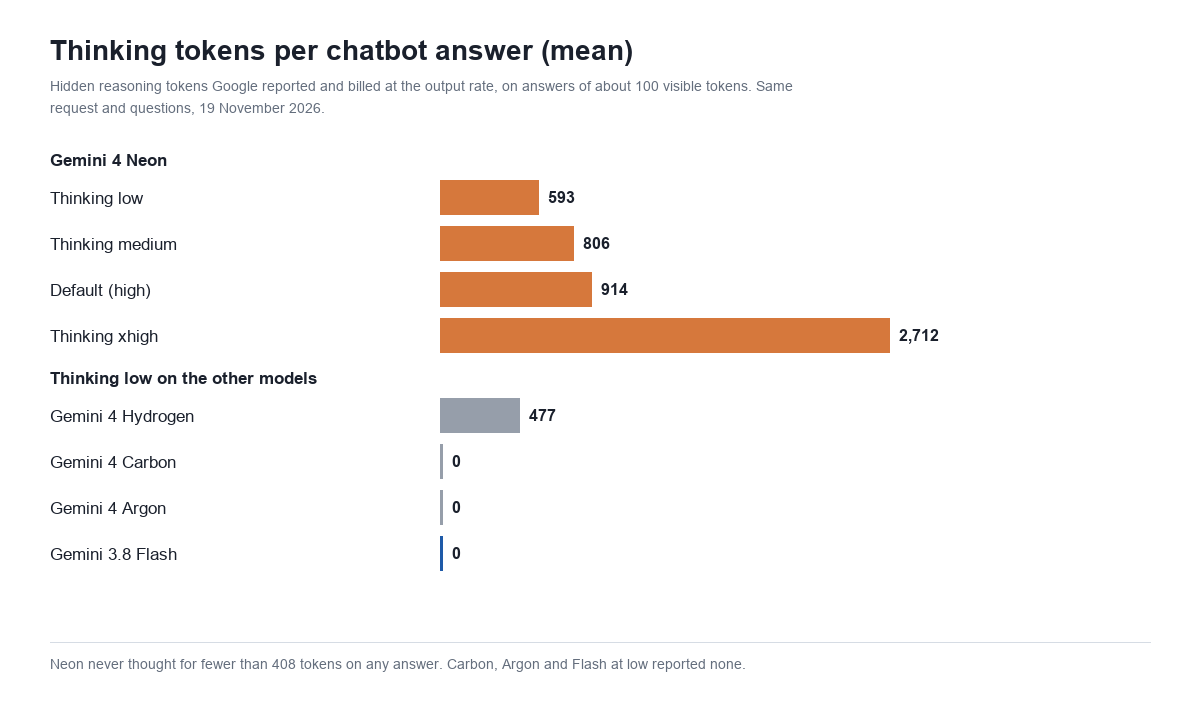
This is the result that decides the bill. On a support answer of about 100 tokens, Neon never thought for fewer than 408 tokens, at any level. We tried each way of turning thinking down:
What we sent to gemini-4-neon | What came back |
|---|---|
thinkingLevel: low | Accepted. 408 to 988 thinking tokens per chatbot answer. |
thinkingLevel: minimal | HTTP 400: “Thinking level MINIMAL is not supported for this model.” |
thinkingBudget: 0 | Accepted, then ignored. A request that only asked the model to say OK still used 86 thinking tokens, against 80 with no setting. |
thinkingLevel: xhigh | Accepted. 1,413 to 3,844 thinking tokens per chatbot answer and a median of 23.5 seconds. |
temperature: 0.2 | Accepted. Google’s migration guide says in-range sampling values are ignored on Gemini 4. |
temperature: 5 | HTTP 400: temperature must be between 0 and 2. |
serviceTier: priority | Accepted, and the response reports the tier as priority. |
serviceTier: flex | Accepted when capacity allowed. The response reports the tier as flex. |
Low is therefore the floor, and low still costs about $8.90 per 1,000 answers in thinking alone. Hydrogen behaves the same way with a lower floor (338 tokens) at half the rate. Carbon, Argon and Gemini 3.8 Flash reported zero thinking tokens at low on the same questions.
One number is worth a second look: Hydrogen’s default spent more thinking tokens than Neon’s default (1,420 against 915), on a cheaper model. Neon’s default still cost more per answer because its rates are double. If you run either model for live chat, set the thinking level yourself.
Speed: 8.5 seconds at best
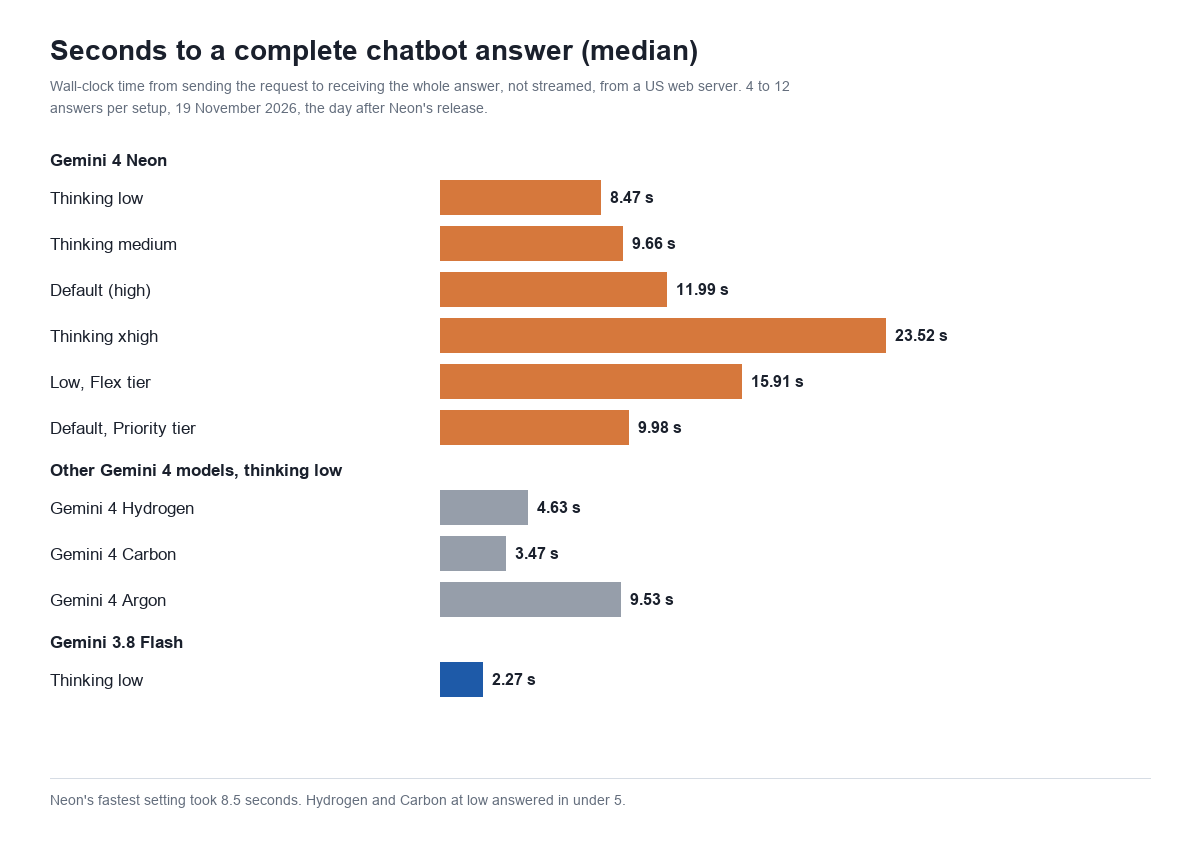
| Setup | Median | Fastest | Slowest | Answers |
|---|---|---|---|---|
| Neon, thinking low | 8.47 s | 6.10 s | 29.12 s | 12 |
| Neon, thinking medium | 9.67 s | 6.78 s | 29.53 s | 8 |
| Neon, default (high) | 11.99 s | 7.40 s | 41.41 s | 12 |
| Neon, thinking xhigh | 23.53 s | 15.94 s | 32.32 s | 4 |
| Neon, default, Priority tier | 9.99 s | 8.56 s | 14.85 s | 4 |
| Neon, low, Flex tier | 15.92 s | 7.11 s | 52.42 s | 8 |
| Hydrogen, thinking low | 4.64 s | 3.52 s | 21.87 s | 8 |
| Carbon, thinking low | 3.47 s | 2.74 s | 33.10 s | 8 |
| Argon, thinking low | 9.53 s | 5.39 s | 38.25 s | 8 |
| Gemini 3.8 Flash, thinking low | 2.28 s | 1.46 s | 10.80 s | 8 |
These are times to a complete answer, not to the first word. A streamed reply would start sooner, but the thinking happens before the first visible token, so most of the wait is still in front of the visitor. Neon’s quickest answer in the whole test took 6.1 seconds. That is fine for a coding agent working through a repository and slow for someone asking whether you ship to Canada.
Two cautions. This was the day after release, and Google’s servers were busy enough to refuse some Flex requests, so Neon may get faster. And every model here had at least one slow outlier above 20 seconds except Flash and Neon on Priority, so the slowest column says more about the day than about the model.
Implicit caching covers about half the prompt
Neon has no explicit cache, so the only discount for a repeated prompt is the implicit one. On repeat passes Google reported cached tokens on 15 of 16 Neon answers at default and low, and the pattern was exact: the cached count was the prompt length minus 2,049 tokens, every time, on all four Gemini 4 models. A 4,093-token prompt had 2,044 cached. A 4,426-token prompt had 2,377 cached.
| Setup | New answer | Exact repeat | Saving |
|---|---|---|---|
| Neon, thinking low | $22.94 | $17.29 | 25% |
| Neon, default (high) | $27.86 | $20.75 | 26% |
| Hydrogen, thinking low | $10.55 | $7.32 | 31% |
| Carbon, thinking low | $9.46 | $5.41 | 43% |
| Gemini 3.8 Flash, thinking low | $3.40 | $1.97 | 42% |
For a chatbot this matters less than the 95% headline suggests. The cache matches a prefix, and in a knowledge-base bot the excerpts change with every question, so a different question shares only the system prompt. Ours is about 800 tokens, well under the 4,096-token minimum. The repeat prices above apply when the same visitor question arrives again within the cache’s lifetime, or to later turns of one conversation. They do not apply to the next visitor’s different question. Thinking is never cached, which is why Neon saves the smallest share.
Flex halves the price and failed one request in five
Flex is the cheapest way to run Neon outside Batch: half the Standard rates for requests that can wait. At low thinking it cost $12.03 per 1,000 new answers, close to Hydrogen on Standard. Across both request layouts, 6 of our 32 Flex requests returned HTTP 503 (“This model is currently experiencing high demand”) on the first attempt, and each succeeded when retried 8 seconds later. Our single Flex probe call failed the same way. No Standard or Priority request failed.
Flex was also slower when it did answer: a median of 15.9 seconds at low, with one answer at 52 seconds. That rules it out for live chat and makes it a reasonable choice for background jobs such as summarising transcripts, provided your code retries.
Priority is the opposite trade. At $5.40 / $27.00 it cost $53.44 per 1,000 answers at default thinking, 92% more than Standard in our run, and its median was 9.99 seconds against 11.99. Its slowest answer was 14.9 seconds against 41.4 on Standard, so what you buy is a steadier wait more than a shorter one. That is four answers, so treat it as a first reading.
What changes on 1 December
Carbon and Argon leave their introductory prices on 1 December 2026 and double. Neon does not move. Here are the same measured answers at the prices Google has published for each date.
| Setup | Per 1,000 today | From 1 Dec 2026 | From 1 Jan 2027 |
|---|---|---|---|
| Gemini 3.8 Flash, thinking low | $3.40 | $3.40 | $6.81 |
| Hydrogen, thinking low | $10.55 | $10.55 | $10.55 |
| Argon, thinking low | $9.38 | $18.76 | $18.76 |
| Carbon, thinking low | $9.46 | $18.91 | $18.91 |
| Neon, thinking low | $22.94 | $22.94 | $22.94 |
| Neon, default (high) | $27.86 | $27.86 | $27.86 |
| Carbon, default (medium) | $17.28 | $34.57 | $34.57 |
Today Neon at low costs 2.4 times what Carbon at low costs. From 1 December the gap narrows to 21%, and Neon on its default becomes cheaper than Carbon on its default. Hydrogen at low stays the cheapest Gemini 4 option throughout, and Flash at low stays cheaper than all of them even after it doubles in January.
Does the request layout change the result?
Our earlier Gemini tests put the system prompt in Gemini’s systemInstruction field. MxChat does not: it sends the instructions as a first user turn. We ran both layouts today, 116 answers in the first and 124 in the second, so the comparison is like for like.
| Setup | MxChat layout | systemInstruction layout |
|---|---|---|
| Neon, thinking low | $22.94, 8.47 s | $21.20, 6.91 s |
| Neon, default (high) | $27.86, 11.99 s | $28.47, 10.76 s |
| Hydrogen, thinking low | $10.55, 4.64 s | $9.88, 3.74 s |
| Carbon, thinking low | $9.46, 3.47 s | $9.40, 3.43 s |
The layout adds 16 input tokens and makes no difference to correctness: all 240 answers held the right fact in both. Neon and Hydrogen at low thought a little more in the MxChat layout (593 against 484 tokens on Neon), which is within what we see from run to run. The ranking of the models is the same either way. The numbers in our Gemini 4 Hydrogen pricing test and Gemini 4 Carbon pricing test used the systemInstruction layout and remain a fair guide.
Neon, Hydrogen, Carbon or Flash for a support bot?
- Cheapest and fastest: Gemini 3.8 Flash with thinking at low. $3.40 per 1,000 answers now, $6.81 from January, 2.3 seconds, correct on every question. Details in our Gemini 3.8 Flash pricing test.
- A Gemini 4 model at a stable price: Hydrogen with thinking at low. $10.55 per 1,000 and 4.6 seconds, with no price change scheduled and a free tier for testing.
- Cheap until 30 November: Carbon at low, $9.46 and 3.5 seconds with no thinking tokens. It doubles on 1 December.
- Not for live chat: Neon. At its cheapest Standard setting it cost more than twice Hydrogen and took almost twice as long, for answers we could not tell apart. Use it where Google aims it: multi-step coding, long documents and analysis, where the thinking earns its cost.
For other providers on a similar request, GPT-6.2 Sol cost $10.71 per 1,000 answers at a median of 1.62 seconds in our GPT-6.2 pricing test the day before, and Claude Fable 5.2 cost $57.47 in our Claude Fable 5.2 pricing test. If you buy Gemini through Google Cloud, our Vertex AI pricing test covers what changes there.
Using Gemini 4 Neon in MxChat
MxChat 3.2.28 sends thinkingLevel: low to Gemini chat models, and we confirmed on our own site that the plugin returns that setting for gemini-4-neon. A bot running Neon through MxChat would get the $22.94 row, not the $27.86 default. Three things to know as of today:
- Neon is not in the plugin’s built-in Gemini model list, which offers Gemini 3.8 Flash as the recommended model and Gemini 4 Argon as the flagship.
- The plugin sends
maxOutputTokens: 8192. On Gemini 4 that cap covers thinking and the answer together, and Google’s migration guide suggests removing low caps. On our support questions it was never reached: the largest thinking count at low was 988 tokens, and no answer was cut off in 124. - The plugin does not send a
serviceTier, so every request runs on Standard. Flex and Priority are not available through MxChat today.
Our recommendation for a WordPress support bot on Gemini is unchanged: Gemini 3.8 Flash. Setup steps for Gemini keys are in the MxChat documentation, and MxChat Pro adds WooCommerce order lookups and human handoff, the features our test questions asked about.
Frequently asked questions
How much does Gemini 4 Neon cost?
$3.00 per million input tokens and $15.00 per million output tokens on the Standard tier, with thinking tokens billed as output. Cached input is $0.15. Batch and Flex are half price ($1.50 / $7.50) and Priority is $5.40 / $27.00. There is no free tier.
Is Gemini 4 Neon cheaper than Gemini 4 Carbon?
Not until 1 December 2026. Carbon is $2 / $10 through 30 November and $4 / $20 after. Per answer in our test, Neon at low cost $22.94 per 1,000 against Carbon’s $9.46 today and $18.91 from December, because Neon always thinks and Carbon at low did not.
Can I turn thinking off on Gemini 4 Neon?
No. thinkingLevel: minimal returns HTTP 400, and thinkingBudget: 0 is accepted but ignored. Low is the lowest setting, and at low Neon used 408 to 988 thinking tokens per support answer.
What is Gemini 4 Neon’s default thinking level?
High. Hydrogen also defaults to high, while Carbon and Argon default to medium. Neon adds an xhigh level, which cost $54.84 per 1,000 answers and took 23.5 seconds in our test.
Does Gemini 4 Neon support context caching?
Implicit caching only, with a 95% discount on cached input for prompts of at least 4,096 tokens. On our 4,200-token prompt Google cached everything except the last 2,049 tokens, about half, and only when the same question was repeated.
How fast is Gemini 4 Neon?
On a short support answer the day after release, a median of 8.5 seconds at low thinking and 12.0 at the default, to a complete non-streamed reply. The fastest single answer took 6.1 seconds. Hydrogen at low took 4.6 seconds and Gemini 3.8 Flash at low 2.3.
Is the Flex tier reliable on Gemini 4 Neon?
On 19 November, 6 of 32 Flex requests returned HTTP 503 on the first attempt and succeeded on a retry. Flex costs half the Standard rate and suits background work that can retry. It is not a fit for live chat.
Does MxChat support Gemini 4 Neon?
It is not in the built-in model list as of version 3.2.28. MxChat already sends thinking level low to Gemini models, which is the cheapest setting Neon accepts. For a support bot we recommend Gemini 3.8 Flash.
Tested 19 November 2026 on the Gemini API with our own paid key. Prices from Google’s Gemini API pricing page, read the same day. Prices and model behaviour change; check Google’s page before you budget.