DeepSeek V4 Pro Pricing: Peak vs Off-Peak, Tested
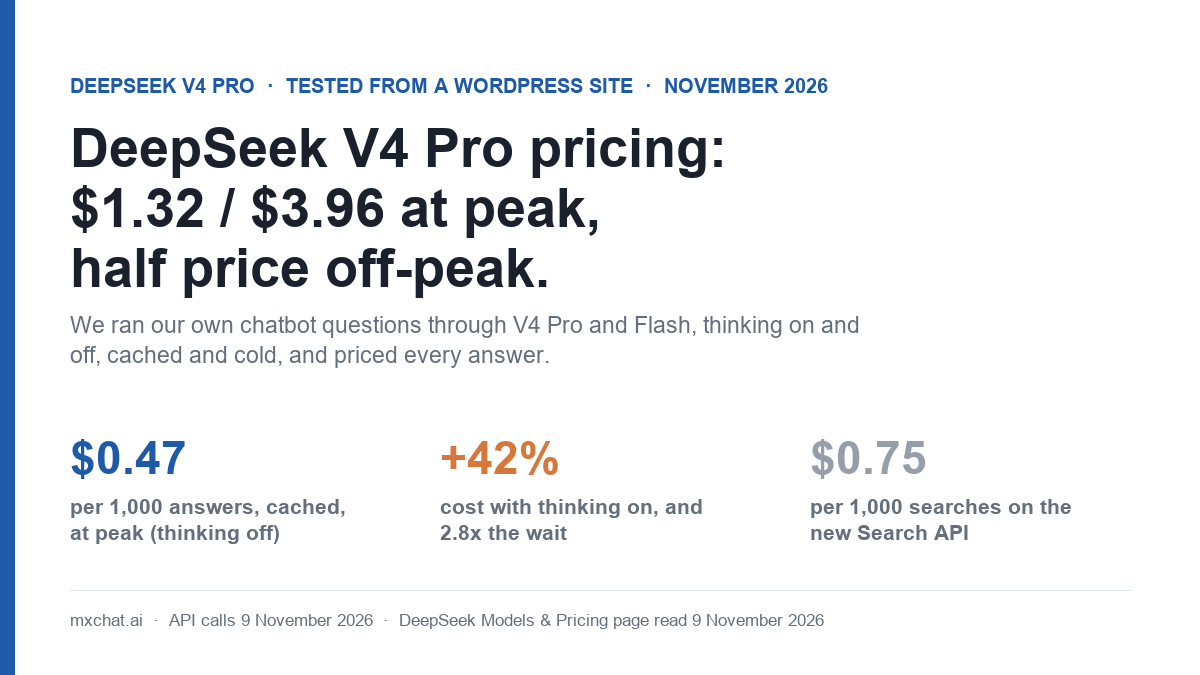
DeepSeek V4 Pro pricing is $1.32 per million input tokens and $3.96 per million output tokens at peak, and exactly half that off-peak: $0.66 and $1.98. A cache hit costs $0.044 at peak and $0.022 off-peak. That is DeepSeek’s own rate card, read on 9 November 2026, for the model it now serves as deepseek-v4-pro (version DeepSeek-V4-Pro-0813). It is about 4.4 times the price of DeepSeek Flash on input and 3.3 times on output.
Rate cards don’t tell you what a chatbot answer costs, so on Monday 9 November we ran V4 Pro the way a WordPress chatbot runs it. From our own server we sent real support questions with our site’s system prompt and four knowledge-base excerpts, with thinking on and off, at both effort levels, against DeepSeek Flash, and during DeepSeek’s peak window. We added a billing check: about 570,000 uncached tokens at peak and the same again off-peak, to see whether the account balance follows the clock. And we tried DeepSeek’s new Search API, which went on sale on 31 October at $0.75 per 1,000 requests.
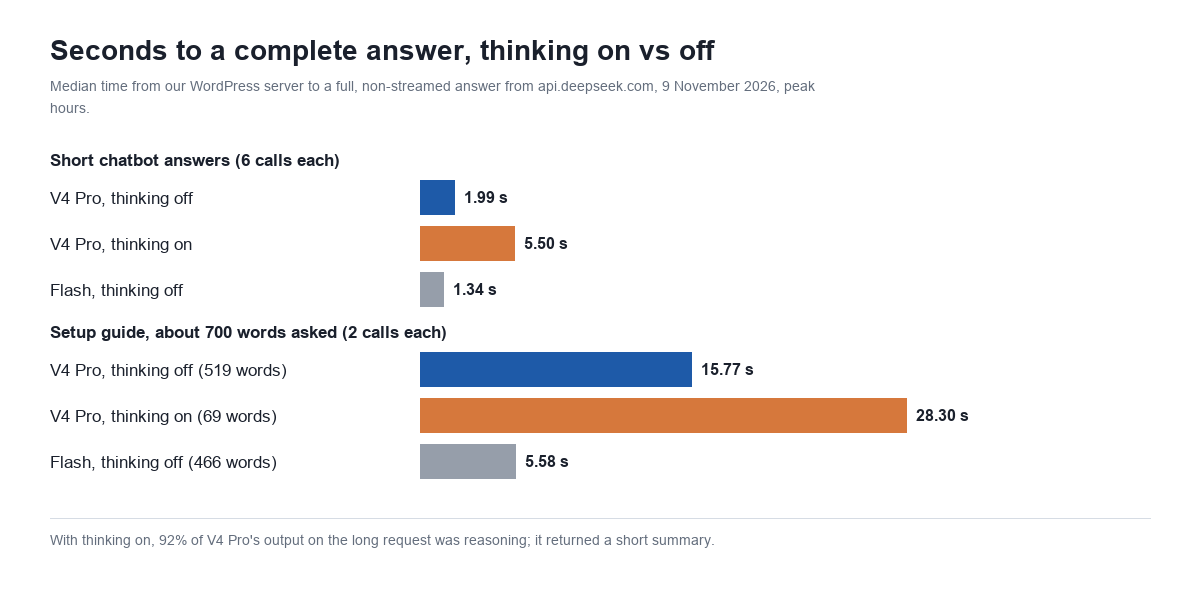
The short answer: with thinking off, which is how MxChat calls DeepSeek, V4 Pro cost $2.04 per 1,000 answers at peak and answered in a median 1.99 seconds. With the prompt cache warm it falls to $0.47 per 1,000, and off-peak halves either figure. Turning thinking on added 42% to the bill and nearly tripled the wait. The “low” effort setting didn’t change that at all: it spent the same 203 reasoning tokens per answer as the default.
DeepSeek V4 Pro pricing: the rate card
These rates come from DeepSeek’s Models & Pricing page, read on 9 November 2026, in US dollars per million tokens. Both models have a 1M-token context window and a maximum output of 384K tokens.
| Meter | V4 Pro, off-peak | V4 Pro, peak | Flash, off-peak | Flash, peak |
|---|---|---|---|---|
| Input, cache miss | $0.66 | $1.32 | $0.15 | $0.30 |
| Input, cache hit | $0.022 | $0.044 | $0.003 | $0.006 |
| Output (includes reasoning) | $1.98 | $3.96 | $0.60 | $1.20 |
| Concurrency limit | 500 | 2,500 | ||
| Vision input | Not supported | Supported | ||
Three lines on that page decide your bill more than the headline numbers do:
- Peak is a narrow window. Peak hours are 01:00 to 04:00 and 06:00 to 10:00 UTC, Monday to Friday, excluding Chinese public holidays. Everything else is off-peak, weekends included. That is 35 peak hours out of 168 a week, so 79% of the week is billed at half price. For a US site, 06:00 to 10:00 UTC is 1 am to 5 am Eastern: most American chatbot traffic lands off-peak without any effort.
- A cache hit is 1/30 of a cache miss. DeepSeek caches repeated prompt prefixes on its own, with no flag to set. On V4 Pro a cached token costs 3.3% of an uncached one, which matters more for a chatbot than the peak discount does (see below).
- Reasoning bills as output. V4 Pro’s thinking mode is on by default. Its reasoning tokens are billed at the full output rate, $3.96 per million at peak, even though the visitor never sees them.
The rates haven’t changed since DeepSeek’s August repricing, which we covered in what DeepSeek’s peak hours really cost. What changed since then is the line-up: deepseek-flash is now V4.1 Flash, the old V4 Flash names are routed to it, and V4 Pro is the only other model on the API. Our DeepSeek Flash pricing test covers the cheaper model.
How we tested it
Every call went from our WordPress server to api.deepseek.com/chat/completions with our site’s DeepSeek key, the same endpoint and key MxChat uses. Each request carried:
- our site’s real chatbot system prompt (3,478 characters);
- four knowledge-base excerpts from our own documentation and blog, about 16,000 characters, the shape of a retrieval chatbot’s context;
- one visitor question: WooCommerce order lookup, Pinecone versus storing embeddings in WordPress, or handing a visitor to a human on Slack or Telegram.
That came to about 4,200 input tokens per request. We ran each of the three questions twice on five setups: V4 Pro with thinking off, V4 Pro with thinking on at the default effort (high), V4 Pro with thinking on at reasoning_effort: "low", and Flash with thinking off and on. The grid ran between 09:24 and 09:28 UTC on a Monday, inside the peak window. Costs below use DeepSeek’s list rates applied to the token counts in each response’s usage object (prompt_cache_hit_tokens, prompt_cache_miss_tokens and completion_tokens). Times are wall-clock seconds for a complete, non-streamed answer.
Results: what one chatbot answer costs on V4 Pro
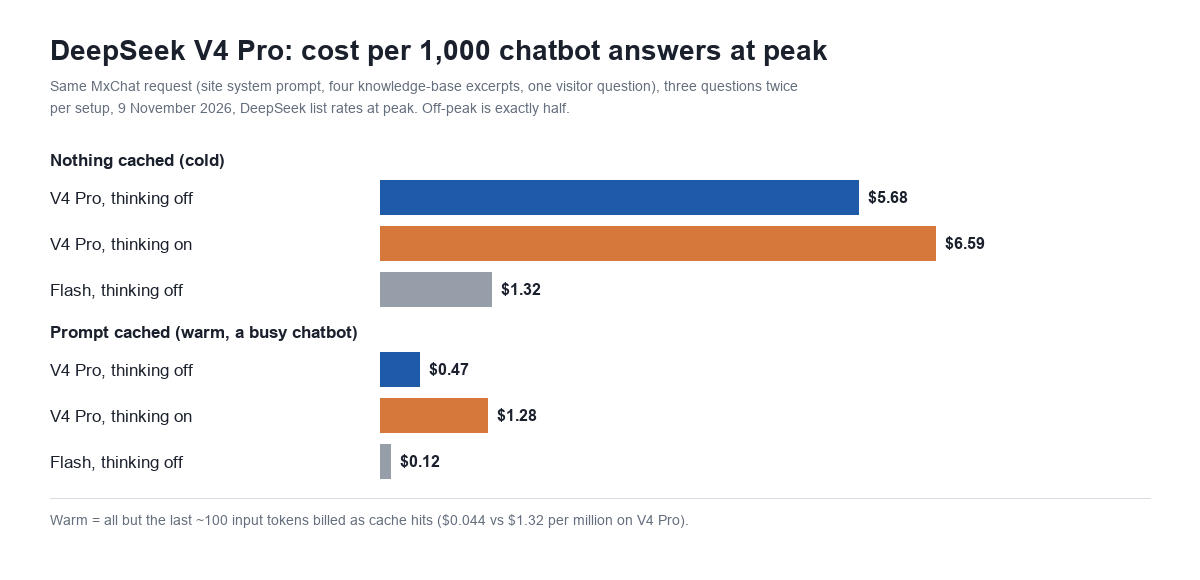
Because DeepSeek’s cache is automatic, the same request can cost very different amounts depending on whether the prefix was already cached. So the table shows three figures: what our calls actually billed (a mix of hits and misses), the cold cost with nothing cached, and the warm cost when everything but the last ~100 tokens is a cache hit, which is what a busy chatbot settles into.
| Setup (6 answers each) | As billed, peak | Cold, peak | Warm, peak | Warm, off-peak | Median time | Output tokens |
|---|---|---|---|---|---|---|
| V4 Pro, thinking off (MxChat’s setting) | $2.04 | $5.68 | $0.47 | $0.24 | 1.99 s | 40 |
| V4 Pro, thinking on (default, high) | $2.89 | $6.59 | $1.28 | $0.64 | 5.50 s | 243 (202 reasoning) |
| V4 Pro, thinking on, effort low | $1.22* | $6.50 | $1.29 | $0.65 | 3.71 s | 247 (203 reasoning) |
| Flash, thinking off | $0.48 | $1.32 | $0.12 | $0.06 | 1.34 s | 56 |
| Flash, thinking on (default) | $0.61 | $1.46 | $0.25 | $0.13 | 2.13 s | 163 (82 reasoning) |
Cost per 1,000 answers in US dollars. *The low-effort row billed less only because more of its prompts happened to be cached (4,139 of 4,185 input tokens on average, against 2,859 for thinking off). At equal caching, cold or warm, it costs the same as the default effort. That’s why the cold and warm columns are there.
Four things stand out:
- Input is the bill. With thinking off, a V4 Pro answer was 40 output tokens against 4,200 input tokens, and output was only 26% of what our calls billed. That’s why the cache moves the price more than anything else. Going from cold to warm cuts a V4 Pro answer from $5.68 to $0.47 per 1,000 at peak, a 92% drop. The peak discount only halves it.
- Thinking costs 42% more, and the visitor waits 2.8 times as long. V4 Pro with thinking on spent about 200 reasoning tokens before answering. The visible answers were no longer (28 words against 27), and in the first run of the WooCommerce question every setup, Flash included, named the add-on, the Pro requirement and the logged-in restriction from the excerpts.
- “Low” effort did nothing here. We expected
reasoning_effort: "low"to cut the reasoning. It averaged 203 reasoning tokens against 202 at the default. Its median time was lower (3.71 against 5.50 seconds), but the slowest single answer at low effort took 10.89 seconds, the slowest of the whole grid. On short chatbot questions, if you want V4 Pro to think less, turn thinking off. - Flash is a quarter of the price and faster. Warm, Flash costs $0.12 per 1,000 answers at peak against $0.47 for V4 Pro, and answered in 1.34 seconds against 1.99. For FAQ-style support, V4 Pro is a lot more money for answers our questions couldn’t tell apart.
Longer answers: where thinking mode backfires
We also asked each model for a complete setup guide, about 700 words, twice per setup. That’s the kind of request where you might reach for the bigger model.
| Setup (2 runs) | Cost per 1,000, peak | Median time | Output tokens | Words in the answer |
|---|---|---|---|---|
| V4 Pro, thinking off | $5.91 | 15.77 s | 892 | 519 |
| V4 Pro, thinking on | $6.34 | 28.30 s | 1,533 (1,415 reasoning) | 69 |
| Flash, thinking off | $0.96 | 5.58 s | 720 | 466 |
With thinking on, V4 Pro spent 92% of its output on reasoning and then handed back a three-step summary of 53 and 85 words, pointing to the documentation, instead of the guide we asked for. It cost more than the full guide with thinking off and took nearly twice as long. Our system prompt tells the bot to keep answers short. With thinking off, V4 Pro balanced that against the user’s explicit “about 700 words” and wrote the guide. With thinking on, it reasoned its way into the system prompt’s rule. That’s one prompt and two runs, so treat it as a warning rather than a law. It’s still the opposite of what most people expect when they pay for reasoning.
The cache: 99.5% of the prompt at 1/30 the price
To isolate caching, we sent the same request three times in a row to each model, with a random string at the start of the system prompt so nothing could already be cached.
| Call | V4 Pro: cached / uncached tokens | Flash: cached / uncached tokens |
|---|---|---|
| 1st (fresh prefix) | 0 / 4,374 | 0 / 4,375 |
| 2nd, 3 seconds later | 4,352 / 22 | 4,224 / 151 |
| 3rd | 4,352 / 22 | 4,224 / 151 |
On V4 Pro the input part of the request fell from $5.77 per 1,000 to $0.22 per 1,000 at peak once the prefix was cached. There’s no write fee: unlike Anthropic, which charges 1.25x input to write a cache entry, DeepSeek bills the first call as an ordinary miss. It needs no flag, either. The catch is that the prefix has to be byte-identical, so a chatbot gets the full benefit only if the system prompt comes first and stays fixed, with changing material (retrieved excerpts, chat history) after it. When an answer pulls different excerpts, only the system prompt is a hit, which is why our mixed grid billed between the cold and warm figures.
Does the bill really follow the clock?
DeepSeek’s discount depends on when a request arrives, so we checked it against the account balance. We sent 15 identical requests of about 38,000 uncached tokens each, a random string at the start of every prompt so nothing could be a cache hit, once inside the peak window (09:09 to 09:10 UTC, Monday) and again just after it closed (10:03 to 10:04 UTC). We read the balance from DeepSeek’s /user/balance endpoint every few minutes.
| Run | Uncached tokens | List price at that hour | Balance moved | Median time per call |
|---|---|---|---|---|
| Peak (09:09 UTC) | 569,497 | $0.752 | $0.66 by 09:24* | 3.75 s |
| Off-peak (10:03 UTC) | 569,492 | $0.376 | $0.38 | 4.16 s |
*Includes about $0.015 of probe calls sent at 09:09. Over the whole peak window the balance fell $0.76 against $0.87 at list prices for everything we sent, so peak billing came in somewhat under our arithmetic. The balance shows two decimals.
Off-peak billing matched the half-price list rate to the cent. The peak run cost about 1.7 times as much as the identical off-peak run on the balance, close to the advertised 2x but a little under it. We can’t see per-request charges, so we can’t say where the gap went. Two practical points came out of this:
- The balance lags. Two minutes after the peak run finished, the balance had moved one cent. It took 10 to 15 minutes to settle. If you watch spend through the balance, don’t read it straight after a burst.
- Off-peak wasn’t slower. The median call took 4.16 seconds off-peak against 3.75 at peak, within normal variation. The discount doesn’t come with a slower queue that we could measure.
DeepSeek’s Search and Fetch APIs: $0.75 per 1,000
On 17 October DeepSeek opened two standalone tools to every API account, and billing for them started on 31 October at 16:00 UTC:
- Search (
POST /v1/tools/search) takes a query of up to 128 characters and returns up to 50 results with title, URL, snippet, summary and, if you ask for it, the full page text. It supportssite:,-site:,lang:,after:andbefore:operators. - Fetch (
POST /v1/tools/fetch) returns one URL as Markdown.
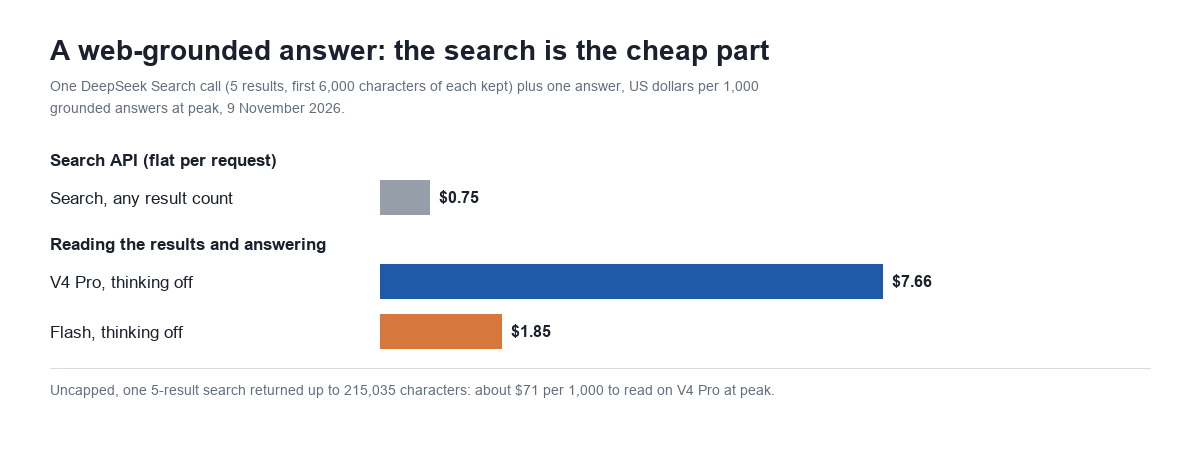
Each costs $0.75 per 1,000 successful requests, regardless of how many results you ask for or whether you ask for full content. We ran 15 searches (five queries at 5 results, 5 with content, and 10 with content) and two fetches:
| Measurement | Result |
|---|---|
| Search latency, 15 calls | 0.55 to 0.82 s |
| Results returned | Always the number requested |
| Full page text, 5 results | 18,807 to 215,035 characters per search |
| Full page text, 10 results | 45,213 to 244,798 characters per search |
| Fetch, docs page | 0.36 s |
| Fetch, our WordPress home page | 7.44 s |
The price per search is the small part. One search with full content for “MxChat WordPress chatbot plugin” returned 215,035 characters, around 54,000 tokens. Feeding all of that to V4 Pro uncached would cost about $0.07 at peak, 95 times the $0.00075 the search itself cost. The useful pattern is to search without content, or cap each result. In our grounded test we searched “DeepSeek V4 Pro API pricing peak”, kept the first 6,000 characters of each of five results (21,725 characters), and asked both models what V4 Pro output costs at peak:
| Grounded answer | Search | Model call, peak | Total | Answer |
|---|---|---|---|---|
| V4 Pro, thinking off | $0.00075 | $0.00766 | $0.0084 | $3.96, two sources cited |
| Flash, thinking off | $0.00075 | $0.00185 | $0.0026 | $3.96 peak and $1.98 off-peak, cited |
Both got it right. Flash added the off-peak price and still cost less than a third as much. For comparison, Perplexity’s Sonar charges per request on top of tokens too: our Perplexity API pricing test has those numbers. One caution for WordPress sites: our mxchat.ai search returned three of our own pages and two from an unrelated site, so check what a search engine says about your brand before you let a bot ground its answers on it.
What DeepSeek V4 Pro costs a real WordPress site
Take a site whose chatbot answers 10,000 questions a month, roughly a busy WooCommerce store, with the request shape we tested. Most of those answers will have the system prompt cached and the excerpts not, so the realistic figure sits between our billed and warm numbers.
| Model and setting | All off-peak, warm | As billed, all off-peak | As billed, all peak | All cold, peak (worst case) |
|---|---|---|---|---|
| V4 Pro, thinking off | $2.36 | $10.18 | $20.36 | $56.83 |
| V4 Pro, thinking on | $6.39 | $14.44 | $28.88 | $65.90 |
| Flash, thinking off | $0.61 | $2.41 | $4.82 | $13.23 |
Even the worst case for V4 Pro is less than a single month of most hosted chatbot plans. The reason to choose between these isn’t the absolute amount. It’s that V4 Pro is about four times Flash for answers our support questions couldn’t tell apart. If you run several models, our OpenRouter versus direct API comparison shows what routing DeepSeek through a third-party host does to the same request.
When V4 Pro is worth paying for
- Use Flash for support and FAQ bots. It’s cheaper, faster and accepts images. That’s MxChat’s recommended DeepSeek model.
- Use V4 Pro with thinking off for long-form answers, multi-step product comparisons, or agent tool calls where Flash gets it wrong on your own content. Test with your own questions first.
- Don’t turn thinking on for a chatbot unless you’ve measured that it helps your questions. In our tests it cost 42% more, took 2.8 times as long on short answers, and on the long request returned a summary instead of the guide.
- Keep the system prompt first and fixed. That one thing cuts the input bill by up to 96%. It’s worth more than timing your traffic around peak hours.
Does MxChat use DeepSeek V4 Pro?
Yes. MxChat lists DeepSeek V4 Pro and DeepSeek Flash in its model menu and calls them with your own DeepSeek API key, so you pay DeepSeek’s rates directly with no markup. MxChat sends thinking: {"type": "disabled"} on every DeepSeek chat request, so you get the fast, cheaper row in our table rather than the default thinking mode. Old deepseek-chat and deepseek-reasoner settings are moved to DeepSeek Flash automatically, because DeepSeek retired those names in July. MxChat doesn’t call DeepSeek’s Search API. Web search in MxChat runs through its own search options instead.
The free MxChat plugin covers the chatbot, the knowledge base and every model provider. MxChat Pro adds the add-ons, including WooCommerce order lookup and live-agent handoff. The setup steps are in the MxChat documentation.
DeepSeek V4 Pro pricing: frequently asked questions
How much does DeepSeek V4 Pro cost per million tokens?
$1.32 input (cache miss), $0.044 input (cache hit) and $3.96 output at peak, and half those off-peak: $0.66, $0.022 and $1.98. Rates read from DeepSeek’s pricing page on 9 November 2026.
When are DeepSeek’s peak hours?
01:00 to 04:00 and 06:00 to 10:00 UTC, Monday to Friday, excluding Chinese public holidays. All other hours, including all of Saturday and Sunday, are billed at the off-peak rate.
Is DeepSeek V4 Pro more expensive than DeepSeek Flash?
Yes. It’s 4.4 times Flash on uncached input, 7.3 times on cached input and 3.3 times on output. Per chatbot answer in our test it was about four times the cost: $0.47 against $0.12 per 1,000 answers warm, at peak.
Does thinking mode cost extra on DeepSeek?
Reasoning tokens are billed at the output rate. On V4 Pro, thinking added about 200 output tokens per short answer, which put the bill up 42% and the wait up 2.8 times. Thinking is on by default, so send "thinking": {"type": "disabled"} to turn it off.
Does reasoning_effort “low” reduce DeepSeek V4 Pro costs?
Not on our chatbot questions. Low effort averaged 203 reasoning tokens against 202 at the default (high). If you want less reasoning on short answers, disable thinking.
How much is the DeepSeek Search API?
$0.75 per 1,000 successful requests, and the same for the Fetch API, with billing since 31 October 2026. The model tokens you spend reading the results are billed separately, and on full-content searches they cost far more than the search does.
Does DeepSeek V4 Pro support images?
No. DeepSeek’s pricing page lists vision as “not supported” for V4 Pro. DeepSeek Flash accepts images.