DeepSeek API Pricing: What Peak Hours Really Cost
DeepSeek repriced its API at 16:00 UTC on 16 August 2026, and the coverage settled on one number: prices up by as much as 1,100%. A second, calmer reading also circulated — that off-peak rates simply match what you were already paying, so nothing really changed. Both are wrong, in opposite directions, and it is worth being precise about why.
Here is the short version for anyone running an AI chatbot on WordPress: the meter that drives your bill went up 3.03x, not 12x — and DeepSeek’s cheapest model just became more expensive than GPT-5.6 Luna for a typical retrieval chatbot. That second sentence is the one worth acting on, so the arithmetic behind it is laid out in full below, with every rate traced to a source you can check.
Update, 27 September 2026: DeepSeek retired V4 Flash on 10 September and replaced it with V4.1 Flash, now called deepseek-flash, at lower rates: $0.15 cache-miss input, $0.003 cache-hit input and $0.60 output off-peak, double at peak. Requests to deepseek-v4-flash are served by the new model at the new price. On 24 real calls a retrieval chatbot reply fell 31%, and V4.1 Flash off-peak is now about half the cost of GPT-5.6 Luna for this workload. The V4 Flash rates and the crossover below are kept as a record of 1 September. Full measurements: DeepSeek Flash pricing after V4.1, measured.
What DeepSeek actually charges now
Read directly from DeepSeek’s own API rate card on 1 September 2026, in dollars per million tokens. DeepSeek states that off-peak rates are exactly half the peak rates, so every off-peak figure below is the peak figure halved:
| Model | Meter | Off-peak | Peak |
|---|---|---|---|
| deepseek-v4-flash | Input (cache hit) | $0.007 | $0.014 |
| Input (cache miss) | $0.22 | $0.44 | |
| Output | $0.66 | $1.32 | |
| deepseek-v4-pro | Input (cache hit) | $0.022 | $0.044 |
| Input (cache miss) | $0.66 | $1.32 | |
| Output | $1.98 | $3.96 |
Both models carry a 1M-token context window and a 384K maximum output. The vision-experimental variant, deepseek-v4-flash-vision-exp, bills at the same rates as V4-Flash, with images converted to input tokens by dimension.
The line almost nobody quoted: Monday through Friday
DeepSeek’s rate card carries a footnote that materially changes the arithmetic, and it is missing from most of the secondary coverage I read. In DeepSeek’s own words, off-peak rates are half of peak, and peak hours are 01:00–04:00 and 06:00–10:00 UTC, Monday through Friday — all other hours are off-peak.
Weekends are entirely off-peak. That takes peak from seven hours a day every day to seven hours a day on five days:

Thirty-five hours out of 168 is 20.8% of the week. Read the rule as applying seven days a week — which is what a summary that omits “Monday through Friday” implies — and you would budget for 49 peak hours, 40% more peak exposure than actually exists.
I checked the top organic results for deepseek api pricing to see how widely the weekday qualifier had travelled. The result worth reporting is narrower than “everyone got it wrong”: DeepSeek’s own documentation ranks first, and the qualifier appears verbatim in its search snippet, so the correct answer is the first thing a searcher sees. Below that, the picture is messier — results still quoting the pre-16-August flat rates, one quoting OpenRouter’s own separate pricing for V4-Pro, and one quoting V3-era rates from 2025 that are three model generations stale. The problem is less that the weekday rule is contradicted and more that it is simply absent once you leave the official page.
Off-peak is not a discount on what you were paying
This is where the reassuring reading breaks down. “Off-peak is half price” is true relative to the new peak rate. It is not true relative to the flat rate DeepSeek charged before 16 August.
The pre-change rates are corroborated by three independent sources: Quartz’s 13 August report, Engadget’s coverage, and benchlm.ai’s rate card stamped 31 July 2026 — that is, written and dated before the change, which makes it a useful contemporaneous record rather than a retrospective claim.
| Model / meter | Before 16 Aug | Off-peak now | vs. old | Peak now | vs. old |
|---|---|---|---|---|---|
| V4-Flash, cache-hit input | $0.0028 | $0.007 | 2.50x | $0.014 | 5.00x |
| V4-Flash, cache-miss input | $0.14 | $0.22 | 1.57x | $0.44 | 3.14x |
| V4-Flash, output | $0.28 | $0.66 | 2.36x | $1.32 | 4.71x |
| V4-Pro, cache-hit input | $0.003625 | $0.022 | 6.07x | $0.044 | 12.14x |
| V4-Pro, cache-miss input | $0.435 | $0.66 | 1.52x | $1.32 | 3.03x |
| V4-Pro, output | $0.87 | $1.98 | 2.28x | $3.96 | 4.55x |
Every single meter went up, in every hour of the week. There is no hour at which DeepSeek is as cheap as it was on 15 August. Off-peak cache-miss input is up roughly 50%, and off-peak output has more than doubled. The lowest number in that table is 1.52x.
Where “up to 1,100%” comes from
The headline figure is real and it is reproducible — it is the bottom row of the previous table. V4-Pro cache-hit input went from $0.003625 to $0.044 per million tokens at peak, a 12.14x rise, or +1,114%.

The context that never travels with the number: that is the cheapest meter on V4-Pro’s card. Cache-hit input is what you pay to re-send context the model has already seen, and even after a twelvefold rise it costs $0.044 per million tokens — one thirtieth of the cache-miss input rate sitting directly above it. A twelvefold increase on a rounding error is still close to a rounding error.
Meanwhile, the meter that genuinely drives a retrieval chatbot’s invoice — cache-miss input — carries the smallest multiple on the chart at 3.03x. The number in the headline and the number on your invoice are almost inversely related.
What this costs a WordPress chatbot
Rate cards are per million tokens; invoices are per conversation. To convert, you need to know what one reply actually sends, and that is measurable rather than assumable.
On this site, the chatbot retrieves six context chunks at the plugin default of 4,000 characters each and prepends a 3,478-character system prompt. That is roughly 7,000 input tokens and about 150 output tokens per reply — an input-to-output ratio of about 47:1, which is the defining characteristic of retrieval chatbots and the reason the input price decides the bill. A thousand replies is therefore 7 million input tokens and 150,000 output tokens.
| Model and hour | Cost per 1,000 replies | vs. GPT-5.6 Luna |
|---|---|---|
| V4-Flash, before 16 Aug | $1.02 | 35% cheaper |
| GPT-5.6 Luna | $1.58 | — |
| V4-Flash, off-peak | $1.64 | 3.7% more |
| V4-Pro, before 16 Aug | $3.18 | 101% more |
| V4-Flash, peak | $3.28 | 107% more |
| V4-Pro, off-peak | $4.92 | 211% more |
| V4-Pro, peak | $9.83 | 522% more |

The GPT-5.6 Luna figure of $1.58 comes from the same measurement applied to OpenAI’s rate card, worked through in our breakdown of what 1,000 replies cost on Luna.
The crossover, and exactly where it sits
Before 16 August, DeepSeek V4-Flash was the obvious budget choice for this workload at $1.02 per 1,000 replies — 35% below Luna. After 16 August it costs $1.64 off-peak, which is 3.7% more than Luna, and $3.28 at peak, which is 107% more. If your traffic were spread evenly across the week, the blended rate would be $1.98, or 25% more than Luna.
It would be easy to write that as “DeepSeek is now more expensive than OpenAI.” That is too broad, and it is not what the numbers say. The honest version is narrower and more useful.
DeepSeek V4-Flash off-peak charges more than Luna on input ($0.22 vs $0.20) and considerably less on output ($0.66 vs $1.20). Which one wins is therefore decided entirely by your output-to-input ratio. Setting the two costs equal and solving gives a clean threshold:
| Your workload | Output as % of input tokens | Cheaper option |
|---|---|---|
| Retrieval chatbot (this site) | 2.1% | GPT-5.6 Luna |
| Break-even | 3.7% | identical |
| Conversational assistant, light context | 25%+ | DeepSeek V4-Flash (off-peak) |
| Content generation, short prompts | 100%+ | DeepSeek V4-Flash (off-peak) |
So DeepSeek V4-Flash is still the cheaper model for most generative workloads — if you send a short prompt and ask for a long answer, it wins comfortably, and at off-peak rates it wins by a lot. It loses specifically on retrieval, where you stuff thousands of tokens of context in and get a couple of sentences back, because that workload spends nearly all its money on the one meter where DeepSeek is now the pricier of the two.
Retrieval is what a WordPress site chatbot does almost exclusively. That is why the crossover matters here and might not matter at all for your other projects.
When peak actually falls in your timezone
The peak windows are published in UTC, and converting them is where budgeting goes wrong. In local terms:
| Timezone | Peak window 1 | Peak window 2 |
|---|---|---|
| UTC | 01:00–04:00 | 06:00–10:00 |
| US Eastern (EDT, to 1 Nov) | 21:00–00:00 | 02:00–06:00 |
| US Eastern (EST, from 1 Nov) | 20:00–23:00 | 01:00–05:00 |
| US Pacific (PDT, to 1 Nov) | 18:00–21:00 | 23:00–03:00 |
| UK (BST, to 25 Oct) | 02:00–05:00 | 07:00–11:00 |
| China (CST) | 09:00–12:00 | 14:00–18:00 |
Two things fall out of that table. First, in Beijing time the peak windows are 09:00–12:00 and 14:00–18:00 — ordinary Chinese office hours, with the lunch break carved out of the middle. The pricing is calibrated to DeepSeek’s domestic demand curve, which is a reasonable thing for DeepSeek to do and an easy thing for everyone else to forget.
Second, and more practically: if your audience is American, DeepSeek’s expensive hours land largely in your quiet ones. A US-facing site sees its peak-rate exposure concentrated in the 21:00–midnight evening block, with the 02:00–06:00 window falling in the dead of night. Your busiest hours — the US working day — are entirely off-peak.
One boundary detail worth catching, because a naive conversion gets it backwards: the weekday rule applies to UTC days. Monday 01:00–04:00 UTC is Sunday 21:00–00:00 in US Eastern. So in Eastern terms the evening peak blocks run Sunday through Thursday, not Monday through Friday, and Friday evening is off-peak.
What to actually do about it
In rough order of how much money each one moves for a retrieval chatbot:
- Cut retrieved context before you switch vendors. Input is 98% of the token volume in this workload. Dropping from six retrieved chunks to four cuts close to 30% of the input bill on any model, and on a well-tuned knowledge base it frequently costs nothing in answer quality. This is a larger lever than the entire peak/off-peak spread.
- Check your model against your ratio, not against a headline. The 3.7% break-even above is the whole decision. Measure what your bot actually sends rather than assuming the cheap model is cheap for your shape of traffic.
- Take caching seriously now. Cache-hit input at $0.022–$0.044 per million is still 30x cheaper than cache-miss input, even after the 12x rise that made the headlines. A stable system prompt and stable retrieved chunks are what let you land on that meter.
- Only then think about scheduling. Shifting batch jobs — reindexing, bulk summarisation, embedding refreshes — out of the two peak windows is genuinely free money, but it does nothing for live chat traffic, which arrives when your visitors arrive.
If you are weighing providers more broadly, we keep a running breakdown of what it actually costs to add a chatbot to a website, and the comparison of the best WordPress chatbot plugins covers which ones let you choose a model at all. Not every plugin does; a fixed-vendor plugin means this entire decision is made for you.
MxChat supports deepseek-v4-flash and deepseek-v4-pro alongside the OpenAI, Anthropic and Gemini families, and the model is a dropdown rather than a rebuild — the documentation covers switching providers, and the retrieval settings that decide your input volume live in the same panel. MxChat Pro adds the retrieval controls this article leans on.
The summary worth remembering
DeepSeek raised every meter on every model in every hour of the week. The 1,100% figure everyone quoted is real, reproducible, and attached to the cheapest meter on the card; the meter that actually bills you rose 3.03x at peak and 1.52x off-peak. Peak covers 20.8% of the week, not 29%, because weekends are exempt — and for a US audience it lands mostly at night.
The consequence that matters is the quiet one. For an input-heavy retrieval chatbot, DeepSeek’s cheapest model crossed over from 35% cheaper than GPT-5.6 Luna to 3.7% more expensive, and the crossover happened because of a two-cent difference in input pricing rather than anything dramatic. If you picked DeepSeek for a WordPress chatbot on price, the reason you picked it expired on 16 August. If you picked it for content generation, nothing about that decision has changed.
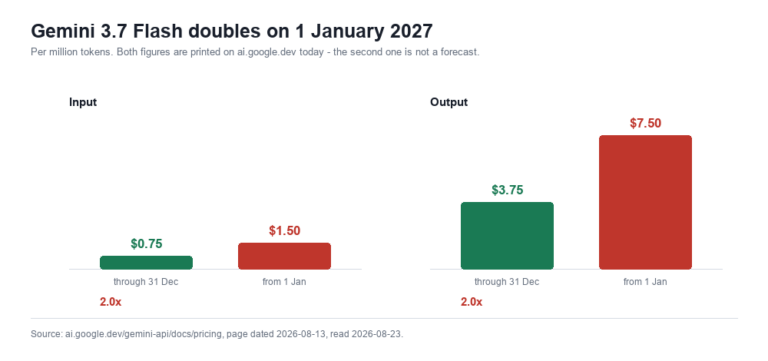
We track vendor pricing events as they land — recent ones include the GPT-5.6 Sol cut and its November review date, Anthropic cancelling the September Sonnet 5 increase, and Gemini 3.7 Flash’s introductory rate and when it expires. The pattern across all four is the same: the headline is about a percentage, and the decision is about your token ratio.
DeepSeek’s off-peak window is one of two ways a vendor sells the same tokens for less. The other is the asynchronous batch lane every major vendor now runs at 50% off — and unlike an off-peak clock, a batch lane cannot price a chatbot reply at all, which changes which half of your bill it can reach.
The same lever runs through xAI’s ladder. Across five Grok models, output tokens account for only 8–12% of a retrieval chatbot’s bill, so the model decision is almost entirely an input-rate decision — the arithmetic is in our breakdown of Grok API pricing.