How to Increase Customer Lifetime Value
If you want to increase customer lifetime value, you have to stop thinking about one-time sales and start building genuine, long-term relationships. This means digging into what really drives repeat business—things like how often people buy and how much they spend—and putting your money into strategies that actually build loyalty.
The whole game is about getting more from the customers you already have.
Why Customer Lifetime Value Is Your Most Important Metric
In a world where grabbing a new customer's attention costs more every day, focusing on Customer Lifetime Value (CLV) isn't just a smart move; it’s the foundation for a business that lasts. Too many companies are stuck on a hamster wheel, constantly chasing the next new sale. But the real gold is in taking care of the customers who have already chosen you.
When you look into the true cost of customer retention, you realize just how critical this shift in focus is.
Prioritizing CLV means you're playing the long game. You stop counting transactions and start measuring the total value a customer brings over their entire journey with your brand. That perspective changes everything—from how you market your products to how you handle a simple customer service ticket.
The Levers That Drive CLV
Calculating CLV can feel intimidating, but it really comes down to a few key pieces you can actively control. The most direct formula uses three levers:
- Average Order Value (AOV): Simply, how much does a customer typically spend per order?
- Purchase Frequency (F): How often do they come back to buy something else?
- Customer Lifespan (L): For how long do they stick around as a customer?
The basic math is straightforward: CLV = AOV x F x L. By zeroing in on improving each of these, even by a little, you create a massive ripple effect on your total CLV. Bumping up AOV by 10% might not sound like much, but when you combine that with a customer who sticks around longer and buys more often, the results really start to stack up.
A Strategic Shift From Acquisition To Retention
When you start focusing on CLV, your resources naturally flow toward retention. It’s no secret that keeping an existing customer is worlds cheaper than finding a new one. The businesses that nail this don't just push products; they build incredible experiences that make people want to stay.
They get that a happy, loyal customer isn't just a revenue source—they're your best marketing channel, driving powerful word-of-mouth referrals. To know if you're on the right track, you absolutely have to monitor the right customer experience metrics. They're the pulse check for satisfaction and loyalty.
This entire process is a cycle. You work on increasing purchase frequency and order value, which in turn builds the kind of loyalty that keeps customers around for the long haul.
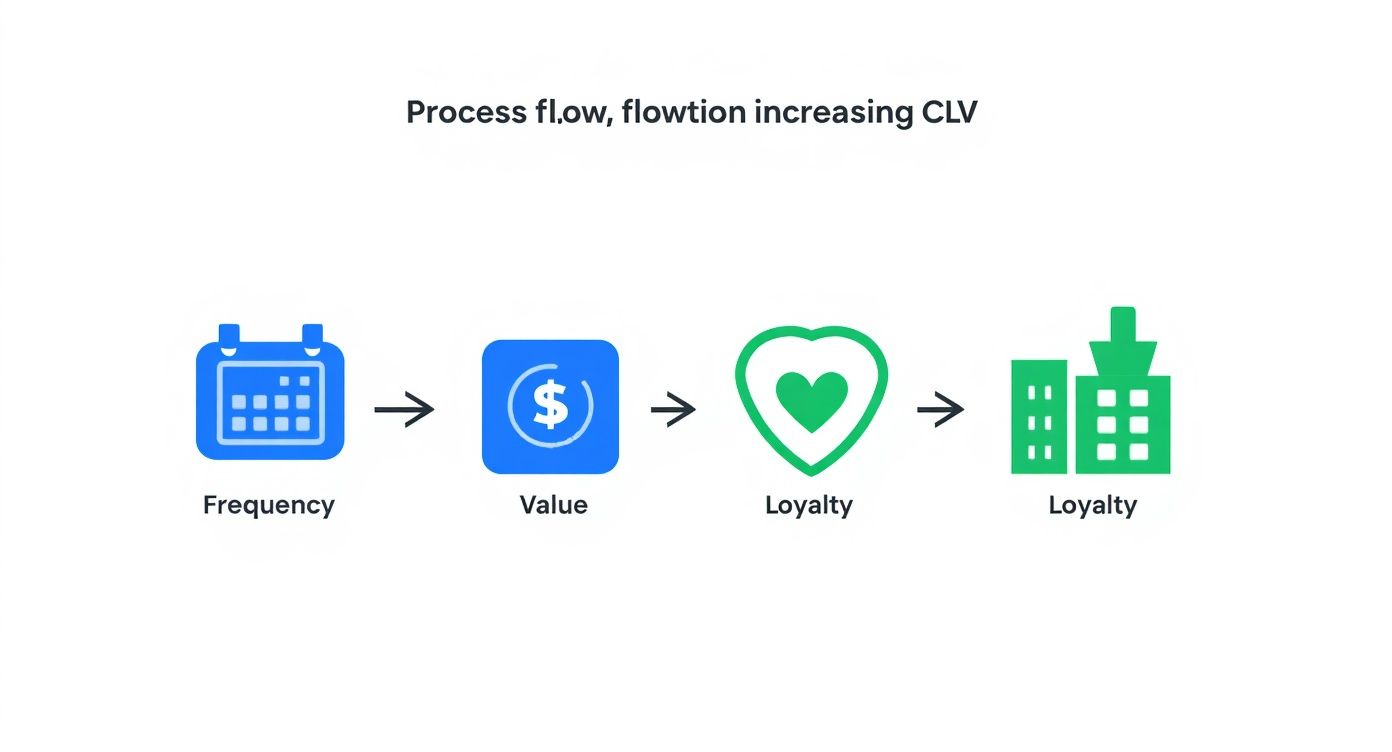
As you can see, boosting CLV isn’t a one-and-done task. It's a continuous loop where every piece strengthens the others, ultimately creating a reliable engine for revenue growth.
Here’s a quick look at the primary strategies covered in this guide and how they directly impact key CLV metrics.
Core Strategies to Increase Customer Lifetime Value
| Strategy | Primary Goal | Impact on CLV | Example Tactic |
|---|---|---|---|
| Segmentation | Understand customer groups | Enables targeted, relevant offers | Sending a special discount to high-spenders. |
| Personalization | Create unique experiences | Increases AOV and loyalty | Recommending products based on past purchases. |
| Loyalty Programs | Reward repeat business | Boosts purchase frequency and lifespan | Offering points for every dollar spent. |
| Retention Tactics | Reduce customer churn | Directly extends customer lifespan | Proactively reaching out to at-risk customers. |
Each of these strategies provides a clear path to improving one or more of the core CLV levers—Average Order Value, Purchase Frequency, and Customer Lifespan.
Using Smart Segmentation to Find Your Best Customers

If you're treating every customer the same, you're leaving money on the table. It's a simple truth. A generic, one-size-fits-all marketing message rarely connects with anyone on a meaningful level. To really move the needle and increase customer lifetime value, the first step is always to figure out who your best customers are and what truly drives them.
This is where smart segmentation comes into play. It’s all about grouping your customer base into smaller, more specific buckets based on what they have in common. This lets you get incredibly precise with your messaging and offers, ensuring you put your time and money where they’ll deliver the biggest impact.
Moving Beyond Basic Demographics
Sure, knowing a customer's age and location is a decent start, but the real magic happens when you dig into their behavioral and psychographic data. This is the stuff that tells you not just who they are, but how they act and why they choose to buy from you.
Instead of broad strokes, focus on creating segments based on what people actually do. Your CRM and analytics tools are treasure troves of this information, just waiting for you to put it to use.
- Purchase History: Look at who buys from you all the time versus who just made one purchase and disappeared. Who are the people consistently buying your most profitable products?
- Engagement Levels: Who’s opening every email you send? Interacting with your chatbot? Following and engaging with your brand on social media?
- Values and Lifestyle: What's the real motivation behind their purchases? Do they prioritize convenience over everything else? Are they drawn to luxury, or is sustainability the most important factor?
When you start layering these data points together, you can build powerful customer cohorts that become the foundation of your entire retention strategy.
Identifying Key Customer Cohorts
As you dig into the data, you'll start to see clear patterns and a few key groups will naturally form. Each of these cohorts is a different opportunity, and each needs a unique approach to get the most value out of the relationship.
Businesses that segment their customers well can boost profits by over 15%. It works because targeted communication just feels more personal and relevant. That deepens the customer relationship and gives them a reason to come back.
For instance, you'll likely identify segments like these:
- High-Value Loyalists: These are your VIPs—the ones who buy often and spend the most. Treat them like gold. Give them exclusive perks, early access to new products, and maybe even a personal thank-you note. Your only goal here is to make them feel indispensable.
- First-Time Buyers: This group is at a crossroads. Their first experience with you is everything. A great one can turn them into a loyalist for life. Follow up their initial purchase with a helpful onboarding guide, some tips for getting the most out of their product, and a small incentive to come back for a second order.
- At-Risk Customers: These are the folks who haven't bought anything in a while. You can spot them by looking at their typical buying cycle and flagging anyone who has gone silent. Re-engage them with a friendly "we miss you" campaign, a special offer to lure them back, or by asking for their feedback with an interactive in-chat form.
Getting their input is a fantastic first step; you can see how to build a great lead capture form that makes gathering this kind of information easy and effective.
Each of these segments is a different conversation waiting to happen. By tailoring your messaging to the specific needs and actions of each group, you build much stronger connections that directly translate into a higher lifetime value for your business.
Driving Repeat Sales with AI-Powered Personalization
Once you’ve figured out who your best customers are, the real work begins: making them feel like it. Sending out the same generic message to everyone is a fast track to the spam folder and being completely forgotten. If you're serious about increasing customer lifetime value, you have to stop broadcasting and start having real conversations.
This is where AI-powered personalization stops being a marketing buzzword and becomes your secret weapon for repeat business. It's about using the data you already have to create experiences that feel less like a sales pitch and more like a helpful tip from a friend.
Let's be clear: modern shoppers don't just like personalization, they demand it. Companies that get this right generate a staggering 40% more revenue from their efforts. Even better, customers who get a consistent, personalized experience across all your channels have a 30% higher lifetime value. The numbers don't lie.
Turning Data into Delightful Experiences
The mission here is simple: show the right customer the right thing at exactly the right time. AI is the engine that makes this possible, crunching through mountains of data—browsing history, past purchases, what they're clicking on right now—to figure out what they’ll want next.
This means you can stop guessing and start making smart, data-backed decisions that make the shopping experience better.
- Smarter Product Recommendations: Suggest items that actually complement what’s in their cart or what they’ve bought before. Think "people who bought this camera also bought this specific memory card."
- Personalized Offers: See a customer eyeing the same product for the third time? Send them a unique discount code to nudge them over the finish line.
- Dynamic Content: A customer who always buys hiking gear shouldn't see swimsuits on your homepage. Change the hero image and messaging to match their interests when they return.
These aren't huge, complicated changes. They're small, thoughtful touches that show you're paying attention. That's how you build real loyalty—the kind that keeps people coming back.
Implementing Personalization with a Chatbot
If you're running on WordPress and WooCommerce, a tool like MxChat can be your always-on personalization expert. A well-designed chatbot can watch a visitor's behavior in real-time and jump in with a conversation that guides them toward the perfect product.
A well-placed, personalized recommendation doesn't just bump up one order's value. It shows the customer you get them, giving them a powerful reason to think of your store first next time they need something.
Think about it. A customer is deep into your running shoe category. Instead of a generic "Can I help you?" pop-up, an AI chatbot can offer something truly useful: "Hey, I see you're checking out our trail runners. Customers who bought these also loved our moisture-wicking socks. Want to take a look?" That’s not an interruption; it’s a helping hand. For more ideas on this, check out our guide on using chatbots for marketing.
And it goes way beyond just product suggestions. A smart AI assistant can trigger personalized email campaigns based on what a visitor did on your site, follow up on abandoned carts with a tailored offer, or even change the content inside the chat window to make every single conversation feel one-of-a-kind. This tech unlocks the real benefits of AI in marketing and lets you create those powerful, individual experiences that turn one-time buyers into lifelong fans.
Building Loyalty That Lasts and Maximizing Retention
It's expensive to get a new customer in the door. No question about it. But the real secret to long-term, sustainable growth? It's all about keeping the customers you’ve already won over.
A solid retention strategy is what truly pumps up your customer lifetime value. You shift your mindset from chasing one-off sales to building genuine relationships that bring people back again and again.
The bedrock of any great retention plan is a loyalty program that offers real, tangible value. Sure, just handing out points for purchases is a start, but today's shoppers expect more. The programs that really work make customers feel like insiders and give them compelling reasons to stick with you.
Designing a Loyalty Program That Connects
To create a program that genuinely resonates, you have to think past simple discounts. Your rewards should create a feeling of progress and exclusivity.
- Tiered Rewards: Think in terms of levels—Bronze, Silver, Gold. As customers spend more, they unlock better perks. Maybe it's free shipping, early access to new drops, or products only they can buy. This "gamifies" the experience and naturally encourages them to spend a bit more to reach that next level.
- Exclusive Access: Give your most loyal folks first dibs on new collections or limited-edition items. It’s not a monetary reward, but it creates a powerful sense of being in the inner circle.
- Community Perks: You can foster a true sense of belonging by creating a private Facebook group or hosting a members-only webinar. Suddenly, the relationship isn't just transactional; it's communal.
Loyalty programs are absolutely central to boosting CLV, as they drive repeat business and create deep brand affinity. It's no wonder the global loyalty management market, valued at around $15.19 billion in 2025, is projected to hit $41.21 billion by 2032.
Businesses are pouring money into this because they know that getting a new customer can be up to 25 times more expensive than keeping an existing one. If you want to dive deeper into the economics of it all, Netsuite.com offers some great insights on customer retention strategies.
Proactive Retention Before Customers Churn
Here's a tip from experience: the best retention strategies don't wait for customers to walk away. They pinpoint people who are at risk of leaving and re-engage them before they're gone for good.
Keep an eye on engagement data—things like how often someone buys, if they're opening your emails, or how long it's been since they visited your site. These are all clues that someone might be drifting away.
Once you spot these customers, you can launch a targeted "win-back" campaign. Sometimes, a simple "We miss you" email with a personalized offer is all it takes. This proactive touch shows customers you actually value their business and notice when they're not around.
A 5% increase in customer retention can lead to a profit increase of 25% to 95%. It's a small lift that delivers an outsized impact on your bottom line.
Automating the Post-Purchase Experience
The moments right after a customer clicks "buy" are absolutely critical for building loyalty. A smooth, supportive post-purchase experience reassures them they made the right call. This is where a tool like MxChat can be a game-changer for any WooCommerce store.
You can set up automated chatbot flows to handle the heavy lifting:
- Confirm Orders Instantly: Give customers immediate peace of mind with an automated order confirmation and a tracking link, delivered right in the chat window.
- Follow Up Post-Delivery: A few days after the package arrives, the chatbot can pop up to ask if everything is okay and gather some quick feedback.
- Request Reviews: If the feedback is positive, the bot can follow up with a gentle nudge to leave a product review. Just like that, you're turning a happy customer into powerful social proof.
This kind of automated, conversational follow-up feels personal and helpful. It builds trust and paves the way for their next purchase, directly feeding into a higher CLV.
Mastering Upselling and Cross-Selling with AI
One of the most straightforward paths to boosting your customer lifetime value is to simply increase your average order value (AOV). It’s all about making each sale count for more. The two classic techniques here are upselling and cross-selling. When you get them right—especially with a bit of smart technology—they stop feeling like a sales pitch and start feeling like genuinely helpful advice.
Upselling is all about encouraging a customer to go for a slightly better, more feature-packed version of what they're already looking at. Think bigger, better, or more premium. Cross-selling is different; it’s about suggesting related items that make the original purchase even better.
Both tactics work wonders, but the magic is in the timing. Get it wrong, and you just come across as pushy.
The Art of the Right Offer at the Right Time
Timing and relevance are everything. A clunky, poorly timed offer can completely derail the customer's journey, sometimes even causing them to abandon their cart altogether. The real goal is to present an offer that solves a need or improves their experience right when they're most receptive.
This is where AI really shines. It can look at a customer’s browsing history, what they've bought before, and what they’re doing on your site right now to figure out what they actually want. This lets you serve up the perfect offer at just the right moment.
- On the Product Page: This is your first chance. Suggest a premium upgrade (an upsell) or a must-have accessory (a cross-sell) before they’ve even hit "Add to Cart."
- In the Cart: Just before checkout, you can recommend a related product that people often buy with the items already in the cart. "Customers also bought…" is a classic for a reason.
- Post-Purchase: The thank you page and follow-up emails are goldmines. You can offer a small discount on a complementary item to entice them back for another purchase.
If you want to dig deeper into these kinds of sales-boosting strategies, we have a whole guide on how to increase online sales.
Using AI to Make Every Recommendation Count
Bringing AI into your upselling and cross-selling strategy is a total game-changer. It’s not just a hunch; the data backs it up. According to research from Superagi.com, a staggering 71% of companies that use AI in their marketing report significant bumps in CLV. Why? Because AI goes way beyond basic rules. It creates recommendations that are predictive and feel incredibly personal.
Think about it this way: someone buys a professional-grade camera from your store. A basic system might suggest a generic camera bag. But a smart, AI-driven system? It analyzes what other pro photographers buy with that exact camera model. It might recommend a specific high-speed memory card, a compatible lens filter, and a top-rated tripod—all bundled together as a helpful "pro kit."
This is exactly where an AI tool like MxChat can make a huge difference for WooCommerce stores. It doesn’t just pop up random offers. It engages customers in a real conversation, figures out what they need, and then makes intelligent product recommendations right there in the chat window.
When your offers feel like a natural part of the conversation, you don't just increase AOV. You build real trust, which is the foundation of long-term loyalty and a much higher CLV.
Frequently Asked Questions About CLV
Once you start putting these strategies into practice to increase customer lifetime value, you'll naturally run into a few questions. I've seen it time and time again. Getting these cleared up early helps you move forward with confidence and sidestep common hurdles. This section tackles the most common questions I hear from fellow business owners.
We'll get into the practical stuff, from the easiest way to run the numbers to what you can realistically expect. Think of this as your quick-reference guide to keep your CLV efforts on track.
What Is the Simplest Way to Calculate Customer Lifetime Value?
When you're just starting out, you don't need a complex predictive model. The most direct approach focuses on just three core metrics, giving you a powerful, back-of-the-napkin number to guide your decisions.
The basic formula is:
(Average Purchase Value) x (Average Purchase Frequency) x (Average Customer Lifespan)
Let's make that real. Say your average customer spends $50 an order, buys four times a year, and sticks with you for about three years. Their estimated CLV would be $600 ($50 x 4 x 3). It's that simple. While you can get way more granular later, this calculation immediately shows you the health of your customer relationships.
This simple CLV formula is your baseline. It quickly reveals which customer segments are the most profitable, helping you decide where to focus your marketing and retention efforts for the highest return.
How Long Does It Take to See an Increase in CLV?
This is the big question, and the answer really depends on the tactics you're using. Some moves pay off almost immediately, while others are more of a slow burn, building deep-seated loyalty that pays off for years.
I like to think about the impact in two buckets:
- Short-Term Wins (Immediate – 3 months): Things like upselling and cross-selling can bump up your Average Order Value (AOV) right away. A smart, automated product recommendation during checkout can boost the value of that very transaction.
- Long-Term Growth (6 – 18 months): Deeper strategies, like a well-designed loyalty program or proactive customer support, take time to really sink in. You'll spot early wins in engagement and repeat purchases pretty quickly, but the major lift in your overall CLV metric often takes a year or more to become obvious as those customer bonds strengthen.
Can Small Businesses Really Use AI to Increase CLV?
Yes, absolutely. The old notion that AI is reserved for giant corporations with teams of data scientists is completely outdated. Today's tools have put incredibly powerful AI within reach for businesses of all sizes, especially those running on platforms like WordPress and WooCommerce.
For a small e-commerce shop, a plugin like MxChat brings that sophistication right into your dashboard without you having to write a single line of code. You don't have to boil the ocean. Start with one high-impact use case, like setting up a post-purchase chatbot to automatically check in on orders and ask for feedback.
Once you see that working, you can easily branch out to AI-powered product recommendations or building personalized chat conversations that guide shoppers to what they need. You don't need a massive budget—just a clear goal and a willingness to build on what works.
Ready to turn conversations into conversions and build unbreakable customer loyalty? MxChat gives you the AI-powered tools to automate support, deliver personalized recommendations, and increase customer lifetime value—all without monthly fees.