Qwen4 Max Pricing: Chatbot Cost Test vs Qwen3.8 Max
Qwen4 Max pricing on Alibaba’s International endpoint is $1.50 per million input tokens and $4.50 per million output tokens, with cached input at $0.075 and one flat rate up to a 1M-token context. That is 25% below the $2 / $6 Alibaba lists for Qwen3.8 Max. One detail changed today: the discounted qwen4-max-preview was retired on 25 November 2026, and calls to it now run on qwen4-max at the standard rate.
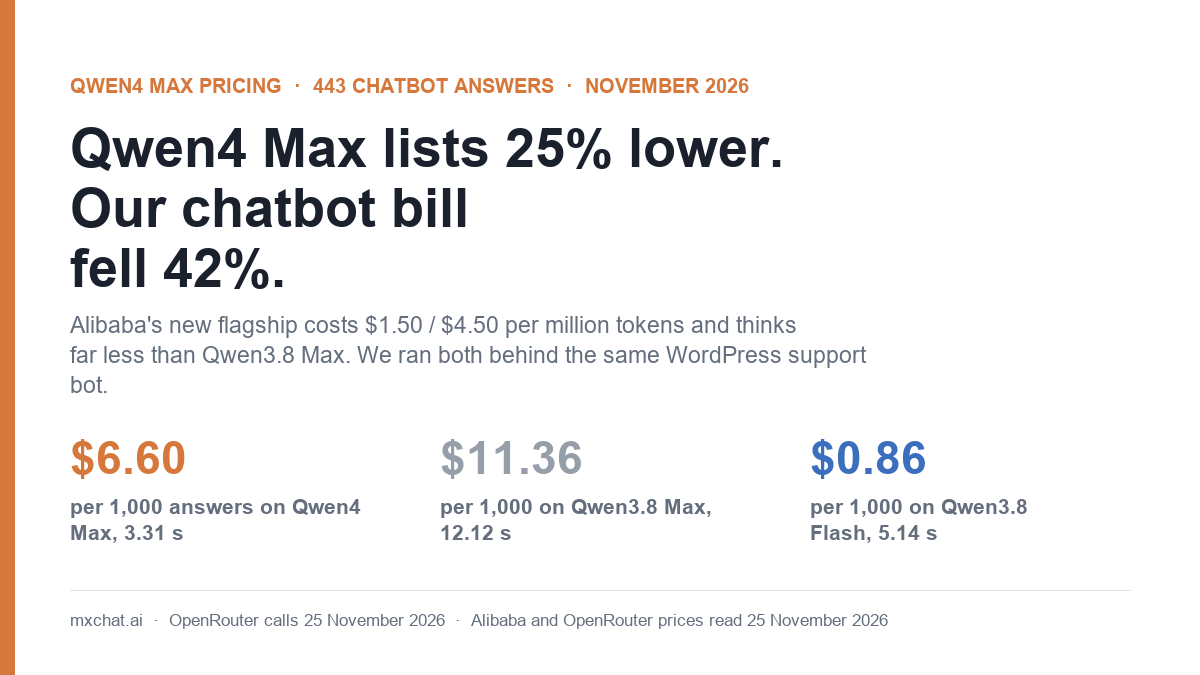
We put the new model behind a WordPress support bot and measured it against its predecessor. 1,000 answers cost $6.60 on Qwen4 Max and $11.36 on Qwen3.8 Max, so the real saving was 42%, not 25%. The extra came from thinking: Qwen4 Max used 54 hidden tokens per answer where Qwen3.8 Max used 415. It also answered in 3.31 seconds instead of 12.12. The cheapest Qwen for this job was neither of them, and those numbers are below too.
Qwen4 Max pricing: the full rate card
These are Alibaba’s list prices per million tokens, from the Model Studio and QwenCloud pricing pages on 25 November 2026. The same price applies with thinking on or off, and thinking tokens are billed as output.
| Billing item | International (Singapore) | Global and Beijing |
|---|---|---|
| Input | $1.50 | $1.413 |
| Output, thinking included | $4.50 | $4.24 |
| Cached input, read | $0.075 | $0.071 |
| Explicit cache write, 5 minutes | $1.875 | $1.767 |
| Explicit cache write, 1 hour | $3.00 | $2.827 |
Four things the headline price leaves out:
- The region decides the price. The Global deployment, available in Frankfurt, Hong Kong, Tokyo and US (Virginia), is about 6% cheaper than Singapore. A separate US-only (Virginia) deployment, added on 20 November, is listed at the Singapore price of $1.50 and $4.50.
- The batch discount is Beijing only. Alibaba’s price page marks
qwen4-maxfor half-price batch calls in the China (Beijing) table and not in the International one. A live chatbot cannot use batch anyway. - There is no long-prompt surcharge. A 900,000-token request pays the same rate per token as a short one.
- The preview is gone. Alibaba’s release notes say the
qwen4-max-previewID now routes toqwen4-maxand bills at the standard rate, without the limited-time discount. The preview was sold through Token Plan, Alibaba’s subscription for coding tools.
What OpenRouter charges
MxChat reaches Qwen through OpenRouter, so this is the table that matters for a WordPress bot. Prices are from OpenRouter’s model list on the same day. Its Qwen4 Max price includes a 5% discount. OpenRouter also charges a fee when you buy credits, which is covered in our OpenRouter pricing comparison and not included here.
| Model on OpenRouter | Input | Output | Cached input | Context |
|---|---|---|---|---|
| Qwen4 Max | $1.425 | $4.275 | $0.07125 | 1M |
| Qwen3.8 Max (0902) | $2.00 | $6.00 | $0.25 | 1M |
| Qwen3.7 Max | $1.475 | $4.425 | $0.295 | 1M |
| Qwen3.8 Flash | $0.15 | $0.47 | $0.016 | 1M |
How we tested
We sent 444 requests on 25 November 2026 from the mxchat.ai WordPress server through OpenRouter, in the layout MxChat uses for OpenRouter models: the bot’s system prompt and four knowledge-base excerpts in the system message, the visitor’s question as the user message, and temperature 1. The four main questions are ones visitors ask us: WooCommerce order lookups, Pinecone or WordPress storage, handing a chat to Slack or Telegram, and using your own API key. Each model answered every question three times (twice for Qwen3.7 Max and for Qwen4 Max at high effort, four times for Qwen4 Max with thinking off).
MxChat does not send a reasoning setting to OpenRouter, so “default” below is what your bot would do. We added rows with thinking switched off or set to low and high to see what they change. Three more checks covered order arithmetic, a question the knowledge base cannot answer, and caching. Of the 444 requests, 443 returned an answer. The other was rejected, as explained below. The whole test cost $1.28.
Results: cost per 1,000 chatbot answers
Costs here use each answer’s token counts at OpenRouter’s full input rate, with no caching, so the models can be compared fairly. Real bills are often lower, as the caching section shows.
| Model | Input tokens | Output tokens (thinking) | Per 1,000 answers | Median time | Key fact present |
|---|---|---|---|---|---|
| Qwen4 Max, default | 4,217 | 138 (54) | $6.60 | 3.31 s | 12 / 12 |
| Qwen4 Max, thinking off | 4,218 | 73 (0) | $6.32 | 2.31 s | 16 / 16 |
| Qwen4 Max, effort low | 4,217 | 140 (49) | $6.61 | 3.01 s | 12 / 12 |
| Qwen4 Max, effort high | 4,217 | 135 (54) | $6.58 | 3.03 s | 8 / 8 |
| Qwen3.8 Max, default | 4,242 | 479 (415) | $11.36 | 12.12 s | 12 / 12 |
| Qwen3.7 Max, default | 4,204 | 1,800 (1,729) | $14.16 | 25.95 s | 8 / 8 |
| Qwen3.8 Flash, default | 4,242 | 471 (422) | $0.86 | 5.14 s | 12 / 12 |
| Qwen3.8 Flash, thinking off | 4,206 | 63 (0) | $0.66 | 2.01 s | 12 / 12 |
| GPT-6.2 Sol | 4,115 | 54 (0) | $8.77 | 1.90 s | 12 / 12 |
| Gemini 3.8 Flash | 4,174 | 607 (536) | $5.95 | 4.59 s | 12 / 12 |
| Claude Sonnet 5.5 | 6,941 | 320 (164) | $17.08 | 3.23 s | 12 / 12 |
| Claude Haiku 5.5 | 6,941 | 363 (252) | $0.88 | 2.37 s | 12 / 12 |
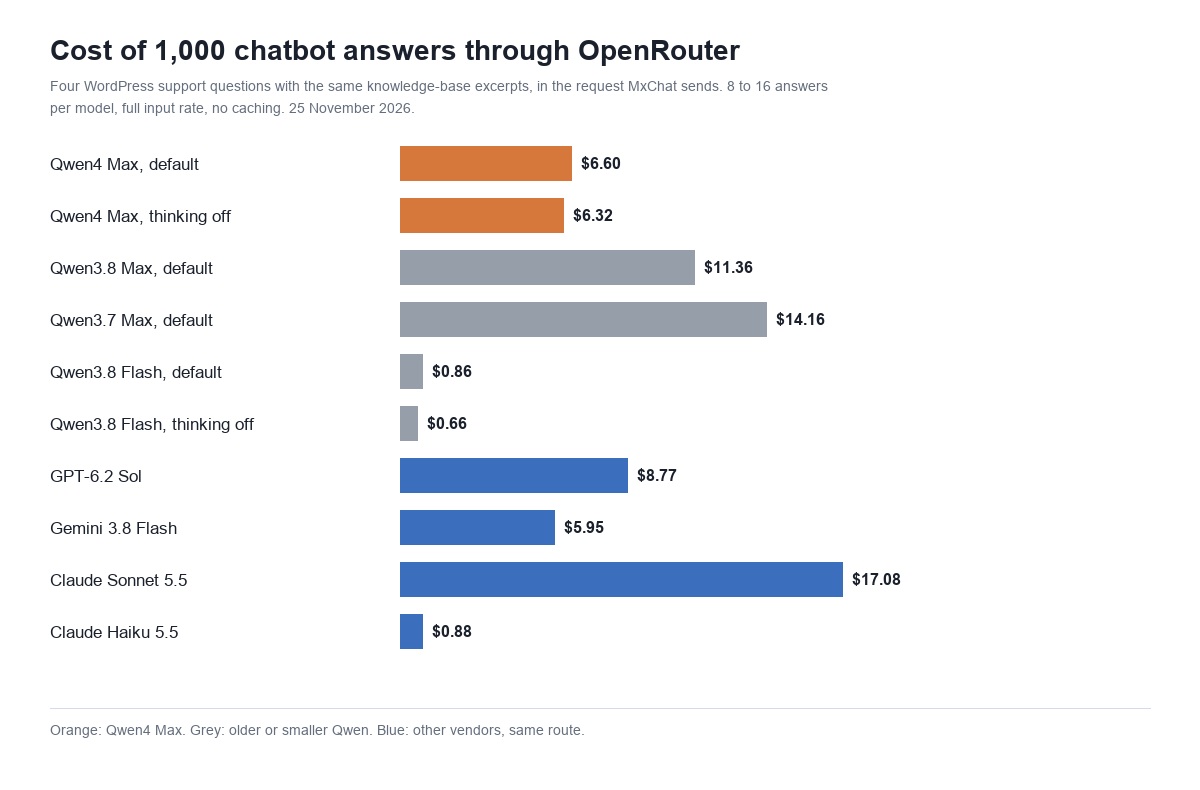
Every model found the fact it was asked for, so accuracy on simple lookups does not separate them. Price and waiting time do. At monthly volumes, before caching:
| Answers per month | Qwen4 Max | Qwen3.8 Max | GPT-6.2 Sol | Claude Haiku 5.5 | Qwen3.8 Flash |
|---|---|---|---|---|---|
| 1,000 | $6.60 | $11.36 | $8.77 | $0.88 | $0.86 |
| 5,000 | $33.00 | $56.80 | $43.85 | $4.40 | $4.30 |
| 20,000 | $132.00 | $227.20 | $175.40 | $17.60 | $17.20 |
Where the 42% comes from
The old model thinks far longer
Both models counted almost the same number of input tokens for the same request, 4,217 and 4,242. There is no hidden tokenizer change here like the one in our Claude Opus 4.5 test. The difference is output. Qwen3.8 Max wrote 479 tokens per answer, and 415 of them were thinking the visitor never sees. Qwen4 Max wrote 138, of which 54 were thinking. Output cost $2.87 per 1,000 answers on the old model and $0.59 on the new one.
Qwen3.7 Max shows why list prices mislead. Its OpenRouter rate is within 4% of Qwen4 Max’s, but it spent 1,729 thinking tokens per answer on simple questions such as whether you need Pinecone. Its answers cost more than twice as much and took 26 seconds. In our September Qwen pricing post we compared 3.7 and 3.8 using a fixed reply length, which made 3.7 look cheaper on OpenRouter. Measured with thinking included, it is the most expensive Qwen here.
Effort settings barely matter on support questions
We expected effort: high to cost more. It did not. Low, default and high averaged 49, 54 and 54 thinking tokens, and the bill stayed between $6.58 and $6.61. On a lookup, Qwen4 Max seems to decide for itself that little thought is needed. Turning thinking off saved $0.28 per 1,000 answers and about a second per reply.
Waiting time improved more than price
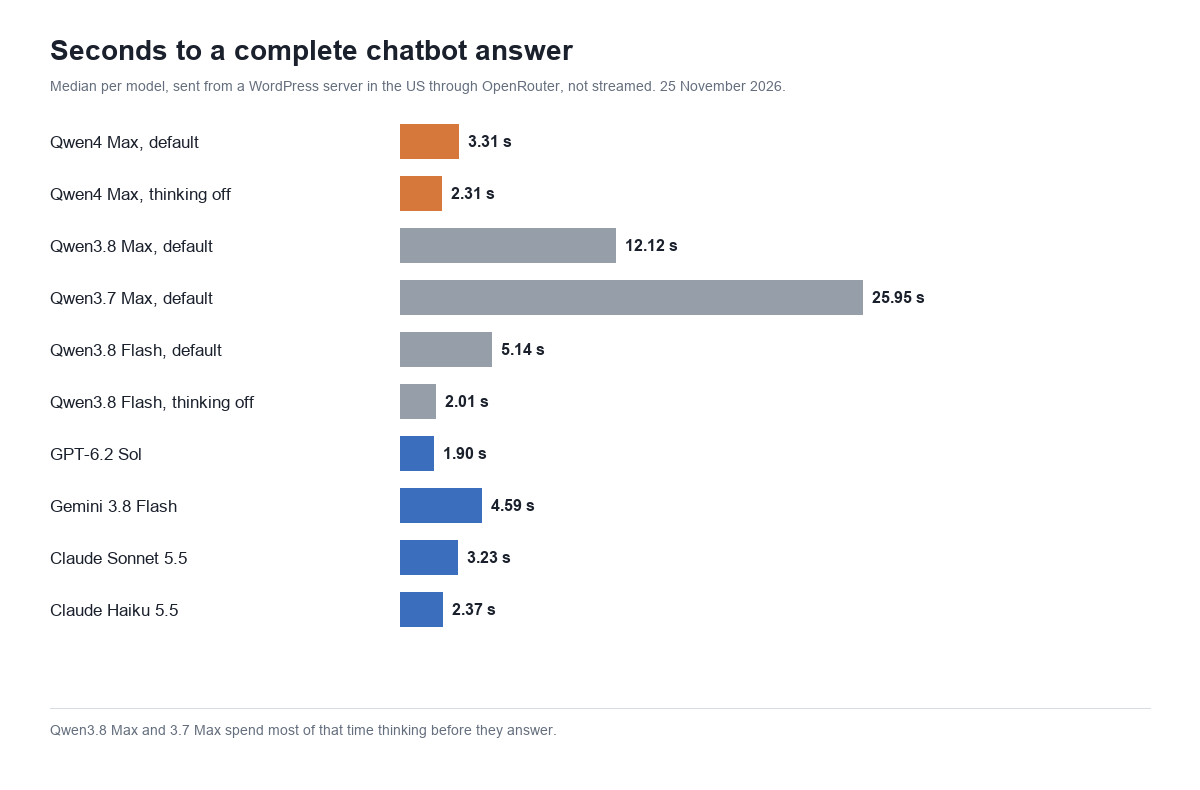
Qwen3.8 Max took 7.5 to 22.5 seconds per answer. Qwen4 Max took 2.4 to 3.8. For a chat widget that is the bigger change, because a visitor may leave during a 12-second wait. No setting fixes the slow model on this route, either. When we asked OpenRouter to run Qwen3.8 Max with thinking off, it returned HTTP 400: “Reasoning is mandatory for this endpoint and cannot be disabled.” Qwen4 Max and Qwen3.8 Flash both accepted the same request.
Is it accurate when the question needs arithmetic?
Finding a paragraph is easy. Adding up an order with a bundle price, a discount code and a Canadian shipping rule is harder. We gave each model a one-page price list for an invented desk shop and four questions with one right answer: the cheapest total for three items, a discounted order to Canada, the latest delivery date around a holiday, and a partial refund. Each model had three runs, except Qwen3.7 Max, which had one.
| Model | Correct | Thinking tokens | Median time | Per 1,000 answers |
|---|---|---|---|---|
| Qwen4 Max, default | 12 / 12 | 136 | 3.64 s | $1.73 |
| Qwen4 Max, thinking off | 11 / 12 | 0 | 2.41 s | $1.13 |
| Qwen3.8 Max | 12 / 12 | 478 | 11.62 s | $4.36 |
| Qwen3.7 Max | 4 / 4 | 1,422 | 18.50 s | $7.36 |
| Qwen3.8 Flash, default | 12 / 12 | 630 | 4.62 s | $0.41 |
| Qwen3.8 Flash, thinking off | 12 / 12 | 0 | 1.66 s | $0.14 |
| GPT-6.2 Sol | 12 / 12 | 11 | 2.39 s | $1.64 |
| Gemini 3.8 Flash | 12 / 12 | 727 | 5.60 s | $3.76 |
| Claude Sonnet 5.5 | 12 / 12 | 169 | 3.04 s | $4.28 |
| Claude Haiku 5.5 | 12 / 12 | 332 | 2.20 s | $0.29 |
Qwen4 Max raised its thinking from 54 tokens to 136 for these questions and got all 12 right. Its one miss with thinking off was a date: it skipped a Friday the shop was open and promised delivery a day late. These requests are short, about 500 input tokens, so the costs are lower than in the main table and should only be compared with each other.
The system prompt changed the result
We first ran these questions with our own site’s system prompt still in place, which tells the bot it is the MxChat assistant. Default Qwen4 Max answered all 12 from the price list. With thinking off it refused seven of 12, replying that MxChat is a plugin and not a shop. That was a mistake in our setup, and arguably a correct refusal, so the table above uses a shop prompt. Qwen3.8 Flash with thinking off did worse in that first version, with four wrong totals or dates and one refusal, against 12 of 12 with a matching prompt. If your bot runs without thinking, make sure its instructions describe the same business as its knowledge base.
What happens when the answer is not in the knowledge base?
We asked for a support phone number and whether a refund is possible after 45 days, with excerpts about WooCommerce. Across seven setups and 23 answers, none invented a number or a refund rule. Qwen4 Max pointed the visitor to a support ticket all eight times, with thinking on and off. One habit to watch: in three of four default answers it wrote “No phone support” as a statement, where the other models said they did not have a phone number.
Caching: cheap reads, automatic on OpenRouter
Alibaba caches repeated prompt openings of 1,024 tokens or more on its own. On OpenRouter, Qwen4 Max’s read price is 5% of its input price, and Qwen3.8 Max’s is 12.5%. We saw cached tokens without asking for them:
- First time each question was asked: three of four requests reused 768 tokens of the system prompt, and the billed cost was $5.83 per 1,000 answers.
- The same question again: nearly the whole prompt came from cache, and the cost fell to $0.96 per 1,000. That only happens when two visitors trigger the same excerpts within a short time.
We then tested the layout where caching pays most: the whole FAQ pasted into the bot’s instructions, 14,304 tokens, with only the question changing.
| Qwen4 Max layout | First answer | Later answers, per 1,000 | Cached tokens |
|---|---|---|---|
| Whole FAQ, automatic cache | $0.020 | $1.95 | 14,080 |
| Whole FAQ, explicit 5-minute cache marker | $0.026 | $1.75 | 14,272 |
| Four retrieved excerpts, no cache (for comparison) | $0.007 | $6.60 | 0 |
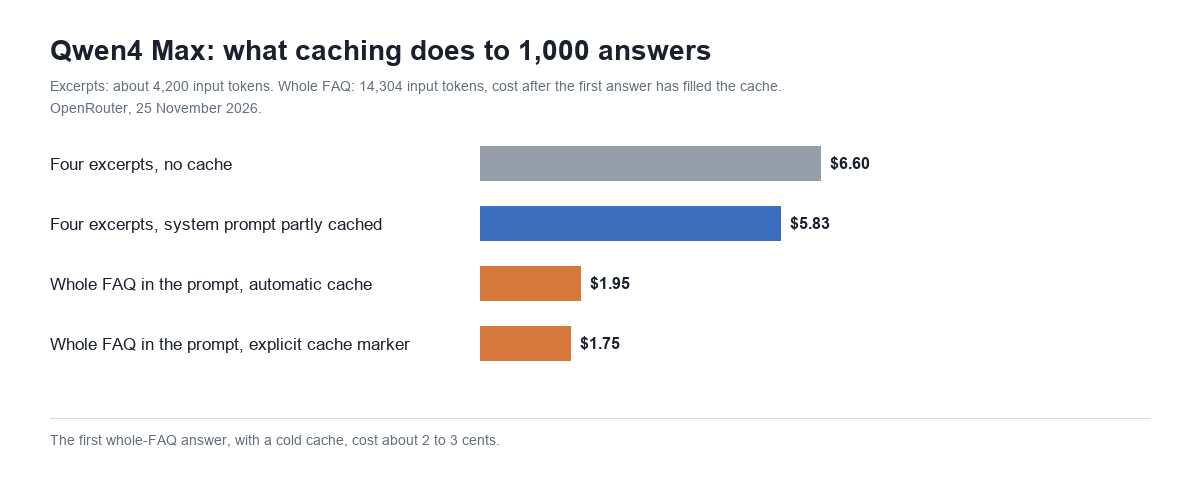
Once warm, a prompt more than three times as long cost 70% less per answer. The automatic cache hit on all seven follow-ups in our run, but Alibaba does not guarantee it, and a quiet site would pay the first-answer price often. The cache marker removed the guesswork and cost 25% more on the write. MxChat does not add cache markers to OpenRouter requests, so a bot gets the automatic version. For how another vendor handles this, see our Claude prompt caching test.
Should you use Qwen4 Max for a WordPress chatbot?
| Your situation | Our pick | Why |
|---|---|---|
| You run Qwen3.8 Max or 3.7 Max today | Qwen4 Max | 42% to 53% cheaper per answer and about 4 to 8 times faster |
| A normal support bot on a budget | Qwen3.8 Flash or Claude Haiku 5.5 | Under $1 per 1,000 answers, same key facts |
| You want a large model at a lower price | Qwen4 Max | 25% under GPT-6.2 Sol and 61% under Sonnet 5.5 on this request |
| Speed matters most | GPT-6.2 Sol | 1.90 s median, and it did not think at all on lookups |
| Chats must stay in one region | Check first | Alibaba was the only OpenRouter host for Qwen4 Max on 25 November |
Qwen4 Max is a clear upgrade for anyone already on a Qwen Max model, and more model than most support bots need. Its answers were longer than Qwen3.8 Max’s (55 words against 37) and read well, but Qwen3.8 Flash found the same facts for about an eighth of the price. The case for paying more is messy, multi-part questions, and even on arithmetic the small models kept up in our test.
Setting it up in MxChat
- Create an OpenRouter key, add a small amount of credit, and paste the key into MxChat’s API Keys settings.
- Choose OpenRouter as the chat provider, load the model list and select
qwen/qwen4-max. - Ask your five most common visitor questions, read the replies, then check the token counts in your OpenRouter account.
MxChat has no setting to turn thinking off for an OpenRouter model today, so plan on the default rows. The MxChat documentation covers the model settings, and MxChat Pro lists what the paid version adds. For other models on the same kind of request, see the MiMo V2.6 Pro, DeepSeek V4 Pro and GPT-6.2 tests.
Limits of this test
Twelve answers per setup is enough to price a request, since input tokens barely move, but thinking length varies from run to run. All times are for complete, unstreamed answers from one US server on one morning. We tested the OpenRouter route only; a direct Alibaba account has different prices and possibly different speed. The Qwen3.8 Max we measured is the qwen3.8-max-0902 snapshot, the version OpenRouter lists apart from the pricier Prime tier. Two Qwen3.8 Flash calls in the first arithmetic run were served by Featherless instead of Alibaba. “Key fact present” means the answer named the thing the question was about; we did not grade style. We did not test the vendor’s benchmark claims.
FAQ
How much does Qwen4 Max cost?
$1.50 per million input tokens and $4.50 per million output tokens on Alibaba’s International endpoint, or $1.413 and $4.24 on the Global one. Cached input is $0.075. OpenRouter lists $1.425 and $4.275. In our chatbot test, 1,000 answers cost $6.60.
Is Qwen4 Max cheaper than Qwen3.8 Max?
Yes. The list price is 25% lower ($1.50 / $4.50 against $2 / $6), and per chatbot answer it was 42% cheaper through OpenRouter because it thinks much less: $6.60 against $11.36 per 1,000.
What happened to qwen4-max-preview?
Alibaba retired it on 25 November 2026. Requests to the old ID are routed to qwen4-max and billed at the standard price, and the preview discount no longer applies.
Does Qwen4 Max charge for thinking tokens?
Yes, as output, and thinking is on by default. Our support questions used about 54 thinking tokens per answer, roughly $0.23 per 1,000 answers, and questions with arithmetic used 136.
Can I turn off thinking on Qwen4 Max?
Yes, with enable_thinking: false on Alibaba’s API or reasoning: {"enabled": false} on OpenRouter. We tested the OpenRouter setting: it saved about a second per answer and 4% of the cost. MxChat does not send it.
Is there a free tier for Qwen4 Max?
Alibaba’s price page lists a free quota of 1 million tokens for the model on the International endpoint, valid for 90 days. OpenRouter’s Qwen4 Max route is paid.
How big is the Qwen4 Max context window?
1 million tokens, at one flat price. A chatbot answer with four knowledge-base excerpts used about 4,200 of them.
Can I use Qwen4 Max with a WordPress chatbot?
Yes. MxChat reaches it through an OpenRouter key: pick OpenRouter as the provider and select qwen/qwen4-max from the model list.