
Grok 4.7 Pricing: 17% More Tokens, Cheaper Replies
xAI released Grok 4.7 on 21 September 2026 and kept the price where Grok 4.6 left it: $2 per million input tokens, $0.50 cached, $6 per million output, doubling past 200,000 tokens of prompt. A new model at the same rate card reads like a free upgrade. Grok 4.7 pricing is only half of the story, though, because Grok 4.7 is built on a new, larger base model, and a new base model can bring a new tokenizer and a new habit of thinking out loud. Both change the bill without touching the rate card.
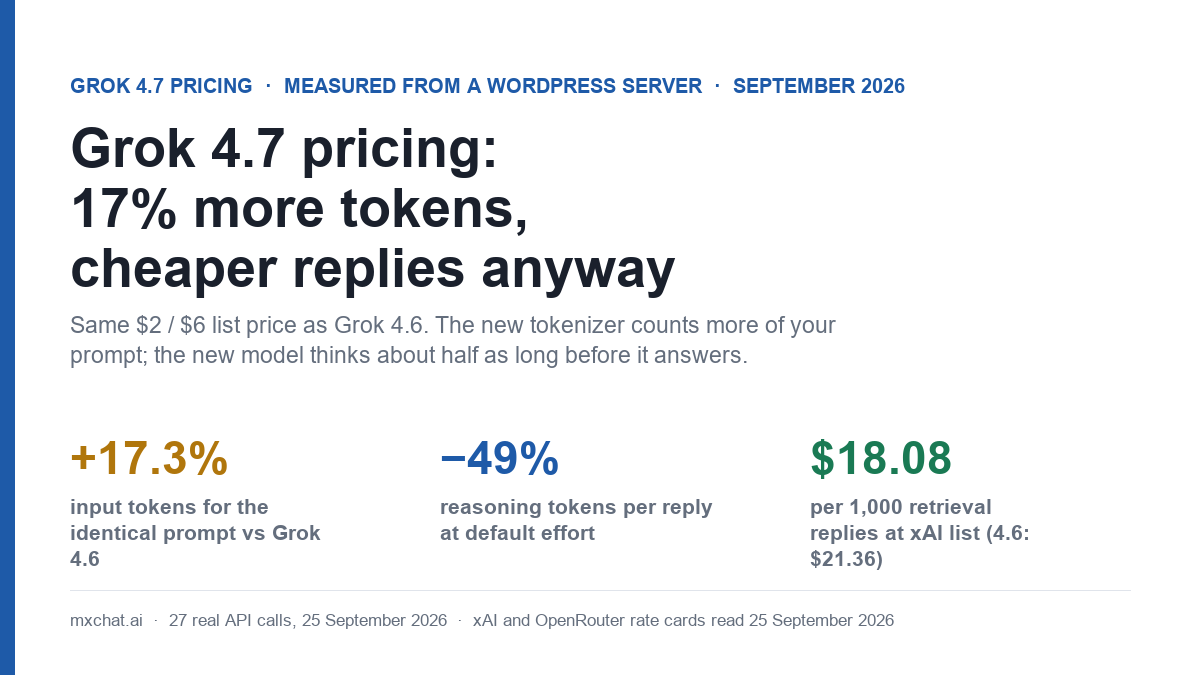
So we measured it. We sent the same chatbot prompt, the same six knowledge-base documents and the same three visitor questions to Grok 4.6, Grok 4.7 at all four reasoning efforts, and Grok 4.3, from a production WordPress server on 25 September 2026: 27 real API calls. Three findings. Grok 4.7 counts 17.3% more input tokens for the identical prompt. It also reasons about half as long before it answers, and reasoning tokens bill at the output rate. The second effect is bigger than the first, so a retrieval chatbot’s replies come out about 15% cheaper at xAI’s list price and about 32% cheaper through OpenRouter, which lists xAI’s own Grok 4.7 endpoint at 20% under xAI’s pricing page.
The Grok 4.7 rate card, as published
This is xAI’s API pricing page as it read on 25 September 2026, per million tokens. Every current Grok text model has a second, higher rate that applies once a single prompt reaches 200,000 tokens. A website chatbot never gets near that line, so the first three columns are the ones that matter.
| Model | Input | Cached input | Output | At or above 200K prompt | Context |
|---|---|---|---|---|---|
| Grok 4.7 | $2.00 | $0.50 | $6.00 | $4.00 / $1.00 / $12.00 | 500K |
| Grok 4.6 | $2.00 | $0.50 | $6.00 | $4.00 / $1.00 / $12.00 | 500K |
| Grok 4.5 | $2.00 | $0.30 | $6.00 | $4.00 / $0.60 / $12.00 | 500K |
| Grok 4.3 | $1.25 | $0.20 | $2.50 | $2.50 / $0.40 / $5.00 | 1M |
| Grok 4.20 (reasoning / non-reasoning) | $1.25 | $0.20 | $2.50 | $2.50 / $0.40 / $5.00 | 1M |
Two things on that card are easy to miss. Grok 4.5’s cached input is cheaper than 4.6’s and 4.7’s ($0.30 against $0.50), so the newest models are not the cheapest to cache on. And there is a Grok 4.7 Fast at $4 / $12 with twice the output speed, but at launch it is only offered inside Cursor and xAI’s Grok Build tool, not on the API a WordPress plugin talks to. Grok 4.7 itself has four reasoning efforts: low, medium, high (the default) and xhigh.
The same model on OpenRouter costs 20% less
OpenRouter’s model listing for x-ai/grok-4.7 shows one upstream provider, xAI itself (endpoint grok-4.7-20260916), at $1.60 input, $0.40 cached and $4.80 output. That is exactly 0.8 times xAI’s own page. OpenRouter lists Grok 4.6 at the full $2 / $6 and Grok 4.3 at the full $1.25 / $2.50, so the discount is specific to 4.7. The listing carries no promotional flag and no end date. We were billed at those rates on every Grok 4.7 call: the cost field OpenRouter returns matched $1.60 / $0.40 / $4.80 to the tenth of a cent each time. OpenRouter also has a priority tier for Grok 4.7 at $3.20 / $9.60, which is not worth paying for a chatbot.
The honest caveats on that route: OpenRouter takes a fee when you buy credits (5.5% on card top-ups at the time of writing), which moves the effective rate to about $1.69 / $5.06, still below xAI direct. And a price with no date on it can change without notice. We ran into the same kind of thing with GPT-5.6 Sol’s promotional rate, which does have a date on it.
How we tested it
The test copies what a real WordPress chatbot sends, not a toy prompt. Each call carried this site’s own production system prompt (3,478 characters, which caps answers at one to three sentences), then a knowledge-base block of six site documents cut to 3,200 characters each, then the visitor’s question. Three questions: an integration question (“Does MxChat work with WooCommerce, and can the bot look up an order status for a logged-in customer?”), a short one (“What does it cost to run?”) and a long one asking for a step-by-step comparison.
We meant to call xAI directly, but the direct xAI key stored on this site was rejected (“Incorrect API key”), so every call went through OpenRouter. OpenRouter sent all 27 to xAI’s own servers; the provider field on each response says xAI. That means the token counts below are xAI’s own counts, and the xAI-direct prices in the tables are those counts priced at xAI’s published rates, not a bill we paid. The whole test cost $0.35.
| Setting | Calls | Input tokens (mean) | Output tokens (mean) | Of which reasoning | Visible answer | Mean latency |
|---|---|---|---|---|---|---|
| Grok 4.6, default effort | 9 | 5,973 | 1,815 | 1,768 (97%) | 48 | 29.2 s |
| Grok 4.7, low | 3 | 7,009 | 677 | 596 (88%) | 81 | 12.8 s |
| Grok 4.7, medium | 3 | 7,009 | 769 | 704 (92%) | 65 | 9.8 s |
| Grok 4.7, high (default) | 6 | 7,009 | 965 | 899 (93%) | 66 | 12.5 s |
| Grok 4.7, xhigh | 3 | 7,010 | 987 | 936 (95%) | 51 | 13.1 s |
| Grok 4.3, default | 3 | 5,870 | 398 | 373 (94%) | 25 | 3.4 s |
Finding 1: the new tokenizer counts 17% more of your prompt
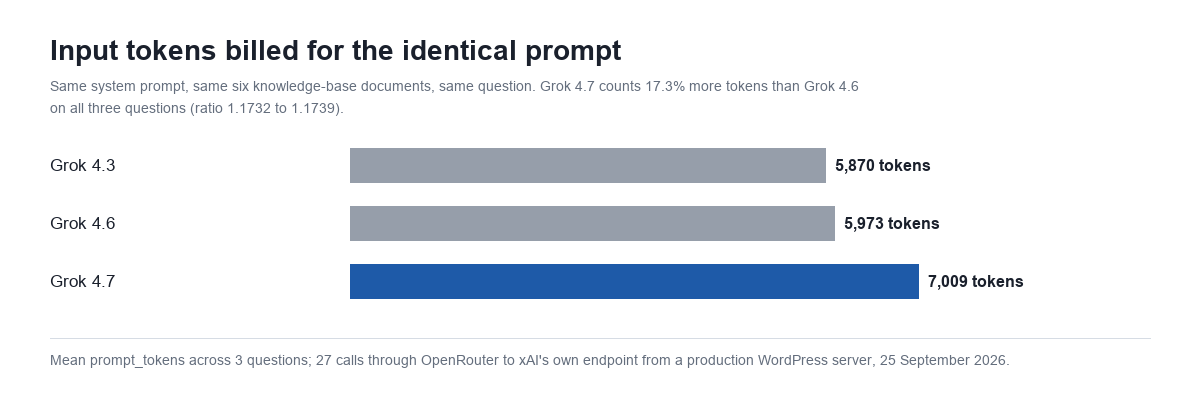
The same bytes went to both models, and Grok 4.7 counted more of them. Question one: 5,976 tokens on Grok 4.6, 7,012 on Grok 4.7. Question two: 5,959 and 6,995. Question three: 5,983 and 7,019. The ratio is 1.1732 to 1.1739 on all three, which is what a tokenizer change looks like: a fixed multiplier on the same text, not noise. Grok 4.3 counted 5,870, close to 4.6, so the change arrived with 4.7’s new base model.
For the bill, that works like a hidden price rise on input. At xAI’s list rate, $2 per million Grok 4.7 tokens is about $2.35 per million of the tokens you used to count on Grok 4.6. Through OpenRouter the 20% discount more than covers it: $1.60 × 1.173 is $1.88, still 6% under 4.6’s $2. We saw the same pattern when Anthropic changed tokenizers, and wrote it up in how Claude’s tokenizer changes your token count. The rule carries over. When a vendor says the price is unchanged, count your own prompt on the new model before you believe it.
Two practical effects beyond price. Any setting that caps context by tokens, such as a plugin’s “max knowledge tokens” or a history window, now fits about 15% less text on Grok 4.7. And any cost estimate you built with a Grok 4.6 token count is 17% low on the input side.
Finding 2: Grok 4.7 thinks about half as long
Every Grok model in this test is a reasoning model. Before it writes the answer the visitor sees, it produces reasoning tokens the visitor never sees, billed at the output rate. On a chatbot that is told to answer in three sentences, those hidden tokens are nearly the whole output bill: 97% of Grok 4.6’s output tokens were reasoning. Its visible answers averaged 48 tokens. Its reasoning averaged 1,768.
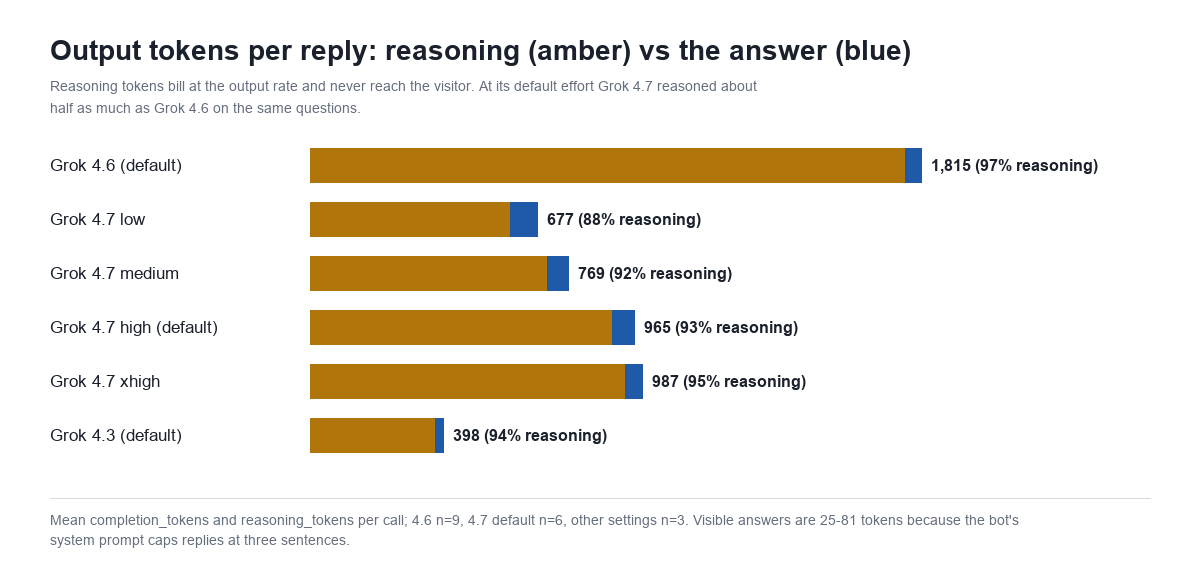
At its default effort Grok 4.7 averaged 899 reasoning tokens, 49% fewer than Grok 4.6, and 965 output tokens in all. It also answered faster: 12.5 seconds on average against 29.2 for Grok 4.6, measured from the WordPress server, network included. For a chat widget the latency matters as much as the price. Thirty seconds is long enough for a visitor to close the tab.
The effort setting did less than the names suggest. On these short answers, low effort saved about 30% of output tokens against the default and xhigh added about 2%. Individual calls varied a lot: the same question at low effort used anywhere from 381 to 960 reasoning tokens. Three calls per setting is enough to see the direction, not to promise an exact saving. If you run Grok 4.7 behind a chatbot with a short answer style, medium or low is a reasonable setting. Xhigh buys nothing we could measure on a three-sentence reply.
What 1,000 chatbot replies cost on Grok 4.7
Cost per reply depends on how much of the prompt gets cached, and that depends on how the bot is built. We priced the measured token counts two ways, the same two ways we priced Claude Opus 5.5 for a chatbot:
- Retrieval bot: knowledge is looked up per question, so only the system prompt repeats and gets cached. This is how MxChat and most knowledge-base chatbots work.
- Static bot: the whole knowledge block is pasted into every prompt, so all of it can be cached and only the question is new.
| Per 1,000 replies | Retrieval bot | Static bot | Nothing cached |
|---|---|---|---|
| Grok 4.6, xAI list | $21.36 | $14.01 | $22.84 |
| Grok 4.7, xAI list | $18.08 (−15%) | $9.43 (−33%) | $19.81 (−13%) |
| Grok 4.7, OpenRouter | $14.46 (−32%) | $7.54 (−46%) | $15.85 (−31%) |
| Grok 4.3, xAI list | $7.32 | $2.26 | $8.33 |
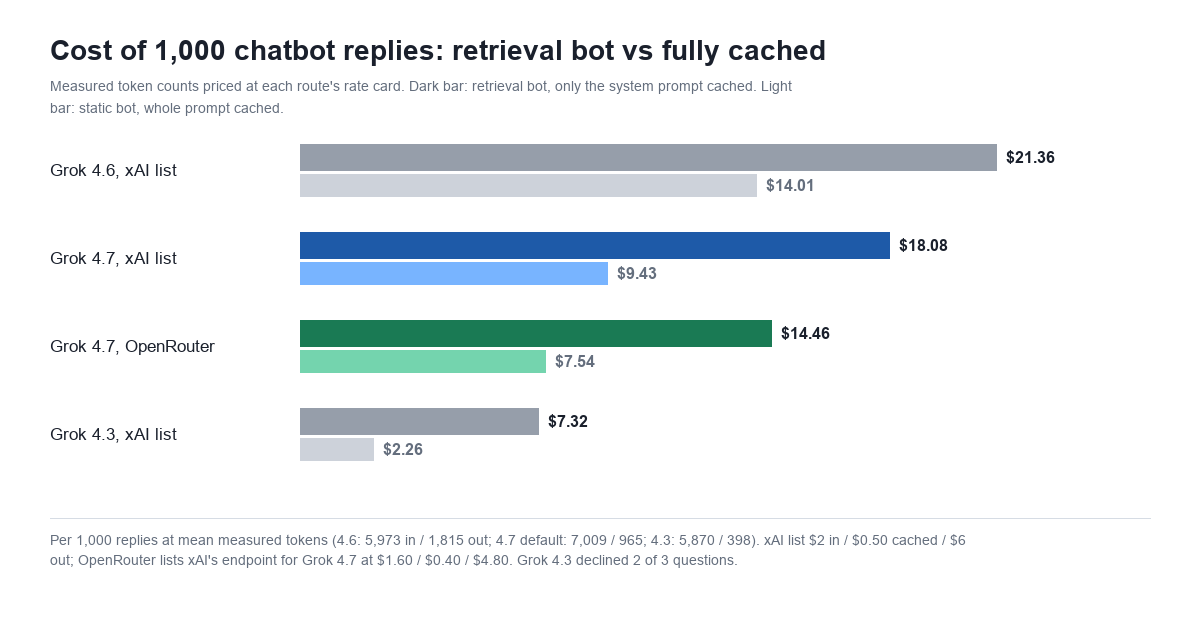
The saving is largest on a static bot. There the input is almost free, so the output bill decides the total, and output is where Grok 4.7 got cheaper. On a retrieval bot the uncached knowledge block is most of the cost, and that is exactly the part the new tokenizer inflates. So the retrieval saving at xAI’s list price is a modest 15%. Most of the saving is the thinking Grok 4.7 skips, and some of it goes back to the tokenizer.
Caching is automatic, and it misses
xAI caches repeated prompt prefixes on its own; you do not mark anything. In our run it was not reliable. Grok 4.6 missed the cache on its first three calls and hit a 5,888-token cached prefix on all six after that. Grok 4.7 hit the full cached prefix (6,912 tokens) on only 5 of the 14 calls that followed its first, and fell back to caching just the system prompt (1,152 tokens) on the rest, even though the knowledge block was identical every time. So the static-bot column is a best case for Grok 4.7. At default effort our Grok 4.7 calls through OpenRouter were billed between $5.92 and $13.65 per 1,000 replies, depending on whether the cache hit.
Did the answers get better?
This test was built to measure cost, not quality, and three questions settle nothing. With that said, two things were consistent. On “What does it cost to run?”, Grok 4.7 answered from the knowledge base on all five calls where we logged the text, quoting the per-1,000-reply figure from one of the documents. Grok 4.6 answered on one of the two logged calls and declined on the other. Grok 4.3 declined. On the other two questions every model said it did not have the information and pointed the visitor to the documentation or a support ticket. That was the correct answer: the six documents were the newest posts that mention WooCommerce, not the integration docs. None of the models invented an answer.
Grok 4.3 is the cheapest option on the card by a distance ($7.32 per 1,000 retrieval replies) and the fastest (3.4 seconds). It is also the model that declined the one question the knowledge block did answer. On a bot where a wrong “I don’t know” costs you a sale, that matters more than $10 per 1,000 replies.
Grok 4.7 against other models, per 1,000 replies
For context, here is where Grok 4.7 sits against models we have priced the same way on this site, all as retrieval bots at list prices. Prompts and dates differ between those tests, so treat this as rough placement rather than a head-to-head benchmark.
| Model | List price (in / out per M) | Retrieval bot, per 1,000 replies | Source |
|---|---|---|---|
| Grok 4.3 | $1.25 / $2.50 | $7.32 | this test |
| Grok 4.7 via OpenRouter | $1.60 / $4.80 | $14.46 | this test |
| Claude Sonnet 5 | $2 / $10 | $15.52 | Opus 5.5 test, 23 Sep |
| Grok 4.7, xAI direct | $2 / $6 | $18.08 | this test |
| Grok 4.6, xAI direct | $2 / $6 | $21.36 | this test |
| Claude Opus 5.5 | $4 / $20 | $33.16 | Opus 5.5 test, 23 Sep |
For the earlier Grok models and the rest of xAI’s price list, see our Grok API pricing breakdown for WordPress chatbots. If you are weighing a cloud marketplace instead of the vendor API, Bedrock against direct API pricing covers the markup side. OpenRouter lists Bedrock’s Grok 4.6 at 10% above xAI’s.
Using Grok 4.7 in a WordPress chatbot today
- Pick the route. Through OpenRouter, Grok 4.7 is 20% cheaper per token than xAI direct at the time of writing. In MxChat the OpenRouter model list is fetched live, so
x-ai/grok-4.7can be selected now. The direct xAI model picker in MxChat 3.2.22 lists up to Grok 4.6. - Re-check any token budgets. If you set a knowledge or history limit in tokens, Grok 4.7 fits about 15% less text in it. Either raise the limit or accept shorter context.
- Set effort to medium or low if your bot gives short answers. The default “high” spent 25% more output tokens than medium on our questions, with no visible gain on a three-sentence reply.
- Keep the system prompt first and stable. Caching only works on a repeated prefix. Put the fixed instructions first and the retrieved knowledge and question after, and do not put timestamps or visitor names in the system prompt.
- Put a ceiling on spend. Reasoning models make each reply’s cost vary; one of our Grok 4.6 calls used 2,267 reasoning tokens for a 16-word answer. A per-visitor rate limit and a provider spend cap protect you from a bad day. We covered why in denial-of-wallet attacks on WordPress chatbots.
- Measure your own prompt. Our numbers are one site’s prompt. Send twenty real visitor questions through Grok 4.6 and 4.7, read
prompt_tokens,reasoning_tokensand the cost field, and price your own mix.
MxChat connects to xAI, OpenRouter, OpenAI, Anthropic, Google and DeepSeek from one settings screen, so moving a bot from Grok 4.6 to 4.7, or to a cheaper model, is a dropdown change rather than a rebuild. See MxChat Pro for the full feature set, or the documentation for setting up providers.
FAQ
How much does Grok 4.7 cost?
On xAI’s API, $2 per million input tokens, $0.50 per million cached input tokens and $6 per million output tokens, rising to $4 / $1 / $12 once a prompt reaches 200,000 tokens. That is the same list price as Grok 4.6. OpenRouter lists xAI’s Grok 4.7 endpoint at $1.60 / $0.40 / $4.80.
Is Grok 4.7 cheaper than Grok 4.6?
Per token, no; per reply, yes on our test. Grok 4.7 counts 17.3% more input tokens for the same text but used 49% fewer reasoning tokens, so 1,000 retrieval-chatbot replies came to $18.08 against $21.36 at xAI’s list price.
Does Grok 4.7 use a different tokenizer?
Its token counts say so. The identical prompt counted 5,976 tokens on Grok 4.6 and 7,012 on Grok 4.7, a ratio of 1.173 that held on all three questions we sent.
What reasoning effort should a chatbot use on Grok 4.7?
For short answers, medium or low. Default (high) used 965 output tokens per reply on our test, medium 769 and low 677. Xhigh used 987 and bought nothing we could see on a three-sentence answer.
Is Grok 4.7 Fast available on the API?
Not at launch. Grok 4.7 Fast ($4 / $12, about twice the output speed) was released only inside Cursor and xAI’s Grok Build tool.


