customer support vs customer service: The key difference
When people talk about customer support vs. customer service, they're really talking about two sides of the same coin. The simplest way to think about it is that customer support is transactional—it's about fixing a specific problem or answering a technical question. On the other hand, customer service is relational, focused on building long-term value and making the customer feel good about their entire experience.
Defining Customer Support and Customer Service
Though the terms are often swapped in conversation, customer support and customer service are actually two different functions. Getting the distinction right is the first step to creating a customer experience strategy that actually works. Both are absolutely critical, but they have different goals, require different skill sets, and are measured with completely different yardsticks.
This distinction has gained a lot of traction as businesses realize how much each function impacts their operations and bottom line. Customer support is reactive; it kicks in when a customer has a problem they need help with. In contrast, customer service is a much broader, more proactive effort to create positive interactions at every single touchpoint. You can find more great insights on this operational split over at BoldDesk.com.
This fundamental difference in approach shapes everything from day-to-day tasks to long-term company goals.
Core Distinctions at a Glance
Let's get practical. Customer support is the "how-to" team. They provide tactical, step-by-step solutions to very specific problems. Think of a support agent like a mechanic. When your car breaks down, their job is to get it running again as quickly and efficiently as possible. They need to know the product inside and out.
Customer service, however, is all about the overall journey. A service representative is more like a personal concierge, making sure the entire experience—from the first question they ask to the follow-up after a purchase—is a positive one. Their goal is to build a relationship that keeps customers coming back.
"Support is about fixing a problem with the product; service is about nurturing the relationship with the person."
To make this even clearer, here's a quick rundown of the main differences.
Quick Comparison: Customer Support vs. Customer Service
| Attribute | Customer Support | Customer Service |
|---|---|---|
| Primary Focus | Reactive, transactional, and technical | Proactive, relational, and value-driven |
| Core Goal | Resolve issues, fix problems, answer questions | Build loyalty, enhance satisfaction, create value |
| Key Skills | Product knowledge, problem-solving, technical proficiency | Empathy, communication, relationship-building |
| Main Channels | Ticketing systems, live chat, help desks | Email, social media, phone calls, in-person |
| Typical Metrics | First Response Time (FRT), Resolution Rate | Net Promoter Score (NPS), CSAT, CLV |
Ultimately, support is there to answer, "How do I fix this?" while service tackles the bigger question: "How does this company make me feel?" You need both to succeed. A business that nails both not only solves customer problems effectively but also makes people feel genuinely valued along the way.
2. Comparing Roles, Goals, and Critical Metrics
To get to the heart of the customer support vs. customer service conversation, you have to look at how each one actually operates. They're built on different foundations—with distinct roles, separate goals, and unique ways of measuring success. Think of them as two specialized gears in a much larger customer experience machine; they work together, but they are not interchangeable.
This image really drives the point home, showing the hands-on, problem-solving nature of support versus the relationship-building approach of service.
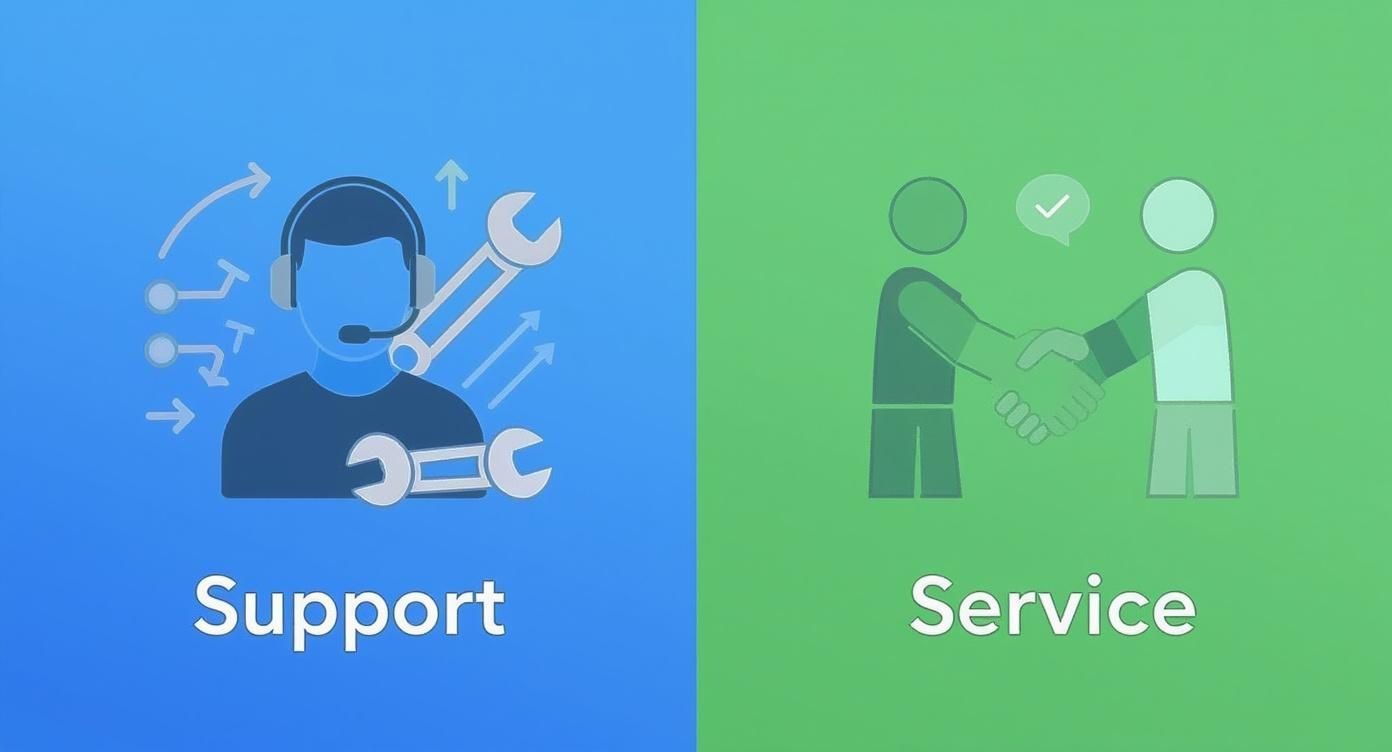
On one side, you have support agents with their toolkits, focused on fixing what's broken. On the other, you have service pros building valuable, long-term connections.
The World of Customer Support
Customer support is all about the here and now. It’s a reactive, tactical field where the main goal is to solve problems as they pop up, making sure a product or service works the way it's supposed to. The people on this team are specialists with deep technical know-how.
Take the Technical Support Specialist. This person is a master problem-solver, whether they’re digging into a software bug, walking a user through a tricky setup, or figuring out a hardware malfunction. Their work is transactional—it’s about closing tickets and getting things working again, fast.
Success in support is all about speed and effectiveness. The key performance indicators (KPIs) are laser-focused on efficiency and the quality of the fix.
- First Response Time (FRT): This is the stopwatch metric. How quickly does an agent jump on a new support ticket? A low FRT is a big deal, especially since 73% of consumers will bolt to a competitor after just a few bad experiences. Slow responses are a top cause of frustration.
- Average Handle Time (AHT): This tracks how long an agent spends on a single case from start to finish. It’s a great way to measure efficiency and pinpoint where your processes might need a tune-up.
- First Contact Resolution (FCR): This might be the holy grail of support metrics. FCR tells you what percentage of issues are completely solved in the very first interaction. A high FCR means your team is knowledgeable and your process is sharp, which has a direct and immediate impact on customer happiness.
These metrics are short-term, all centered on a single interaction. The mission is simple: fix the problem, do it right, and do it quickly.
The Landscape of Customer Service
Customer service, on the other hand, plays the long game. It’s proactive and strategic. The objective isn't just to fix one issue; it's to build a positive, lasting relationship with the customer. The real prize is increasing their lifetime value and turning them into people who rave about your brand.
A central role here is the Customer Success Manager (CSM). A CSM acts more like a partner, making sure customers get every bit of value out of what you offer. They might check in with helpful tips, offer strategic advice, or even spot opportunities to upgrade that perfectly match the customer's needs.
"Support focuses on the product's functionality for the customer, while service focuses on the company's relationship with the customer."
To truly understand the difference, you need to look at the key customer service performance indicators that measure success in this relationship-focused world. These metrics are about how people feel about your brand, their loyalty, and your company's long-term health.
- Customer Satisfaction (CSAT): Usually measured with a quick post-interaction survey like, "How satisfied were you?" CSAT gives you an instant snapshot of how happy a customer is in that moment.
- Net Promoter Score (NPS): This one asks the big question: "How likely are you to recommend us?" It’s a powerful gauge of overall loyalty and how people perceive your brand.
- Customer Lifetime Value (CLV): CLV is a prediction of the total revenue you can expect from a single customer over the entire course of your relationship. Amazing service is a direct driver of CLV because it keeps customers around longer and helps find new ways for them to grow with you.
By tracking these broader customer experience metrics, a business can see the real, long-term financial impact of investing in great service.
Real-World Scenarios: Seeing Support and Service in Action
It’s one thing to talk about the differences between customer support vs. customer service in theory, but where the distinction really comes alive is in the day-to-day trenches of a business. Seeing how each one plays out in real situations makes it all click. After all, every customer interaction is a chance to either solve a problem or build a relationship.
Let's dive into a familiar setting for many of us: a WooCommerce store. This is the perfect environment to see how transactional support and relational service work side-by-side.

Scenarios in a WooCommerce Store
Picture this: a customer is on your WooCommerce site, ready to buy, but their payment keeps getting declined. Frustration is building. They open a live chat, clearly annoyed.
- Customer Support in Action: A support agent jumps into the chat right away. Their mission? Fix the problem—fast. They dig into the payment gateway logs, spot a configuration error, and guide the customer through re-entering their details. The payment goes through, the order is complete, and the ticket is closed. That’s classic support: a direct, technical solution to a specific roadblock.
Now, let's look at another customer at that same store. This person has been a regular, making several large purchases over the last six months.
- Customer Service in Action: The customer service team, keeping an eye on purchasing trends, identifies this person as a VIP. They don’t wait for a problem to arise. Instead, they send a personal email that’s much more than a simple "thanks." It might include a guide on getting the most out of their recent purchases, a direct line to a dedicated account manager, and even a surprise loyalty discount for their next order. This is all about proactive engagement, making the customer feel valued and building a genuine connection.
The takeaway here is crucial: Support fixed a single broken transaction. Service worked to nurture a valuable relationship, ensuring many more transactions in the future.
This isn't just a nice-to-have. With 86% of customers ready to walk away after just one bad experience, getting both the immediate fix (support) and the long-term relationship (service) right is essential for survival.
Examples from a WordPress Plugin Company
These same principles are just as relevant in the B2B software world. Take a company that sells WordPress plugins. The technical nature of the product draws a very clear line between reactive support and proactive service.
A user installs a new plugin, and suddenly, it's conflicting with their WordPress theme and messing up their site's layout. They’re stressed and fire off a support ticket with screenshots.
- Customer Support in Action: A support specialist picks up the ticket. Their objective is to resolve the technical conflict, period. They'll ask for a list of active plugins, replicate the issue on a test site, pinpoint the specific CSS clash, and provide a code snippet to fix it. This is a focused, methodical, and reactive process. To keep these interactions consistent and accurate, many teams rely on well-crafted customer support scripts to troubleshoot common problems effectively.
Meanwhile, the company is also thinking about the bigger picture: keeping its long-term users happy and helping them succeed.
- Customer Service in Action: The customer success team (a form of service) notices a group of users who’ve been subscribed for over a year but are only scratching the surface of the plugin's capabilities. They organize an exclusive webinar to showcase advanced features and power-user tips. After the session, they follow up with attendees, offering one-on-one strategy calls to help them hit their business goals with the plugin. This effort provides value far beyond the product's core function, building loyalty and stopping customers from churning.
In both the WooCommerce and WordPress examples, you can see the pattern. Support is the essential "break-fix" crew, while service is the strategic "value-add" team.
How Technology and Channels Shape Customer Interactions
The tools you use don't just facilitate conversations; they fundamentally shape them. The line between customer support and customer service becomes crystal clear when you look at the technology and channels each one relies on. The way a customer chooses to contact you is often a huge clue about what they need—a quick fix or a genuine conversation.
Think about it: platforms built for speed, like live chat and ticketing systems, are the natural habitat for customer support. They're designed for transactional, get-it-done interactions, which is exactly what a customer with a technical problem wants. They need a fast, methodical solution.
On the flip side, channels that foster deeper, more personal dialogue are where customer service shines. A thoughtful email, a direct phone call, or even a well-handled social media DM—these are the tools for building relationships and creating long-term loyalty.
The Rise of Immediate and Omnichannel Experiences
Today’s customers don't just want answers; they want them now, and they expect the conversation to follow them wherever they go. The data is pretty clear on this. Live chat has quickly become the go-to support channel for 41% of consumers, leaving phone support (32%) and email (23%) behind.
The satisfaction rates are even more telling. Live chat clocks in with 73% satisfaction, a massive jump from email's 51% and the phone's 44%. What’s really interesting is that 73% of consumers now hop between different channels to solve a single issue. This makes a unified, omnichannel strategy not just a nice-to-have, but a must-have. You can explore more customer support trends and statistics to see just how much these expectations are changing.
This channel-hopping behavior puts a ton of pressure on businesses. If a customer starts with a chatbot and then needs to talk to a person, they shouldn't have to repeat their entire story. When they do, it creates friction and frustration, slowly eroding the trust you've built.
An effective omnichannel strategy ensures the conversation flows smoothly from one channel to the next, preserving context and making the customer feel heard at every step.
Aligning the Right Channel with the Right Task
Choosing the right channel is more than a matter of preference; it’s a strategic move that directly impacts how efficiently you can help someone. Pushing a customer with a complex billing dispute into a simple chatbot is a surefire way to create a miserable experience. The trick is to guide people to the best channel for their specific problem.
For example, technologies like customer support transcription allow businesses to analyze phone calls for quality control and agent training. This makes the phone an incredibly powerful tool for those high-stakes, complex service conversations where nuance is everything.
Matching the task to the channel is key. Below is a quick guide to help you think about where each channel fits best.
Optimal Channels for Support and Service Tasks
| Channel | Best for Customer Support (Reactive) | Best for Customer Service (Proactive) |
|---|---|---|
| Live Chat & Chatbots | Answering FAQs, troubleshooting simple issues, and guiding users through website navigation. | Engaging website visitors, capturing leads, and offering quick assistance before a problem arises. |
| Ticketing Systems | Managing complex technical problems that require investigation and collaboration between agents. | Tracking long-term customer requests and feedback to identify trends and improvement areas. |
| Phone Calls | Handling urgent, sensitive, or highly complex issues that require immediate, direct communication. | Conducting relationship-building check-ins, onboarding new high-value clients, and resolving serious complaints. |
| Providing detailed, step-by-step instructions and official documentation for non-urgent matters. | Sending personalized follow-ups, sharing valuable content, and delivering proactive account updates. |
In the end, it’s not about being available everywhere; it’s about being effective everywhere. A truly modern, customer-focused operation knows how to blend these channels. This is where smart help desk automation comes in, allowing a single interaction to evolve seamlessly. A customer might start with a chatbot to get a quick answer, then get handed off to a live agent for a more in-depth service chat—all without leaving the same window. That blend is what great experiences are made of.
Using AI to Elevate Both Support and Service
When you bring artificial intelligence into the picture, the distinction between customer support and customer service becomes a real strategic advantage. AI and automation are changing the game, turning these functions from cost centers into powerful engines for efficiency and growth. It’s not about replacing your team; it's about empowering them to work smarter.

You can see this shift most clearly in customer support. AI-powered chatbots and intelligent knowledge bases can offer instant, 24/7 answers to common questions—think password resets, order tracking, or basic how-to guides.
By automating these routine, high-volume tasks, you free up your skilled human agents. Now they can focus on what they do best: solving the complex, high-stakes problems that actually require critical thinking and empathy. The impact on your operational efficiency is huge.
Boosting Support with Automation
Think of automation as your first line of defense. It filters and resolves the majority of simple queries before they ever need a human touch, which dramatically cuts down on wait times and gives customers the immediate answers they’ve come to expect.
The effect on the bottom line is massive. AI can slash customer service operational costs by 30%. What’s more, organizations with AI-assisted agents resolve issues 47% faster and achieve a 25% higher first-contact resolution rate compared to teams without it. You can dig into more customer service statistics on Salesmate.io to see the full picture.
This isn’t just about saving money. It’s about creating a better experience with faster, more consistent answers around the clock.
Elevating Service with Intelligent Insights
When it comes to customer service, AI’s role is less about deflecting tickets and more about delivering intelligence. These tools can analyze huge amounts of customer data—from past purchases to browsing behavior—to spot opportunities for proactive and genuinely meaningful engagement.
Imagine an AI flagging a customer who seems to be struggling with a new feature, or identifying a loyal user who’s a perfect fit for an upgrade. This lets your service team step in at precisely the right moment with a personalized offer or helpful advice, turning a simple interaction into a relationship-building moment.
AI handles the predictable tasks of support so your team can deliver the exceptional, relationship-building moments of service.
Technologies like Retrieval-Augmented Generation (RAG) are at the heart of this evolution. RAG is what allows AI chatbots, like those from MxChat, to tap into and actually understand your company’s specific knowledge base, documents, and product data.
This means the AI isn't just spitting out generic answers. It's providing highly accurate, context-aware responses based on your trusted information. For a WooCommerce store, it could pull specific product details to make a smart recommendation. For a WordPress site, it could reference your own documentation to guide a user through a tricky setup.
This level of precision builds trust and makes automated interactions feel genuinely helpful, not robotic.
The New Synergy Between Humans and AI
The real goal here is to create a seamless partnership between automation and your human experts. Let AI handle the high volume of simple, repetitive support tasks to guarantee speed and availability. This frees up your team to dedicate their energy to the high-value, proactive service conversations that build loyalty and drive growth.
This hybrid model lets you scale your operations efficiently while keeping the personal touch that truly makes a difference. If you're ready to put this strategy into action, a great place to start is learning how to automate customer service effectively within your existing workflows.
Ultimately, integrating AI isn't about choosing between support and service. It's about using technology to make your reactive support instantaneous and your proactive service more intelligent and impactful than ever. The result is a customer experience that is both efficient and emotionally resonant.
Deciding When to Prioritize Support or Service
Knowing the difference between customer support and customer service is one thing, but actually deciding where to put your time and money is where the real strategy comes in. This isn't about choosing a side and sticking with it forever. It’s about figuring out what your business needs right now based on your products, your industry, and where you are on your growth journey.
Think about a brand-new SaaS company launching a complicated piece of software. Their number one priority has to be rock-solid customer support. Early adopters are going to run into bugs, get confused by the interface, and need technical help. If they can't get problems solved quickly, they'll just leave. The focus is purely transactional: make the product work so you can build a user base.
Now, picture a high-end eCommerce brand that sells luxury watches. Their focus has to be on world-class customer service. Of course, their website needs to work, but people are paying a premium for the entire experience. This means personalized recommendations, proactive updates on their order, and a "white-glove" approach that reinforces the brand's value. The goal is to build a long-term, emotional connection.
Finding the Right Blend for Your Business
Most businesses live somewhere in the middle, needing a mix of both. The trick is to know when to lean one way or the other. A company that sells WordPress plugins might start out heavy on support, helping people with installation and troubleshooting. But over time, they should shift toward a service mindset by creating helpful video tutorials and building a community forum to help users help themselves.
A business that only offers support is constantly putting out fires. A business that integrates service learns to prevent them, building a more resilient and loyal customer base.
So, how do you find the right balance for your own business? It really comes down to a few key factors:
- Product Maturity: Are you launching something new or complex? You'll need a heavy dose of support. If your product is well-established and easy to use, you can focus more on proactive service initiatives.
- Business Model: A transaction-focused business, like a WooCommerce store, needs flawless support to resolve checkout issues and prevent cart abandonment. A subscription business, on the other hand, depends on relationship-building service to keep churn low.
- Customer Expectations: If your customers are looking for a bargain, they probably just want fast, efficient problem-solving (support). If you're selling a premium product, they expect a more personal, high-touch experience (service).
Ultimately, support and service aren't enemies; they're two sides of the same coin. The best companies know that every support ticket is a chance to deliver amazing service. They fix the immediate problem with efficient support, but they also use thoughtful service to build a relationship that lasts. This integrated approach is how you keep the 73% of consumers who would otherwise leave for a competitor after a few bad experiences right where you want them: with you.
Frequently Asked Questions
As you dig into the differences between customer support and customer service, you'll naturally start thinking about how it all applies to your own business. Let's tackle some of the most common questions that come up when putting these ideas into practice.
How Should We Structure Our Support and Service Teams?
When you're just starting out, it's normal for one team—or even one person—to wear both hats. But as your company scales, splitting these functions can make a huge difference.
You can create a dedicated customer support team that lives and breathes your product. They become the go-to experts for technical troubleshooting, bug reports, and resolving tickets with precision.
Meanwhile, your customer service team can focus on the bigger picture of the customer relationship. They'll handle things like onboarding, checking in with clients, gathering feedback, and other proactive efforts that make people feel seen and valued long after a problem is solved.
When Is the Right Time to Invest in New Customer Experience Tech?
The best time to invest is when you can clearly identify a bottleneck. Are your agents constantly answering the same basic questions over and over? That’s your cue to look into an AI chatbot to handle those repetitive queries. Are support tickets getting lost or taking too long to resolve? A good ticketing system can bring order to the chaos.
A new tool should always be the answer to a specific problem. Don't chase shiny objects. Instead, adopt technology that directly addresses a measurable pain point, like cutting down ticket resolution time or boosting customer satisfaction scores.
Can a Small Business Really Do Both Support and Service Well?
Yes, and it’s actually a huge advantage. For small businesses, the magic word is integration. Every time you solve a problem (support), you have a golden opportunity to build the relationship (service).
Think about it: after you fix a technical glitch, a quick, personal follow-up email asking if everything is running smoothly can turn a simple transaction into a standout experience. The goal is to build a culture where everyone on the team feels ownership over both sides of the coin. Using a single, unified tool helps everyone see the full customer story, which is key to making this work without a massive budget.
Ready to see how smart, user-friendly AI can elevate both your support and service? MxChat helps you build intelligent, no-code chatbots for WordPress, delivering instant answers and proactive engagement around the clock. Discover how MxChat can transform your customer experience today.