It's 9pm. A Buyer Is on Your Website Asking About That F-150 — Nobody's There to Answer
A practical guide to using an automotive chatbot on your WordPress site to capture leads, book appointments, and answer common questions — without overpromising what a bot can actually do.

The 9pm Problem Every Automotive Business Knows
Picture this: a buyer has just finished dinner, opened their laptop, and landed on your inventory page. They've found a used F-150 they like, and they have two questions — is it still available, and can they get into it for under $500 a month. It's 9:14pm on a Tuesday. Nobody on your team is available.
Without anything interactive on your site, that shopper either fills out a static contact form they're not confident anyone will read, or they close the tab and go to the next dealership. Either way, you've lost a warm lead that was already on your lot — digitally speaking.
This is the core problem an automotive chatbot solves: it keeps your dealership or shop present and responsive during the hours when your staff isn't. Not by replacing your sales team, but by being the first point of contact that collects the right information and sets up a real conversation for the next morning.
💡 The Real Opportunity
A meaningful share of car shoppers browse outside business hours. The question isn't whether those visitors exist — it's whether your site does anything useful when they show up. A well-configured chatbot captures leads your static contact form never will.
Independent dealers, small franchise operators, service shops, detailers, and parts sellers all face the same gap. The difference between them and a large OEM dealer group is that enterprise solutions built for the latter are often overkill — and overpriced — for the former.
This guide is written specifically for WordPress-based automotive businesses: the single-point dealer running their own site, the auto repair shop that built on WordPress because it made sense, the detailer or parts seller who wants to compete without a six-figure tech stack. If you've been wondering whether an automotive chatbot is worth adding to your WordPress site, here's a straight answer — along with an honest look at where these tools work, where they don't, and how to pick the right one for your situation. For a wider view of the plugin landscape, see our roundup of the best WordPress chatbot plugins.
What an Automotive Chatbot Can Actually Do on Your WordPress Site
Let's be specific. The use cases that deliver real, measurable value for automotive businesses on WordPress fall into a handful of clear categories.

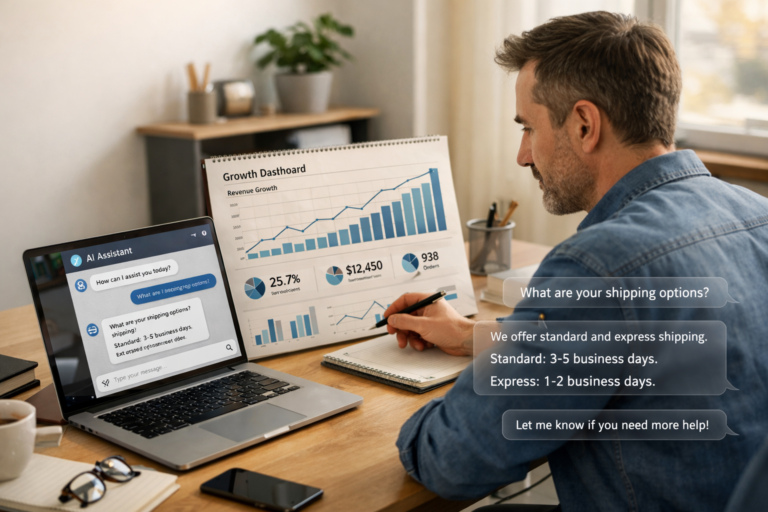
A chatbot widget works across both dealership and repair shop contexts — the use cases differ, but the core function is the same.
After-Hours Lead Capture
Lead capture after hours is the most immediate and measurable win. A chatbot can greet visitors, ask what they're looking for, and collect a name, phone number, email, and vehicle of interest — all without a human in the loop. By morning, your sales team has a qualified list instead of a cold inbox. This alone tends to justify the setup cost for most independent dealers.
Test Drive Booking
Test drive booking is a natural fit for chat. A bot can ask which vehicle the visitor is interested in, confirm availability messaging, and collect a preferred date and time — routing that information to your calendar or CRM. It won't replace your scheduling system, but it feeds it consistently, even when nobody's in the building.
Service and Maintenance Appointment Scheduling
Service and maintenance appointment scheduling works especially well for repair shops and service centers. A chatbot can ask what service the customer needs, collect their vehicle year, make, and model, and offer available time slots. For shops running on WordPress, this is often the highest-ROI use case because service bays fill up and customers book late — frequently after your service desk has closed for the day. The parallel with how restaurant chatbots handle after-hours reservations is worth noting: the problem is nearly identical.
Inventory and Availability Questions
Shoppers want to know if a specific vehicle is still on the lot before they drive 40 minutes. A chatbot can be configured to answer common inventory FAQs, direct visitors to your inventory page, and capture contact info when a vehicle they want isn't currently available. This last part — the "we don't have it now, but let me get your info for when we do" flow — is genuinely useful and easy to set up.
Trade-In Inquiries and Financing Pre-Qualification
Trade-in inquiries and financing pre-qualification questions are where a chatbot can open the conversation — and then hand it off cleanly. A bot can ask whether the visitor has a trade-in, collect basic details (year, make, model, mileage), and let them know your team will follow up with a real assessment. Same with financing: the bot can ask a few general questions and route the lead to your finance team. What it should never do is quote a number or make a promise — more on that in the next section.
Parts and Accessory Inquiries
Parts and accessory inquiries are a strong use case for parts sellers and shops. A bot can help visitors describe what they're looking for, confirm that fitment questions are best answered by a parts specialist, and collect contact info for follow-up. It keeps the conversation moving without requiring a parts counter person to be available at 10pm.
Limits and Compliance: What a Chatbot Should Never Do
This section deserves more prominence than it typically gets in chatbot marketing material, so here it is, plainly stated.
⚠ Compliance Line — Do Not Cross
A website chatbot should never quote firm financing terms, make credit decisions, run a soft or hard credit pull, or promise a trade-in value. Those processes belong to your finance and insurance team, your DMS, and your lender relationships. If a vendor claims their bot can approve financing or replace your F&I process, that is a red flag — not a feature.
A chatbot should never quote firm financing terms. It cannot know your current lender rates, your customer's credit profile, or your dealership's current incentive structure. If a visitor asks "can I get this for $450 a month," the right answer from a bot is to collect their contact information and let your finance team follow up — not to generate a payment estimate. Payment estimates from a bot create expectations your team will have to spend time correcting.
A chatbot should never make credit decisions, run a soft credit pull, or imply that pre-qualification has occurred. Those processes belong to your finance and insurance team, your DMS, and your lender relationships. A bot that appears to pre-qualify a customer creates liability and sets expectations your team will have to walk back in the first five minutes of a real conversation.
A chatbot should never promise a trade-in value. Trade-in appraisals depend on condition, mileage, market data, and your lot's current inventory needs. A bot that says "your 2018 Silverado is worth around $18,000" is making a claim your appraisal team hasn't agreed to — and that creates friction, not trust, when the customer arrives on your lot.
"Keep your chatbot scoped tightly and it will serve you well. A bot that says 'I can help you get started — let me connect you with our team' is more valuable than one that tries to do too much and does it wrong."
The bot's job is lead capture, scheduling, and FAQ handling. Everything binding goes to a human. That's not a limitation to apologize for — it's the correct design for a compliant, trustworthy customer experience. The same principle applies whether you're running an auto shop, a dealership, or — as covered in the insurance chatbot guide for WordPress — any regulated or high-stakes business context.
Specialized Automotive Chatbot Platforms: Where They Win
Purpose-built automotive platforms earn their place in the market. If you're running a franchise dealership with OEM compliance requirements, a multi-rooftop dealer group, or a high-volume operation with a live DMS feed, these platforms offer integrations and workflows that a general-purpose chatbot won't match out of the box. It's worth being direct about that.
- CarNow focuses on real-time inventory integration and digital retailing workflows, connecting chat directly to your DMS so inventory data stays current. For a store doing 150+ units a month, that live feed matters. Shoppers can see accurate availability without your team fielding the same "is it still available" question 30 times a day.
- Kenect and Podium are broader customer communication platforms that include texting, reviews, and chat — they work well for dealerships that want a unified inbox across channels and have the budget and staff to manage it. If your business runs on multi-channel communication and you need everything in one place, these are legitimate options.
- Rybo and Spyne address more specialized needs around AI-driven inventory merchandising and lead engagement, with automotive-specific training and integrations that take time and resources to implement properly.
The honest trade-off: these platforms are priced for dealerships, not independent shops or small operators. Monthly costs can run from a few hundred to several thousand dollars depending on the tier and integrations. They also typically require onboarding, dedicated support relationships, and in some cases OEM approval processes. For the right buyer — a franchise group, a high-volume lot, a dealer group with a dedicated BDC — that investment makes sense. For a two-bay repair shop or a 30-unit independent lot, it often doesn't.
WordPress-Native Chatbots: Where MxChat Fits for Independent Automotive Businesses
For automotive businesses running on WordPress — independent dealers, service and repair shops, detailers, and parts sellers — a WordPress-native chatbot plugin offers a different value proposition: you install it on a site you already own and control, configure it for your specific use cases, and pay a fraction of what enterprise SaaS platforms charge.
MxChat is built as a WordPress plugin, which means it lives on your site, uses your existing hosting, and doesn't require a separate SaaS account with its own login, onboarding team, and contract. For a shop owner who built their site on WordPress because they wanted control and simplicity, that alignment matters. If you're already comfortable managing WordPress plugins, the learning curve is minimal — the practical steps for setting up a chatbot on WordPress are covered in detail elsewhere on this site.
For lead capture and scheduling use cases — the highest-value applications for most independent automotive businesses — a well-configured WordPress chatbot handles the job effectively. You can train it on your inventory FAQs, your service menu, your hours and location, your financing process overview, and your trade-in intake flow.
MxChat supports custom knowledge bases, which means you can feed it your specific business information: the vehicles you typically carry, the services you offer, your appointment booking process, and the questions your staff answers most often. That customization is what makes it feel like your chatbot, not a generic widget that gives the same canned responses regardless of context.
🔍 What You Can Configure
- Your service menu and pricing overview (oil changes, brakes, tires, etc.)
- Inventory FAQs — vehicle types you carry, typical price ranges, financing process overview
- Appointment booking flows for test drives and service appointments
- Trade-in intake: collect year, make, model, mileage, and condition for your team to follow up
- After-hours lead capture with name, phone, email, and vehicle of interest
- Fallback responses that escalate to a human via phone or email
The limitations are real and worth naming: MxChat doesn't have a native live DMS inventory feed the way CarNow does, and it's not built for OEM-compliant franchise workflows. If those are hard requirements, a specialized platform is the right call. But for the majority of independent WordPress-based automotive businesses, those aren't the binding constraints — budget, simplicity, and control are.
WordPress Chatbot Plugin vs. Specialized Automotive SaaS: A Fair Comparison

The right choice depends on your business size, technical requirements, and budget — not on which platform has the longest feature list.
| Factor | Specialized Automotive SaaS | WordPress Plugin (MxChat) |
|---|---|---|
| Monthly Cost | $300–$2,000+ depending on tier and features | One-time or low-cost subscription; fraction of SaaS pricing |
| DMS / Inventory Integration | Pre-built connectors for Reynolds & Reynolds, CDK, and others | Requires manual configuration or third-party bridges |
| Setup & Control | Vendor-managed onboarding; separate dashboard and login | Installed on your site; you own the plugin and the data |
| OEM Compliance | Often on approved vendor lists; built for franchise workflows | Not applicable for independent businesses |
| Lead Capture & Scheduling | Strong; deeply integrated with CRM and BDC workflows | Strong for independent businesses; configurable to your workflow |
| Support | Dedicated account managers; automotive-specific support teams | Documentation, community, and your own configuration work |
| Best Fit | Franchise dealers, multi-rooftop groups, high-volume operations | Independent dealers, repair shops, detailers, parts sellers on WordPress |
Cost structure is the most immediate difference. Specialized automotive platforms typically run $300–$2,000+ per month depending on features and dealership size. A WordPress plugin like MxChat operates on a one-time or low-cost subscription model — relevant for businesses where margins are tight and tech budgets are limited.
DMS and inventory integration is where specialized platforms have a genuine advantage. If you need your chatbot to pull live inventory data, check vehicle availability in real time, or sync with your Reynolds & Reynolds or CDK setup, purpose-built automotive platforms have pre-built connectors. A WordPress plugin will require manual configuration or third-party bridges for that level of integration — and that's an honest limitation worth knowing upfront.
Setup and control favor the WordPress-native approach for businesses that already manage their own site. There's no new vendor relationship to manage, no separate dashboard to learn, and no dependency on a SaaS company's uptime or pricing changes. You own the plugin, it runs on your server, and your data stays in your ecosystem. For a comparison of how different WordPress chat tools approach this trade-off, the Tawk.to vs MxChat comparison and the LiveChat vs MxChat breakdown cover the general-purpose side of this decision in practical terms.
OEM compliance and franchise requirements are non-factors for independent businesses but critical for franchise dealers. If you have brand standards, approved vendor lists, or co-op advertising requirements from a manufacturer, you'll need to verify any chatbot solution against those. Independent operators don't have that constraint — which is actually one of the advantages of running your own shop.
The bottom line: if you're a franchise dealer group or a high-volume operation with a DMS that needs to talk to your chat tool in real time, invest in a specialized platform. If you're an independent dealer, repair shop, detailer, or parts seller running on WordPress who wants to capture more leads and book more appointments without enterprise overhead, a WordPress-native chatbot is the more practical fit.
FAQ: Real Questions from Automotive Business Owners
Can a chatbot actually replace my BDC or sales staff for lead follow-up?
No — and it shouldn't try to. A chatbot handles the first touch: greeting the visitor, collecting their information, and answering common questions. The follow-up, the negotiation, the relationship — that's your team's job. Think of the bot as the after-hours receptionist who takes a message, not the salesperson who closes the deal. The goal is to make sure your team starts the next day with qualified leads rather than empty inboxes.
What happens when a customer asks something the bot doesn't know?
A well-configured chatbot should recognize when a question is outside its scope and respond honestly — something like "That's a great question for our team. Can I get your contact info so someone can follow up with you?" Escalation to a human, by phone or email, is always the right fallback. For practical guidance on configuring fallback responses, the guide to building a chatbot on WordPress covers this in useful detail. A bot that admits its limits and routes to a human is far more trustworthy than one that makes something up.
Is it hard to set up on a WordPress site?
For someone comfortable with WordPress plugins, installation is straightforward. The more meaningful time investment is in configuration — writing out your FAQs, your service menu, your hours, your inventory overview, and your lead capture flow. That work pays off in a bot that actually reflects your business rather than giving generic responses. Plan for a few hours of setup work, not a few weeks. The AI chatbot integration guide for WordPress walks through the process step by step if you want a reference point before starting.
Will customers actually use it, or will they just call?
Both happen, and that's fine. Some customers prefer to call during business hours. But a meaningful segment of shoppers — especially younger buyers and after-hours visitors — will engage with a chat widget when it's available. The goal isn't to replace phone calls; it's to capture the leads that would otherwise leave without contacting you at all. If even a handful of those visitors convert into appointments each month because your chatbot was there at 9pm, the tool has paid for itself.
Putting It Together: What to Actually Do Next
If you're an independent dealer, auto repair shop, detailer, or parts seller running on WordPress, the decision framework is straightforward:
- Define your top two or three use cases. For most independent dealers, that's after-hours lead capture and test drive booking. For repair shops, it's service appointment scheduling. Start there — don't try to solve every possible customer interaction at once.
- Write out your FAQ content before you configure anything. The quality of your chatbot depends almost entirely on the quality of the information you give it. List the 15–20 questions your team answers most often, and write clear, honest answers to each. That content becomes your bot's knowledge base.
- Set clear escalation paths. Decide in advance what happens when a visitor asks something the bot can't handle. A phone number, an email, a contact form — pick one and make sure the bot knows to offer it. This is the most important compliance decision you'll make in your setup.
- Keep financing and trade-in conversations at the collection stage only. Configure your bot to collect information and promise follow-up, never to quote numbers. This protects your customers and your business.
- Review your lead capture data weekly for the first month. See what questions visitors are actually asking, where conversations are dropping off, and what information your bot is missing. Adjust accordingly. A chatbot is a tool you improve over time, not a set-it-and-forget-it solution.
📋 Key Takeaways
- An automotive chatbot's primary value is capturing leads and booking appointments during hours your staff isn't available.
- A bot should never quote financing terms, make credit decisions, or promise trade-in values — those belong to your team.
- Specialized platforms like CarNow, Kenect, and Podium are built for franchise dealers and high-volume operations with DMS integration needs.
- For independent dealers, repair shops, and WordPress-based automotive businesses, a WordPress-native plugin offers the same core functionality at a fraction of the cost.
- The quality of your chatbot is directly proportional to the quality of the information you configure it with — invest time in your knowledge base.
The 9pm shopper looking at your F-150 isn't going to wait until morning to get their questions answered. They'll either find a way to engage with your site, or they'll move to the next one. A chatbot doesn't close that deal — but it keeps the conversation alive long enough for your team to close it in the morning. For most independent automotive businesses on WordPress, that's exactly the right scope for the tool.
Ready to Put Your WordPress Site to Work After Hours?
MxChat is built for WordPress-based businesses that want practical lead capture and scheduling — without enterprise pricing or a six-month onboarding process. If you're an independent dealer, repair shop, or automotive business running on WordPress, it's worth a look.
See How MxChat Works