Chatbots for Enterprise A Practical Guide
When you hear the word "chatbot," you might picture a simple pop-up window on a website that answers basic questions. But for a large business, that’s just scratching the surface. An enterprise chatbot is a whole different beast. It's a deeply integrated AI platform designed to mesh with your core business systems, automating complex tasks that go far beyond a simple Q&A.
Think of it less as a customer service add-on and more as a strategic asset. These advanced bots connect directly to your CRM, ERP, and internal databases, allowing them to deliver truly personalized and context-aware interactions that boost efficiency and drive real revenue.
Why Enterprise Chatbots Are a Strategic Asset
It's a common misconception to lump all chatbots together. Many businesses see them as simple, scripted tools for handling FAQs, but that perspective completely misses the bigger picture. True chatbots for enterprise aren't just conversational windows; they're powerful automation engines that plug right into the heart of your operations.
Here's an analogy: a basic chatbot is like a calculator. It’s great for quick, simple tasks. An enterprise chatbot, on the other hand, is like sophisticated financial modeling software. It juggles multi-step processes, pulls in data from all over the place, and delivers personalized results at an incredible scale.
Beyond Simple Questions and Answers
The real magic happens when an enterprise chatbot integrates with your most critical business systems. Once it's connected to your Customer Relationship Management (CRM) or Enterprise Resource Planning (ERP) software, the bot stops being a passive information source and becomes an active player in your daily operations.
For example, an integrated chatbot can instantly:
- Check real-time inventory levels when a customer asks about a product.
- Update a customer's contact details in your CRM right after a conversation.
- Log a new support ticket in your helpdesk system without a human touching it.
- Kick off an order process directly within your e-commerce platform.
This kind of deep integration creates a smooth, end-to-end automated workflow that was once impossible without a ton of manual effort. It cuts down on repetitive data entry, eliminates human error, and keeps everything consistent for your customers.
An enterprise chatbot's primary role is not just to talk, but to do. It executes tasks, processes information, and connects disparate systems to create a unified, efficient operational flow.
Unlocking New Operational Efficiencies
By automating all those routine but necessary tasks, these chatbots give you back your most valuable resource: your team's time. When your employees aren't bogged down with password resets, order status updates, or basic policy questions, they can tackle the complex, high-value challenges that actually require their expertise.
This shift has a direct impact on your bottom line. A study from IBM revealed that conversational AI can slash cost-per-contact by 23.5% while also boosting revenue by an average of 4%. This dual-threat of cutting costs and growing revenue is what makes enterprise chatbots such a smart strategic investment. To really dig into this, you can explore the comprehensive benefits of chatbots for business and how they boost engagement. It’s how you turn a customer support department from a cost center into a powerful engine for growth.
Decoding Enterprise Chatbot Architecture
To really get what makes chatbots for enterprise so powerful, you have to look under the hood. The architecture is what separates a basic, glorified FAQ bot from a smart automation platform that plugs right into your business. Think of it as the difference between a scripted stage play and a brilliant improv show—one is stuck on a fixed path, while the other can adapt to anything the audience throws at it.
This architecture stands on three core pillars that work in harmony. Understanding them is the key to seeing how these systems scale, stay secure, and unlock their true potential for your business.
The Brain of the Operation: The NLP Engine
At the heart of any smart chatbot is its Natural Language Processing (NLP) engine. This is the bot’s brain, and its job is to figure out what a user is actually trying to say. It takes messy human language—typos, slang, and all—and translates it into a clear command the machine can understand.
Instead of just looking for keywords, a good NLP engine figures out the user's intent. It understands that "Where's my stuff?", "track package," and "delivery status" all point to the same goal: the user wants to find their order. This leap from matching words to interpreting meaning is what makes a conversation feel natural and not robotic.
An advanced NLP engine is what lets a chatbot break free from rigid scripts. It's the part that gets the context, remembers what was said earlier, and gives answers that feel genuinely helpful and aware.
Guiding the Conversation with Dialogue Management
Once the NLP engine grasps the user's intent, the Dialogue Management system steps in. This is the conversation's director, responsible for steering the interaction from start to finish. It decides what the bot needs to say or do next based on the user's request and the information it already has.
For example, if someone wants to book a meeting, the dialogue manager knows it has to ask for a date, a time, and who should be invited. It keeps the conversation flowing, asks for more details when things are unclear, and makes sure every box is ticked to get the job done. To see how modern systems handle these conversations, check out our guide on the OpenAI Assistants API and its capabilities.
This infographic highlights how enterprise chatbots are making a real difference across key business functions.
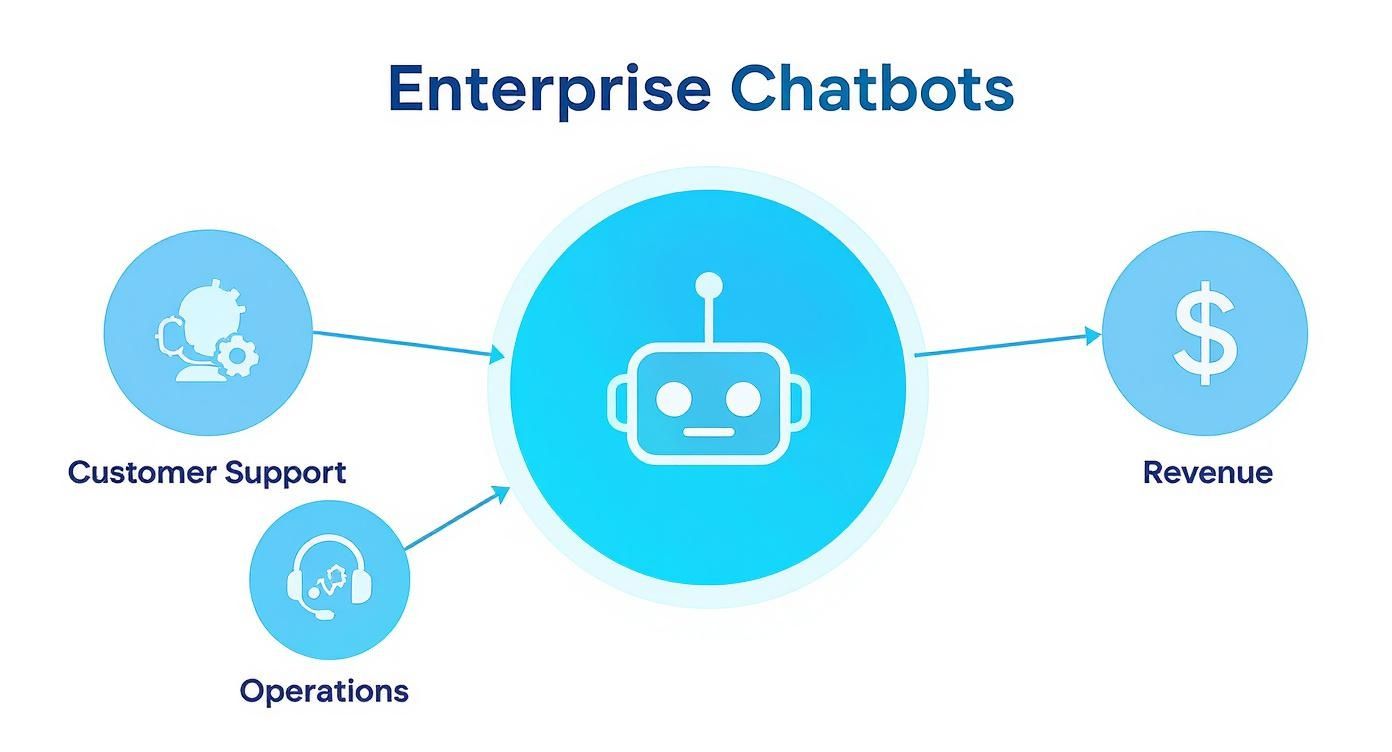
As you can see, these bots aren't just for customer support anymore; they're actively boosting efficiency and helping to drive revenue.
The Integration Layer: Connecting to Your Business Systems
The final piece of the puzzle—and arguably the most critical for any enterprise—is the integration layer. This is the bridge that connects the chatbot to your core business systems: your CRM (like Salesforce), your ERP (like SAP), or your inventory database. Without this, a chatbot is just an isolated tool with very limited knowledge.
With it, the chatbot becomes a powerhouse, able to perform meaningful actions in real-time. This is precisely why the global enterprise chatbot market, valued at USD 7.76 billion in 2024, is expected to soar to USD 27.29 billion by 2030. A huge driver for this growth is the demand for integrated solutions, which already account for 62% of the market's revenue. You can find more data on the chatbot market's rapid expansion on Grand View Research.
This connection gives a chatbot the ability to:
- Pull up a customer's entire order history from your e-commerce platform.
- Instantly create a new lead in your CRM after a promising sales chat.
- Check real-time product stock levels straight from your warehouse system.
Ultimately, this seamless link to your data and tools is what elevates a chatbot from a simple Q&A machine into a fully automated, productive member of your team.
Measuring the Real-World Business Impact
It’s one thing to understand the technical side of chatbots for enterprise, but let's be honest—the only question that really matters to a business leader is, "What's the ROI?" When we strip away the tech jargon, the true value of these bots is measured by their direct impact on your bottom line and how smoothly your operations run. The numbers don't lie: a well-implemented chatbot isn't just a line item expense; it's a serious investment that pays for itself.
The first and most obvious win is in operational cost savings. Chatbots take over the routine, high-volume questions that eat up your team's day, which brings the cost of each customer interaction way down. This frees your human agents from the grind of repetitive tasks, allowing them to focus on the complex, high-stakes issues where their skills truly shine.
Just think about all the simple, everyday questions your team fields: "Where's my order?" or "How do I reset my password?" An enterprise chatbot handles these instantly, around the clock, without ever needing a coffee break. That automation translates directly into lower labor costs and a much more efficient support team.
Quantifying the Financial Gains
The financial upside of this automation is huge. We're seeing companies save up to $300,000 annually just by letting bots handle the easy stuff. These chatbots can successfully resolve up to 80% of standard customer questions on their own, a shift that has been shown to reduce global labor hours by a staggering 2.5 billion. You can dig into more of this data on how AI chatbots are driving efficiency on Thunderbit.
This newfound efficiency sends positive ripples across the entire company. You're not just cutting support costs; you're also boosting overall productivity because your teams can suddenly accomplish more without needing to expand headcount.
The core value of an enterprise chatbot isn't just answering questions. It's about systematically removing operational bottlenecks and freeing up capital that can be poured back into growing the business.
Accelerating Sales and Boosting Conversions
Beyond just saving money, enterprise chatbots are absolute powerhouses for speeding up your sales cycle and driving revenue. Think of them as tireless sales assistants, ready to engage a potential customer the second they arrive on your website. They can qualify leads, answer product questions on the spot, and gently guide users toward a purchase.
Instead of making a potential customer fill out a boring form and wait for someone to call back, a chatbot starts the conversation right now. That instant engagement is crucial—it keeps people on your site and stops them from bouncing over to a competitor.
- Lead Qualification: The bot can ask a few smart questions to figure out who's a hot lead and then instantly connect them with your sales team.
- Demo Scheduling: It can sync with calendars to book demos or appointments automatically, killing the endless email chain for good.
- Personalized Recommendations: By paying attention to what a user is looking at, a chatbot can suggest other products they might love, acting as a personal shopper to upsell and cross-sell.
By turning passive website visitors into active participants in a sales conversation, chatbots create a much shorter path from interest to revenue. For a deeper dive, our guide on how to boost conversions with chat funnels is packed with actionable tips.
Enhancing Customer Satisfaction and Loyalty
Finally, you can't ignore the massive impact on customer satisfaction (CSAT). We live in an on-demand world, and customers expect answers now. A chatbot delivers that instant gratification with 24/7 support, ensuring no question is left hanging, no matter the time of day.
Getting quick, reliable help makes for a great customer experience, which is the bedrock of loyalty and retention. When customers know they can count on you for a fast answer, their trust in your brand deepens.
Plus, by letting bots handle the simple stuff, you ensure that when a customer really needs to talk to a person, an expert agent is available and ready to tackle their complex problem. This tag-team approach—instant automated help combined with skilled human support—creates a genuinely superior service experience that builds relationships for the long haul.
Practical Use Cases Across Your Organization
When people think of chatbots for enterprise, customer support is usually the first thing that comes to mind. But that's just scratching the surface. A well-designed chatbot is more like a digital Swiss Army knife—a versatile tool that can solve problems and streamline work for nearly every department.
By taking over routine tasks and putting information at everyone's fingertips, these bots are changing how entire companies get work done. Let's move past the theory and dive into some real-world scenarios where a chatbot turns a clunky, manual process into a slick, automated one.

A New Era for Human Resources
Think about the typical HR department, constantly fielding the same questions from employees day in and day out. An enterprise chatbot acts as an HR assistant that never sleeps, providing instant answers and taking the friction out of key processes.
Before: An employee needs to know the company’s parental leave policy. They shoot an email to HR, wait a day for a reply, and then have a follow-up question. This simple request ends up taking two days, pulling time from both the employee and the HR manager.
After: The same employee opens the internal chatbot and types, "What's our parental leave policy?" The bot instantly gives them a summary and a link to the full document. It follows up with, "Want me to check your eligibility based on your start date?" The employee says yes, the bot confirms they qualify, and even offers to book a meeting with an HR specialist for them. The whole thing is done in under two minutes.
Common HR chatbot applications include:
- Onboarding New Hires: Guiding new team members through all the initial paperwork, training modules, and setup tasks.
- Answering Policy Questions: Giving instant clarity on everything from vacation days to expense reporting.
- Benefits Enrollment: Walking employees through their options and helping them fill out the right forms.
Unclogging the IT Support Pipeline
The IT help desk is another prime candidate for automation. So many IT tickets are for simple, repetitive issues like password resets or basic troubleshooting. A chatbot can handle these low-hanging fruit, freeing up your skilled IT pros to tackle the big, complex problems.
Before: An employee can't log into a critical system because they forgot their password. They submit a ticket and wait… and wait. Their productivity grinds to a halt while the IT team’s ticket queue just keeps getting longer.
After: The employee messages the IT support bot: "I forgot my password for the CRM." The bot kicks off a secure verification process. Once it confirms their identity, it walks them through the password reset. The employee is back to work in minutes, and a support ticket was never even created.
By automating routine IT tasks, enterprise chatbots not only slash resolution times but also make for happier employees. People get an immediate solution without the frustrating wait, letting them get back to their actual jobs.
Empowering Sales and Marketing Teams
In sales and marketing, timing is everything. An enterprise chatbot can act as a 24/7 lead qualification engine, making sure you never miss an opportunity just because it's after hours.
Before: A potential customer is browsing your website at 10 PM. They have a question but all they can do is fill out a "Contact Us" form and hope someone gets back to them tomorrow. By then, the initial spark of interest might be gone—or worse, they’ve already found a competitor.
After: A visitor lands on your site and a chatbot greets them. It answers their questions about features and pricing. Recognizing their answers signal a strong interest, the bot qualifies them as a hot lead and asks, "Would you like to schedule a 15-minute demo with a specialist?" It syncs with the sales team's calendar and books the meeting right there on the spot.
This kind of instant engagement dramatically shortens the sales cycle. The impact is huge; AI-driven personalized offers were credited with driving $60 billion in extra online sales during a recent holiday season, proving just how much revenue potential is on the table.
Your Implementation Playbook for Enterprise Chatbots
Rolling out a powerful chatbot for enterprise use isn't just a tech project; it’s a strategic move. You can have the smartest AI on the planet, but without a solid game plan, it won't deliver the value you're expecting. Success really comes down to a deliberate, phased approach that ties the technology directly to your business goals from day one.
Think of it like building a house. You wouldn't just start buying lumber and pouring a foundation without a detailed blueprint. In the same way, a chatbot implementation needs a clear architectural plan that defines what you're trying to accomplish and how you'll get there.
Start with a Strategic Foundation
Before you even think about code or conversation design, you have to define what a "win" looks like. This first step is all about zeroing in on a specific, high-impact problem you want to solve. A common pitfall is trying to build a bot that does everything for everyone—that usually just leads to a muddled user experience and weak results.
It's much smarter to start small with a focused pilot program. Find a recurring pain point in one department, like the IT help desk getting flooded with password reset requests or HR fielding the same policy questions over and over. This lets you test the waters, learn quickly, and show some real value before you decide to scale up.
Your initial groundwork should cover:
- Defining Clear Objectives: What specific problem will this chatbot solve? For example, "Cut down on IT tickets for password resets by 50%."
- Setting Key Performance Indicators (KPIs): How will you actually measure success? You'll need metrics like containment rate (how many queries the bot solves on its own) and customer satisfaction (CSAT).
- Mapping the User Journey: What are the most common things people will ask or need to do?
Design Intuitive Conversation Flows
Once your goals are crystal clear, it’s time to think about the user experience. A great enterprise chatbot guides people to answers without making them work for it. The conversation should feel natural, almost like the bot knows what the user needs next and offers a clear path to get there.
This means mapping out potential conversation paths, writing bot responses that are short and to the point, and—this is crucial—planning for a seamless human escalation path. Let's be realistic: no bot can answer every single question. A well-designed system knows exactly when to gracefully hand a conversation over to a live agent. A bot that just traps users in frustrating loops will do more harm than good.
The goal of a chatbot conversation isn't just to provide an answer; it's to resolve an issue with minimal effort from the user. Simplicity and clarity are your guiding principles.
Integrate and Train Your AI Model
This is where the bot gets its brains and its muscle. The integration phase is about connecting your chatbot to the systems that run your business—your CRM, ERP, and internal knowledge bases—using APIs. This step turns your bot from a simple Q&A machine into a genuine productivity tool that can perform real actions, like looking up an order status or creating a support ticket.
For this kind of heavy lifting, cloud deployments are the go-to, holding a 78.4% market share for a reason: they scale. Done right, this can lead to huge cost savings. Some companies have slashed customer support costs by up to 92%, saving about $4.13 per interaction compared to having a human handle it. You can dig into these market trends and savings on Mordor Intelligence.
Next up is training the AI model. With platforms like MxChat, this process involves feeding the bot your own company data—think product manuals, internal policy documents, and website content.
This screenshot gives you a peek at how straightforward it is to build a knowledge base in MxChat for WordPress. You can easily upload your documents and add URLs to teach the bot. By grounding the AI in your own proprietary information, you make sure it gives accurate, relevant answers that sound like they're coming from you.
Common Pitfalls and How to Avoid Them
Bringing a chatbot into an enterprise environment can be a game-changer, but I've seen too many promising projects stumble because they fell into a few common, avoidable traps. Having a powerful AI is great, but without the right strategy, it's like having a race car with no driver. The tech is rarely the reason these things fail; it's almost always the approach.
One of the biggest mistakes is expecting too much, too soon. Some leaders get sold on the idea of a bot that can understand every complex, subtle question right out of the box. The reality is, a new chatbot is like a new hire. It needs training, focus, and time to get up to speed. If you launch it expecting perfection on day one, you're setting everyone up for disappointment.
Another classic pitfall is poor integration. What good is a chatbot if it's stuck on an island? If your bot can't actually do anything—like check an order status in your inventory system or create a ticket in your CRM—it’s just a fancy FAQ page. Users get frustrated fast when they expect action but just get answers.

Forgetting the Human in the Loop
This one is probably the most critical. You absolutely must have a clear path for escalating a conversation to a person. No chatbot can handle 100% of inquiries, and when a user gets stuck in a loop with a confused bot, it creates a memorably awful experience. The best systems know their own limits and make it dead simple to get a human involved.
The goal isn't to replace your team, but to supercharge them. A well-designed chatbot handles all the repetitive, routine questions, freeing up your human experts to tackle the high-value, complex problems where they're needed most.
And that handoff has to be seamless. The bot needs to pass the entire conversation history to the agent so the customer doesn't have to repeat everything they just typed. That's the difference between a helpful, modern support experience and a frustrating dead end.
Launching and Leaving
Finally, a chatbot is not a crockpot—you can't just "set it and forget it." I've seen organizations spend months building and launching a bot, only to move on to the next project and never look back. This is a surefire recipe for failure. An enterprise chatbot is a living system that needs constant care and feeding.
To get this right, you need to think long-term from the very beginning.
- Start with a Focused Scope: Don't try to boil the ocean. Pick one specific, high-impact problem and solve it brilliantly before you even think about expanding.
- Prioritize System Integration: Map out all the connections your bot needs to be truly useful before you start building. Make sure it can talk to your core business systems.
- Monitor and Analyze Performance: Get in the habit of reviewing conversation logs and user feedback weekly. This is where you'll find the golden nuggets for improving answers and conversation flows.
- Establish Strong Governance: You need clear rules of the road. Keeping conversations on track is crucial, and you can learn more about managing this with our guide on effective AI moderation strategies.
When you treat your chatbot as a strategic asset that requires ongoing attention—not just a piece of software—you'll sidestep these common mistakes and build something that delivers real, lasting value.
Your Questions Answered: Getting Real About Enterprise Chatbots
Even when you get the concept, the practical side of bringing a chatbot into your business can seem a little fuzzy. Let's tackle some of the most common questions that pop up when teams start thinking seriously about deploying a chatbot.
How Can We Be Sure Our Data Stays Secure?
This is often the first question, and for good reason. Security isn't just a feature for enterprise-level chatbots; it's the foundation. Think of it like a bank vault. They use multiple layers of protection, like end-to-end encryption, to keep conversations secure whether they're in transit or sitting on a server.
Access is also tightly controlled. Role-based access controls mean that only authorized personnel can view specific data, and secure APIs ensure any connection to your other systems is locked down.
For businesses in heavily regulated industries like healthcare or finance, you can take it a step further. Deploying the chatbot on a private cloud or even on-premise gives you total control over the physical location of your data, helping you meet strict GDPR or HIPAA requirements.
What's a Realistic Timeline to Get a Chatbot Up and Running?
The timeline really depends on what you want the chatbot to do. You don't have to boil the ocean on day one.
A simple, focused bot—say, an internal IT assistant that handles password resets—can often be up and running in a pilot phase in just 4-6 weeks.
If you're aiming for something more ambitious, like a customer service bot that needs to talk to your CRM and inventory management system, you're looking at a more involved project. A timeline of 3-6 months is more realistic for that kind of deep integration.
The smartest way to start is with a phased rollout. Pick one high-impact problem to solve first. This lets you prove the value quickly and learn from real user interactions before you expand its skills.
How Do We Actually Measure the ROI?
Measuring a chatbot's success isn't about a single magic number. It's about looking at its impact from a few different angles: operations, finance, and customer happiness.
Here are a few of the most important metrics (or KPIs) to keep an eye on:
- Containment Rate: What percentage of conversations does the bot handle completely on its own, without needing to escalate to a human?
- Cost per Interaction: This is a direct comparison. How much does an automated interaction cost versus what you'd pay a live agent to handle the same query?
- Customer Satisfaction (CSAT): Are people actually happy with the help they're getting? A quick post-chat survey is the best way to find out.
If your chatbot is involved in sales, you'll also want to track things like lead conversion rates or the number of sales demos it books. The true ROI comes from balancing the initial investment against the combined savings, new revenue, and smoother operations it creates.
Ready to build an intelligent AI assistant for your WordPress site? With MxChat, you can deploy a powerful, no-code chatbot that integrates with your content and automates customer support 24/7. Discover how MxChat can transform your business today.