Gemini 4 Carbon Pricing: Tested on a WordPress Chatbot
Gemini 4 Carbon pricing on the Gemini API is $2 per million input tokens and $10 per million output tokens until 30 November 2026, then $4 and $20 from 1 December. That is exactly the rate card of Gemini 4 Argon, the smaller Gemini 4 model. Google opened Carbon to paying API developers on 10 November 2026, and there is no free tier.
Identical prices don’t mean identical bills. On 11 November 2026 we sent the same support-bot request from our own WordPress server to Gemini 4 Carbon, Gemini 4 Argon and Gemini 3.8 Flash, at every thinking level each model accepts. We timed every answer, recorded the tokens Google reported, and checked each answer against our documentation.
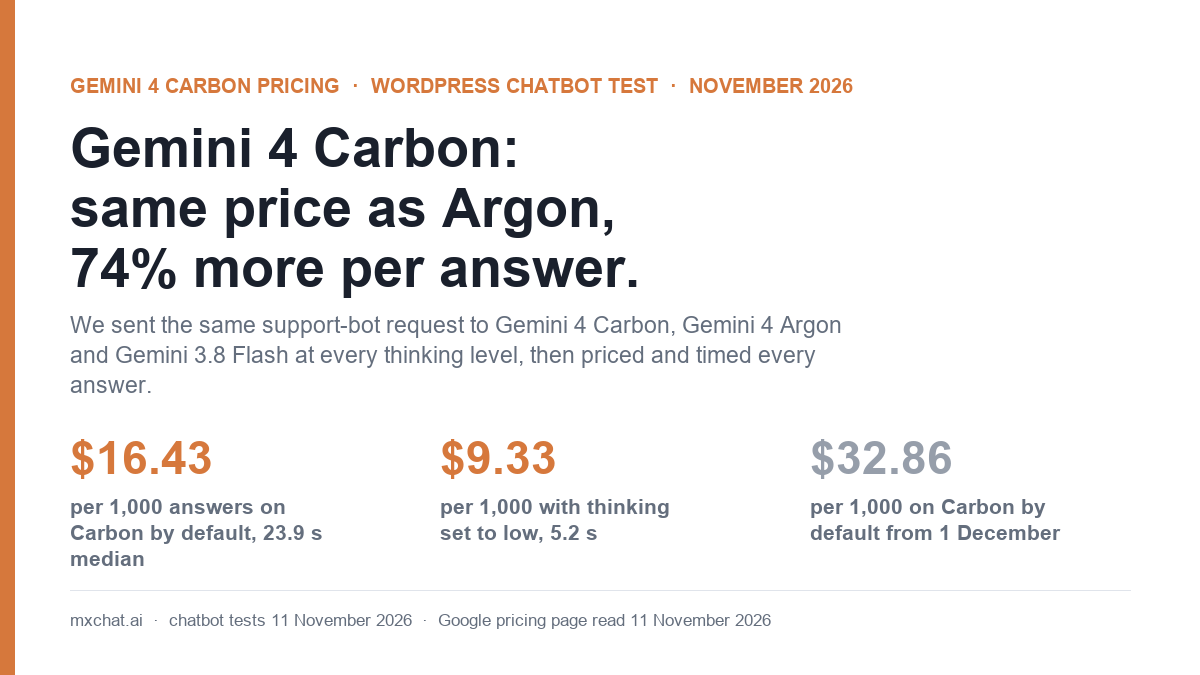
The short answer: left on its default setting, Carbon cost $16.43 per 1,000 answers, 74% more than Argon’s $9.43 at the same per-token price, because Carbon spent about 700 hidden thinking tokens on every answer and Argon spent none. Carbon’s default answers took a median of 23.9 seconds. With thinking set to low, Carbon cost $9.33 and answered in 5.15 seconds, with the same correct answers. From 1 December every one of those figures doubles: default Carbon becomes $32.86 per 1,000.
Gemini 4 Carbon pricing: the rate card
These are the prices on Google’s Gemini API pricing page as we read it on 11 November 2026, per million tokens. The model ID is gemini-4-carbon.
| Tier | Input, to 30 Nov | Output, to 30 Nov | Cached input, to 30 Nov | Input, from 1 Dec | Output, from 1 Dec | Cached input, from 1 Dec |
|---|---|---|---|---|---|---|
| Standard | $2.00 | $10.00 | $0.10 | $4.00 | $20.00 | $0.20 |
| Batch | $1.00 | $5.00 | $0.05 | $2.00 | $10.00 | $0.10 |
| Flex | $1.00 | $5.00 | $0.05 | $2.00 | $10.00 | $0.10 |
| Priority | $3.60 | $18.00 | $0.18 | $7.20 | $36.00 | $0.36 |
Four details in the small print matter for a chatbot:
- Output includes thinking tokens. The tokens the model spends reasoning before it answers are billed at the output rate. You never see them, but you pay $10 per million for them, and $20 from December.
- No free tier. Google’s page lists every Carbon price as “Not available” on the free tier, so you can’t trial it on a free key.
- Implicit caching only. Carbon doesn’t support explicit caching. Google caches repeated prompt text automatically when it chooses to, and you can’t force it.
- Grounding with Google Search is free for the first 5,000 requests a month, shared across Gemini 3 and newer models, then $14 per 1,000 requests.
Argon’s standard, batch and priority prices are the same as Carbon’s, cent for cent, including the 1 December doubling. Gemini 3.8 Flash is $0.75 input and $3.75 output until 31 December 2026, then $1.50 and $7.50 from 1 January 2027.
How we tested it
Each request was the one a MxChat support bot sends: our site’s real system prompt plus four passages from our own documentation, about 4,170 tokens on Gemini’s count, followed by one visitor question. We used four questions a real visitor might ask:
- Does MxChat work with WooCommerce, and can the bot look up an order for a logged-in customer?
- Do I need Pinecone for the knowledge base, or can embeddings live in WordPress?
- Can a visitor be handed to a human on Slack or Telegram?
- Can I use my own OpenRouter or OpenAI key, and which models can I choose?
We sent those to the Gemini API directly, with our own paid key, without streaming. Carbon ran with no thinking setting (three passes, 12 answers), then with thinking set to low, medium and high and with a thinking budget of zero (one pass each). Argon ran with no setting (two passes) and at low, medium and high. Gemini 3.8 Flash ran with no setting (two passes). Neither Gemini 4 model accepts the minimal level; both return a 400 error for it.
That came to 56 requests. At Google’s list prices they cost about $0.66. The Gemini API doesn’t return a dollar figure, so every cost below is the measured tokens multiplied by the prices in the table above.
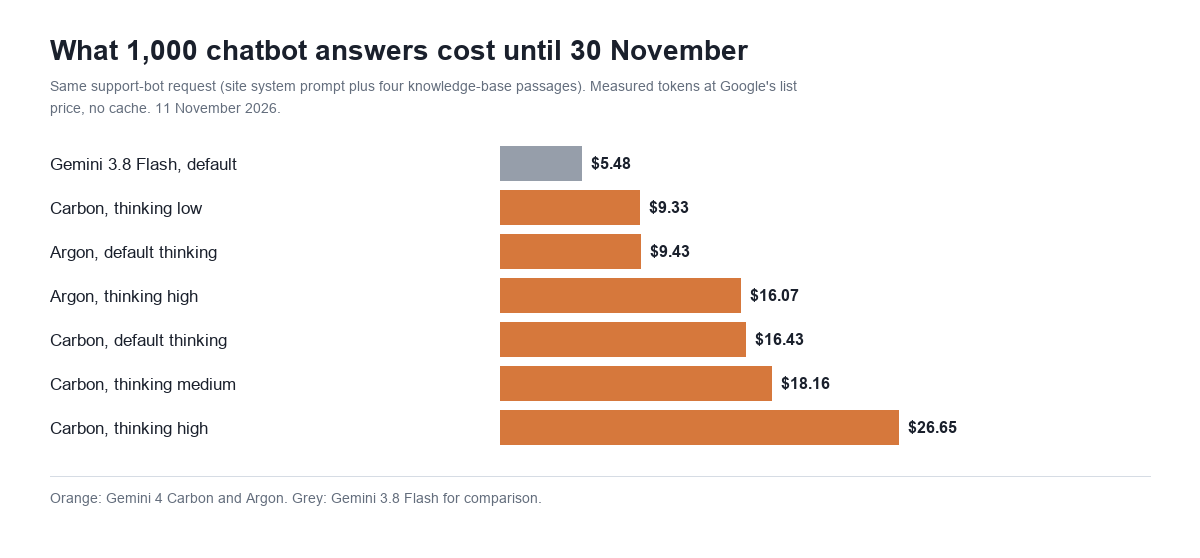
What 1,000 answers cost
| Setup | Thinking tokens per answer | Per 1,000 answers, to 30 Nov | Per 1,000 answers, from 1 Dec | Median answer | Correct answers |
|---|---|---|---|---|---|
| Carbon, default | 709 (395 to 1,095) | $16.43 | $32.86 | 23.91 s | 12 of 12 |
| Carbon, thinking low | 0 | $9.33 | $18.66 | 5.15 s | 4 of 4 |
| Carbon, thinking budget 0 | 0 | $9.34 | $18.69 | 5.83 s | 4 of 4 |
| Carbon, thinking medium | 887 | $18.16 | $36.32 | 21.06 s | 4 of 4 |
| Carbon, thinking high | 1,732 (1,149 to 2,613) | $26.65 | $53.30 | 22.37 s | 4 of 4 |
| Argon, default | 0 | $9.43 | $18.87 | 6.53 s | 8 of 8 |
| Argon, thinking low | 0 | $9.64 | $19.28 | 6.90 s | 4 of 4 |
| Argon, thinking medium | 0 | $9.44 | $18.89 | 8.30 s | 4 of 4 |
| Argon, thinking high | 671 | $16.07 | $32.14 | 13.60 s | 4 of 4 |
| Gemini 3.8 Flash, default | 566 | $5.48 | $5.48 (doubles 1 Jan) | 6.54 s | 8 of 8 |
All costs are with no cache, so they are the most you would pay for this request.
Carbon thinks by default. Argon, on these questions, did not. With no thinking setting, Carbon reported between 395 and 1,095 thinking tokens on every one of its 12 answers. Argon reported none on any of its eight. Since both models charge the same $10 per million for those tokens, that is the whole gap between them. A default Carbon answer broke down like this, per 1,000 answers:
- Input (about 4,170 tokens): $8.34
- Hidden thinking (about 709 tokens): $7.09
- The answer the visitor reads (about 100 tokens): $1.00
So on a default Carbon request, thinking cost seven times as much as the answer itself. Carbon’s default behaved much like its medium setting (709 against 887 thinking tokens). Setting thinking to low, or setting a thinking budget of zero, removed the thinking tokens completely and brought Carbon to $9.33, a little under Argon.
Argon only started thinking when we asked for high, and then it spent a steady 627 to 704 tokens per answer. Carbon on high was much less predictable: 1,149 to 2,613 thinking tokens for the same four questions, and $26.65 per 1,000.
Gemini 3.8 Flash also thinks by default, about 566 tokens an answer, but at $3.75 per million that adds $2.12 rather than $7.09. It came out at $5.48 per 1,000, a third of default Carbon.
Speed: 5 seconds or 24, depending on one setting
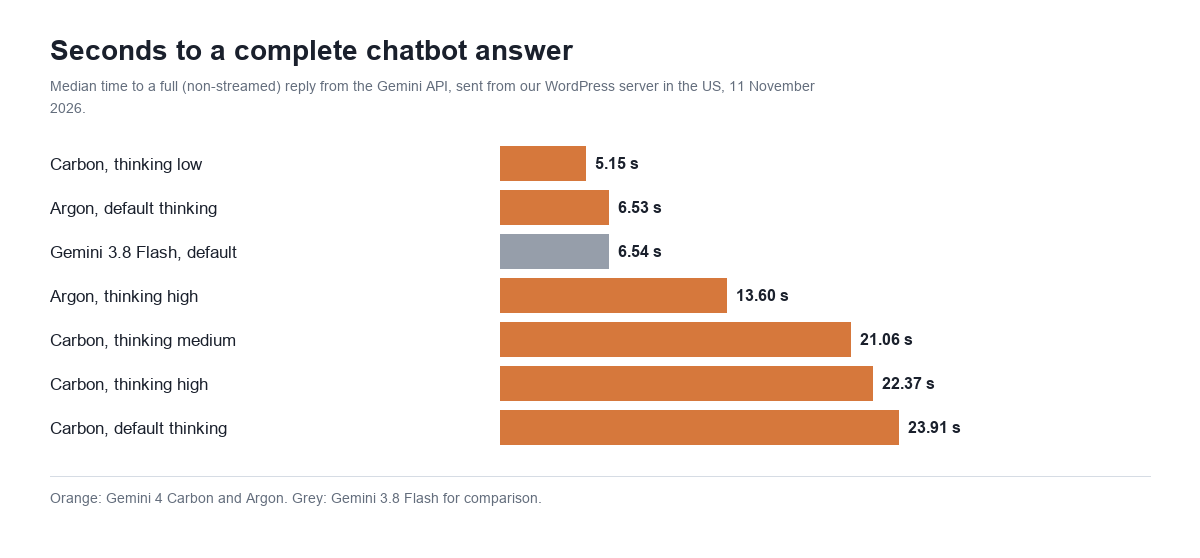
With thinking set to low, Carbon was the fastest setup in the test: a 5.15 second median, with all four answers between 4.33 and 5.65 seconds. Argon on its default took 6.53 seconds and Gemini 3.8 Flash 6.54.
On its default, Carbon was the slowest. The median over 12 answers was 23.91 seconds. The first pass was the best, 9.89 to 18.03 seconds for three of the four answers. The later passes were worse, and five of the 12 default answers took between 44 and 64 seconds.
Some of that is thinking, and some of it looked like load. Across the whole test, six of the 28 Carbon answers took longer than 40 seconds, and so did one of the 20 Argon answers (72 seconds, on a request with no thinking tokens at all). We tested the day after Carbon opened to all paying developers, so expect the queueing to settle. The thinking time won’t: a model that writes 700 tokens before it starts the answer will always be slower than one that doesn’t.
For a chat widget this is the number that decides it. A visitor will wait five seconds for an answer. Very few will wait 24, and almost none will wait a minute.
Did the extra thinking improve the answers?
Not on support questions like these. All 56 answers, on every model and every thinking level, were correct on the facts: WooCommerce order lookups need the add-on and a logged-in customer, Pinecone is optional, Slack and Telegram handoff both exist, and you bring your own API key.
The answers were also about the same length. Carbon wrote 58 to 64 words per answer at every thinking level. Argon wrote 66 to 82. Flash was the briefest at 49. Reading them side by side, we couldn’t tell a Carbon answer that used 2,600 thinking tokens from one that used none. One high-thinking answer was a little more careful: it noted that our documentation describes a visitor asking for a human, not an automatic handoff when the bot is stuck, and pointed to the documentation for the rest. That is a fair reading, and the low-thinking answers simply said yes.
This is what you’d expect. The request already contains the passages that hold the answer, so the job is to read and summarise, not to reason through a hard problem. Carbon is built for long coding and agent tasks, and a support question doesn’t give it anything to think about. If your bot does multi-step work, such as comparing products across several tool calls, the thinking may earn its cost. Test that on your own questions before you pay for it.
Caching: about half the prompt, some of the time
Carbon and Argon support implicit caching only, at $0.10 per million cached tokens until 30 November. Google’s page says explicit caching isn’t supported, and the API’s model list offers no cache-creation method for either model. Gemini 3.8 Flash still has one.
On the second pass, a few minutes after the first, Google reported cached tokens on all four Argon requests and three of the four Carbon requests. Each hit covered roughly half the prompt, 2,008 to 2,340 of about 4,170 input tokens. With those hits Argon’s second pass cost $5.41 per 1,000 instead of $9.43, and Carbon’s default pass cost $12.83 instead of $15.90.
The hits weren’t dependable. Counting every Gemini 4 request we sent after the first pass, 13 of 40 got a cache hit, and four whole passes got none. A busy bot that sends the same system prompt all day should do better than our short test, but with implicit caching you can’t plan on it. Budget on the no-cache figures and treat cache savings as a bonus.
What changes on 1 December
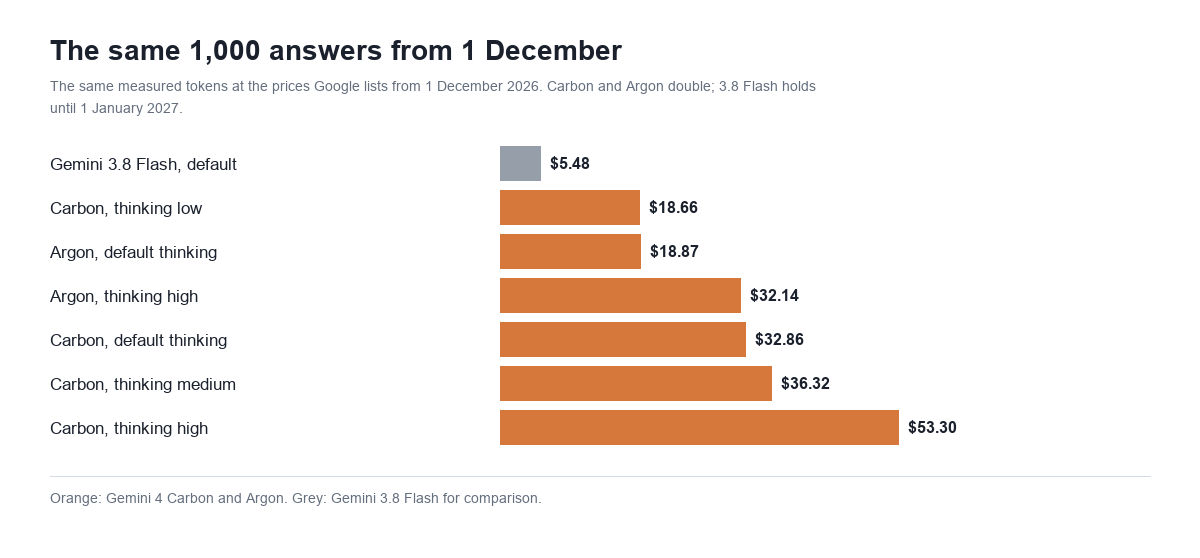
Carbon’s launch prices and Argon’s both end on 30 November 2026. From 1 December, input goes to $4, output and thinking to $20, and cached input to $0.20. Nothing else about the request changes, so every per-answer cost doubles. For a site that answers 10,000 questions a month:
| Setup | 10,000 answers in November | 10,000 answers from December |
|---|---|---|
| Carbon, default thinking | $164 | $329 |
| Carbon, thinking low | $93 | $187 |
| Argon, default | $94 | $189 |
| Gemini 3.8 Flash, default | $55 | $55 in December, $110 from January |
Flash’s own introductory price ends on 31 December, so its doubling comes a month later. Even then it stays well under either Gemini 4 model. We covered Flash’s thinking costs in detail in our Gemini 3.8 Flash pricing test.
Carbon, Argon or Flash for a support bot?
| Gemini 4 Carbon | Gemini 4 Argon | Gemini 3.8 Flash | |
|---|---|---|---|
| Input / output per million, now | $2 / $10 | $2 / $10 | $0.75 / $3.75 |
| Price doubles on | 1 December 2026 | 1 December 2026 | 1 January 2027 |
| Thinks by default on a support question | Yes, about 709 tokens | No | Yes, about 566 tokens |
| Cost per 1,000 answers, default | $16.43 | $9.43 | $5.48 |
| Cost per 1,000 answers, thinking low | $9.33 | $9.64 | Not tested |
| Median answer, default | 23.91 s | 6.53 s | 6.54 s |
| Explicit caching | No | No | Yes |
| Free tier | No | No | Yes |
Our view: for answering visitor questions from a knowledge base, Gemini 3.8 Flash is still the sensible Google model. It was as fast as Argon, got every answer right, and cost 41% less than the cheapest Gemini 4 setup, a gap that widens to 71% in December.
If you want a Gemini 4 model, set thinking to low. At that setting Carbon and Argon cost the same and Carbon was slightly quicker in our test. Running Carbon on its default for support chat means paying 74% more and making visitors wait about four times as long for the same answer.
For comparison with other flagship models on the same request: Claude Opus 5.5 cost $28.67 per 1,000 answers at standard speed in our Claude fast mode test, and answered in about three seconds. Carbon at low thinking is a third of that price until December. Our Vertex AI pricing test covers Argon on Google Cloud, where the same December doubling applies.
Using Gemini 4 Carbon in MxChat
MxChat connects to Gemini with your own Google API key. Three things to know before you switch:
- You need a paid Gemini API key. Carbon and Argon aren’t available on the free tier. Our documentation shows where the key goes.
- MxChat 3.2.28’s built-in Gemini list includes Gemini 3.8 Flash (the recommended choice) and Gemini 4 Argon. Carbon was released after that version shipped.
- MxChat sends Gemini 4 models a thinking level of low. So the figure that applies to a MxChat site on Argon is the low row in our table: $9.64 per 1,000 answers now, $19.28 from December, at about seven seconds. Developers can change the level with the
mxchat_gemini_thinking_levelfilter. Based on this test we wouldn’t raise it for support chat.
If you call the Gemini API from your own code, the setting is generationConfig.thinkingConfig.thinkingLevel, with the values low, medium and high. Leave it out and Carbon chooses for itself, which in our test meant the $16.43 row.
Whatever you pick, put a reminder in your calendar for 1 December. A bot that costs $94 a month on Argon today will cost $189 with no change on your side. Order lookups for logged-in WooCommerce customers need MxChat Pro. If you’re weighing Google against OpenAI at this price level, see our GPT-6.1 Terra pricing test.
Frequently asked questions
How much does Gemini 4 Carbon cost?
On the Gemini API, $2 per million input tokens, $10 per million output tokens (thinking tokens included) and $0.10 per million cached input tokens until 30 November 2026. From 1 December 2026 those become $4, $20 and $0.20.
What does Gemini 4 Carbon cost per chatbot answer?
In our test, with a 4,170-token support prompt and short answers, $16.43 per 1,000 answers on the default thinking setting and $9.33 per 1,000 with thinking set to low, with no cache. Both figures double on 1 December 2026.
Is Gemini 4 Carbon more expensive than Gemini 4 Argon?
Not per token: the two rate cards are identical. Per answer it was 74% more expensive on default settings in our test, because Carbon spent about 709 thinking tokens per answer and Argon spent none.
Does Gemini 4 Carbon have a free tier?
No. Google’s pricing page lists Carbon as not available on the free tier. You need a paid Gemini API key.
Can you turn off thinking on Gemini 4 Carbon?
In our test, yes. Setting the thinking level to low, or the thinking budget to zero, produced answers with no thinking tokens. The minimal level is rejected with a 400 error.
Does Gemini 4 Carbon support context caching?
Implicit caching only. Google applies it automatically at $0.10 per million cached tokens until 30 November 2026. In our test a hit covered about half the prompt, and 13 of 40 follow-up requests got one.
How fast is Gemini 4 Carbon?
With thinking set to low, a median of 5.15 seconds for a complete 60-word answer. On the default setting the median was 23.91 seconds, and five of 12 answers took 44 to 64 seconds, the day after launch.
When does the Gemini 4 Carbon price go up?
On 1 December 2026. Standard input rises from $2 to $4 per million tokens and output from $10 to $20. Gemini 4 Argon rises by the same amounts on the same day.
Method note: tests run 11 November 2026 from mxchat.ai’s server in the US against the Gemini API with a paid key, 4 questions per pass, three passes for Carbon on default, two for Argon and Gemini 3.8 Flash on default and one for every other setting, no streaming, default temperature. Prices are from Google’s Gemini API pricing page read the same day. The API returns token counts, not charges, so costs are measured tokens at list prices; per-1,000 figures are means over the answers in each setup. Your costs depend on your prompt size, answer length and traffic pattern.