
Meta Muse Spark Pricing: 18 Chatbot Routes Tested
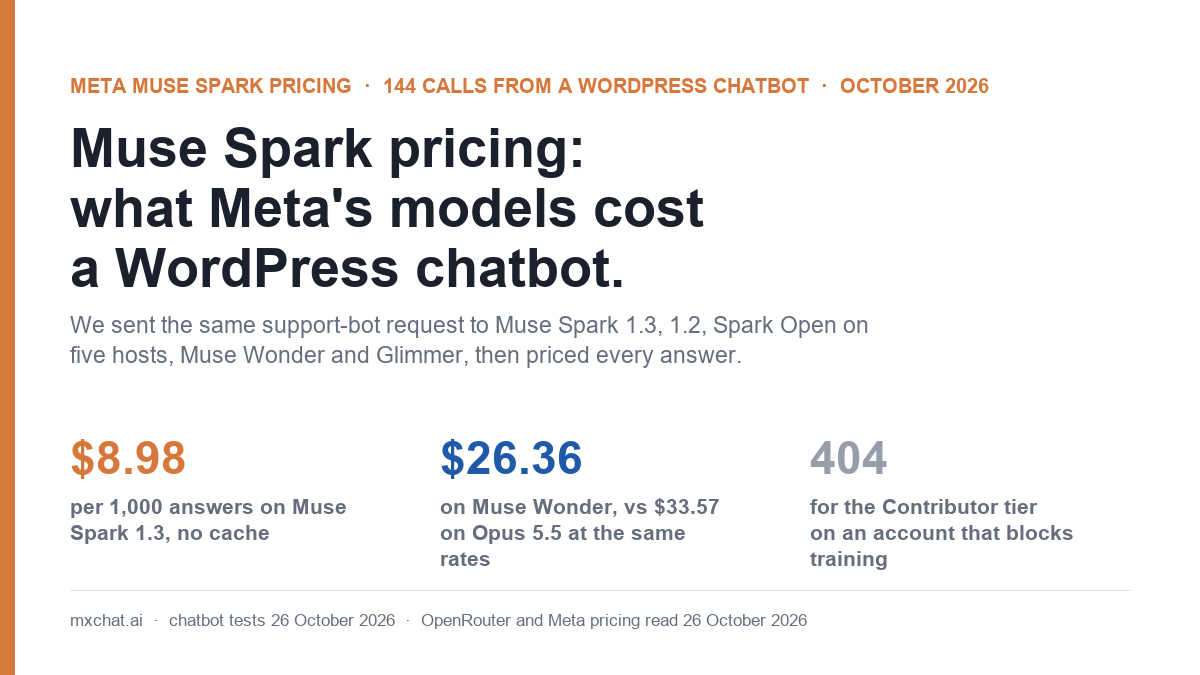
Meta Muse Spark pricing is $1.25 per million input tokens and $4.25 per million output tokens for Muse Spark 1.3, the current version on Meta’s API, with cached input at $0.15. Muse Wonder, the frontier model Meta released on 12 October 2026, costs $4 and $20, the same rate card as Claude Opus 5.5. There is also a Contributor tier at $0.10 and $0.20 that is cheaper because Meta can train on what you send it. We sent the same WordPress chatbot request to every Muse model we could reach, from our own server, and priced each answer. At list price with no cache, 1,000 chatbot answers cost $8.98 on Muse Spark 1.3 and $26.36 on Muse Wonder. Claude Opus 5.5, at exactly Wonder’s rates, cost $33.57.
This post covers Meta’s current price list, what each Muse model costs per chatbot answer, why Muse Spark spends more than 20 times as many tokens thinking as writing, what happened when we tried the Contributor tier (OpenRouter refused the request), how Muse Spark Open behaves on five different hosts, and how all of it compares with Claude, GPT-6 Luna and MiniMax on the same request.
Meta Muse pricing in October 2026
These are the per-token rates OpenRouter listed for Meta’s endpoints on 26 October 2026. They match the rates reported for Meta’s own Model API since Muse Spark 1.1 launched as Meta’s first paid model.
| Model | Released (OpenRouter) | Input / 1M | Cached input / 1M | Output / 1M |
|---|---|---|---|---|
| Muse Spark 1.3 | 2 Sep 2026 | $1.25 | $0.15 | $4.25 |
| Muse Spark 1.3 Contributor | 2 Sep 2026 | $0.10 | $0.002 | $0.20 |
| Muse Spark 1.2 | 21 Aug 2026 | $1.25 | $0.15 | $4.25 |
| Muse Wonder | 12 Oct 2026 | $4.00 | $0.20 | $20.00 |
| Muse Spark Open (open weights) | 15 Oct 2026 | $1.25 | $0.15 | $4.25 |
| Muse Glimmer 30B (open weights) | 9 Aug 2026 | $0.30 (DeepInfra) | $0.04 | $1.20 |
Every Muse Spark version has kept the same price, so upgrading from 1.2 to 1.3 does not change your rate card. All Meta-hosted models have a context window of about one million tokens. Web search grounding is extra, at $2.50 per 1,000 searches. Meta has been reported to give new API accounts $20 of free credit; we did not open a new account to check.
Reasoning tokens are billed as output. That matters more on Muse Spark than on most models, as the test below shows.
The Contributor tier: 92% off, paid for with your data
The Contributor tier runs Muse Spark at $0.10 input and $0.20 output, a 92% discount on input and 95% on output. In exchange, Meta may use your prompts and completions to train future models. For a website chatbot, the prompt is the visitor’s question plus whatever your knowledge base retrieved, so your customers’ messages and your own documentation would both go into that pool. Reporting on the tier says Meta does not publish a retention period or a way to withdraw data once it is sent.
We tried to test it and could not. OpenRouter returned HTTP 404 on all eight requests with this reason: “Paid model training violation (account settings): 1 endpoint excluded.” Our OpenRouter account does not allow paid models that train on prompts, so OpenRouter removed the only endpoint. That is the setting you want on a business account, and it is worth checking yours before you pick a model from a price list. If you are weighing what leaves your site when a chatbot calls an AI API, our WordPress AI plugin data egress audit goes through it field by field.
For reference only: at Contributor prices, Muse Spark 1.3’s measured tokens would have cost $0.59 per 1,000 answers. That assumes the Contributor endpoint serves the same model with the same token counts, which we could not confirm.
How we tested
We built each request the way MxChat builds a chatbot reply. The system message holds our site’s own system prompt plus four knowledge-base passages from mxchat.ai pages, and the user message is the visitor’s question. That came to about 4,000 input tokens. The four questions are ones our own chatbot gets:
- Does MxChat work with WooCommerce, and can the bot look up an order status for a logged-in customer?
- Do I need Pinecone to use the knowledge base, or can I store embeddings in WordPress?
- Can a visitor be handed over to a human on Slack or Telegram when the bot cannot answer?
- Can I use my own OpenRouter or OpenAI API key, and which models can I choose from?
Each question went twice to each of 18 routes through OpenRouter on 26 October 2026: Muse Spark 1.3 on Meta at default and low reasoning effort, with reasoning switched off, and on the Contributor tier; Muse Spark 1.2; Muse Wonder at default and low effort; Muse Spark Open on Together, Fireworks, Nebius and BaseTen with the host pinned and fallbacks off, plus once with OpenRouter choosing the host; Muse Glimmer 30B on DeepInfra; and five comparison models, Claude Opus 5.5, Claude Sonnet 5.5, Claude Haiku 5.5, GPT-6 Luna and MiniMax M3.1 Flash. That is 144 requests. 128 returned an answer. The 16 failures were the eight Contributor requests (404, above) and eight “reasoning off” requests (400, below).
We read every answer. All 128 were correct: each said the WooCommerce order lookup needs MxChat Pro and a logged-in customer, that Pinecone is optional, that Slack and Telegram handoff are both available, and that you can bring your own key.
Costs below are measured tokens multiplied by each route’s list price, with no cache discount, so you can compare routes on equal terms. We give cached figures separately.
What 1,000 chatbot answers cost on each Muse model
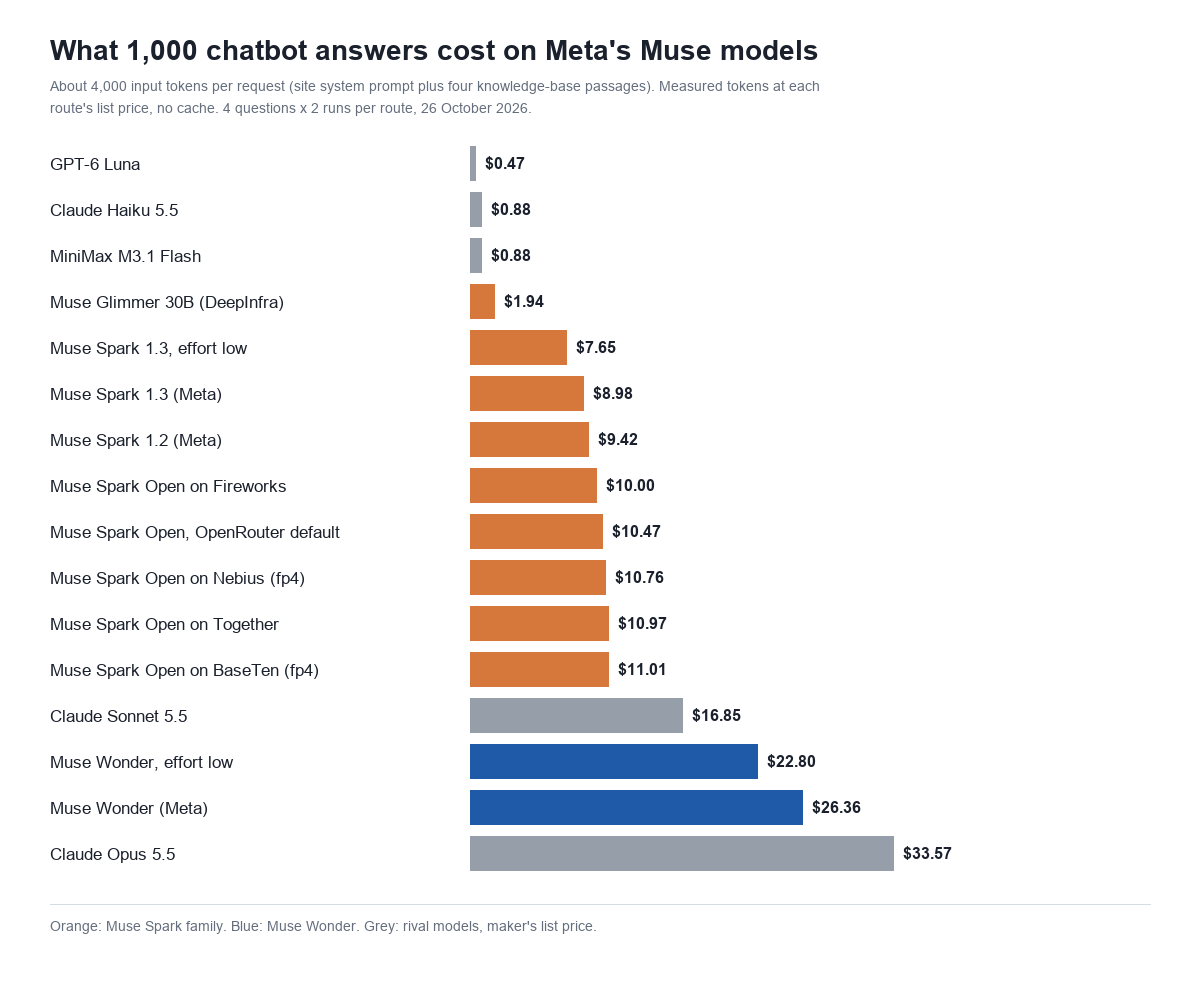
| Route | Input tokens | Output tokens | Of which reasoning | Answer words | Cost per 1,000 answers | Median seconds |
|---|---|---|---|---|---|---|
| Muse Spark 1.3 (Meta) | 4,026 | 929 | 834 | 29 | $8.98 | 5.05 |
| Muse Spark 1.3, effort low | 4,026 | 617 | 525 | 37 | $7.65 | 3.58 |
| Muse Spark 1.2 (Meta) | 4,026 | 1,032 | 891 | 57 | $9.42 | 4.36 |
| Muse Wonder (Meta) | 4,026 | 513 | 424 | 38 | $26.36 | 3.92 |
| Muse Wonder, effort low | 4,026 | 335 | 265 | 36 | $22.80 | 2.99 |
| Muse Glimmer 30B (DeepInfra) | 4,028 | 611 | n/a | 30 | $1.94 | 4.92 |
| Claude Opus 5.5 | 6,838 | 311 | 158 | 62 | $33.57 | 5.33 |
| Claude Sonnet 5.5 | 6,838 | 317 | 147 | 72 | $16.85 | 4.44 |
| Claude Haiku 5.5 | 6,838 | 385 | 277 | 44 | $0.88 | 2.44 |
| MiniMax M3.1 Flash | 4,252 | 404 | 353 | 32 | $0.88 | 4.80 |
| GPT-6 Luna | 4,067 | 119 | 73 | 28 | $0.47 | 3.23 |
Three things stand out.
Muse Spark is a mid-priced model, not a budget one. At $8.98 per 1,000 answers it costs about ten times Claude Haiku 5.5 or MiniMax M3.1 Flash and nineteen times GPT-6 Luna on the same request, and all of those answered every question correctly too. It is about half the price of Claude Sonnet 5.5. If your bot answers questions from a knowledge base, Muse Spark is paying for capability the job does not use.
Muse Spark 1.3 is slightly cheaper than 1.2 at the same price. It used 10% fewer output tokens, which brought the cost per answer down 5%. 1.2 also wrote answers twice as long (57 words against 29) and, in our runs, returned no cache hits at all.
Muse Wonder costs 21% less than Claude Opus 5.5 at an identical rate card. Both are $4 input and $20 output. The difference is the tokenizer: Anthropic counted our request as 6,838 input tokens, Meta as 4,026. Input is most of a chatbot’s bill, so the same text costs 70% more to send to Claude. Wonder spent more on reasoning (513 output tokens against 311) but not nearly enough to close the gap. We saw the same tokenizer effect in our Claude Opus 5.5 pricing test.
Where the money goes: reasoning
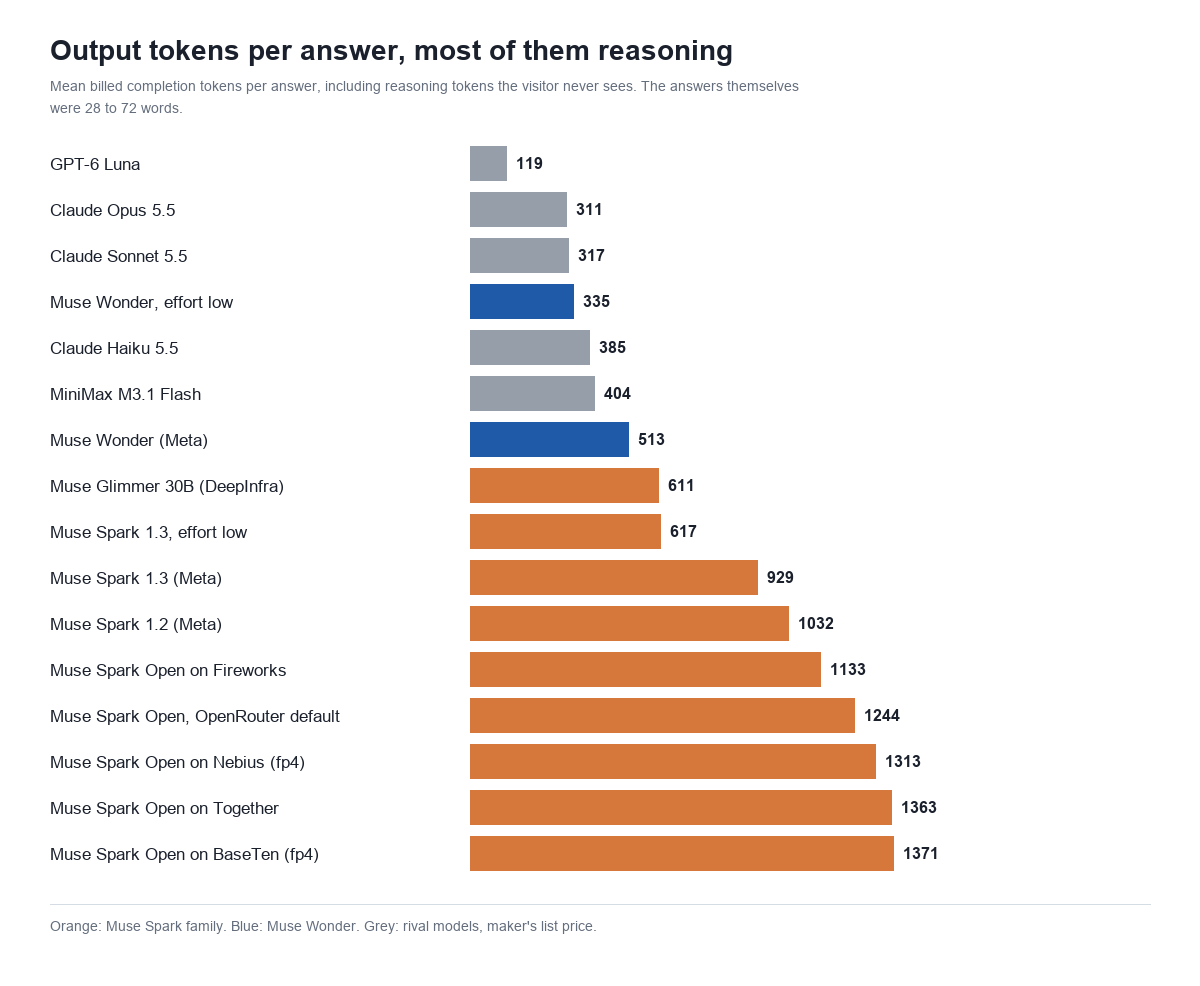
Muse Spark 1.3 spent an average of 834 reasoning tokens to write a 29-word answer. Those tokens are billed at the $4.25 output rate, so 39% of each answer’s cost was thinking the visitor never sees. Muse Spark Open went further, at 1,041 to 1,275 reasoning tokens per answer depending on the host, about half its bill.
You cannot switch it off. Every request we sent to Muse Spark 1.3 with reasoning disabled came back HTTP 400: “Reasoning is mandatory for this endpoint and cannot be disabled.” MiniMax M3.1 Flash gave the same error in our MiniMax test the day before, so this is becoming a common pattern for reasoning-first models.
You can turn it down. With reasoning effort set to low:
| Setting | Reasoning tokens | Cost per 1,000 answers, no cache | Billed, second run | Median seconds |
|---|---|---|---|---|
| Muse Spark 1.3, default | 834 | $8.98 | $7.62 | 5.05 |
| Muse Spark 1.3, effort low | 525 (−37%) | $7.65 (−15%) | $4.30 (−44%) | 3.58 (−29%) |
| Muse Wonder, default | 424 | $26.36 | $25.35 | 3.92 |
| Muse Wonder, effort low | 265 (−38%) | $22.80 (−14%) | $19.89 (−22%) | 2.99 (−24%) |
The answers at low effort were just as correct, and slightly longer. For a support chatbot there was no downside in our test. The billed second-run figure for Spark 1.3 at low effort dropped further because more of its prompt was served from cache on that run; we come back to caching below.
Muse Spark Open on five hosts
Muse Spark Open is the open-weight member of the family, released on 15 October and described by OpenRouter as tuned for agentic coding. Because the weights are public, inference companies host it themselves. Six hosts were listed on 26 October and every one charged Meta’s price, so the host decides speed and behaviour, not the rate card.
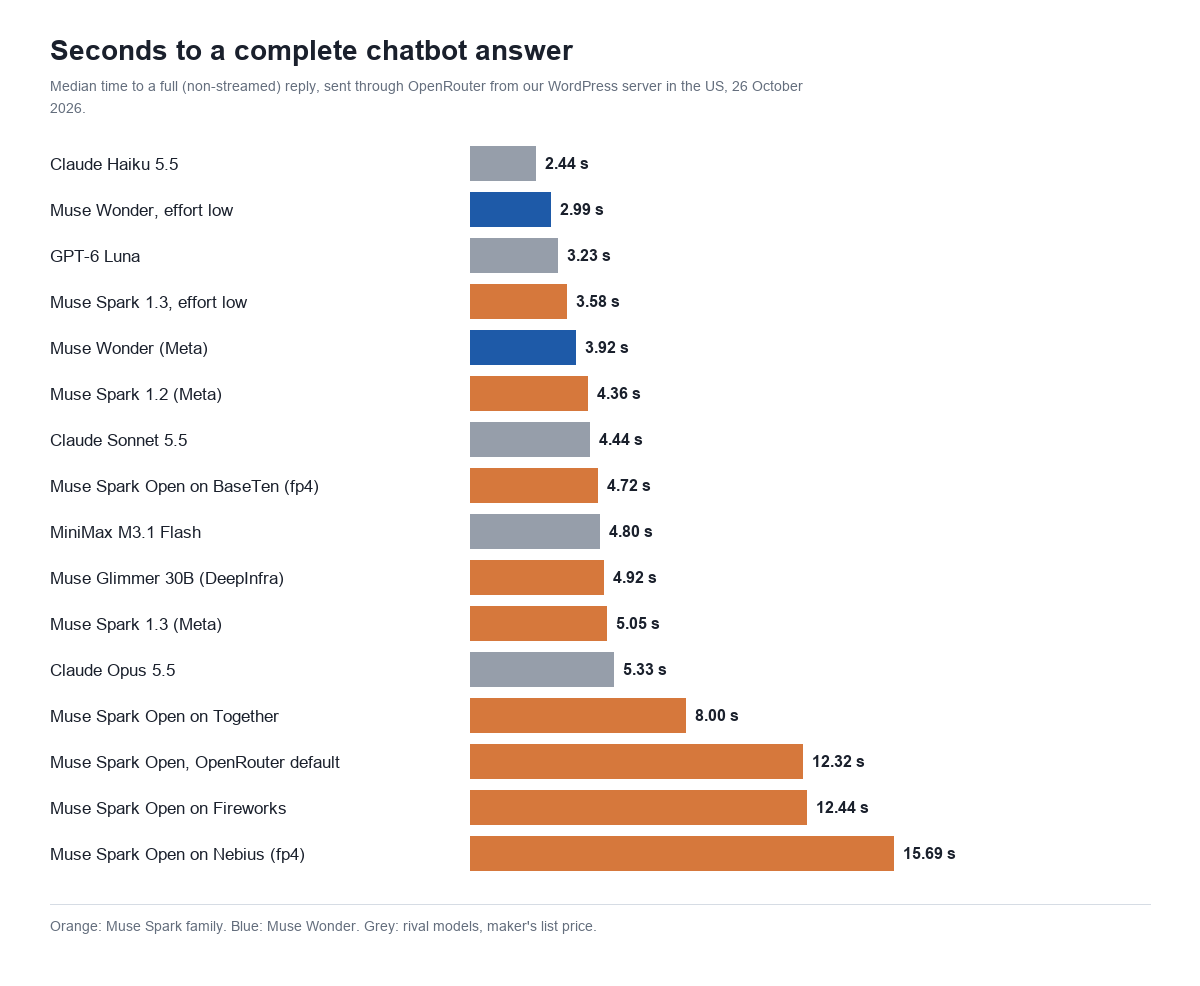
| Muse Spark Open host | Weights | Reasoning tokens | Cost per 1,000, no cache | Billed, second run | Median seconds | Slowest answer |
|---|---|---|---|---|---|---|
| BaseTen | fp4 | 1,275 | $11.01 | $8.08 | 4.72 | 7.7 s |
| Together | not stated | 1,271 | $10.97 | $6.15 | 8.00 | 24.9 s |
| Fireworks | not stated | 1,041 | $10.00 | $5.61 | 12.44 | 20.0 s |
| Nebius | fp4 | 1,210 | $10.76 | $6.07 | 15.69 | 20.0 s |
| OpenRouter’s choice | mixed | 1,150 | $10.47 | $5.92 | 12.32 | 24.2 s |
BaseTen was the only host fast enough for live chat, at under five seconds median. Nebius took almost 16 seconds, and the slowest answers on three hosts took 20 to 25 seconds, which is long enough for a visitor to leave. Left to choose, OpenRouter sent six of eight requests to Nebius, the slowest host. Fireworks reasoned least and was cheapest, but slow.
Two more details. The hosts counted our request as 4,145 input tokens against Meta’s 4,026, so the same text costs about 3% more to send to Muse Spark Open. And on a chatbot, Muse Spark Open has no advantage over Muse Spark 1.3 from Meta: it costs 11% to 23% more per answer at the same rates and is slower on four of five routes. Its case is self-hosting or coding agents, not a site assistant. We covered how much the host can change an open-weight model’s speed and price in our OpenRouter pricing comparison.
Caching: what a busy chatbot actually pays
A chatbot sends the same system prompt with every message, so prompt caching should cut its bill. Meta lists cached input for Muse Spark at $0.15, 88% off. In practice it was patchy:
| Route | Cached input tokens, second run | Cost per 1,000, no cache | Billed, second run |
|---|---|---|---|
| Muse Spark 1.3 | 1,020 of 4,026 | $8.98 | $7.62 |
| Muse Spark 1.3, effort low | 2,933 of 4,026 | $7.65 | $4.30 |
| Muse Spark 1.2 | 0 | $9.42 | $8.74 |
| Muse Wonder | 0 | $26.36 | $25.35 |
| Muse Spark Open, Fireworks | 2,288 of 4,145 | $10.00 | $5.61 |
| Muse Glimmer 30B, DeepInfra | 3,920 of 4,028 | $1.94 | $0.93 |
| GPT-6 Luna | 4,064 of 4,067 | $0.47 | $0.10 |
Meta’s endpoint caches implicitly, with nothing to switch on, but it did not cache consistently. Muse Wonder at default effort and Muse Spark 1.2 cached nothing across eight requests each with an identical system prompt. Muse Spark 1.3 cached between a quarter and three quarters of the prompt. GPT-6 Luna cached almost all of it every time. Plan your Muse budget on the uncached figure and treat cache savings as a bonus.
Muse Glimmer 30B: the cheap Meta option
If you want a Meta model at a chatbot price, Muse Glimmer 30B is it. It is a dense open-weight model distilled from Muse Spark, hosted on DeepInfra at $0.30 input and $1.20 output. It cost $1.94 per 1,000 answers with no cache and $0.93 billed on the second run, answered all eight questions correctly in about 30 words, and took 4.9 seconds median.
That is still twice the price of Claude Haiku 5.5 or MiniMax M3.1 Flash on the same request. DeepInfra also caps output at 16,384 tokens per request, which a chatbot reply will never reach.
Which Muse model should a WordPress chatbot use?
| If you want | Use | Cost per 1,000 answers (our test) |
|---|---|---|
| A Meta model at the lowest cost | Muse Glimmer 30B on DeepInfra | $1.94 |
| Meta’s main model | Muse Spark 1.3 on Meta, effort low | $7.65 |
| Meta’s best model on the API | Muse Wonder, effort low | $22.80 |
| The cheapest correct answers, any vendor | GPT-6 Luna | $0.47 |
| Not Contributor tier | Your customers’ messages would be training data | n/a |
For most site assistants, a Muse model is hard to justify on cost alone: the small models from OpenAI, Anthropic and MiniMax got the same answers right for a tenth of Muse Spark’s price. Muse Spark makes sense if you already use Meta’s API elsewhere, or if your bot does multi-step work where a reasoning model earns its tokens. Muse Wonder is the more interesting price story: it undercuts Claude Opus 5.5 by a fifth at the same headline rate. It is not the strongest Muse model, though. Reporting since launch says the larger Muse Wonder Full is sold only through Meta’s Muse Code subscriptions and is not on the API.
How to use Muse Spark in MxChat
- Add your OpenRouter API key in MxChat under Settings, API Keys.
- Choose
meta/muse-spark-1.3(ormeta/muse-wonder,meta/muse-glimmer-30b) from the OpenRouter model list for the bot. - In your OpenRouter account’s privacy settings, leave paid-model training off. That blocks the Contributor endpoints, as it did for us.
- Ask your bot a few real questions and watch the response time, especially if you pick Muse Spark Open.
MxChat sends the model name to OpenRouter but not a reasoning effort or host preference, so Muse models run at their default effort, which cost 15% more and took 29% longer than low effort in our test. If speed matters, you can exclude slow hosts such as Nebius in your OpenRouter account’s provider settings. The MxChat documentation covers the OpenRouter setup, and the WooCommerce, Slack and Telegram features our test questions asked about are part of MxChat Pro.
Frequently asked questions
How much does Meta Muse Spark cost?
Muse Spark 1.3 costs $1.25 per million input tokens, $0.15 per million cached input tokens and $4.25 per million output tokens, as listed on 26 October 2026. Reasoning tokens are billed as output. On our chatbot test that came to $8.98 per 1,000 answers without caching.
Is Muse Spark 1.3 more expensive than Muse Spark 1.2?
No. Both have the same token prices. On our test 1.3 was 5% cheaper per answer because it used fewer output tokens, and it was the only one of the two that returned cache hits.
What is the Muse Spark Contributor tier?
A discounted Muse Spark endpoint at $0.10 input and $0.20 output per million tokens, in exchange for letting Meta train future models on your prompts and completions. OpenRouter blocks it on accounts that do not allow paid-model training; ours returned HTTP 404 on every request.
How much does Muse Wonder cost?
$4 per million input tokens, $0.20 cached and $20 per million output tokens, the same as Claude Opus 5.5. On our chatbot test it cost $26.36 per 1,000 answers against $33.57 for Opus 5.5, because Meta’s tokenizer counted the same request as 41% fewer tokens.
Can you turn off reasoning on Muse Spark?
No. Meta’s endpoint returned HTTP 400 on every request that disabled reasoning. Setting effort to low cut reasoning tokens by 37%, cost by 15% and the median response time from 5.05 to 3.58 seconds, with answers just as correct.
Is Muse Spark good for a website chatbot?
It answered all eight of our knowledge-base questions correctly on every route, so quality was not the problem. Price was: GPT-6 Luna, Claude Haiku 5.5 and MiniMax M3.1 Flash were also 100% correct for $0.47 to $0.88 per 1,000 answers. We tested factual questions answered from supplied context, not long multi-step tasks.


