MiMo-V2.6-Pro Pricing: 5 Hosts Tested on a Chatbot
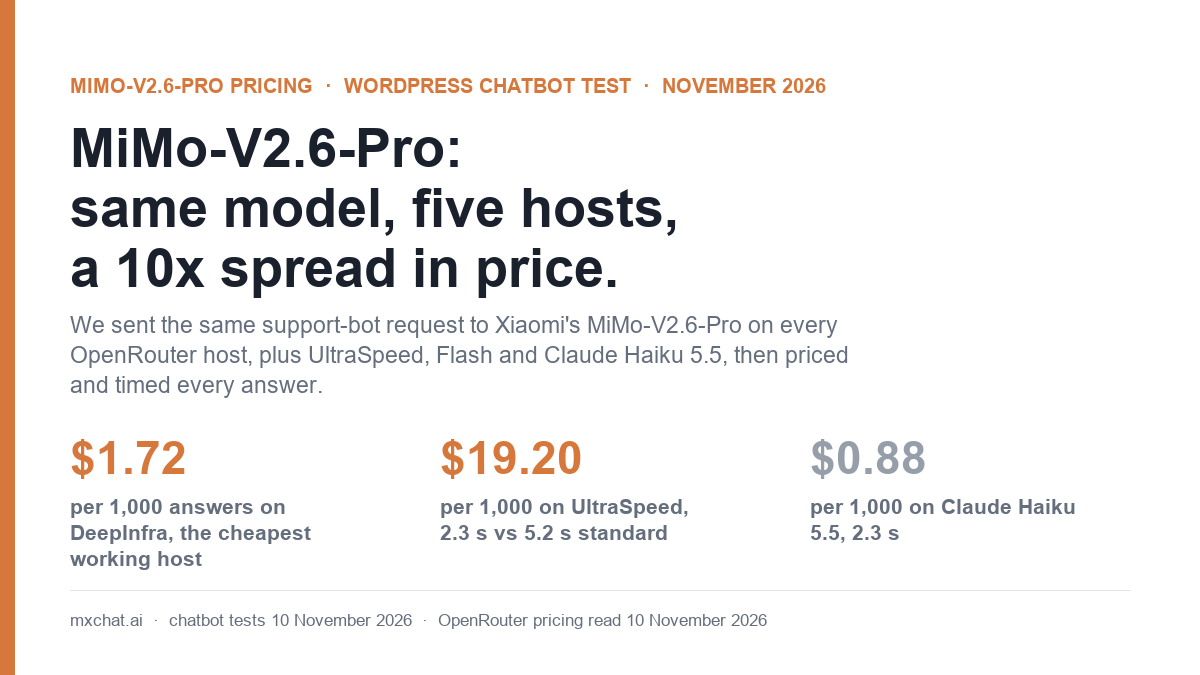
Xiaomi’s MiMo-V2.6-Pro lists at $0.435 per million input tokens and $0.87 per million output tokens on Xiaomi’s own endpoint, with cached input at $0.0036 per million. That is cheap for a model with a one-million-token context window, and it is now served by five companies on OpenRouter, at prices that run from 25% below Xiaomi’s rate to nine times above it. Xiaomi also sells an UltraSpeed edition of the same model at exactly ten times the price.
A rate card doesn’t tell you what a support chatbot will cost, so on 10 November 2026 we sent the same support-bot request from our own WordPress server to MiMo-V2.6-Pro on every host, to UltraSpeed, to the smaller MiMo-V2.6-Flash and, for comparison, to Claude Haiku 5.5. We timed every answer, recorded the tokens and the amount OpenRouter billed, and checked each answer against our documentation.
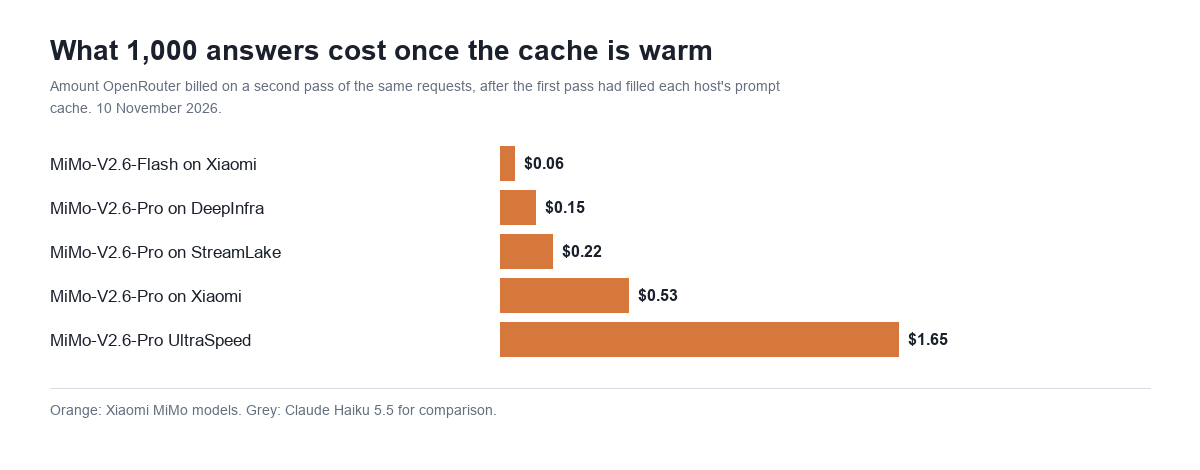
The short answer: on a normal host, MiMo-V2.6-Pro cost $1.72 to $2.27 per 1,000 answers with no cache and about $0.15 to $0.53 once the prompt cache was warm, answering in a little over 4 to 5 seconds. UltraSpeed cut that to 2.28 seconds but cost $19.20 per 1,000. A third-party host, PrimaLabs, was faster still at 1.41 seconds for slightly less, $17.83. Claude Haiku 5.5 answered the same questions in 2.29 seconds for $0.88. One of the five listed hosts returned empty answers all morning, and another failed one question every time.
MiMo-V2.6-Pro pricing by host
These are the rates OpenRouter listed on 10 November 2026, per million tokens. The model ID is xiaomi/mimo-v2.6-pro for every row except UltraSpeed, which has its own ID, xiaomi/mimo-v2.6-pro-ultraspeed.
| Host | Input | Cached input | Output | Versus Xiaomi | Precision |
|---|---|---|---|---|---|
| Xiaomi | $0.435 | $0.0036 | $0.87 | List price | FP8 |
| GMICloud | $0.326 | $0.003 | $0.653 | 25% lower | BF16 |
| DeepInfra | $0.387 | $0.0032 | $0.783 | 10% lower | FP8 |
| StreamLake | $0.522 | $0.0043 | $1.044 | 20% higher | Not stated |
| PrimaLabs | $4.00 | $0.036 | $8.00 | About 9x | FP8 |
| Xiaomi UltraSpeed (separate model ID) | $4.35 | $0.036 | $8.70 | 10x | FP8 |
Third-party price trackers report the same $0.435 / $0.87 rates on Xiaomi’s own MiMo platform, with batch requests at half price. We tested through OpenRouter only, so the batch rate isn’t part of our numbers.
For context, the previous version, xiaomi/mimo-v2.5-pro, is still listed at $0.48 input and $1.80 output. V2.6-Pro cuts the output price by more than half, but a support bot’s bill is mostly input, as the next section shows, so the saving per answer is much smaller than that headline cut.
How we tested it
Each request was the one a MxChat support bot sends: our site’s real system prompt plus four passages from our own documentation, about 4,140 tokens on MiMo’s count, followed by one visitor question. We used four questions a real visitor might ask:
- Does MxChat work with WooCommerce, and can the bot look up an order for a logged-in customer?
- Do I need Pinecone for the knowledge base, or can embeddings live in WordPress?
- Can a visitor be handed to a human on Slack or Telegram?
- Can I use my own OpenRouter or OpenAI key, and which models can I choose?
Every setup got the four questions twice. The first pass shows the cost with no cache; the second shows what happens once the host has cached the long, repeated part of the prompt, which is the normal state for a busy chatbot. We pinned each host with OpenRouter’s provider setting and fallbacks turned off, so each row really came from the host named. PrimaLabs and GMICloud got one pass. All requests went from mxchat.ai’s server in the US, without streaming, at temperature 1.
The whole test, 64 requests, cost $0.18 in OpenRouter credit.
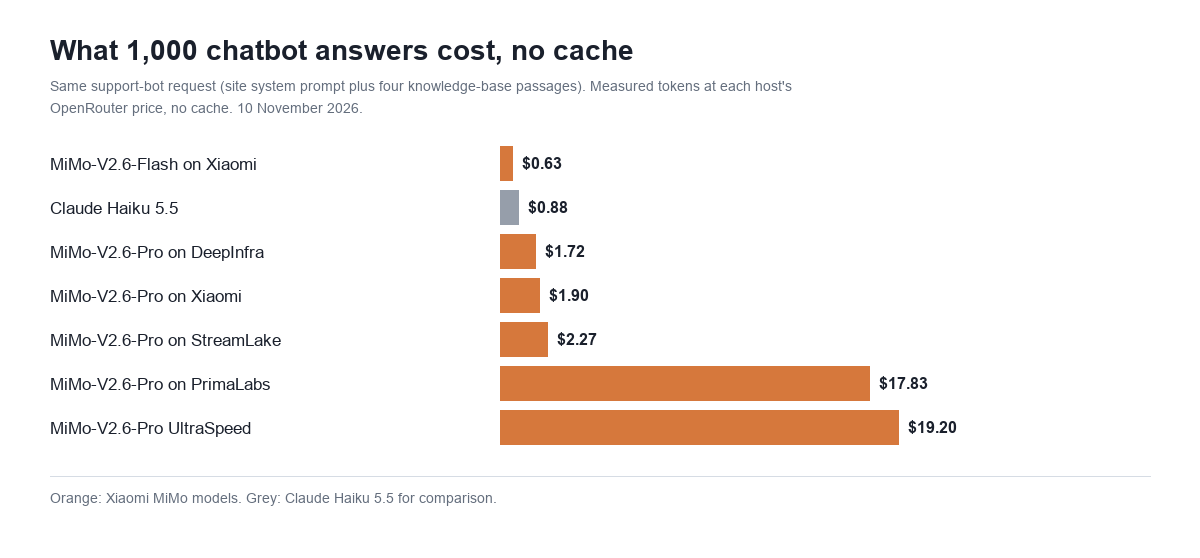
What 1,000 answers cost on each host
| Setup | No cache, per 1,000 | Warm cache, billed per 1,000 | Median answer | Correct answers |
|---|---|---|---|---|
| MiMo-V2.6-Pro on DeepInfra | $1.72 | $0.15 | 4.22 s | 8 of 8 |
| MiMo-V2.6-Pro on Xiaomi | $1.90 | $0.53 | 5.25 s | 8 of 8 |
| MiMo-V2.6-Pro on StreamLake | $2.27 | $0.22 | 4.24 s | 6 of 8 (2 errors) |
| MiMo-V2.6-Pro on PrimaLabs | $17.83 | Not tested | 1.41 s | 4 of 4 |
| MiMo-V2.6-Pro UltraSpeed | $19.20 | $1.65 | 2.28 s | 8 of 8 |
| MiMo-V2.6-Pro on GMICloud | No answers | Not tested | 32 to 58 s, empty | 0 of 4 |
| MiMo-V2.6-Flash on Xiaomi | $0.63 | $0.06 | 6.67 s | 8 of 8 |
| Claude Haiku 5.5 | $0.88 | No cache hits | 2.29 s | 4 of 4 |
The no-cache column is each setup’s measured tokens multiplied by that host’s listed rates, which is the fair way to compare hosts. The warm column is what OpenRouter actually billed on the second pass.
Input is about 95% of the bill. On Xiaomi’s endpoint an average request was 4,140 input tokens and 111 output tokens. At list rates that’s $1.80 of input and $0.10 of output per 1,000 answers. Answers were short, 45 to 58 words on every Pro host, and reasoning was light. So the big V2.6 output cut barely moves a support bot’s bill: the same tokens at V2.5-Pro rates would come to about $2.19 per 1,000, so V2.6-Pro is roughly 13% cheaper per answer, not 50%. That figure is calculated from today’s tokens, not a separate V2.5 test.
It also explains why the cache matters so much. Cached input on MiMo is less than 1% of the normal input price, and once the repeated prompt was cached, DeepInfra billed $0.15 per 1,000 answers, less than a tenth of its cold cost. Xiaomi’s warm figure is higher, $0.53, because one of its four second-pass requests hit only 384 cached tokens instead of about 4,000. That’s the nature of automatic caching: it is likely, not guaranteed, and a busy bot sees a mix.
Speed: what ten times the price buys
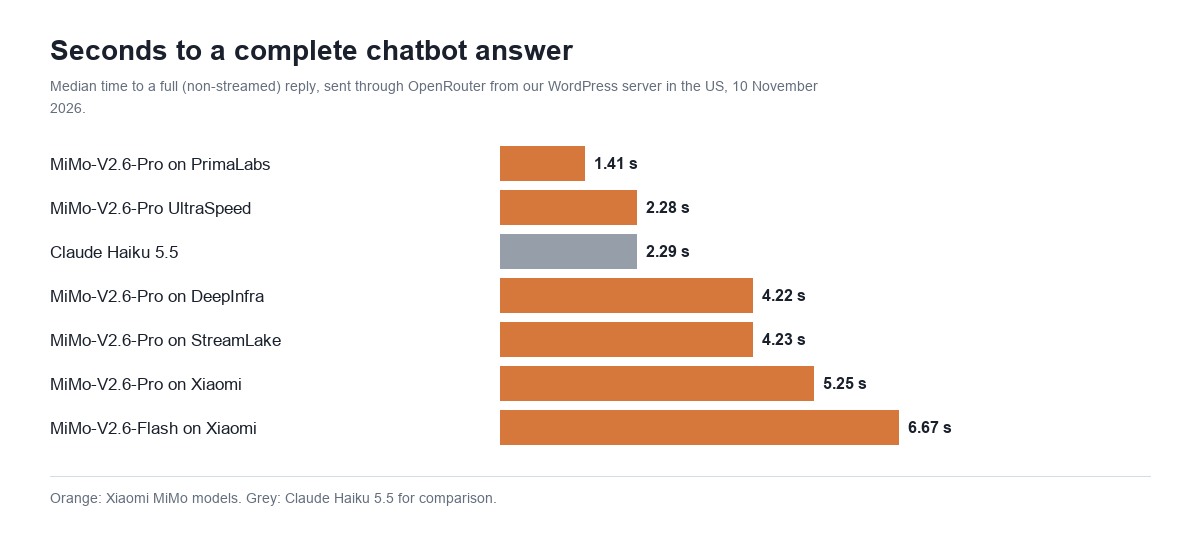
On standard hosts MiMo-V2.6-Pro took 4.2 to 5.3 seconds to finish a short answer. That isn’t slow for a 50-word reply, but a visitor notices it next to a model that answers in two seconds.
UltraSpeed does what its name says. Xiaomi’s own fast edition finished in a median of 2.28 seconds against 5.25 seconds for the standard model on the same endpoint, about 2.3 times faster. It gave the same kind of answers: 8 of 8 correct, about 57 words each. For that you pay ten times the per-token price.
The surprise was PrimaLabs. It serves the standard model ID at $4.00 / $8.00, slightly less than UltraSpeed, and it was faster: a 1.41 second median, with two of its four answers back in under 0.9 seconds. If you want MiMo-V2.6-Pro to feel instant and don’t mind paying about nine times the standard rate for it, PrimaLabs beat Xiaomi’s own premium tier in our test. Four answers is a small sample, so treat that as a lead rather than a verdict.
But the comparison that matters for most WordPress sites is the last one. Claude Haiku 5.5 matched UltraSpeed’s speed at less than a twentieth of its cost. If speed is the reason you are looking at UltraSpeed or PrimaLabs, a smaller fast model is the cheaper fix.
Reliability: one host down, one failing a question
Price and speed only matter if the host answers. Two of the five did not, fully:
- GMICloud, the cheapest listing at 25% below Xiaomi, returned HTTP 200 with no answer and no token counts on all four requests, after 32 to 58 seconds each. OpenRouter’s endpoint list already showed it in a degraded state with about 70% recent uptime. A chatbot would show the visitor nothing.
- StreamLake answered three of the four questions on both passes, and failed the Slack and Telegram question every time, with a 502 “InternalServerError” from the host, two attempts per pass. That was our longest request at 4,331 tokens, though still tiny against the advertised context. We can’t tell you why. We can tell you it was repeatable.
- PrimaLabs refused our first attempt with a 402: OpenRouter reserves credit for the host’s maximum output, 131,072 tokens at $8 per million, and our test account didn’t hold enough. Setting
max_tokensto 2,000 fixed it. On a normally funded account you won’t see this, but it is worth knowing if you run on a small balance.
Xiaomi, DeepInfra and UltraSpeed answered every request.
Does the host change the answers?
Not in any way we could see. Every successful answer on every host was correct on the facts: WooCommerce order lookups need the add-on and a logged-in customer, Pinecone is optional, both Slack and Telegram handoff exist, and you bring your own key. Style varied a little: some answers used emoji or offered the discount code from our system prompt, on more than one host. Those are differences between individual samples at temperature 1 rather than anything we would pin on a host.
MiMo-V2.6-Pro reasons before it answers by default, but not much on a question like these. OpenRouter returned a few dozen to a few hundred characters of reasoning per answer. Turning reasoning off ("reasoning": {"enabled": false}) on Xiaomi’s endpoint cut output from 111 to 71 tokens and the median time from 5.25 to 4.08 seconds. The answers were shorter and still correct. Because input dominates the bill, the cost barely changed: $1.86 against $1.90 per 1,000 at list rates.
What happens when you don’t pick a host
Most site owners won’t pin a host. MxChat, for example, sends OpenRouter a model ID with no provider preference. We ran that case too, plus OpenRouter’s :floor shortcut, which asks for the cheapest host. Four answers each, run after the main test, so caches were warm and billed amounts are lower than list.
| Model ID sent | Hosts it used | At listed rates, no cache | Median answer |
|---|---|---|---|
xiaomi/mimo-v2.6-pro | Xiaomi and DeepInfra | $1.89 | 5.92 s |
xiaomi/mimo-v2.6-pro:floor | DeepInfra x4 | $1.93 | 17.89 s |
Default routing did fine here: it stayed on the two hosts that work and avoided both the failing and the expensive ones. :floor went to DeepInfra as expected, since GMICloud was down, but all four answers took 17 to 21 seconds, against a 4.22 second median when we pinned DeepInfra directly a few minutes earlier. We don’t know why, and four requests isn’t enough to say it always happens. It’s a reminder that the cheapest-host shortcut optimises price, not speed, and that a 10% discount isn’t worth a 15-second wait on a chat widget.
MiMo-V2.6-Flash: cheaper, not faster
Xiaomi’s smaller model, xiaomi/mimo-v2.6-flash, lists at $0.14 input and $0.28 output, and eight hosts serve it. On Xiaomi’s endpoint it cost $0.63 per 1,000 answers cold and just $0.06 with a warm cache, the cheapest result in this test. It answered all eight questions correctly.
It was not faster. The median was 6.67 seconds, slower than the Pro model, and one answer took 23.56 seconds. Flash’s answers were also longer, 83 words on average against 55. For a low-traffic site where cost is everything, Flash is a reasonable choice. For a site where visitors expect a quick reply, it isn’t the speed upgrade the name suggests.
Is MiMo-V2.6-Pro the right model for a support bot?
Compared directly with Claude Haiku 5.5, which most of our tests use as the baseline:
| MiMo-V2.6-Pro (DeepInfra) | MiMo-V2.6-Pro (Xiaomi) | Claude Haiku 5.5 | |
|---|---|---|---|
| Listed rates per million (input / output) | $0.387 / $0.783 | $0.435 / $0.87 | $0.10 / $0.50 |
| Input tokens for the same request | 4,140 | 4,140 | 6,838 |
| Cost per 1,000, no cache | $1.72 | $1.90 | $0.88 |
| Cost per 1,000, warm cache | $0.15 | $0.53 | $0.88 (no cache hits) |
| Median answer | 4.22 s | 5.25 s | 2.29 s |
Haiku 5.5 needs 65% more tokens for the same text, but its input price is about a quarter of MiMo’s, so it still comes out at half the cold cost, and it is twice as fast. MiMo pulls ahead only when its cache is warm, which on a busy bot is most of the time. Haiku reported no cached tokens on our single pass; with Anthropic’s own caching set up, its warm cost would fall too.
Our view: MiMo-V2.6-Pro makes sense for a busy bot where most requests share the same long prompt, or where you need the long context for big knowledge-base passages. For a small site that wants fast, cheap answers out of the box, Haiku 5.5 or another small model is simpler. We saw the same pattern with DeepSeek V4 Pro and MiniMax M3.1 Flash: the Chinese frontier models are priced to win on cached, high-volume traffic. For the whole Claude line-up on the same request, see our Claude API pricing test.
Using MiMo-V2.6-Pro in MxChat
MxChat connects to MiMo through OpenRouter. Its OpenRouter model picker loads OpenRouter’s model list and has no host setting, so the host choice is made on OpenRouter’s side:
- Create an API key on OpenRouter and add credit. Our documentation shows where the key goes in MxChat.
- Select
xiaomi/mimo-v2.6-proin MxChat’s OpenRouter model picker, orxiaomi/mimo-v2.6-pro-ultraspeedif you want Xiaomi’s fast edition and have checked the cost above. - In your OpenRouter account settings, add GMICloud to the ignored providers while it is degraded, and StreamLake too if your questions are long. That setting is account-wide, so it affects other apps using the same account.
- Send your bot a few real visitor questions and check the answers and the hosts in your OpenRouter activity before you switch it on for everyone.
MxChat doesn’t send a reasoning setting, so MiMo will reason by default. On support questions like ours that added about a second and almost nothing to the bill, so we wouldn’t worry about it. Every answer in our test finished well inside MxChat’s request time limit. Order lookups for logged-in WooCommerce customers need MxChat Pro. If you’re choosing between hosts for an open-weights model more generally, our Kimi K3.1 Pro provider test shows a much wider spread in both price and speed.
Frequently asked questions
How much does MiMo-V2.6-Pro cost?
On Xiaomi’s endpoint through OpenRouter, $0.435 per million input tokens, $0.0036 per million cached input tokens and $0.87 per million output tokens, as listed on 10 November 2026. Other hosts charge from 25% less to about nine times more.
What does MiMo-V2.6-Pro cost per chatbot answer?
In our test, with a 4,140-token support prompt and short answers, $1.72 to $2.27 per 1,000 answers with no cache on standard hosts, and $0.15 to $0.53 per 1,000 once the prompt cache was warm.
What is MiMo-V2.6-Pro UltraSpeed?
A faster edition of the same model sold by Xiaomi under its own ID at ten times the per-token price. It answered in a median of 2.28 seconds against 5.25 seconds for the standard model, and cost $19.20 per 1,000 answers with no cache.
Which MiMo-V2.6-Pro host is cheapest?
GMICloud lists the lowest price but returned empty answers in our test. The cheapest working host was DeepInfra, 10% below Xiaomi, at $1.72 per 1,000 answers.
Is MiMo-V2.6-Flash faster than Pro?
Not in our test. Flash cost about a third as much but had a slower median answer, 6.67 seconds against 5.25 seconds on Xiaomi’s Pro endpoint.
Does MiMo-V2.6-Pro support prompt caching?
Yes, automatically, on Xiaomi, DeepInfra, StreamLake and UltraSpeed. Once warm, most requests read about 4,000 of their 4,140 input tokens from cache, at less than 1% of the normal input price.
Can I use MiMo-V2.6-Pro with a WordPress chatbot?
Yes. Any chatbot plugin that accepts an OpenRouter key and model ID can use it. In MxChat you select it in the OpenRouter model picker.
Method note: tests run 10 November 2026 from mxchat.ai’s server in the US through OpenRouter, 4 questions per pass, two passes for Xiaomi, DeepInfra, StreamLake, UltraSpeed and Flash and one for the other setups, temperature 1, no streaming. Prices are OpenRouter list prices read the same day. Costs per 1,000 answers are means over the answers in each setup. Your costs depend on your prompt size, answer length and traffic pattern.