LLM SEO: 24% of My Page-One Impressions, Zero Clicks
For about a year now the standard advice has been that AI assistants are quietly becoming a traffic source, and that you should be optimising for them. The advice is everywhere. The measurement almost never is.
So I measured it on this site. I pulled every query Google Search Console would disclose for mxchat.ai over the 28 days to 22 August 2026 — 3,050 of them — wrote a classifier that separates conversational, sentence-shaped queries from conventional keyword phrases, and counted impressions and clicks in each bucket.
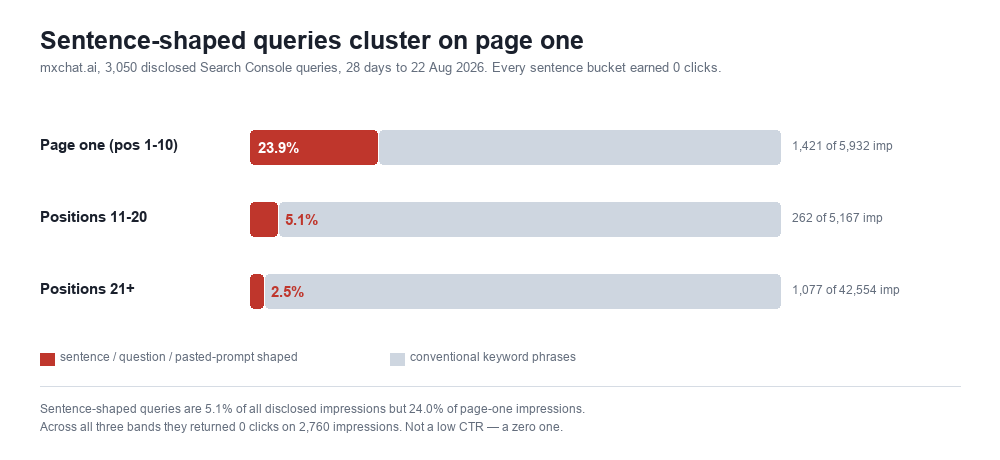
The headline number is smaller and stranger than the hype implies. Sentence-shaped queries are 5.1% of all disclosed impressions. But they are 24.0% of the impressions on page one, and across all 2,760 of them they produced exactly zero clicks. Not a poor click-through rate. Zero.
Here is the method, the raw numbers, and — more usefully — the part that turned out to be wrong when I looked closely.
What Search Console will and won’t tell you
Start with the limit, because it shapes everything after it. Search Console does not show you all your queries. It withholds rare ones to protect user privacy, and the withheld portion is not small.
| 28 days to 22 Aug 2026 | Impressions | Share |
|---|---|---|
| Site total (date-dimension query) | 75,998 | 100% |
| Disclosed as individual queries | 53,653 | 70.6% |
| Anonymised / withheld | 22,345 | 29.4% |
Nearly three impressions in ten are attached to no query you can read. I asked for up to 5,000 rows and got 3,050, so this is not a row-cap artefact — that is genuinely everything Google would name.
This matters twice over. Unique, wordy, one-off queries are exactly the kind Google is most likely to anonymise, and machine-generated prompts are almost always unique and wordy. So every figure below is a floor, not an estimate. The true sentence-shaped share is higher than 5.1% by an amount I cannot measure from this data. Anyone who quotes you a precise percentage for “AI traffic” from Search Console alone is quoting you a number their instrument cannot produce.
The classifier
The rule I settled on is deliberately conservative — it is trying to avoid false positives, because the interesting claim is “these are not normal searches” and I would rather under-count than inflate it. A query is sentence-shaped if any of the following hold:
- it contains a question mark;
- it runs to ten or more words;
- it runs to seven or more words and either opens with a question word or contains a personal pronoun (
my,our,you); - it contains sentence punctuation — a comma, full stop, colon or quotation mark — and runs to six or more words.
Everything else is a conventional keyword phrase. best wordpress chatbot plugin is a keyword. can you recommend the best ai chatbot platforms for small businesses? is a sentence. The distinction is roughly the one between how people type into a search box and how people type into a chat window — which is also the distinction at the heart of semantic search versus keyword search.
Result: small overall, concentrated on page one
| Position band | Sentence impressions | Share of band | Sentence clicks | Keyword CTR |
|---|---|---|---|---|
| Page one (1–10) | 1,421 | 23.95% | 0 | 5.74% |
| Positions 11–20 | 262 | 5.07% | 0 | 0.57% |
| Positions 21+ | 1,077 | 2.53% | 0 | 0.03% |
The gradient is the finding. Sentence-shaped queries are nearly ten times over-represented on page one relative to the deep pages. That is the opposite of what you would expect from ordinary long-tail question traffic, which tends to sit wherever its competition puts it.
And the zero column holds all the way down. Across every band, 2,760 impressions, not one click.
The mistake I made first
My first pass at this used a query-and-page breakdown rather than queries alone, and it returned a much smaller number: 6.3% of page-one impressions instead of 24.0%. I nearly published that.
The reason for the gap is mundane and worth knowing if you run this yourself. Search Console caps rows per request. When you add page as a second dimension, every query gets split across the pages it appeared on, so the same row budget covers far fewer distinct queries — and it spends them on the head, where the big keyword terms live. The long tail, where all the sentence queries are, falls off the end.
For this question the query-only cut is the correct instrument and the query-and-page cut is actively misleading. Same site, same window, same classifier, four-fold difference in the answer.
One bucket, two populations
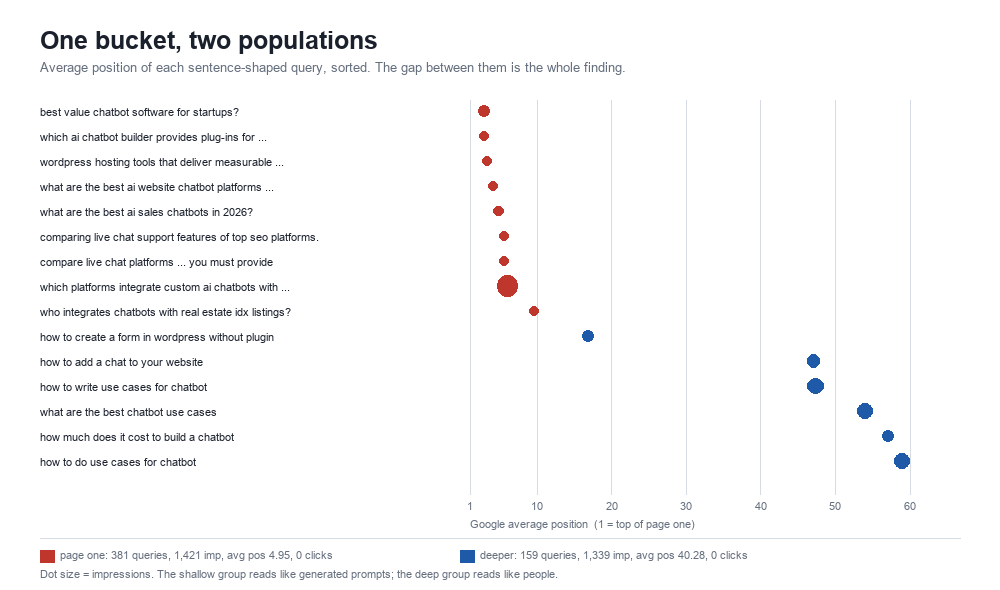
Here is where the “AI traffic” framing starts to break down, and where I think most coverage of this topic goes wrong. The sentence-shaped bucket is not one thing. Plot the queries by position and it splits cleanly in half.
| Sub-population | Queries | Impressions | Avg position | Clicks |
|---|---|---|---|---|
| Shallow cluster | 381 | 1,421 | 4.95 | 0 |
| Deep cluster | 159 | 1,339 | 40.28 | 0 |
The deep cluster is ordinary human long-tail. how to write use cases for chatbot at position 47. how much does it cost to build a chatbot at position 57. These are real people asking real questions, and they earn no clicks for the boring reason that nobody scrolls to position 57.
The shallow cluster is a different animal. which platforms integrate custom ai chatbots with existing customer communication software? at position 6.00 with 248 impressions. what are the best ai sales chatbots in 2026? at 4.82. which ai chatbot builder provides plug-ins for popular ecommerce platforms and cms? at 2.90.
These rank near the top of page one and convert at zero. That combination does not happen with human traffic. On this same site, over the same 28 days, the homepage earns 11.05% at position 9.90 and a blog post earns 8.56% at 9.61. A better position returning nothing is not explicable by rank, and it is not explicable by a weak title either.
The tell
Three queries in the shallow cluster settle the question, because they are not phrased as searches at all:
wordpress hosting tools that deliver measurable customer support improvements within the first quarter.— a declarative sentence, ending in a full stop, at position 3.26comparing live chat support features of top seo platforms.— a gerund phrase, full stop, position 5.56compare live chat platforms for website integration and chatbot capabilities. you must provide …— position 5.60
That last one is the giveaway. “You must provide” is not something a person types into Google. It is instruction text — the tail of a prompt, leaking into Search Console as a query string. Alongside it sit four near-identical queries differing only by country, one impression each, which is what a templated loop looks like from the outside.
None of this is hostile, and it is worth separating from the question of who is crawling you — I audited that separately and found that 46% of the self-declared AI crawlers hitting this site were fake. This is a different phenomenon: real searches, issued on behalf of someone, with no browser and no human at the end of them.
What it does to the numbers you report
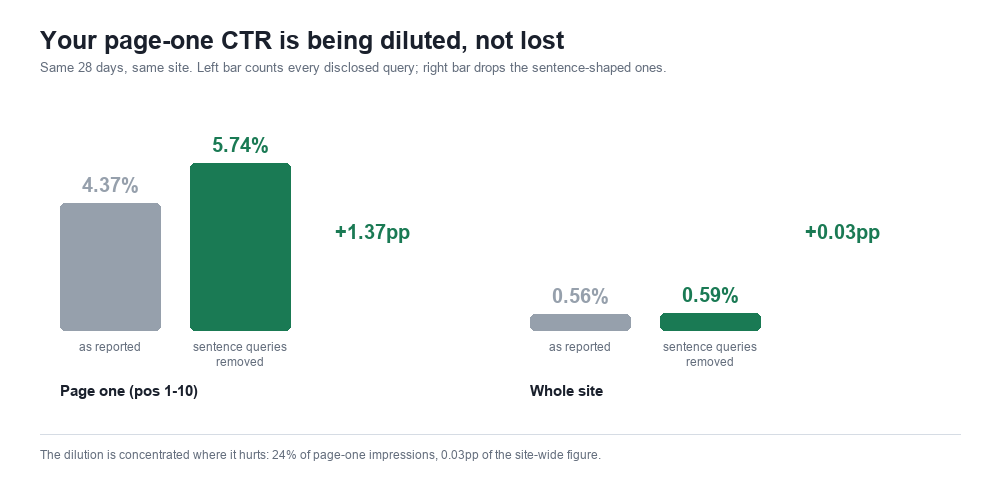
Removing sentence-shaped queries lifts this site’s page-one CTR from 4.37% to 5.74% — a 1.37-point difference, or about a third of the reported figure. Site-wide the same operation moves the needle 0.03 points, from 0.56% to 0.59%.
That asymmetry is the practical point. The distortion is invisible in your headline CTR and material in exactly the place you are most likely to be making decisions: the page-one pages you are trying to optimise. If you have a page sitting at position 4 with a CTR you cannot explain, this is a hypothesis worth eliminating before you rewrite the title for the third time.
What this does not prove
I want to be precise about the limits, because this is an area where confident numbers get repeated without them.
- Sentence shape is a proxy, not a detector. Some humans type full questions into Google. Some machine-issued queries are short keyword phrases. The classifier measures phrasing, and phrasing correlates with origin — it does not establish it.
- 29.4% of impressions were never disclosed. Every number here describes the 70.6% that was.
- One site, one niche, 28 days. A WordPress chatbot plugin is unusually likely to be surfaced by AI assistants answering software-recommendation questions. Do not port 24% to your recipe blog.
- Zero clicks is not zero value. If an assistant reads your page and names you in its answer, you got a mention and no click. That may be worth something. It is simply not something Search Console can price.
Running this on your own site
The whole exercise is about twenty minutes.
- Export queries only. In Search Console, Performance → Queries, last 28 days, export. Do not add the Pages dimension — as above, it will halve your answer.
- Get your true total. Read the impressions figure from the date view, not the sum of your query rows. The difference is your anonymised mass, and you want to know how big it is before you trust anything else.
- Sort by word count. You do not need my classifier. Sort descending by number of words and read the top hundred. The shape is obvious within about ninety seconds — you are looking for full stops, “you must”, pasted persona text, and near-duplicate rows differing by one country or industry.
- Check position against clicks. The signature is shallow position plus zero clicks. Deep position plus zero clicks is just ordinary long-tail and needs no explanation.
If step three turns up a meaningful cluster, the useful response is not to chase it. It is to stop counting it — carve those queries out before you judge a page’s CTR, and re-baseline. On this site that single change moved the page-one figure by a third.
FAQ
Is this the same as Google’s AI Overviews taking my clicks?
No, and they are easy to conflate. AI Overviews are a SERP feature that answers a human’s query above your result — the human exists, they just do not click. What is described here is a query that appears to have been issued by software. Both produce impressions without clicks; only the first has a person on the other end.
Should I block AI crawlers to stop this?
It would not help. These are Google searches your pages ranked for; blocking a crawler in robots.txt does not change what Google shows. Blocking also removes you from the assistant answers you might actually want to appear in. The crawler question is a separate decision with separate trade-offs.
Does 24% of page one mean I am losing a quarter of my traffic?
No. It means a quarter of page-one impressions were never going to convert, so your real CTR on human traffic is better than reported. Nothing was lost — the denominator was wrong.
Will this share grow?
Probably, and I have not measured it over time yet, so treat any trend claim you read — including one from me — as unsupported for now. I have a baseline here and will re-run the same classifier on the same site in a few months.
The short version
AI-shaped queries are real, measurable and much smaller than the discourse suggests — 5.1% of impressions here, floor rather than estimate. They concentrate on page one, where they reach 24% and reliably earn nothing, which quietly understates your true click-through rate on the pages you care most about. And the bucket everyone treats as one thing is two: shallow machine-shaped prompts, and ordinary human questions ranking too deep to matter.
The instrument matters more than the conclusion. I got a four-fold different answer from the same data by choosing the wrong Search Console dimension, and I would have published it.
Update, 13 September 2026: there is a layer under this one. Before a page can rank on page one and earn nothing, Google has to fetch it, and the access log shows that is not guaranteed either: five of the thirteen posts published after this one were never requested by Googlebot in their first one to two weeks, while the sitemap listing them was read 476 times.
MxChat is the WordPress chatbot plugin I build, and the audits behind posts like this one are run against its own install — the documentation covers setup, and the shop has the current plans. If you are still deciding which plugin to run, the comparison of WordPress chatbot plugins is the more useful starting point.
Related, 28 August 2026: the impressions above are what the models produce after they have read you. The traffic on the other side of that is now measurable too — AI crawlers fetch more pages from this server than every search engine put together, and from 15 September Cloudflare starts blocking some of them by default on ad-bearing pages. Zero clicks on 2,760 impressions is the number to weigh against that before deciding to let them keep crawling.