Mastering Customer Experience Metrics for Growth
Customer experience metrics are the vital signs of your business. They are the specific, measurable data points that tell you how customers feel about their interactions with your brand, from their initial purchase to ongoing support. Think of them less as abstract numbers and more as a direct line to your customers' honest opinions.
This data is what allows you to move from guessing to knowing, guiding every strategic decision you make to improve satisfaction, loyalty, and, ultimately, your bottom line.
Why Customer Experience Metrics Are Your Compass
Trying to grow a business without tracking customer experience is like trying to navigate a vast ocean without any instruments. You might have a destination in mind, but you're essentially sailing blind, at the mercy of shifting tides and unseen hazards. It’s a high-stakes guessing game you can’t afford to lose.
These metrics replace gut feelings and assumptions with hard evidence. You stop wondering if your customers are happy and start measuring it. You stop hoping they’ll come back and start understanding the factors that predict their loyalty. They translate fuzzy concepts like "satisfaction" and "frustration" into concrete data you can actually use.
The Real Cost of Ignoring CX Data
Failing to track this data isn't just a missed opportunity; it's a direct threat to your business. Today’s customers have endless choices and very little patience for a clunky or unhelpful experience. The cost of getting it wrong is startlingly clear.
Recent studies show that 70% of customers will ditch a brand after just two negative experiences, and 72% will jump to a competitor after only three poor service interactions. Even something as common as being put on hold is enough to make 53% of people take their business elsewhere. You can find more eye-opening stats on rising customer expectations here.
These figures tell a powerful story: customer loyalty is incredibly fragile. If you aren't actively measuring and improving the customer journey, you're almost certainly losing customers without ever understanding why.
Turning Numbers into a Navigation System
Key metrics like Net Promoter Score (NPS), Customer Satisfaction (CSAT), and Customer Effort Score (CES) aren't just for data nerds. Together, they create a powerful navigation system for your entire company.
A great way to think about it is this: CSAT tells you about the weather during a specific leg of the journey, CES tells you how easy the ship is to steer, and NPS tells you if your passengers would recommend the cruise to their friends. Each metric offers a unique but crucial piece of the puzzle.
By consistently tracking these numbers, you unlock the ability to:
- Pinpoint Friction: Discover the exact moments customers get stuck or frustrated, whether it's a confusing checkout page or a slow response from your support team.
- Boost Loyalty: Understand what makes customers happy and keeps them coming back, allowing you to double down on what works. Retailers, for example, can see massive gains by improving the shopping journey. You can explore how conversational AI for retail enhances customer experience in our dedicated guide.
- Slash Churn: Get an early warning when a customer is unhappy, giving you a crucial window to step in and fix the problem before they leave for good.
- Drive Growth: Delighted customers become your most effective marketers, spreading the word and fueling organic growth.
In the end, customer experience metrics are your direct connection to the voice of the customer. They ensure that every decision you make is firmly rooted in what your customers truly need and want.
The Three Core Customer Experience Metrics Explained
If you want to genuinely understand what your customers are thinking and feeling, you have to look beyond just sales numbers. While there are countless metrics you could track, the world of customer experience really boils down to three core pillars: NPS, CSAT, and CES.
These aren't just trendy acronyms to fill up a spreadsheet. Think of them as a diagnostic toolkit for your business. One checks your company's long-term health, another takes a customer's temperature right after a specific interaction, and the last one looks for any friction or pain points in their journey.
Let's break down each of these foundational metrics.
This visual helps show how these key numbers connect directly to the things that matter most—loyalty, customer churn, and real business growth.
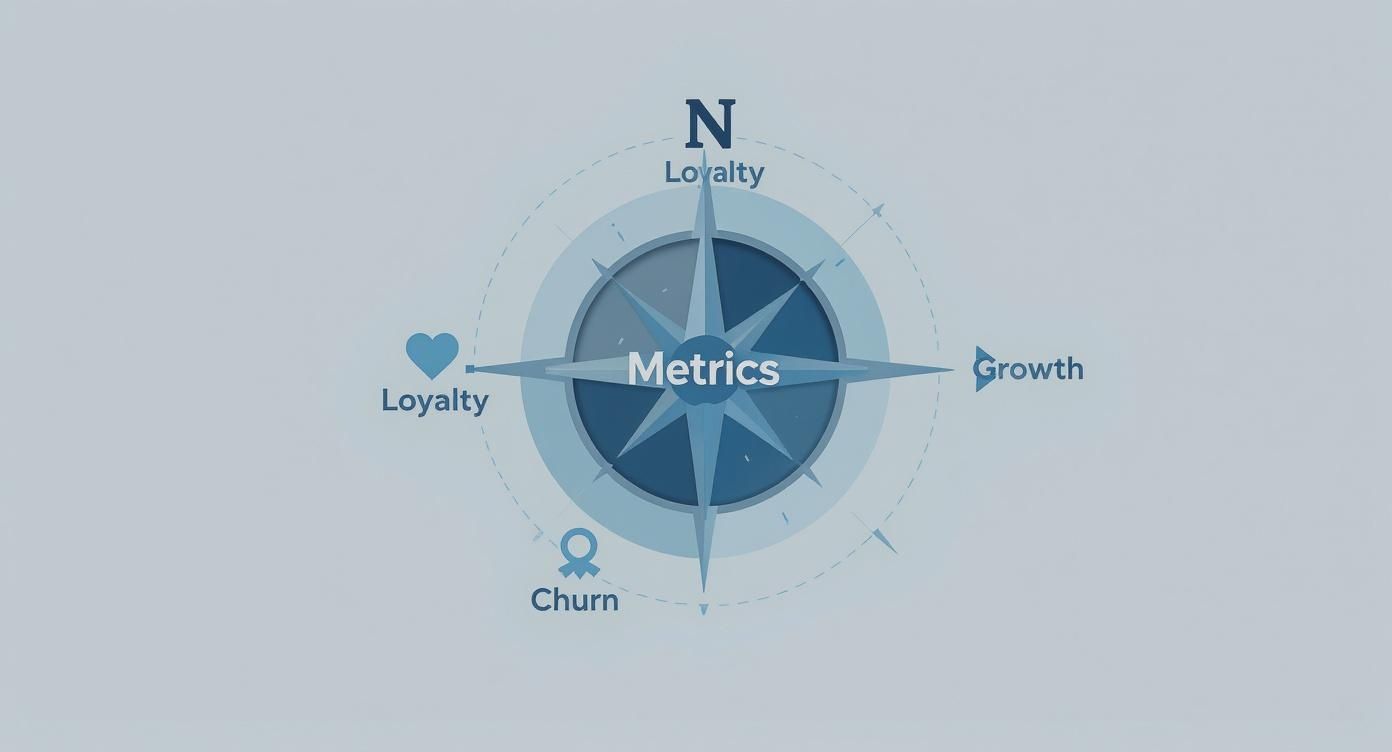
As you can see, each metric gives you a different angle, helping you make smarter decisions about whether customers are likely to stay, leave, or become your biggest fans.
To make things even clearer, let's summarize these three powerhouse metrics before we dive deeper into each one.
The Core CX Metrics at a Glance
This table gives you a quick snapshot of the "big three," what they measure, and the fundamental question each one helps you answer.
| Metric | What It Measures | Key Question |
|---|---|---|
| NPS | Overall brand loyalty and willingness to recommend. | "Will you recommend us to others?" |
| CSAT | Immediate satisfaction with a specific interaction. | "Are you happy with this right now?" |
| CES | The ease of a customer's experience. | "Was that easy for you?" |
Now, with that framework in mind, let's unpack what makes each of these so valuable.
Net Promoter Score (NPS): The Brand Ambassador Test
Net Promoter Score (NPS) is your go-to metric for measuring long-term loyalty. It’s not about how a customer felt about a single purchase; it’s about their entire relationship with your brand. It answers the big question: Is their experience so good that they’d put their own reputation on the line to recommend you?
I call it the "Brand Ambassador Test." It separates the passively satisfied customers from the true fans who will actively grow your business for you.
The question is famously simple:
"On a scale of 0 to 10, how likely are you to recommend [Company Name] to a friend or colleague?"
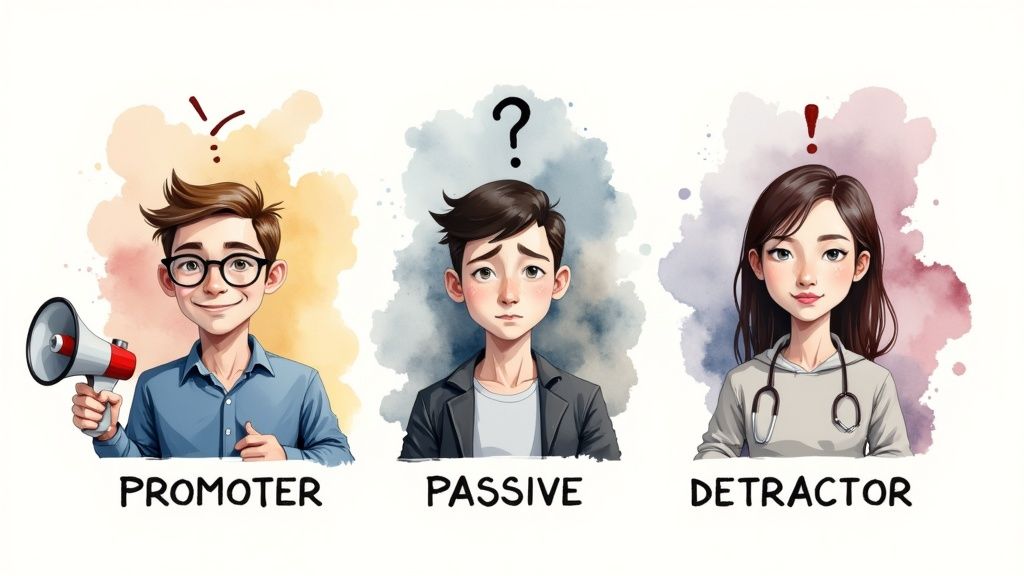
Based on their score, customers fall into one of three camps:
- Promoters (9-10): These are your champions. They're loyal, enthusiastic, and drive growth through word-of-mouth marketing.
- Passives (7-8): They're satisfied, but not wowed. They could easily be swayed by a competitor's offer.
- Detractors (0-6): These are unhappy customers. They pose a real risk to your brand through negative reviews and feedback.
To get your score, you simply subtract the percentage of Detractors from the percentage of Promoters. The result is a number between -100 and +100 that gives you a powerful snapshot of customer sentiment and your potential for growth.
Customer Satisfaction (CSAT): The Instant Reaction Check
While NPS looks at the big picture, Customer Satisfaction (CSAT) is all about the here and now. Think of it as the "Instant Reaction Check." It’s designed to capture a customer's feelings immediately after a specific interaction.
Did the support agent solve their problem? Was the app easy to navigate? CSAT gives you a quick pulse check on these individual moments. The survey is usually sent right after an interaction, asking something direct like:
"How satisfied were you with your [support call/recent purchase] today?"
Customers typically answer on a 1-5 scale (e.g., Very Unsatisfied to Very Satisfied). You calculate the score by finding the percentage of customers who gave a "Satisfied" or "Very Satisfied" response. A high CSAT score tells you a specific part of your journey is working perfectly, while a dip is an immediate red flag that something needs fixing.
Customer Effort Score (CES): The Friction Finder
Last but not least is the Customer Effort Score (CES). This is your "Friction Finder." It’s built on a simple but powerful idea: the easier you make it for customers to do business with you, the more loyal they become.
CES measures how much work a customer had to put in to get something done—whether it was resolving an issue, finding information, or making a purchase. The research is clear: reducing customer effort is often a better predictor of loyalty than trying to "delight" them.
After an interaction, you ask a question focused on ease:
"How easy was it to handle your request?"
Customers rate this on a scale, usually from "Very Difficult" to "Very Easy." A poor score (meaning high effort) is a huge warning sign that your processes are creating roadblocks and frustration. For instance, a chatbot that gives instant answers can dramatically lower customer effort. To see more on how that works, check out the key benefits of chatbots for business in our detailed guide.
By tracking CES, you can pinpoint and remove those frustrating obstacles, making every interaction with your company feel smooth and effortless.
Using Net Promoter Score to Build Lasting Loyalty
Some customer experience metrics give you a snapshot of a single moment, but the Net Promoter Score (NPS) tells a much bigger story. Think of it as a reliable barometer for long-term customer loyalty and the overall health of your brand. It cuts through the noise of transactional satisfaction to answer a far more important question: Is your customer's experience so good they'd stick their neck out and recommend you?
This score isn't just a number to flash in a quarterly meeting; it’s a strategic compass. The real magic happens when you use NPS to segment your audience and get inside the heads of your customers. By splitting them into three distinct groups—Promoters, Passives, and Detractors—you can stop guessing what they want and start building targeted strategies that create real, lasting loyalty.
Each of these groups has a completely different mindset and needs a unique approach. Lumping them all together is like a doctor prescribing the same medicine to every patient, no matter the ailment.
Understanding Your NPS Segments
So, who exactly are these groups? It all starts by asking one simple question: "On a scale of 0-10, how likely are you to recommend our company to a friend or colleague?" The responses instantly sort your customers into clear, actionable categories.
- Promoters (Score 9-10): These are your die-hard fans. They're the enthusiastic, repeat buyers who go out of their way to tell others about you, becoming a powerful engine for your organic growth.
- Passives (Score 7-8): This group is content, but they're not committed. They see your service as "fine," but they're easily swayed by a competitor's shiny new offer. They won't bad-mouth you, but they won't sing your praises, either.
- Detractors (Score 0-6): These are your unhappy campers. They are at serious risk of leaving, and worse, they might share their negative experiences with others, actively hurting your reputation.
The final NPS score, which can range from -100 to +100, is calculated by subtracting the percentage of Detractors from the percentage of Promoters. While any positive score is a step in the right direction, the best companies are always aiming higher.
For instance, the average NPS in the global retail sector hovers around 41, while industry leaders consistently score above 50. A high NPS is a clear signal of deep-rooted loyalty and a powerful driver for sustainable growth. You can explore more 2025 retail benchmarks on ContactPigeon's blog.
Activating Your Promoters
Your Promoters are your most powerful marketing asset, and they work for free! The key is to make it easy for them to shout your praises from the rooftops. Don't just send a generic "thanks for the high score" email; give them the tools to become true brand advocates.
Consider launching a referral program that rewards them for bringing new people into the fold. You could also invite them to an exclusive community or a beta testing group, making them feel like valued insiders. Simply featuring their positive reviews on your website can also validate their decision to choose you and build trust with potential new customers.
Engaging Your Passives
Passives are the ones sitting on the fence, and they represent a huge flight risk. They aren't upset enough to complain, but they also aren't excited enough to stick around if a better deal comes along. To win them over, you need to proactively figure out what's keeping them from becoming true fans.
A great way to do this is to follow up with a simple, open-ended question like, "What's one thing we could do to make your experience even better?" Their feedback is pure gold, often highlighting small friction points that, once fixed, can improve the journey for everyone. Sometimes, a small, unexpected perk—like a discount on their next purchase—is all it takes to nudge them over into the Promoter camp.
Recovering Your Detractors
A Detractor isn't just a problem; they're an opportunity in disguise. Their feedback, even when it's tough to hear, is a gift. It points directly to the biggest pain points in your business. Ignoring it is a guaranteed way to bleed customers and tarnish your brand.
The best defense is a swift, personal offense.
- Reach Out Immediately: Set up an alert so that a low score automatically triggers a personal follow-up from a real person on your team.
- Listen and Empathize: Drop the defenses. Hear them out completely to understand the root of their frustration.
- Solve the Problem: If you can fix it on the spot, do it. If not, be crystal clear about the steps you're taking to make it right.
- Close the Loop: Once the issue is resolved, check back in to make sure they're happy with the outcome.
This "closing the loop" process is incredibly effective. By showing a Detractor you're listening and taking their feedback to heart, you can often transform a negative experience into a positive one. In many cases, you can even turn your biggest critics into some of your most loyal advocates.
Getting In-the-Moment Feedback with CSAT
If Net Promoter Score is your long-term relationship forecast, then Customer Satisfaction (CSAT) is your real-time emotional check-in. This metric is like a magnifying glass, giving you a crystal-clear look at how a customer feels about a specific interaction, right as it happens. It’s one of the most powerful customer experience metrics for gauging the health of individual touchpoints along the customer journey.

Here's an easy way to think about it: NPS asks, "So, how are we doing overall?" But CSAT gets right to the point: "How did that specific thing we just did for you go?" This immediate, transactional feedback is gold for evaluating anything from a support chat to the checkout process.
How to Measure CSAT Effectively
Calculating your CSAT score is refreshingly simple. You just ask a direct question right after an interaction wraps up, like, "How satisfied were you with your support experience today?"
Customers typically answer on a straightforward scale:
- 1 – Very Unsatisfied
- 2 – Unsatisfied
- 3 – Neutral
- 4 – Satisfied
- 5 – Very Satisfied
The magic is in focusing on the happy customers. The formula is all about calculating the percentage of people who gave you a positive rating.
CSAT Score = (Number of Satisfied Customers [4s and 5s] / Total Number of Responses) x 100
Let's say you get 200 survey responses, and 150 of them are a 4 or a 5. Your CSAT score would be a solid 75%. Just like that, you have a clear signal about the quality of that specific experience.
This simplicity is what makes CSAT so effective. It’s quick and easy for customers, which means you get higher response rates and a constant flow of data you can actually use.
Turning CSAT Data into Action
A CSAT score isn't just a number to report—it's a launchpad for making real improvements. Because the feedback is tied to a specific event, you can immediately pinpoint what’s working and what’s not.
A low score after a live chat, for example, is a direct signal to your support manager to review that conversation and see where things went off the rails. To get ahead of these issues, you can maximize customer support with effective live chat scheduling using MxChat to ensure you have the right people available at the right times.
To get honest, useful answers from your CSAT surveys, follow these best practices:
Time It Perfectly: Ask for feedback right after the interaction ends. The memory is fresh, and the response will be far more accurate. Waiting even 30 minutes can muddy the waters.
Keep It Simple: Fight the temptation to pack your survey with questions. Stick to the main satisfaction question and maybe add one optional, open-ended follow-up like, "Is there anything we could have done better?"
Analyze in Segments: Your overall score is just the beginning. Dig deeper by segmenting CSAT data by agent, support channel, or type of issue. This is where you'll find the specific trends and patterns that need your attention.
By consistently gathering and acting on this real-time feedback, you build a powerful cycle of continuous improvement. You stop guessing if the customer journey is smooth and start actively measuring each step, fixing the cracks as you find them. And those are the kinds of changes customers truly notice.
How Customer Effort Score Predicts Future Behavior
Let’s be honest: how easy are you to do business with? This simple question gets to the heart of what might be the most powerful customer experience metric out there today: the Customer Effort Score (CES). While other metrics look at satisfaction or general loyalty, CES zeroes in on something more tangible—how much friction a customer runs into when they interact with your brand.

Think of any customer interaction as a path. Is it a smooth, paved walkway, or a rocky, overgrown trail littered with obstacles? Every confusing checkout process, every time they have to repeat their problem to a new support agent, every hard-to-find answer on your website—that’s another rock on the trail. CES is how you map those friction points and, more importantly, start clearing the path.
The Link Between Effort and Loyalty
The connection between how much effort a customer puts in and what they do next is incredibly strong. When a customer has to fight tooth and nail just to get something done, it wears down their patience and trust. On the flip side, an effortless experience builds confidence and makes them want to come back. They remember the ease, not the struggle.
This isn’t just a gut feeling; the data is compelling. Studies consistently show that a lower effort score is a fantastic predictor of customer loyalty. Why? Because reducing friction makes customers feel respected and encourages them to stick around. Companies that really focus on improving their CES have seen incredible results, with some reporting up to 80% increases in revenue and 60% higher profit margins just by making things smoother. You can dig into the numbers and learn more about these customer experience metric findings on Gainsight.com.
Measuring and Reducing Customer Effort
So, how do you measure it? You ask a simple, direct question right after a specific interaction, like when a support ticket is closed or after a purchase is completed.
"To what extent do you agree or disagree with the following statement: The company made it easy for me to handle my issue."
Customers usually answer on a 7-point scale, from "Strongly Disagree" all the way to "Strongly Agree." A high score means you’ve created a low-effort experience, which is exactly what you're aiming for.
Once you start gathering this feedback, you can pinpoint the exact moments that are causing headaches and quietly pushing customers away. The usual suspects often include:
- Repetitive Information: Having to explain the same problem over and over to different agents.
- Complex Navigation: Burying critical information deep within your website’s menus.
- Channel Switching: Forcing someone to go from a chat to a phone call just to solve a simple issue.
From Low Effort to High Loyalty
Reducing customer effort is a direct investment in keeping your customers. When an experience is seamless and easy, people are far more likely to buy again and tell their friends about you. They don't just feel satisfied; they feel understood and valued.
Take a WordPress store owner using MxChat, for example. They can set up an AI chatbot to handle common questions instantly, 24/7. This drastically cuts down the effort a customer needs to find an answer, turning a potentially frustrating search into a quick, simple interaction.
In the end, CES helps you shift your perspective. Instead of just trying to "delight" customers with grand gestures, you focus on making their lives easier. By removing obstacles and streamlining your processes, you create a path of least resistance that leads them right back to your business, time and time again.
Turning Your CX Metrics Into Meaningful Action
https://www.youtube.com/embed/mzPx32cUtxM
Collecting customer experience metrics is a bit like gathering ingredients for a recipe. The numbers themselves are just raw materials. The real magic happens when you combine them to create something meaningful. A high NPS or a low CES score is a signal, not a solution. To truly move the needle, you have to turn those signals into a clear, actionable strategy.
The first step is looking beyond the numbers to understand the "why." A quantitative score tells you what happened, but it's the qualitative feedback—the comments and open-ended answers—that tells you why it happened. Blending these two is the key to unlocking powerful insights that lead to real, tangible improvements.
Building a Closed-Loop System
The most effective way to put your CX data to work is by creating a closed-loop feedback system. This isn't about a one-time analysis. It's about building a continuous cycle of listening, acting, and measuring that keeps your business perfectly in sync with what your customers actually want and need.
This system ensures feedback doesn't just get collected and then forgotten on a dashboard. Instead, it becomes the fuel for positive change across your entire organization. You can even supercharge this process with the right tools. To see how this works in practice, you can learn more about using a platform like the ultimate CX automation platform MxChat to streamline the whole feedback-to-action pipeline.
A successful closed-loop system really comes down to five key steps:
- Collect Data: Systematically gather feedback at key moments in the customer journey using NPS, CSAT, and CES.
- Identify Patterns: Dive into the data to spot recurring themes, common friction points, or those little moments of delight you can double down on.
- Share Insights: Get actionable findings into the hands of the people who can make a difference—whether that’s the product, support, or sales team.
- Implement Changes: Use the insights to make targeted improvements. This could be anything from fixing a frustrating bug to retraining a support team.
- Measure and Repeat: Track how your changes impact the original metrics to see what worked. Then, start the cycle all over again.
Mini Case Study: How "Pixel Threads" Fixed a Critical Flaw
Let's imagine an online clothing store, "Pixel Threads." They noticed their CSAT scores for post-purchase support were starting to drop. By digging into the qualitative feedback, they pinpointed the problem: customers were frustrated because their order confirmation emails didn't include tracking information.The support team shared this insight with the development team, who quickly updated the email template. Within a single month, CSAT scores for that specific interaction jumped by 20%, and the volume of "Where is my order?" support tickets fell by 35%. This simple fix, driven by CX data, directly improved both customer satisfaction and operational efficiency.
Got Questions About CX Metrics? We've Got Answers.
Diving into customer experience metrics can feel a little overwhelming at first. Once you get past the definitions, you start running into real-world questions about how to actually use them. Let's tackle some of the most common ones we hear from businesses just like yours.
We want you to feel confident enough to start measuring what matters, so you can build a CX program that truly works.
What's the Real Difference Between NPS and CSAT?
Think of it this way: NPS is like asking, "How's our overall relationship going?" while CSAT is like asking, "How was our date last night?"
NPS (Net Promoter Score) is all about the big picture—gauging a customer's long-term loyalty and their general feeling about your brand. It’s a relationship metric.
CSAT (Customer Satisfaction), on the other hand, zooms in on a specific moment. It measures satisfaction with a single, recent interaction, like a chat with a support agent or the experience of making a purchase. It’s a transactional metric, perfect for diagnosing problems at key touchpoints. Use NPS for a health check on your brand, and CSAT to fix specific issues along the customer journey.
How Often Should We Be Measuring This Stuff?
The cadence really depends on what you're trying to learn.
For transactional metrics like CSAT and CES, you need to ask for feedback immediately after the interaction happens. This gives you a raw, honest take while the experience is still fresh in the customer's mind.
For a relationship metric like NPS, you want to take a step back. Sending the survey quarterly or semi-annually is a great rhythm. This lets you track long-term loyalty trends without burning out your customers with too many requests—a classic case of survey fatigue.
This balanced approach ensures you get the data you need without accidentally creating a bad experience while trying to measure a good one.
We're a Small Business. Which Metric Should We Start With?
If you're just starting out, don't try to boil the ocean. Keep it simple and focused.
We almost always recommend starting with NPS. It gives you the broadest possible view of customer loyalty and provides a solid baseline to build on. It’s the perfect foundation for any CX program.
Once you’ve got a good handle on NPS, you can layer in something more specific. For instance, if your support team is a critical part of your business, adding CES can give you incredibly valuable, actionable feedback on where customers are struggling. The key is to start small, listen to the open-ended feedback you receive, and then expand your strategy as you grow.
Ready to turn these insights into action? MxChat helps you build intelligent AI assistants for your WordPress site, drastically reducing customer effort and improving satisfaction. Start automating your customer experience today.