

How to Qualify Sales Leads Without Wasting Time
So, what does it really mean to qualify a sales lead? It’s the process of figuring out if a prospect is a genuinely good fit for what you sell and if they’re actually in a position to buy. This isn't about guesswork; it's a systematic check against specific criteria—think budget, authority, need, and timeline—to make sure your sales team is focused on deals that have a real shot at closing.
Why Most Sales Leads Go Nowhere
Let’s be real for a moment. A massive amount of a sales rep's time is poured into chasing leads that were never going to convert. This isn't just about a few wasted hours. When your pipeline is clogged with unqualified prospects, it creates serious problems for the whole business. Team morale takes a nosedive, sales forecasts become pure fiction, and predicting revenue with any accuracy is impossible. The root of the problem? No structured filtering process.

Without a clear system for qualifying leads, every new name on the list seems like a top priority. This forces your team into a reactive, inefficient scramble. The hard truth is that most leads simply aren't ready to buy. Industry research backs this up, showing that around 60% of leads are not qualified. Even more telling, only about 15–25% of inbound leads are truly sales-ready when they first reach out. You can dig into more of this lead generation data over at Databox.com.
This is exactly why building a solid qualification process is the most powerful thing you can do to improve sales productivity.
A great qualification process isn't about turning people away. It's about systematically finding and focusing on your best opportunities so you can give them the attention they deserve.
The True Cost of a Cluttered Pipeline
When you fail to qualify sales leads effectively, the price you pay goes way beyond lost time. The hidden costs are often the most damaging.
- Inaccurate Forecasting: A pipeline stuffed with wishful-thinking leads gives you a false sense of security. It leads to wildly optimistic projections that, unsurprisingly, never happen.
- Wasted Marketing Spend: Your marketing team is working hard to bring in leads. If the sales team can't tell the promising ones from the tire-kickers, that marketing budget is essentially going down the drain.
- Reduced Team Morale: What burns out a sales rep faster than anything? Chasing ghosts. Spending week after week on dead-end leads and missing quota is a recipe for frustration and turnover.
This guide is your roadmap to fixing that. We'll walk through everything from nailing down your ideal customer profile to implementing proven frameworks and smart automation. It's time to turn your sales process from a high-stakes guessing game into a predictable revenue machine.
Pinpointing Your Ideal Customer Profile
Before you can even think about qualifying leads, you need to know exactly who you’re looking for. Chasing every single lead that comes across your desk is a classic recipe for a clogged pipeline and a frustrated, burnt-out sales team.
The answer is to build a rock-solid Ideal Customer Profile (ICP). Think of it as a blueprint for your perfect customer, built not on guesswork, but on cold, hard data. It’s about reverse-engineering your best, most profitable, and happiest customers to find out what makes them tick.
An ICP isn't just about basic demographics. It’s a much deeper, more detailed sketch that digs into the nitty-gritty of a business.
- Firmographics: This is the high-level company data. We're talking company size (e.g., 50-200 employees), annual revenue, specific industries like SaaS or e-commerce, and even their geographic footprint.
- Technographics: This is all about the technology stack they use. Do your best customers live inside Salesforce? Are they all using Asana for project management? Knowing this is a huge advantage.
- Behavioral Traits: This is about how they think and operate. Are they innovators who jump on new tech, or are they more conservative? Do they prioritize top-tier support over getting the lowest possible price?
Build Your ICP from Your Own Backyard
The only way to build an ICP that actually works is to look at the customers you already have. Seriously, pull up a list of your absolute best clients—the ones who "get it," who have the highest lifetime value, and who are genuinely great to work with. What do they all have in common?
Start by talking to them. Interview your top customers and your own sales reps who closed the deals. Ask pointed questions: What specific problem were you trying to solve? Why did you ultimately choose us over everyone else?
Then, it's time to get your hands dirty with your own data. Dive into your CRM and billing system to spot the patterns. You might find a goldmine. For instance, you could discover that your most successful clients are mid-sized e-commerce brands with over $10 million in annual revenue that use Shopify and Klaviyo. Now that's an insight you can build a strategy around.
An ICP is the ultimate filter for your sales and marketing machine. It ensures you’re not just finding more leads, but finding the right leads—the ones who will stick around and grow with you.
This data-first approach shifts your qualification process from being reactive to being incredibly proactive. It also sets the stage for a better customer journey right from the first touchpoint. If you want to see how these early interactions impact long-term success, it’s worth digging into key customer experience metrics that show the true health of your client relationships.
With a well-defined ICP, every lead can be held up against this benchmark, making it instantly obvious who your team should be spending their valuable time on.
Choosing Your Sales Qualification Framework
A solid framework is your playbook for qualifying leads. Think of it less as a rigid script and more as a compass that guides your sales team to ask the right questions at the right time. Instead of winging it on every call, a good framework provides a repeatable structure to uncover the critical details that separate a "maybe" from a "yes."

The whole point is to move beyond superficial conversations and systematically figure out if a prospect is a genuine fit for what you offer. Different sales cycles, deal sizes, and business models call for different approaches, so let’s look at a few of the most battle-tested frameworks out there.
BANT: The Classic for Speed and Simplicity
First cooked up at IBM decades ago, BANT is the OG of qualification frameworks. It’s stuck around for a reason: it’s direct and gets straight to the point. It works by checking four core boxes:
- Budget: Can they actually afford your solution?
- Authority: Are you talking to the person who signs the checks, or someone who has to ask for permission?
- Need: Do they have a clear, pressing business pain that you can solve?
- Timeline: How soon are they looking to make a purchase?
BANT is a powerhouse in high-volume sales environments where reps need to make go/no-go decisions fast. It’s perfect for shorter sales cycles. The downside? Its rigidity can be a killer in more complex sales where the "need" has to be developed or the budget isn't set in stone yet.
CHAMP: A Customer-Centric Approach
The CHAMP framework flips the BANT model on its head by putting the customer’s world first. It's a more consultative, modern approach that prioritizes their problems over their wallet.
CHAMP starts with Challenges, then moves to Authority, Money (budget), and finally Prioritization (how urgently they need to fix the problem). This is a fantastic fit for sales teams that want to build relationships and be seen as trusted advisors, not just another vendor pushing a product.
By leading with their challenges, you immediately frame the conversation around value. You're not just checking boxes on a list; you're diagnosing their specific pain points to see if you even have the right cure.
MEDDIC: The Enterprise Deal Playbook
When you're dealing with complex, high-value B2B sales, MEDDIC is the framework you bring to the table. It’s a meticulous system designed to navigate the maze of large organizations, multiple stakeholders, and long sales cycles. It truly leaves no stone unturned. If you want to dive deeper into the nuts and bolts of these systems, check out a comprehensive guide to lead qualification frameworks.
The MEDDIC acronym drills down into:
- Metrics: What are the measurable business outcomes the prospect expects? Think ROI, efficiency gains, etc.
- Economic Buyer: Who is the person with the ultimate P&L responsibility for this purchase?
- Decision Criteria: What specific, formal criteria will the company use to choose a vendor?
- Decision Process: What are the exact stages and sign-offs involved in their buying process?
- Identify Pain: What is the real business impact of their current problems?
- Champion: Who is your internal advocate—the person who will sell on your behalf when you're not in the room?
While it’s overkill for smaller deals, MEDDIC is the undisputed champion for enterprise teams trying to land those six or seven-figure contracts with confidence.
Comparison of Sales Qualification Frameworks
To help you visualize which framework might be the best starting point for your team, here’s a quick side-by-side comparison.
| Framework | Acronym Stands For | Best For | Key Focus |
|---|---|---|---|
| BANT | Budget, Authority, Need, Timeline | High-volume sales environments and shorter, transactional sales cycles. | Quickly identifying sales-ready leads with intent. |
| CHAMP | Challenges, Authority, Money, Prioritization | Consultative sales processes where building trust and understanding customer problems is paramount. | Solving the customer's specific business challenges. |
| MEDDIC | Metrics, Economic Buyer, Decision Criteria, Decision Process, Identify Pain, Champion | Complex, high-value enterprise sales with multiple stakeholders and long decision-making processes. | Deeply understanding and influencing the entire buying process. |
Ultimately, the best framework is the one your team will actually use consistently. Don’t be afraid to test one out and adapt it to better fit your unique sales process and customer base. The goal isn't rigid adherence but smarter, more effective conversations.
Building a Practical Lead Scoring System

Alright, let's get practical. A lead scoring system is where your qualification strategy really comes to life, especially as you start to scale. Think of it as an automated system that assigns points to every lead based on who they are and how they've been interacting with you. This turns qualification from a manual, often subjective chore into a sharp, data-driven process.
The goal is simple: make sure your sales team only spends their time on leads who are genuinely ready for a conversation.
The real power of a good scoring system is how it combines two different types of data. You’ve got the explicit stuff—the hard facts a lead hands over—and then you have the implicit data, which is all about reading their digital body language.
- Explicit Data: This is the information they give you directly. Think job titles, company size, industry, or annual revenue. This data tells you if they fit your Ideal Customer Profile (ICP).
- Implicit Data: This is where you connect the dots on their behavior. Did they visit your pricing page? Download a whitepaper? Open every email you sent? These are the clues that signal real interest.
By blending both, you get a much clearer, more complete picture of a prospect's potential.
Designing Your Point System
The secret to a scoring system that actually works is assigning point values that genuinely reflect sales readiness. This isn't just a marketing exercise; it's a conversation that has to happen between sales and marketing. Both teams need to be in the room, agreeing on what attributes and actions really matter.
Let's imagine a B2B marketing agency hammering out their system. It might look something like this:
Positive Scores (High Intent):
- Requests a demo: +25 points
- Company size is 50-250 employees: +15 points
- Multiple visits to the pricing page: +10 points
Negative Scores (Low Fit or Intent):
- Signs up with a personal email (Gmail, Yahoo, etc.): -5 points
- Email domain is from a university (.edu): -10 points
- Unsubscribes from marketing emails: -20 points
See how that works? This simple math quickly bubbles the best prospects to the top while pushing down those who are just kicking the tires.
Setting the Handoff Threshold
With your point system in place, you need to decide on the magic number—the score that officially graduates a Marketing-Qualified Lead (MQL) into a Sales-Qualified Lead (SQL).
Let's say you set that threshold at 75 points. Any lead who hits that score is instantly and automatically routed to a sales rep for immediate follow-up. This automation is absolutely crucial. A Harvard Business Review study found a staggering 10x drop in qualification odds if a rep waits longer than five minutes to respond. If you want to dive deeper, you can check out more powerful sales timing stats here.
Expert Tip: Your lead scoring model isn't a "set it and forget it" tool. It’s a living document. You should be reviewing it quarterly with both sales and marketing. Do the criteria still line up with your best customers? Is the MQL-to-SQL threshold consistently producing high-quality opportunities?
This data-backed approach gets rid of the guesswork and gets your teams aligned. And for those looking to sharpen the very top of their funnel, exploring how to use AI for lead generation can ensure your scoring system is being fed with higher-quality prospects from the get-go.
Ask Questions That Actually Qualify
The right questions can turn a standard sales call into a genuinely productive consultation. You're not there to run through a checklist; you're there to start a real conversation that uncovers the critical details you need. The best questions are almost always open-ended—they invite the prospect to tell you their story, their frustrations, and what they hope to achieve.
Think about it this way. Asking, "Do you have a budget for this?" is a dead end. It’s a simple yes or no. Instead, try something like, "How has your team typically handled funding for new tools that promise a big efficiency boost?" This shifts the focus to value and process, which is a much more insightful conversation than just talking about a number.
Go Deeper Than Surface-Level Answers
Great qualifying questions get to the "why" behind a prospect's interest. They connect the dots between the problem they think they have and the real impact it's having on their business. When you understand the consequences of them doing nothing, you're in a much better position to show them why your solution is so valuable.
Here are a few questions I’ve seen work wonders to get to the heart of the matter:
- To find the real pain: "What's the single biggest hurdle keeping your team from hitting its goals this quarter?"
- To understand the business impact: "If this problem just sits there for another six months, what does that actually mean for the business?"
- To map out the decision-makers: "Besides yourself, who else would need to be part of the conversation for a solution like this?"
See the difference? These questions demand more than a one-word answer. They're how you start piecing together the complete picture and figure out if this lead is truly qualified.
How to Structure Your Discovery Call
A well-planned discovery call feels natural to the prospect but is actually a methodical process for you. It's about building rapport while gathering the intel you need. A simple conversational flow can keep you on track without sounding like you're reading from a script.
I usually start broad, asking about their big-picture company goals. Then, I'll narrow the focus to their specific team's challenges and, finally, dig into what they've already tried to do about it. This progression paints a full picture of their situation, step by step.
Remember, the best sales reps listen way more than they talk. Your main job on a discovery call is to learn. Everything you hear will tell you whether this is an opportunity worth chasing and exactly how to frame your solution later on.
Of course, asking the right questions is only half the battle; you have to capture that information effectively, too. A lot of smart teams use forms to get some initial details even before the first call. A well-designed lead capture form can really streamline this first step, giving your sales reps a huge head start. That initial data gives them the context to ask even better, more targeted questions when they finally get on the phone, making the whole conversation more efficient.
Putting Your Qualification Process on Autopilot
https://www.youtube.com/embed/Z46F8ZiHZJo
A great qualification strategy doesn’t just run on elbow grease; it’s powered by smart technology. By automating the right parts of your process, you can scale up your efforts and engage with leads the moment they show interest. The best part? You can do this without losing the human touch where it really counts.
This is all about using practical tools to handle the initial sifting and sorting. That way, your sales team's calendar is filled with high-value conversations, not dead-end calls.
Smart Tools for That First Interaction
Think about the very first time a potential lead interacts with your brand. This is where tools like website chatbots and intelligent forms can be your 24/7 front line.
Imagine a chatbot asking about company size, the visitor's role, and their main challenges—all before a human ever gets involved. It’s an instant, low-friction way to gather crucial intel. If you're curious about how this works in the real world, check out our guide on using chatbots for marketing.
Automation isn't about replacing sales reps. It’s about arming them with better, pre-qualified leads so they can spend their time building relationships and closing deals.
These tools can feed information directly into your CRM, creating a seamless handoff. And if you really want to get ahead of the curve, digging into AI-Powered Lead Generation is a logical next step.
Building Automated CRM Workflows
Your CRM should be the engine driving your automated qualification process. You can build simple yet powerful workflows that automatically score and assign leads based on the rules you’ve already set.
Here are a couple of practical examples:
- Instant Lead Routing: You could set up a rule that instantly assigns a new lead from a Fortune 500 company to your most senior account executive. No delays, no leads falling through the cracks.
- Automated Nurturing: Leads that don't meet your top-tier criteria can be automatically placed into an email nurture sequence. This keeps them engaged and warms them up until they're ready for a sales conversation.
This isn’t just busy work—it gets real results. Forrester research shows that companies excelling at lead nurturing generate 50% more sales-ready leads at a 33% lower cost. On top of that, businesses that use marketing automation have seen a staggering 451% increase in qualified leads.
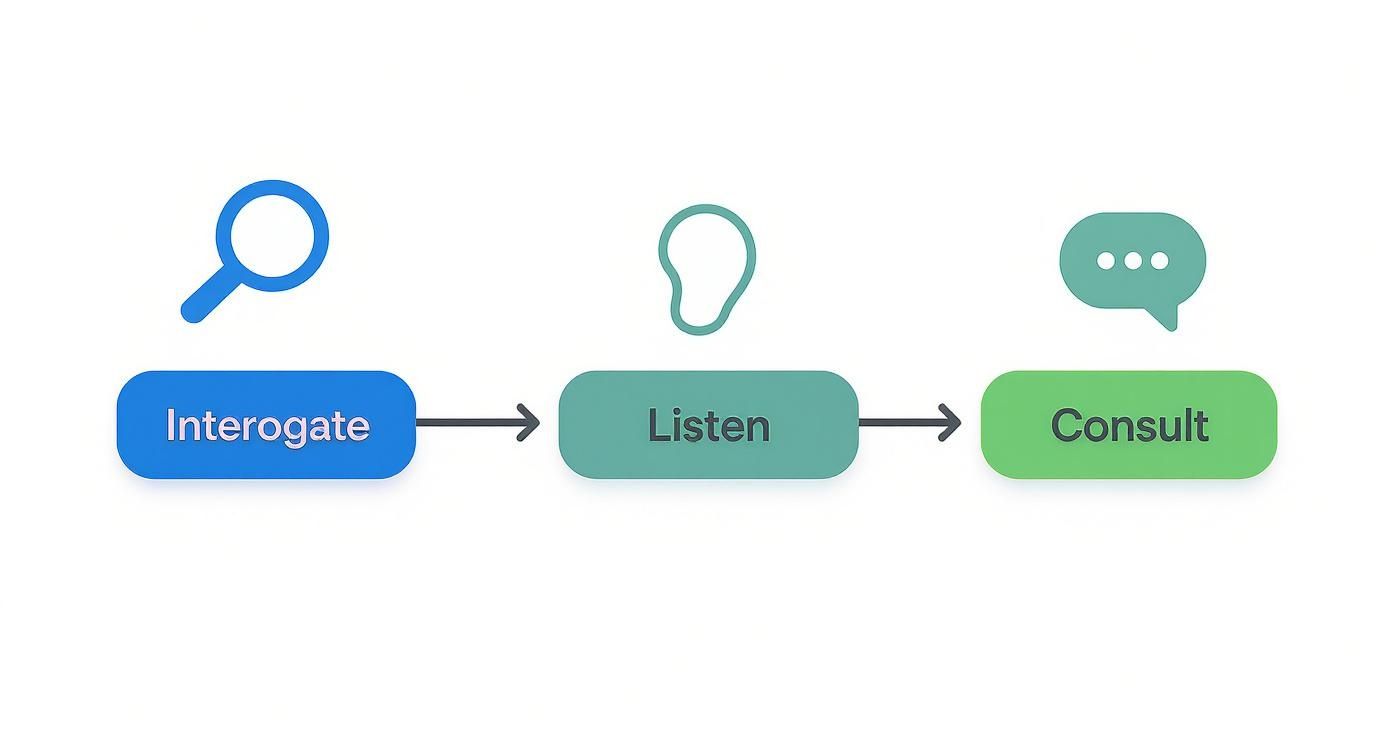
The image above breaks down a simple but incredibly effective flow for a sales call. You start by gathering the facts, then shift to deeply understanding their needs, and finally, you position yourself as a consultant. This is how you turn a basic qualification call into a genuinely valuable conversation.
Navigating Common Lead Qualification Challenges
Even with the best frameworks in place, you're going to hit some tricky situations on the ground. Let's walk through a couple of the most frequent questions I hear from sales teams trying to nail down their qualification process.
What Should I Do When a Great Lead Suddenly Goes Silent?
It’s a classic scenario, isn't it? You have a fantastic conversation, everything seems to line up perfectly, and then… radio silence. It's frustrating, but it happens all the time.
Before you give up and mark the lead as "lost," your best move is to transition them into a lead nurturing sequence. Think of it as putting the conversation on a gentle simmer. Set up an automated email workflow that sends them genuinely helpful content—maybe a case study, a blog post that tackles a common industry problem, or an invite to a webinar.
This approach keeps you on their radar without your sales reps having to spend time on manual follow-ups. Then, when the timing is right on their end, you're the first person they'll think of.
How Do I Know When It's Time to Disqualify a Lead?
Learning when to walk away is one of the most valuable skills in sales. It feels counterintuitive, but it's crucial for efficiency. You're not being rude; you're just being realistic about where to invest your energy.
Here are a few clear signs it's time to disqualify someone:
- There's absolutely no budget. If they tell you point-blank that money isn't available and there's no path to getting it approved, it's a dead end for now.
- They can't identify a real problem. If they can't articulate a specific pain point that your product or service actually solves, there's no foundation for a sale.
- You're talking to the wrong person. If your contact isn't the decision-maker and shows no willingness to connect you with the person who is, you're just spinning your wheels.
Remember, the point of disqualifying a lead isn't to shut the door forever. It's about respecting everyone's time—yours and theirs—and focusing your efforts where they can make a real impact. It’s the fastest way to hit your quota.
Ready to automate your lead qualification? MxChat helps you build intelligent, no-code chatbots for your WordPress site that capture, qualify, and route leads 24/7. Turn your website traffic into sales conversations at https://mxchat.ai.


