Voyage AI Pricing Tested on a Live WordPress Chatbot
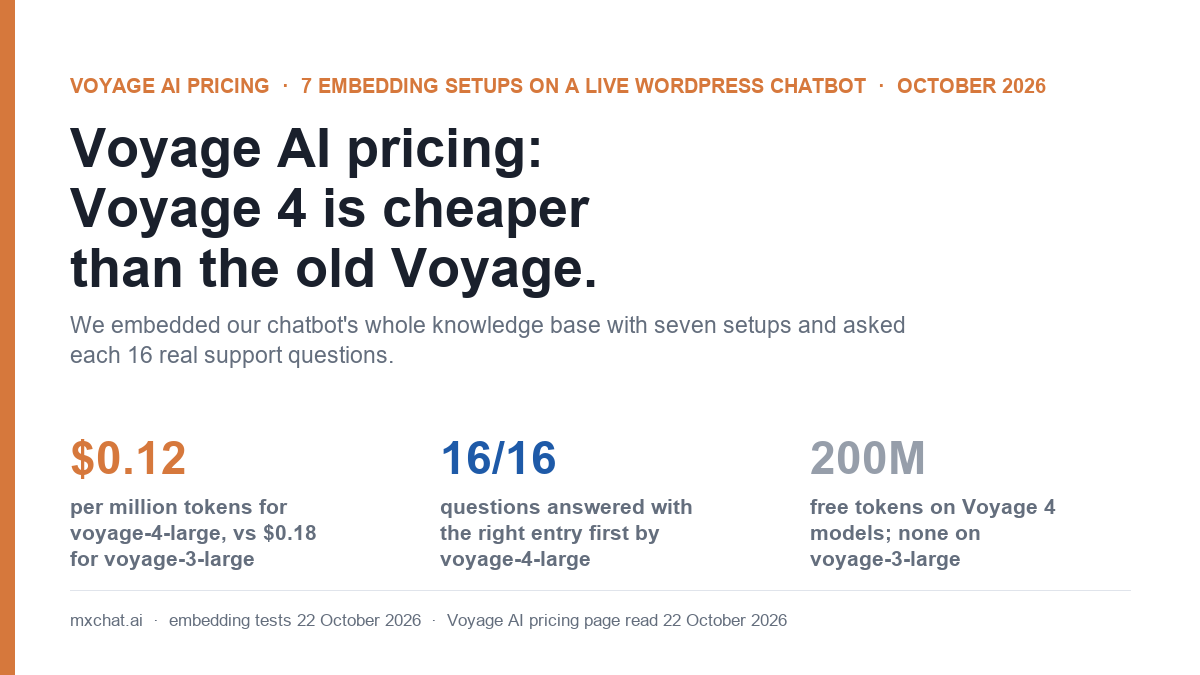
Voyage AI pricing in October 2026 is simple at the top: the current Voyage 4 family costs $0.02 per million tokens for voyage-4-lite, $0.06 for voyage-4 and $0.12 for voyage-4-large, and every account gets 200 million free tokens on each of them. The older models are a different story. voyage-3-large still costs $0.18 per million tokens and comes with no free tokens at all, and voyage-3-large is the only Voyage model in MxChat’s embedding dropdown today.
Prices per million tokens are hard to picture, so we measured what they mean for a real WordPress chatbot. On 22 October 2026 we took the knowledge base behind the MxChat chatbot on this site, 419 chunks of FAQ entries, documentation and blog posts, and embedded all of it with seven setups: three Voyage 4 models, voyage-4 a second time with Voyage’s recommended query and document labels, two OpenAI models and Google’s Gemini Embedding 2. Then we asked each one 16 real support questions, worded differently from the FAQ entries that answer them, and checked whether the right entry came back first.
- voyage-4-large put the correct entry first on all 16 questions. No other setup did. text-embedding-3-small, MxChat’s default, got 15. Every model had the right entry somewhere in its top 5 every time, so the differences are small.
- Embedding the whole knowledge base cost between a quarter of a cent and under three cents depending on the model. voyage-4-large came to $0.0156; voyage-3-large would have been about $0.0234 for the same text.
- Voyage was the fastest at turning a visitor’s question into a vector: about 145 milliseconds, against 274 ms for OpenAI’s small model and 446 ms for Gemini, all measured through the same gateway.
- Telling Voyage which text is a question and which is a document helped. voyage-4 went from 14 to 15 correct first results when we sent Voyage’s
input_typelabels. MxChat does not send them.
Voyage AI pricing: every model, October 2026
These prices come from Voyage AI’s pricing page, read on 22 October 2026. Voyage is owned by MongoDB, and its models are sold through its own API, through MongoDB Atlas and through gateways such as OpenRouter. Embedding models bill only for the text you send in; there is no output charge.
| Model | Price per 1M tokens | Free tokens per account | Notes |
|---|---|---|---|
| voyage-4-lite | $0.02 | 200 million | Cheapest current model |
| voyage-4 | $0.06 | 200 million | General-purpose |
| voyage-4-large | $0.12 | 200 million | Highest quality general model |
| voyage-context-4 | $0.12 | 200 million | Embeds chunks with awareness of the surrounding document |
| voyage-code-4 | $0.12 | 200 million | For source code |
| voyage-multimodal-3.5 | $0.12 text, $0.60 per billion pixels | 200 million text tokens, 150 billion pixels | Text and images |
| voyage-finance-2, voyage-law-2, voyage-code-2 | $0.12 | 50 million | Domain models |
| rerank-3 | $0.05 | 200 million | Reranker |
| rerank-3-lite | $0.02 | 200 million | Reranker |
Voyage also offers a Batch API at a 33% discount. Free tokens do not apply to batch requests, and batch usage does not use up your free balance. For a website chatbot the batch route rarely matters: you embed your content once and the per-question calls have to be answered immediately.
Older Voyage models cost the same or more, with no free tokens
The pricing page lists the previous generations separately, and none of them get free tokens. That includes the model MxChat offers.
| Older model | Price per 1M tokens | Current model at the same tier | Current price |
|---|---|---|---|
| voyage-3-large, voyage-context-3, voyage-code-3 | $0.18 | voyage-4-large | $0.12 |
| voyage-3.5, voyage-3 | $0.06 | voyage-4 | $0.06 |
| voyage-3.5-lite, voyage-3-lite | $0.02 | voyage-4-lite | $0.02 |
| voyage-large-2, voyage-large-2-instruct, voyage-multilingual-2 | $0.12 | voyage-4-large | $0.12 |
| voyage-2 and earlier | $0.10 | voyage-4 | $0.06 |
So moving from voyage-3-large to voyage-4-large cuts the list price by a third and adds 200 million free tokens. The page does not call the older models deprecated; they still work and are still billed.
How we tested
The knowledge base is the real one behind the chatbot in the corner of this page: 419 chunks taken from the site’s production Pinecone index, 612,536 characters in total, about 1,460 characters per chunk. About half are single FAQ entries, which made it possible to score answers exactly. Each of the 16 questions has one FAQ entry that answers it, and we wrote the questions the way a site owner would type them rather than copying the FAQ wording. For example, “Can I use the same license on my staging site and my live site?” should find the entry about how many sites a licence covers.
For each of the seven setups we embedded all 419 chunks, embedded each question, ranked every chunk by cosine similarity and recorded where the correct entry landed. Every question ran twice. All calls went from our WordPress server in the US through OpenRouter’s embeddings endpoint, so every model was reached the same way and billed at its list price; OpenRouter reported “VoyageAI by MongoDB” as the provider for the Voyage models. There were no errors in 231 requests, and both runs gave identical rankings for every model.
This is a small test on one site’s content. Sixteen questions can show you whether a model finds the obvious answer to a support question, which is most of what a chatbot needs, but they are not a benchmark. One or two questions separate every model here.
Which model found the right answer first
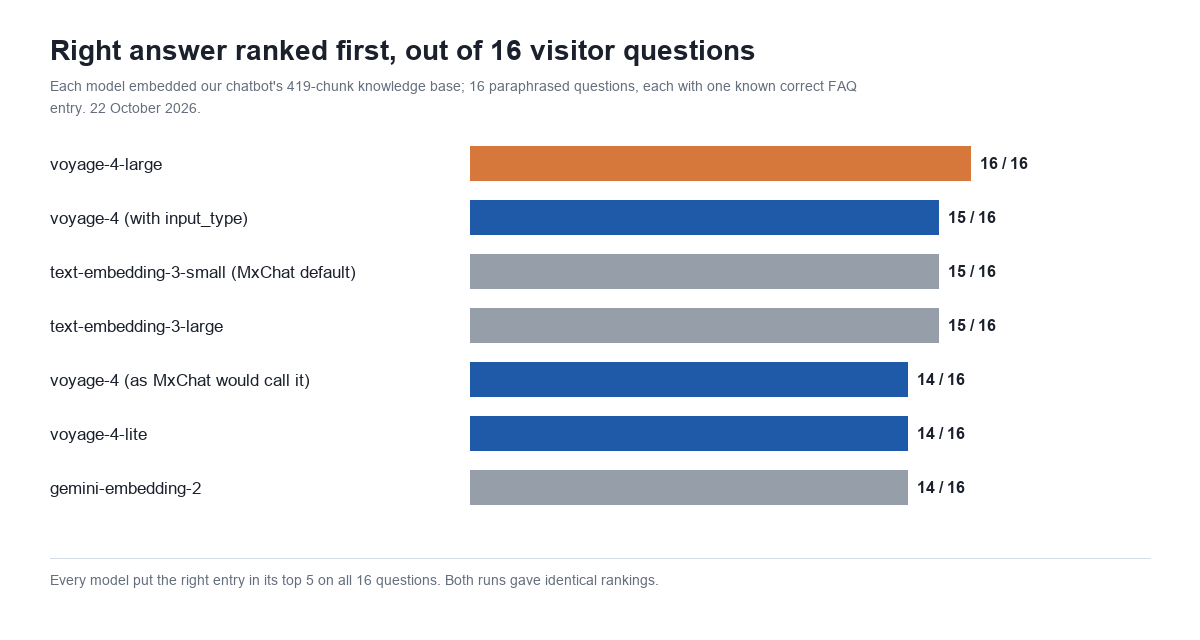
| Setup | Correct entry first | Correct entry in top 5 | Mean reciprocal rank | Dimensions |
|---|---|---|---|---|
| voyage-4-large | 16 / 16 | 16 / 16 | 1.000 | 1,024 |
voyage-4 with input_type | 15 / 16 | 16 / 16 | 0.969 | 1,024 |
| text-embedding-3-small | 15 / 16 | 16 / 16 | 0.969 | 1,536 |
| text-embedding-3-large | 15 / 16 | 16 / 16 | 0.958 | 3,072 |
voyage-4 without input_type | 14 / 16 | 16 / 16 | 0.938 | 1,024 |
| gemini-embedding-2 | 14 / 16 | 16 / 16 | 0.938 | 3,072 |
| voyage-4-lite | 14 / 16 | 16 / 16 | 0.927 | 1,024 |
The misses were near misses. Asked “Is there a way to pass a visitor over to a real person on Slack?”, voyage-4, text-embedding-3-small and Gemini all ranked a neighbouring Slack FAQ first (one about showing the visitor’s name in the Slack channel) and the handoff answer second. Asked “Can I upload a .docx file to teach the bot?”, four setups ranked the general “what content can I train it on” entry above the Word-import entry. A chatbot that receives the top five chunks would have had the right material in every case.
Two results are worth more than the ranking. First, voyage-4-large matched or beat OpenAI’s large model while producing vectors a third of the size: 1,024 numbers against 3,072. Smaller vectors take less storage and, as our Pinecone pricing test showed, less data sent back on every search. Second, voyage-4-lite at $0.02 matched Gemini Embedding 2, which costs ten times as much through the same gateway.
The query and document labels
Voyage recommends telling the API whether each piece of text is a query (the visitor’s question) or a document (your content). It adds a short instruction in front of the text so the two kinds of text are embedded slightly differently. In our test the labels moved voyage-4 from 14 to 15 correct first results and fixed the Slack question. MxChat’s built-in Voyage connection sends only the text and the model name, so a MxChat site using Voyage today gets the unlabelled result. The labels cost nothing extra; the token count for our whole knowledge base was 129,530 with them and 129,950 without.
What Voyage AI pricing means for a chatbot’s bill
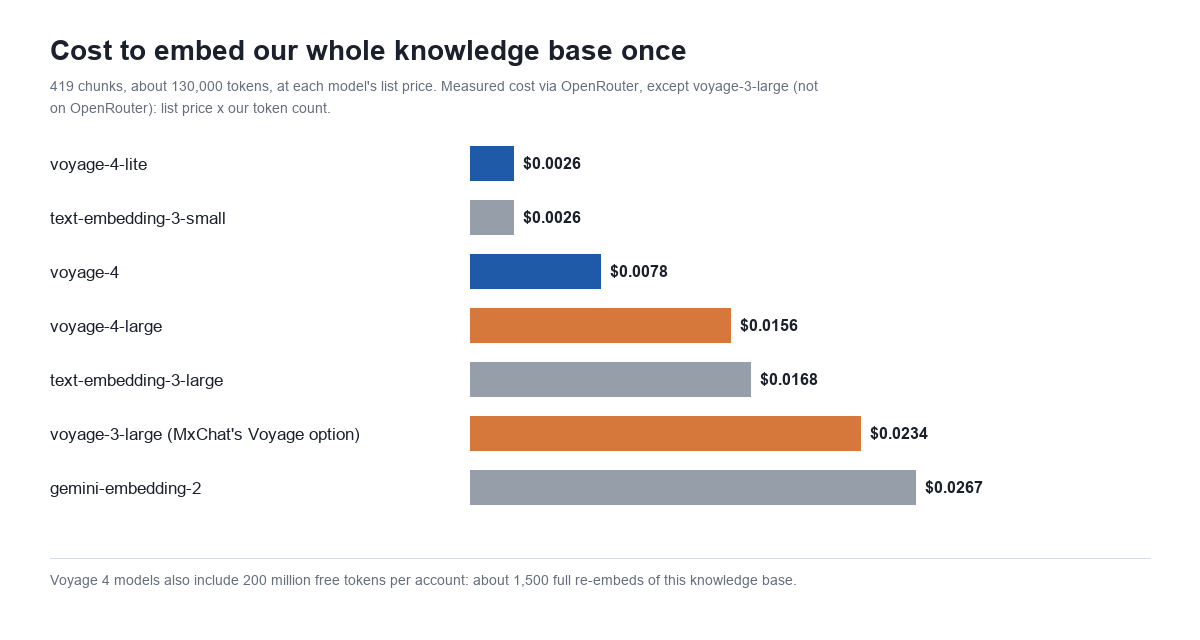
A chatbot pays for embeddings in two places. The first is a one-off: every page, post or FAQ entry is embedded when you add it to the knowledge base, and again only if you change it or switch models. The second runs on every message: the visitor’s question is embedded so it can be compared with your content. Here is what both came to on our site.
| Model | Price per 1M tokens | Tokens for our 419 chunks | Cost to embed the whole knowledge base | Cost per 1M visitor questions (about 15 tokens each) |
|---|---|---|---|---|
| voyage-4-lite | $0.02 | 129,950 | $0.0026 | $0.30 |
| text-embedding-3-small | $0.02 | 128,929 | $0.0026 | $0.30 |
| voyage-4 | $0.06 | 129,950 | $0.0078 | $0.91 |
| voyage-4-large | $0.12 | 129,950 | $0.0156 | $1.81 |
| text-embedding-3-large | $0.13 | 128,929 | $0.0168 | $1.96 |
| voyage-3-large (MxChat’s Voyage option) | $0.18 | about 129,950 | about $0.0234 | about $2.72 |
| gemini-embedding-2 (via OpenRouter) | $0.20 | 133,241 | $0.0267 | $2.96 |
The voyage-3-large row is calculated, not measured: OpenRouter does not carry that model, so we multiplied its list price by the token count Voyage’s tokenizer gave for the Voyage 4 models. Voyage and OpenAI counted almost the same number of tokens for our text, about 130,000; Gemini counted 2.5% more.
The honest conclusion is that embedding prices are not what makes a chatbot expensive. A million visitor questions cost under $3 to embed on the priciest model here. The same million questions cost hundreds or thousands of dollars in the AI model that writes the answers, as our Claude API pricing test measured. Choose an embedding model on answer quality, speed and how well it fits the rest of your setup, then let the price settle ties.
What the free tokens cover
Each Voyage 4 model comes with 200 million free tokens per account. At our knowledge base’s size that is enough to embed everything about 1,500 times, or to embed around 13 million visitor questions. For most WordPress sites a Voyage 4 model will cost nothing for a long time. voyage-3-large gets no free tokens, so a site using MxChat’s Voyage option pays from the first token, at the highest rate on the current price list.
Rate limits
Voyage’s rate limits depend on your usage tier. Tier 1 requires adding a payment method; Tier 2 starts at $100 of billed usage and Tier 3 at $1,000, with limits doubling and tripling. Free tokens do not count toward a tier. Voyage’s rate-limit page does not list separate limits for accounts without a payment method, so add one before you import a large site.
| Model | Tier 1 tokens per minute | Tier 1 requests per minute |
|---|---|---|
| voyage-4-lite | 16 million | 2,000 |
| voyage-4 | 8 million | 2,000 |
| voyage-4-large | 3 million | 2,000 |
| voyage-3-large | 3 million | 2,000 |
Even the lowest of these is far more than a WordPress import needs. Our whole knowledge base is 130,000 tokens, under a twentieth of voyage-4-large’s per-minute allowance.
Speed
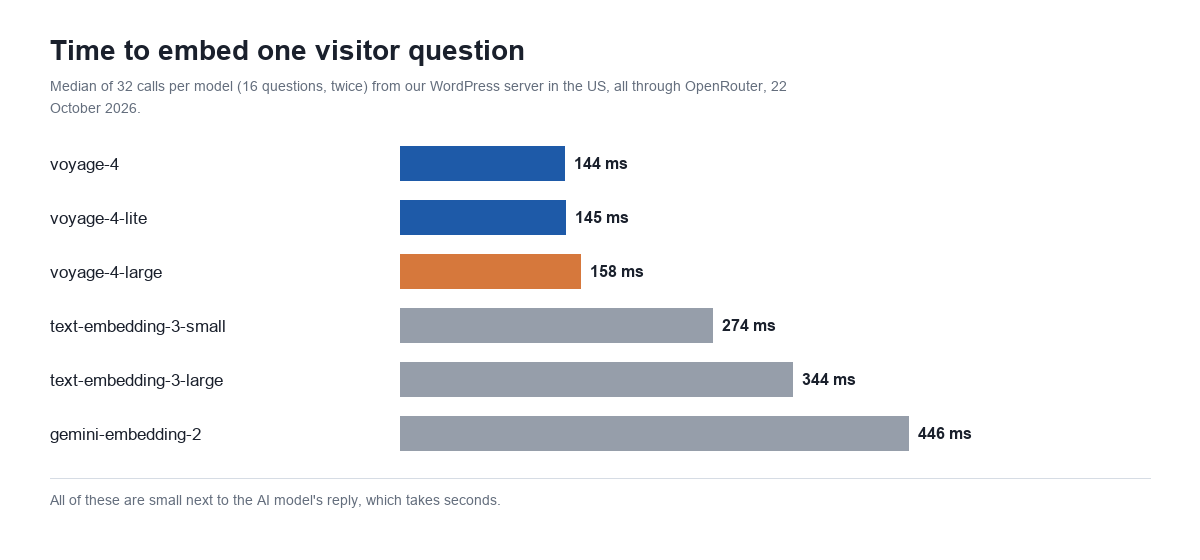
Every chat message waits for its question to be embedded before the knowledge base can be searched, so this step adds directly to the time a visitor waits. The Voyage models were consistently quickest in our test, at a median of 144 to 158 milliseconds. OpenAI’s models took 274 and 344 ms, and Gemini Embedding 2 took 446 ms. These numbers include the trip through OpenRouter, so direct connections to each provider may be faster or slower. In practice none of them is noticeable next to the AI model’s reply, which takes seconds.
Can you use Voyage 4 with MxChat today?
Yes, but not from the Voyage option in the dropdown, and it means rebuilding your knowledge base.
- The dropdown offers voyage-3-large only. MxChat’s built-in Voyage connection, under Settings, Chatbot, AI Models, sends voyage-3-large with 2,048 dimensions. It works, but it is the expensive older model with no free tokens.
- The Custom provider can send other models. MxChat’s Custom (OpenAI-compatible) provider posts the text and a model name to the
/embeddingsaddress of whatever service you point it at, and works out the vector size from the first reply. Voyage’s API accepts that request shape, so a base URL ofhttps://api.voyageai.com/v1, your Voyage key and the model namevoyage-4should work. We ran our test through OpenRouter’s OpenAI-compatible endpoint rather than Voyage’s own, so treat the direct connection as untested by us. The Custom provider uses one base URL, so this only suits sites that are not already using it for their chat model. - Your vectors have to be rebuilt. Embeddings from different models cannot be mixed: questions embedded by one model will not match content embedded by another. Switching means re-importing your knowledge base, which on our site would cost under two cents and, on the free tokens, nothing.
- Check your Pinecone index size. Voyage 4 models produce 2,048, 1,024, 512 or 256 dimensions, not 1,536. A Pinecone index created for OpenAI’s 1,536-dimension models will reject Voyage 4 vectors, so you need a new index at the matching size. Sites that keep their knowledge base in WordPress rather than Pinecone do not have this problem.
If you are happy with your answers, there is no reason to switch. text-embedding-3-small, the default for new installs, scored 15 of 16 in our test at the lowest price on the list. The case for Voyage 4 is a site that wants the best retrieval it can get, for example a large documentation set where similar pages compete, and is willing to rebuild the index once. MxChat’s own embedding model FAQ covers the built-in choices, and the knowledge base documentation explains imports and re-indexing.
Voyage AI pricing compared with OpenAI and Google
| Voyage 4 family | OpenAI text-embedding-3 | Google Gemini Embedding 2 | |
|---|---|---|---|
| Cheapest model | voyage-4-lite, $0.02 | 3-small, $0.02 | One model |
| Top model | voyage-4-large, $0.12 | 3-large, $0.13 | gemini-embedding-2, $0.20 via OpenRouter |
| Free allowance | 200M tokens per model | None | See our Gemini Embedding 2 pricing post |
| Batch discount | 33% | 50% | 50% on Google’s Batch API |
| Vector sizes | 256 to 2,048 | Up to 1,536 or 3,072, can be shortened | Up to 3,072, can be shortened |
| Our test, correct first | 14 to 16 of 16 | 15 of 16 | 14 of 16 |
| Our test, median question time | 144 to 158 ms | 274 to 344 ms | 446 ms |
| Built into MxChat | voyage-3-large only; Voyage 4 via Custom provider | Yes, default | Yes |
If you route several AI providers through one account, our OpenRouter pricing comparison shows what a gateway adds to the bill. For embeddings it added nothing in this test: OpenRouter charged Voyage’s list price to the cent, though calls through it do not use Voyage’s free tokens. For background on how a chatbot uses these vectors at all, see our guide to vector embedding chatbots for WordPress.
Frequently asked questions
How much does Voyage AI cost?
The current models cost $0.02 per million tokens (voyage-4-lite), $0.06 (voyage-4) and $0.12 (voyage-4-large, voyage-context-4 and voyage-code-4), with 200 million free tokens per account on each. Older models cost between $0.02 and $0.18 and have no free tokens.
Is Voyage AI free?
Partly. Each current model includes 200 million free tokens per account, which is enough to embed a typical WordPress site’s content hundreds or thousands of times. After that you pay per token. Free tokens do not apply to the Batch API or to older models such as voyage-3-large.
Is voyage-4 better than OpenAI embeddings?
On our 16 questions, voyage-4-large was slightly better than both OpenAI models, and voyage-4 matched text-embedding-3-small when given Voyage’s query and document labels. The gap was one question either way, so for most chatbots the two are close. Voyage was faster in our test and produces smaller vectors.
Why is voyage-3-large more expensive than voyage-4-large?
Voyage priced its new top model below its old one. voyage-3-large stays at $0.18 per million tokens, and voyage-4-large launched at $0.12 with free tokens included.
Does MxChat support Voyage AI?
Yes. MxChat’s built-in Voyage connection uses voyage-3-large; add your Voyage key under Settings, API Keys. Voyage 4 models can be reached through the Custom (OpenAI-compatible) provider, which needs a knowledge base re-import and, on Pinecone, an index at the new vector size. Both work in the free plugin, and MxChat Pro adds the paid extensions.
How much will embeddings add to my chatbot’s cost?
Very little. On our site, embedding the entire knowledge base cost under three cents on every model we tried, and a million visitor questions would cost $0.30 to $3 to embed. The AI model that writes the replies costs far more.
Method: 419 knowledge-base chunks from this site’s production Pinecone index, embedded with seven setups through OpenRouter on 22 October 2026; 16 questions, each run twice, 231 requests, no errors. Prices from Voyage AI’s pricing and rate-limit pages, read 22 October 2026. Costs are list prices before tax.