Vertex AI Pricing: Gemini 4 Argon and Claude Tested
Vertex AI pricing for Gemini 4 Argon is $2 per million input tokens and $10 per million output tokens on the Global endpoint until 30 November 2026. On 1 December it doubles to $4 and $20. Gemini 3.8 Flash is $0.75 and $3.75 until 31 December, then $1.50 and $7.50 from 1 January 2027. Both prices are the same on Google AI Studio. Pin your requests to a region instead of the Global endpoint and Google adds 10%. Claude Sonnet 5.5 on Vertex costs the same as Anthropic direct on Global, plus 10% in the US or EU.
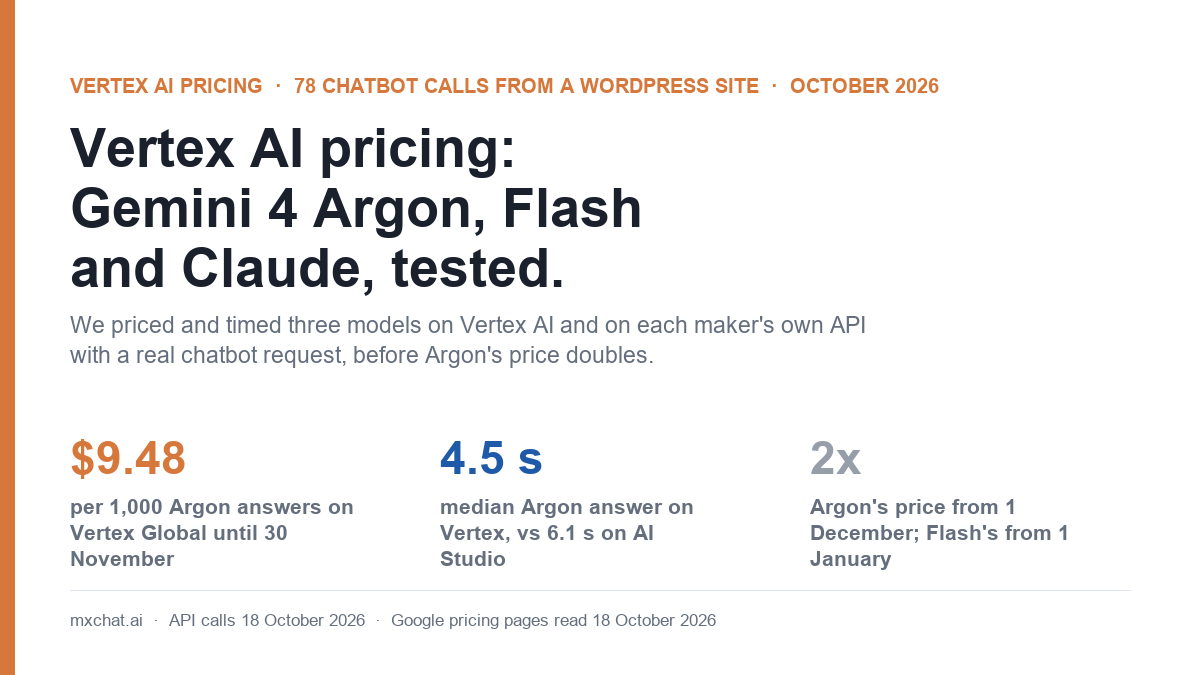
Those are per-token prices. A chatbot pays per answer, so we measured that. On 18 October 2026 we sent the same WordPress chatbot request to Gemini 4 Argon, Gemini 3.8 Flash and Claude Sonnet 5.5 through Vertex AI and through each model’s direct API, from our own production server: 78 streamed calls across 13 routes. On the Vertex Global endpoint, 1,000 Argon answers cost $9.48 without caching and took 4.5 seconds each. The same answers through AI Studio cost $9.49 and took 6.1 seconds. Flash cost about half as much as Argon, not the 63% less its rate card suggests, because it spent around 450 hidden thinking tokens on every answer. Every route answered every question correctly.
One housekeeping note first. Google renamed Vertex AI in April 2026. It is now part of Gemini Enterprise Agent Platform, announced at Google Cloud Next ’26, and the old Vertex AI pricing page redirects to the Agent Platform one. The API endpoints, the billing account and most console links didn’t change. Most people still search for “Vertex AI pricing”, so that’s the name we use here.
Vertex AI pricing in October 2026
These are the pay-as-you-go rates from Google’s Agent Platform pricing page and the Gemini Developer API pricing page, both read on 18 October 2026. Prices are per million tokens, for prompts under 200,000 tokens. “Global” lets Google run the request in any region. “Non-global” means a regional or multi-region endpoint such as us-central1, the US multi-region or the EU multi-region.
| Model and endpoint | Input / 1M | Cached input / 1M | Output / 1M | Until |
|---|---|---|---|---|
| Gemini 4 Argon, Global | $2.00 | $0.10 | $10.00 | 30 Nov 2026 |
| Gemini 4 Argon, non-global | $2.20 | $0.11 | $11.00 | 30 Nov 2026 |
| Gemini 4 Argon, Global, from 1 Dec | $4.00 | $0.20 | $20.00 | – |
| Gemini 4 Argon, Priority, Global | $3.60 | $0.18 | $18.00 | 30 Nov 2026 |
| Gemini 4 Argon, Batch (Vertex) or Flex (AI Studio) | $1.00 | $0.05 | $5.00 | 30 Nov 2026 |
| Gemini 3.8 Flash, Global | $0.75 | $0.075 | $3.75 | 31 Dec 2026 |
| Gemini 3.8 Flash, non-global | $0.825 | $0.0825 | $4.125 | 31 Dec 2026 |
| Gemini 3.8 Flash, Global, from 1 Jan 2027 | $1.50 | $0.15 | $7.50 | – |
| Claude Sonnet 5.5, Global | $2.00 | $0.10 | $10.00 | – |
| Claude Sonnet 5.5, US, EU or regional | $2.20 | $0.11 | $11.00 | – |
| Claude Haiku 5.5, Global | $0.10 | $0.01 | $0.50 | – |
A few things in that list are easy to miss:
- Global matches the direct APIs. Google AI Studio charges the same $2 / $10 for Argon and $0.75 / $3.75 for Flash, and Anthropic charges the same $2 / $10 for Sonnet 5.5. Vertex costs more only when you leave the Global endpoint.
- The regional premium is 10%, and it applies to Claude as well as Gemini. For Gemini it has applied to non-global endpoints of Gemini 3 and later since 1 July 2026. Before that date Google charged Global prices everywhere.
- The Argon promotion works differently on the two platforms. AI Studio simply lists $2 / $10 until 30 November. On Vertex, Google’s page says the promotional price is “provided through 50% credits back on net spend”. If you track your Google Cloud bill line by line, expect the discount to show up as a credit. The promotion doesn’t cover Gemini 4 Argon Cyber Permissive, which is $4 / $20 now.
- Output prices include thinking tokens for every Gemini model. That matters more for Flash than for Argon, as the results below show.
- Grounding with Google Search is priced the same on both: 5,000 grounded queries a month free across Gemini 3 and 4 models, then $14 per 1,000.
How we tested Vertex AI pricing on a chatbot
We used the same request shape a WordPress chatbot sends on every message. Each call carried our site’s real MxChat system prompt plus four knowledge-base excerpts of about 4,000 characters each, around 4,200 input tokens for Gemini, followed by one customer question. We asked three questions our support bot actually gets: whether MxChat can look up a WooCommerce order for a logged-in customer, whether Pinecone is required for the knowledge base, and whether a visitor can be handed to a human on Slack or Telegram.
Each question went to each of 13 routes twice, all streamed, from our production web server in the US, through OpenRouter with the provider pinned and fallbacks turned off:
- Gemini 4 Argon: AI Studio, Vertex Global, Vertex US, AI Studio Flex and Vertex Global Priority.
- Gemini 3.8 Flash: AI Studio, Vertex Global, Vertex US and Vertex Global Flex.
- Claude Sonnet 5.5: Anthropic, Vertex Global, Vertex US and Vertex EU.
We sent no reasoning or thinking setting, the same as a default chatbot install. We worked out the no-cache cost from the input and output tokens each call actually used, at the rate for that route, and scaled it to 1,000 answers. We timed every call from request to last word. All 78 calls succeeded on the first try, and we checked every answer against our documentation. All 78 were correct.
Results: Gemini 4 Argon on Vertex AI vs AI Studio
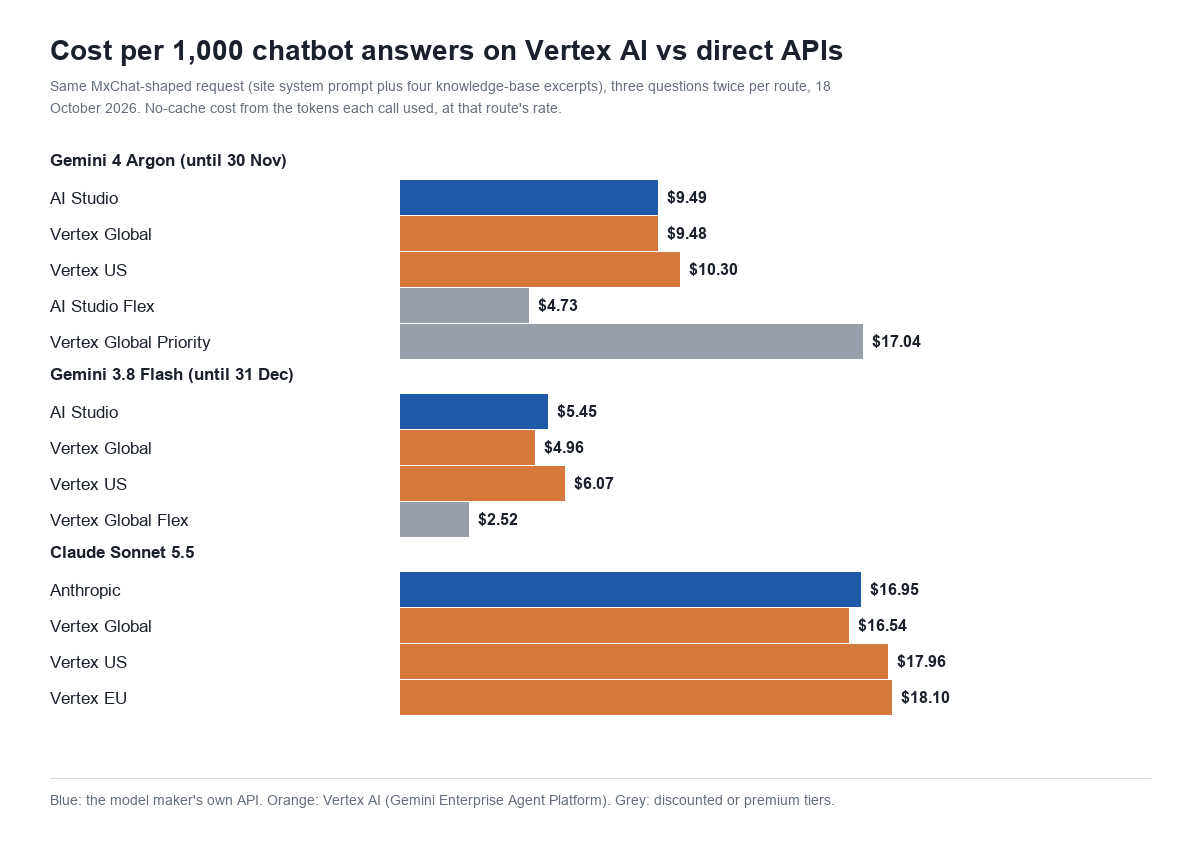
| Argon route | Rate (in / out) | Cost per 1,000 answers, no cache | Median full answer | Slowest of six |
|---|---|---|---|---|
| AI Studio | $2 / $10 | $9.49 | 6.05 s | 11.46 s |
| Vertex Global | $2 / $10 | $9.48 | 4.53 s | 4.73 s |
| Vertex US | $2.20 / $11 | $10.30 | 5.12 s | 9.76 s |
| AI Studio Flex | $1 / $5 | $4.73 | 10.57 s | 14.67 s |
| Vertex Global Priority | $3.60 / $18 | $17.04 | 4.19 s | 5.09 s |
The per-answer cost tracked the rate card closely, because Argon’s answers were short and its usage was almost the same on every route: about 4,200 input tokens and 105 to 110 output tokens. The input side is 88% of an Argon chatbot bill. Long system prompts and knowledge-base excerpts matter far more than answer length.
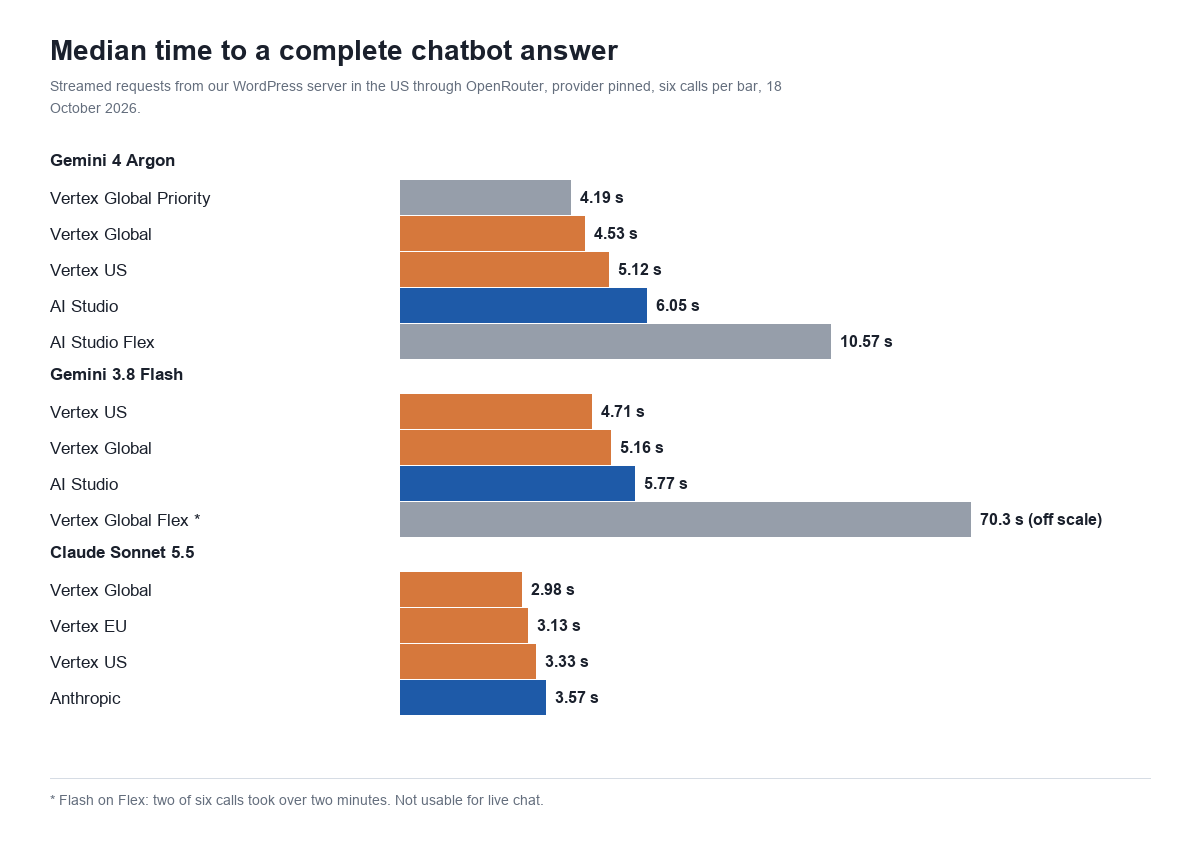
Speed is where Vertex earned its place. Vertex Global answered in 4.5 seconds at the median, and all six calls landed between 4.3 and 4.7 seconds. AI Studio’s median was 6.1 seconds, and its slowest call took 11.5. Priority shaved only another 0.3 seconds off Vertex Global while costing 80% more. Most of Argon’s time goes before the first word: 3.3 seconds on Vertex Global and 4.4 on AI Studio. That is time the model spends before it starts writing, so streaming the reply doesn’t hide it.
One thing we didn’t expect. The output price includes thinking tokens, but OpenRouter reported zero reasoning tokens for every Argon call, and the billed output matched the visible answer. On our bill, Argon’s pre-answer delay cost nothing extra. Flash was a different story.
Results: Gemini 3.8 Flash on Vertex AI
| Flash route | Rate (in / out) | Thinking tokens per answer | Cost per 1,000, no cache | Median full answer |
|---|---|---|---|---|
| AI Studio | $0.75 / $3.75 | 560 | $5.45 | 5.77 s |
| Vertex Global | $0.75 / $3.75 | 435 | $4.96 | 5.16 s |
| Vertex US | $0.825 / $4.125 | 578 | $6.07 | 4.71 s |
| Vertex Global Flex | $0.375 / $1.875 | 448 | $2.52 | 70.30 s |
Flash wrote about 45 words per answer and thought for about 500 tokens before writing them. Those thinking tokens are billed at the output rate. On Vertex Global they were a third of the cost of each answer. That is why Flash’s list price is 63% below Argon’s but its chatbot bill was only 48% lower. The gap between AI Studio ($5.45) and Vertex Global ($4.96) is the same effect. Flash happened to think less on the Vertex calls in our sample. With six calls per route, we wouldn’t read that as a Vertex discount. Treat Flash as roughly $5 per 1,000 answers on either platform.
If you’d rather it didn’t think so much, the thinking level is the setting to change. Our Gemini 3.8 Flash pricing test measured what each thinking level costs on the same kind of request.
Flex is the warning. It halves the per-token rate, and Flash’s Flex bill came in at $2.52 per 1,000. But the median answer took 70 seconds, and two of the six took over two minutes. No visitor waits that long in a chat window. Flex is for batch jobs such as tagging old conversations or rewriting knowledge-base entries, not for live chat. Argon on Flex was slower than standard but usable, at 10.6 seconds.
Results: Claude Sonnet 5.5 on Vertex AI vs Anthropic
| Sonnet 5.5 route | Rate (in / out) | Cost per 1,000, no cache | Median full answer |
|---|---|---|---|
| Anthropic | $2 / $10 | $16.95 | 3.57 s |
| Vertex Global | $2 / $10 | $16.54 | 2.98 s |
| Vertex US | $2.20 / $11 | $17.96 | 3.33 s |
| Vertex EU | $2.20 / $11 | $18.10 | 3.13 s |
Claude on Vertex was the fastest thing we tested. Vertex Global returned a full Sonnet answer in 2.98 seconds, ahead of Anthropic’s own API at 3.57, at the same per-token price. The US and EU endpoints cost 10% more, still beat Anthropic on speed, and are the ones to use if your data must stay in a region.
The surprise is how much more a Sonnet answer costs than an Argon one, at identical $2 / $10 rates. The same system prompt, excerpts and question came to about 4,200 tokens for Gemini and 6,827 for Claude. Claude’s tokenizer counts the same English text as roughly 60% more tokens, and input is most of a chatbot bill. Add slightly longer answers and Sonnet came to $16.54 per 1,000 against Argon’s $9.48 on the same platform. Until 30 November, that is. We covered the tokenizer gap in detail in our Claude tokenizer test.
The price changes on 1 December and 1 January
Both Gemini prices in this test are introductory. If you set up a chatbot on Vertex AI or AI Studio this autumn, the bill you see in November is not the bill you’ll pay in the new year.
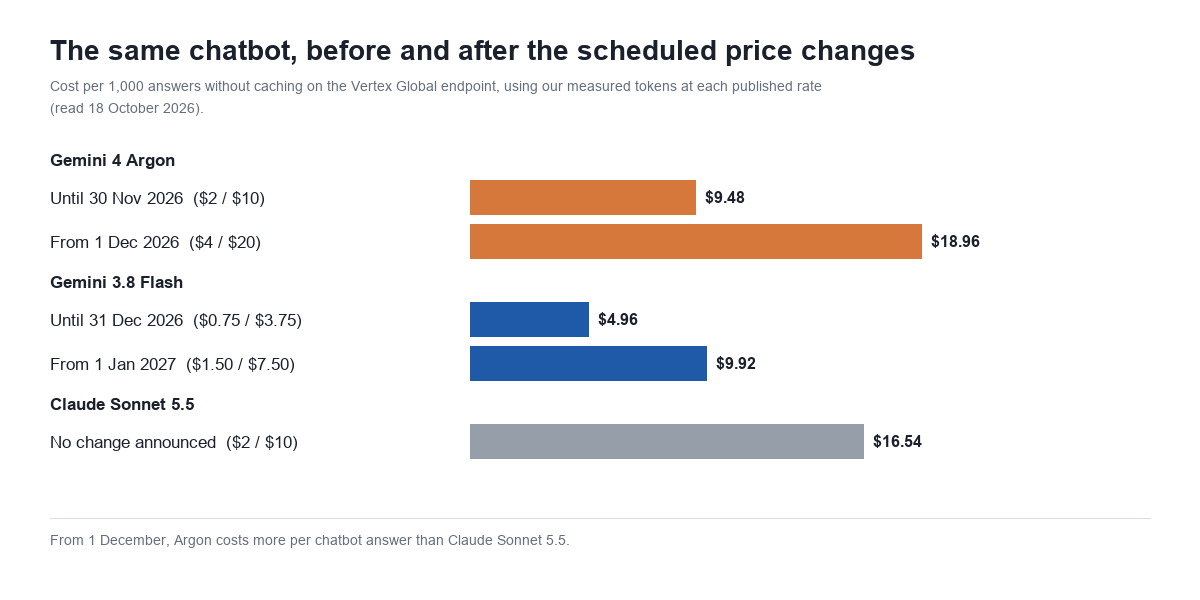
Applying the new rates to our measured token counts on Vertex Global:
- Gemini 4 Argon goes from $9.48 to $18.96 per 1,000 answers on 1 December 2026. At that price it costs more per answer than Claude Sonnet 5.5 ($16.54), even with Claude’s heavier tokenizer.
- Gemini 3.8 Flash goes from $4.96 to $9.92 per 1,000 answers on 1 January 2027. That’s about what Argon costs today.
- Gemini 3.7 Flash and 3.6 Flash are on the same introductory price and change on the same day, so switching down a version doesn’t avoid it.
What it costs per month
Here is what those per-answer costs come to at three chatbot sizes, on the Vertex Global endpoint, without caching. A small business site might handle 5,000 answers a month. A busy WooCommerce store can pass 100,000.
| Model on Vertex Global | 5,000 answers | 20,000 answers | 100,000 answers |
|---|---|---|---|
| Gemini 3.8 Flash, until 31 Dec | $25 | $99 | $496 |
| Gemini 3.8 Flash, from 1 Jan 2027 | $50 | $198 | $992 |
| Gemini 4 Argon, until 30 Nov | $47 | $190 | $948 |
| Gemini 4 Argon, from 1 Dec | $95 | $379 | $1,896 |
| Claude Sonnet 5.5 | $83 | $331 | $1,654 |
| Claude Haiku 5.5 (rate card, not measured today) | About one-twentieth of Sonnet 5.5 per token | ||
Caching brings all of these down. Gemini caches repeated prompt prefixes automatically. Argon supports only this implicit caching, not the explicit kind. Even in our short test, repeat sends of the same request got partial cache hits. The amount actually billed for Argon on Vertex Global averaged $7.45 per 1,000 against the $9.48 no-cache figure, and $5.82 on the Vertex US endpoint, where more of the prompt was cached. A real chatbot sends the same system prompt on every message, so it caches better than our six-call sample. Claude needs explicit cache markers to get its discount. Our Sonnet 5.5 prompt caching test covers what that saves.
When Vertex AI is worth it over AI Studio
On price alone, Vertex Global and AI Studio are the same. The reasons to pick Vertex are elsewhere:
- Steadier speed. In our test, Vertex Global answered every Argon request in under 5 seconds. AI Studio ranged from 4.6 to 11.5 seconds.
- Claude and Gemini on one bill. Vertex serves Claude Sonnet, Haiku and Opus at Anthropic’s prices, and it was faster than Anthropic direct for us.
- Data residency. Regional and multi-region endpoints keep processing in the US or EU for 10% more. AI Studio has no equivalent.
- Your data and Google Cloud commitments. AI Studio’s free tier uses your content to improve Google’s products. Its paid tier and Vertex don’t. Vertex usage also counts toward Google Cloud committed-spend discounts and Flexible Savings Plans.
AI Studio is simpler. You get one API key, no Google Cloud project and a free tier for Flash, which is enough to try a chatbot before paying anything. Argon has no free tier on either platform.
How to use Gemini or Vertex AI with a WordPress chatbot
MxChat connects to Gemini directly with a Gemini API key from Google AI Studio. Paste the key into the API Keys tab of the MxChat settings, then pick Gemini 3.8 Flash (the recommended Gemini model) or Gemini 4 Argon as the chat model. Argon takes the same thinking setting as the Gemini 3 models. The MxChat core documentation walks through the settings.
To bill through Google Cloud instead, the route we used in this test is the simplest one: connect MxChat to OpenRouter, and set Google Vertex as the preferred provider in your OpenRouter account. Our OpenRouter pricing test covers what OpenRouter adds to the bill, and our Azure OpenAI pricing test and AWS Bedrock comparison cover the other two clouds. Knowledge-base search, WooCommerce order lookups and human handoff to Slack or Telegram come with MxChat Pro.
Which should you choose?
| If you want… | Use | Why |
|---|---|---|
| The cheapest good chatbot this year | Gemini 3.8 Flash on Vertex Global or AI Studio | About $5 per 1,000 answers until 31 December, correct on every question |
| The strongest Gemini model before the price doubles | Gemini 4 Argon on Vertex Global | $9.48 per 1,000 answers and 4.5 s each until 30 November |
| The fastest answers | Claude Sonnet 5.5 on Vertex Global | 2.98 s per answer, faster than Anthropic direct at the same price |
| EU or US data residency | Any model on a Vertex regional or multi-region endpoint | 10% over Global; Claude on Vertex US and EU still beat Anthropic direct on speed |
| Free testing before you pay | Gemini 3.8 Flash on the AI Studio free tier | No charge, but Google may use your content |
| The lowest bill, speed no object | Flex or Batch | Half price, but 10 s (Argon) to 70 s (Flash) per answer: background jobs only |
Frequently asked questions
How much does Vertex AI cost?
Vertex AI, now part of Gemini Enterprise Agent Platform, charges per token for its generative models. On 18 October 2026 on the Global endpoint, Gemini 4 Argon was $2 per million input tokens and $10 per million output until 30 November, then $4 and $20. Gemini 3.8 Flash was $0.75 and $3.75 until 31 December, then $1.50 and $7.50. In our WordPress chatbot test, 1,000 answers cost $9.48 on Argon and $4.96 on Flash without caching.
Is Vertex AI more expensive than Google AI Studio?
Not on the Global endpoint. The per-token prices for Gemini 4 Argon and Gemini 3.8 Flash are identical, and our measured cost per 1,000 Argon answers was $9.48 on Vertex against $9.49 on AI Studio. Regional and multi-region Vertex endpoints cost 10% more. Vertex was faster in our test: 4.5 seconds per Argon answer against 6.1.
Is Vertex AI the same as Gemini Enterprise Agent Platform?
Yes. Google announced Gemini Enterprise Agent Platform as the successor to Vertex AI at Google Cloud Next ’26 in April 2026. The generative AI features, the APIs and pricing carried over. The Vertex AI pricing page now redirects to the Agent Platform pricing page.
When does Gemini 4 Argon pricing go up?
On 1 December 2026. The promotional $2 / $10 per million tokens runs through 30 November on both Vertex AI and AI Studio. From 1 December the standard price is $4 / $20 on Global and $4.40 / $22 on regional endpoints. On Vertex the promotion is applied as 50% credit back on net spend.
Is Claude cheaper on Vertex AI than on Anthropic?
The price is the same on Vertex’s Global endpoint: $2 / $10 per million tokens for Claude Sonnet 5.5. US, EU and regional endpoints cost 10% more. In our test Vertex Global was also faster, at 2.98 seconds per answer against 3.57 on Anthropic’s API.
Does Vertex AI have a free tier?
Not for these models. Google AI Studio has a free tier for Gemini 3.8 Flash with lower rate limits, and Google may use that content to improve its products. Gemini 4 Argon has no free tier on either platform. New Google Cloud accounts may get general sign-up credit that can be spent on Vertex.