

Customer Service vs Customer Support Explained
Let's get straight to it. People often use "customer service" and "customer support" as if they're the same thing, but they really aren't. Here's the simplest way to think about it: customer service is the big-picture, proactive strategy for managing the entire customer relationship. Customer support, on the other hand, is the reactive, hands-on function of fixing specific problems.
Think of service as the friendly guide for the whole journey, while support is the specialist you call when something breaks.
Breaking Down The Core Differences
While they work hand-in-hand, understanding the distinct roles of customer service and customer support is the foundation for creating an experience that keeps people coming back. Customer service covers every single touchpoint a person has with your brand—from the first ad they see to a follow-up email months after a purchase.
The main goal here is to build a lasting relationship and earn their loyalty. It's a proactive effort to make every interaction positive and memorable.
Customer support is much more focused and reactive. It's all about helping customers solve technical problems or navigate specific challenges with your product or service. Support teams are the troubleshooters, the ones who provide clear, actionable solutions when things aren't working as expected. They’re your "how-to" experts.
This infographic breaks down the key distinctions visually.
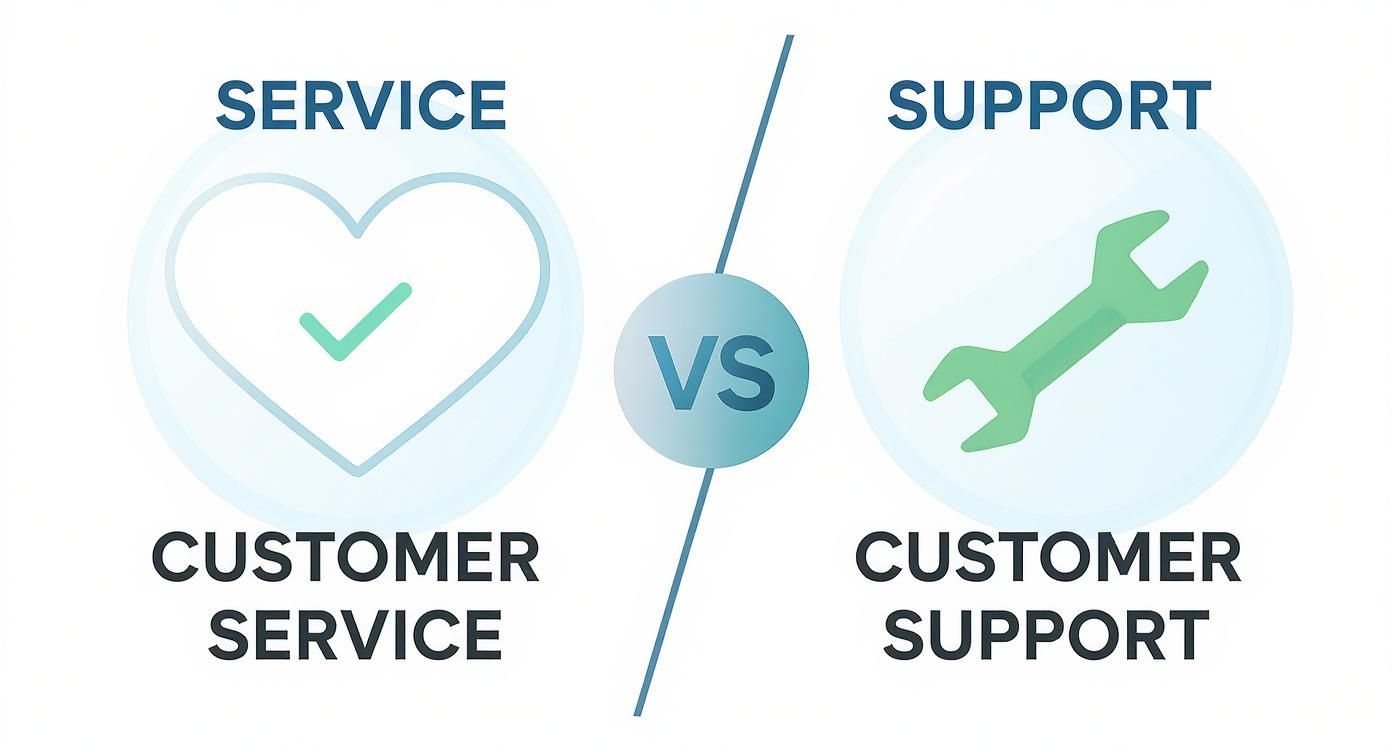
Seeing it laid out like this makes it clear: service is about the relationship, while support is about the resolution. This isn't just semantics; it's a difference that directly affects your bottom line.
Scope And Goals
The scope of customer service is wide and all-encompassing, with the ultimate goal of improving the entire customer experience. When you get service right, you don't just get a sale; you create a fan. In fact, research shows that 93% of customers are more likely to buy again from companies with excellent customer service, highlighting its powerful link to retention.
Customer support, by contrast, operates more on a case-by-case basis. The immediate goal is to fix a user's problem quickly and competently. While a single support interaction might seem small, the quality of that fix is essential for maintaining a customer's trust in your product. The benefits of chatbots for business often shine here, as they can handle these transactional support tasks, letting your human agents focus on the really tough problems.
Customer service is about providing value and building a relationship over the long term. Customer support is about fixing a technical issue and providing a solution in the short term.
Key Interactions And Metrics
A great way to see the customer service vs customer support difference in action is to look at their day-to-day interactions and how we measure their success. This table gives a quick, high-level summary of the fundamental differences.
Customer Service vs Customer Support at a Glance
| Attribute | Customer Service | Customer Support |
|---|---|---|
| Nature | Proactive & Relational | Reactive & Transactional |
| Focus | Building long-term loyalty | Solving short-term problems |
| Goal | Enhance overall experience | Provide technical solutions |
| Example | Onboarding a new client | Fixing a software bug |
| Key Metric | Customer Satisfaction (CSAT) | Average Resolution Time (ART) |
Ultimately, both are measured differently because their goals are different. For service, it's about satisfaction and happiness. For support, it’s about speed and accuracy.
Diving Deeper: Core Functions and Key Metrics

To really get to the heart of the customer service vs. customer support debate, we need to look past the dictionary definitions and see how these teams operate on the ground. Their day-to-day functions are worlds apart, guided by completely different philosophies. One is proactive and built on relationships; the other is reactive and focused on transactions.
Customer service is all about getting ahead of the curve. The goal is to anticipate what a customer might need and add value at every step of their journey with your brand. Think of it as relationship-building. It's designed to make customers feel seen and valued long before a problem ever surfaces.
Customer support, on the other hand, kicks into gear when something goes wrong. It's a reactive function that activates when a customer hits a snag with your product or service. The entire process is transactional: identify the issue, troubleshoot it, and solve it as quickly as possible so everyone can move on.
Proactive Service vs. Reactive Support
This difference in approach really comes to life when you look at real-world scenarios. Proactive service is all about creating positive interactions that strengthen the bond with your customer and hopefully head off future problems.
Here are a few examples of proactive customer service:
- Sending a personalized welcome email to a new user, pointing them to features they might find useful.
- Noticing a customer's usage patterns and reaching out with a helpful tip to improve their experience.
- Following up after a big purchase with a quick survey to check in and ask for feedback.
Reactive support is the "break-fix" crew. It's the essential function that gets customers back on track when they're stuck.
And here’s what reactive customer support looks like in action:
- Walking a customer through troubleshooting steps to resolve a software bug.
- Helping someone correct a billing error or process a refund.
- Resetting a user's password after they've been locked out of their account.
These are absolutely critical tasks, but they're all triggered by a problem that has already happened. The name of the game is fast, accurate resolution. That's why optimizing your team's availability is so important. In fact, you can learn how to maximize customer support with effective live chat scheduling to keep those response times low.
The Metrics That Tell The Story
Because their missions are so distinct, service and support teams are measured by entirely different sets of Key Performance Indicators (KPIs). Looking at these metrics tells you everything you need to know about their core priorities.
Customer service is measured by the health of the relationship, focusing on long-term sentiment and loyalty. Customer support, however, is measured by the speed and efficiency of the solution, focusing on immediate operational performance.
For customer service, success is all about the relationship. The metrics reflect this:
- Customer Satisfaction (CSAT): A snapshot of how happy a customer is with a specific interaction or their overall feeling about your brand.
- Net Promoter Score (NPS): This classic metric gauges how likely a customer is to recommend you, which is a powerful indicator of long-term loyalty.
- Customer Lifetime Value (CLV): A forward-looking metric that estimates the total revenue you can expect from a single customer over their entire relationship with you.
For customer support, it's all about speed and efficiency. The metrics are transactional:
- First Response Time (FRT): This measures how long a customer has to wait for that initial "we're on it" reply.
- Average Resolution Time (ART): The clock is always ticking on this one—it's the average time from when a ticket is opened to when it's fully resolved.
- Ticket Volume: Simply put, this is the number of support requests coming in. A spike can be an early warning sign of a widespread product issue.
How Modern Customer Expectations Reshape Both Roles
The old, neat lines we used to draw between customer service and customer support are getting blurrier by the day. Why? Because customer expectations have completely changed the game. We're all living in a world of instant gratification, where a quick message on social media gets an immediate response. People now expect that same speed, personal touch, and ease from every brand they deal with.
This isn't just a minor shift; it's a fundamental one. Outdated, siloed approaches just don't cut it anymore. Your customers don’t care if they’re asking for technical help or general assistance—to them, it’s all just a conversation with your company. A clunky, disconnected experience isn't just an annoyance; it's a solid reason for them to take their business elsewhere.
The Pressure of an Always-On World
This demand for 24/7 availability has put a ton of pressure on both service and support teams. A slow answer to a technical question or a canned response to a simple inquiry can blow up on social media in a matter of minutes, damaging a reputation you've spent years building.
The numbers back this up. A recent Salesforce survey revealed that a staggering 88% of service professionals have seen customer expectations skyrocket. On top of that, 82% say customers are simply demanding more from every single interaction. This isn't just anecdotal; it's causing real operational headaches. Think about this: 47% of field service appointments are running late, and a concerning 66% of technicians report feeling burned out at least once a month. You can dig deeper into these trends in these insightful customer service statistics.
In today’s market, speed and personalization aren't bonuses anymore. They're the bare minimum. A single bad experience can erase years of loyalty in an instant.
This new standard means both proactive service and reactive support have to be faster, smarter, and woven together seamlessly.
Why Silos No Longer Work
When your service and support teams are stuck in their own bubbles, who pays the price? The customer. They're the ones forced to repeat their problem to multiple people, get bounced between departments, and sit through frustrating delays. This kind of fragmented journey is the exact opposite of the unified, smooth experience they expect.
Think about these all-too-common scenarios that happen when teams don't talk:
- The Broken Record: A customer meticulously explains a technical problem to a support agent. The ticket gets escalated, and what's the first thing the service rep asks? "So, can you tell me what the problem is?"
- Tone-Deaf Timing: A service agent calls a customer with an exciting new offer, having no idea that the same person has been battling an unresolved support ticket for a week. The company just looks out of touch.
- Conflicting Stories: One agent tells the customer a fix will take 24 hours. Another says it's a 3-day job. This kind of inconsistency destroys trust and just adds to the confusion.
These examples drive home a critical point: your customers don’t care about your internal org chart. They see one brand and expect one consistently great experience. This is exactly why businesses are now turning to technology to bridge these internal gaps and deliver the unified journey that modern consumers demand.
Unifying Service and Support for a Better Customer Experience
https://www.youtube.com/embed/XN6sTMIHl6I
Here's a simple truth the best companies get right: your customers don't distinguish between your "service" team and your "support" team. In their minds, they're just dealing with your brand, and they expect one seamless, consistent conversation. When you operate with siloed departments, you create friction and frustration that can easily push customers away for good.
The real goal isn't to debate the fine points of customer service vs customer support but to integrate them into a single, cohesive customer experience. This alignment makes sure every interaction—whether you're proactively reaching out or reacting to a problem—works toward the same goal: building real, lasting loyalty.
Establishing Shared Goals and Data
The first step is getting both teams on the same page with shared goals. Sure, support might track first-response time and service might focus on CSAT scores. But both teams should ultimately be measured on bigger-picture metrics like customer retention and Customer Lifetime Value (CLV). This gives everyone a shared stake in the customer's entire journey, not just one piece of it.
For this to work, you need a single source of truth for your data. Imagine a world where your service agent can see a customer's recent support tickets and your support tech can see their entire purchase history. The conversation is instantly smarter and more helpful. This is how you finally kill the dreaded "let me transfer you" and "can you tell me that again?" runaround that drives customers crazy.
"Support fixes the product, while service mends the relationship. You cannot achieve long-term customer retention without mastering both."
Turning Reactive Insights into Proactive Actions
When you connect these two functions, you create an incredible feedback loop. The data pouring into your customer support channels is a treasure trove of insights, and it’s the perfect fuel for your proactive customer service efforts.
Let's look at how this plays out:
- Spotting Trends: The support team notices a sudden flood of tickets about a specific software feature after a recent update. They flag it immediately.
- Getting Ahead of It: Instead of waiting for more tickets, the service team creates a quick video tutorial explaining the change and emails it to all customers who use that feature.
- Improving Self-Service: The insights from those support tickets are used to update the self-service knowledge base, clarifying the process and preventing even more tickets from being created.
This flow turns reactive firefighting into proactive relationship-building. A huge part of this is learning effective methods for handling customer complaints, because that feedback is pure gold.
By encouraging this kind of communication, you stop just solving problems and start anticipating needs. If you're curious how technology can drive this unified strategy, you can discover the ultimate CX automation platform MxChat and see how it closes the gap between service and support. At the end of the day, bringing these teams together isn't just about efficiency—it's about creating the kind of smart, effortless experience that today's customers expect and will reward with their business.
How AI and Automation Improve Both Service and Support

Let's be honest, both service and support teams are often stretched thin. Modern AI and automation tools tackle this head-on by taking over the routine, repetitive tasks that eat up so much time. This frees up your human agents to handle the high-stakes interactions that truly need their expertise—things like complex problem-solving, strategic thinking, and genuine empathy.
What you get is a much more efficient operation that makes life better for everyone, both customers and employees.
For customer support, the benefits are clear and immediate. Think about all the common technical questions you get: password resets, "how-to" guides, or simple troubleshooting steps. AI chatbots can handle a huge volume of these queries instantly, 24/7, which drastically cuts down resolution times for those straightforward issues.
This automation directly addresses some of the biggest customer pet peeves. Research shows that 33% of customers are most frustrated by waiting on hold, and another 33% can't stand having to repeat themselves to multiple agents. These pain points don't just annoy people; 35% of customers report feeling downright angry during service interactions.
AI for Proactive Service, Not Just Reactive Support
When we turn to customer service, AI’s role shifts from just fixing problems to actively strengthening the customer relationship. Instead of waiting for a complaint, AI tools can offer proactive, around-the-clock help that makes customers feel seen and valued.
Imagine a chatbot that can initiate a helpful conversation, gather feedback with a quick survey, or personalize an interaction at a scale no human team could ever manage. It's about building loyalty, not just closing tickets.
Let's look at a couple of real-world examples to nail down the difference:
- Customer Support in Action: A customer wants to return an item they bought online. An AI chatbot instantly verifies their order number, walks them through the return policy, generates the shipping label, and keeps them updated on their refund status. The entire process is handled without a human agent needing to step in.
- Customer Service in Action: A new user signs up for your SaaS product. A friendly chatbot proactively guides them through the onboarding steps, pointing out key features based on what they're doing. It offers timely tips to make sure they get value out of the software right away.
AI automation turns customer support into a fast, self-service channel. At the same time, it elevates customer service into an ongoing, personalized conversation. Both become smarter, faster, and far more scalable.
Using AI to Create a Unified Experience
Smart AI implementation is the secret to bridging the customer service vs customer support gap. When a chatbot runs into a technical issue it can't solve, it doesn't just give up. It seamlessly passes the entire conversation—complete with customer history—to a human support agent. No more repetition for the customer, and the agent has everything they need to solve the problem quickly.
The insights gathered by AI can also fuel better service. If a chatbot notices it's getting a ton of questions about a confusing part of your billing process, that's a massive red flag. Your service team can then use that data to create proactive guides or videos to clear things up for everyone. To see more ways technology is changing the game, check out this complete guide to customer service automation.
In the end, AI chatbots like MxChat serve as the intelligent front line for both departments. They automate the transactional support tasks while creating personalized service moments, helping you deliver a consistently great experience from start to finish. If you're ready to learn more, see how you can transform your business with AI chatbots.
Frequently Asked Questions
It's one thing to understand the difference between customer service and customer support, but it's another to apply it to your business. Let's dig into some of the most common questions that pop up when you're trying to get this right.
Can a Small Business Just Focus on One?
When you're running a small business, it’s tempting to pick one lane and stick to it. But choosing between service and support is like asking if a car needs an engine or wheels—you need both to get anywhere.
Support is your defense; it keeps the product working and stops customers from leaving out of pure frustration. Service is your offense; it builds the relationships that create loyal fans who stick around and tell their friends about you.
For smaller teams, the smart move is to use tools that do some of the heavy lifting. An AI chatbot, for instance, can handle all the routine support questions. This frees up your people to tackle the tricky support tickets and focus on those high-value service conversations that build real connections.
Which One Is More Important for Customer Retention?
This is a classic question, but it frames the problem the wrong way. Both are absolutely essential for retention, they just play different roles.
Think of it like this: great customer support is what keeps a customer from walking out the door today. If their product is broken and you can't fix it, they're gone. It’s a non-negotiable part of the deal.
Great customer service, on the other hand, is what makes them want to stay for the long haul. It's the proactive advice, the friendly check-in, and the feeling that you've got their back. This is what builds the emotional bond that makes them immune to your competitors' offers.
You can't build loyalty on a broken product, and you can't keep a customer with a functional one if they feel ignored. They are two sides of the same retention coin.
So, the customer service vs. customer support debate isn't about picking a winner. It's about making sure you're strong on both fronts.
How Do You Measure the ROI of Better Customer Service?
Measuring the ROI of something that feels as intangible as "service" can seem tricky, but it's all about connecting the experience to the numbers. You need to track metrics that directly reflect loyalty and revenue.
Here are the key performance indicators (KPIs) you should be watching:
- Customer Lifetime Value (CLV): This tells you the total amount of money you can expect from a single customer account. Better service makes people stick around longer and buy more, which sends your CLV soaring.
- Customer Retention Rate: What percentage of your customers are still with you after a month, a quarter, or a year? A rising retention rate is one of the clearest signs your service strategy is working.
- Net Promoter Score (NPS): This classic metric measures how likely your customers are to recommend you. Great service turns happy customers into a volunteer marketing army.
When you invest in service and see these numbers climb, you have hard data proving your efforts are directly contributing to business growth.
Ready to elevate both your customer service and support with powerful AI? MxChat provides intelligent, no-code chatbots for WordPress that automate support, boost conversions, and create exceptional customer experiences 24/7. Get started with MxChat today and see the difference automation can make.


