

How to Use AI for Lead Generation
Using AI for lead generation isn't about replacing your sales team. It’s about automating the grunt work—the finding, qualifying, and personalizing—so your people can do what they do best: close deals. It means putting smart tools to work, like AI chatbots for instant lead capture or predictive models that pinpoint your hottest prospects.
The result? Less guesswork, more precision, and a much healthier sales funnel.
The End of Guesswork in Lead Generation

Let's be real for a moment. Traditional lead generation can feel like shouting into the void. You pour time and money into big campaigns, hoping for the best, but often end up with a list of lukewarm leads who might not even remember visiting your site. In a world where buyers demand instant answers, this old-school playbook just doesn't cut it anymore.
The fundamental issue is the lack of real-time intelligence. Manual methods simply can't keep up with today's complex, non-linear buyer journey. Your sales team ends up wasting precious time chasing ghosts, while genuinely interested prospects slip away because the follow-up was too slow.
Why Traditional Methods Fall Short
The problems with old-school lead generation are frustratingly familiar. As you try to scale, these issues only get worse, draining your resources and capping your growth.
Here’s where most teams get stuck:
- Poor Lead Quality: Casting a wide net brings in a lot of junk. This forces sales reps to waste up to 80% of their time sifting through prospects who were never going to buy in the first place.
- Delayed Follow-Up: Speed is everything. The first company to respond usually wins. Manual processes make it almost impossible to engage visitors the second they land on your site, especially after hours.
- Lack of Personalization: Generic, one-size-fits-all emails and campaigns are easily ignored. Today's buyers expect you to understand their specific problems and needs.
- Inefficient Resource Allocation: Your top closers are stuck doing manual research and data entry instead of what they were hired for—building relationships and generating revenue.
The true cost here isn't just the marketing budget you've burned. It's the missed opportunity of having your best people tied up in low-value tasks instead of having high-value conversations.
How AI Provides a Tangible Solution
This is exactly where AI flips the script and gives you a serious competitive edge. Think of it not as a replacement for your team, but as a hyper-efficient assistant that handles the repetitive work and delivers the insights they need to be more strategic.
AI directly tackles the biggest weaknesses of traditional methods. For instance, an AI-powered system can crunch thousands of data points in a flash to predict which leads have the highest chance of converting. This lets your team focus their energy with laser precision.
Better yet, tools like intelligent chatbots give you a practical way to engage every single website visitor, 24/7. These aren't the clunky, frustrating bots from a few years ago. Modern AI can hold natural conversations, qualify leads against your specific criteria, and even book meetings right into your sales team’s calendars.
If you want to dig deeper, our guide on how AI chatbots can revolutionize your business is a great place to start. By automating that first critical touchpoint, these tools ensure you never miss a lead again. This is the first, most crucial step toward building a truly efficient and scalable lead generation machine.
Building Your AI Lead Generation Foundation

Before you even think about deploying an AI tool, you need a solid game plan. I’ve seen it time and time again: people get excited about the tech and jump right in, only to see their efforts fall flat. It’s like building a house without a foundation—it’s just not going to stand.
The most successful AI-driven campaigns are always built on a clear strategy. This initial prep work tells the AI exactly what a good lead looks like and what success means for your business. It's the step that separates a promising experiment from a costly failure.
Define Your Ideal Customer Profile
Your AI needs a North Star, and that star is your Ideal Customer Profile (ICP). This isn't just a fuzzy description of who you sell to. It's a razor-sharp, data-backed definition of the perfect customer—the one who gets the most out of your product and, in turn, brings the most value back to you.
Without a well-defined ICP, your AI is essentially flying blind, wasting time and money chasing prospects who will never become customers. You have to dig deeper than just basic demographics.
Get started by focusing on these key areas:
- Firmographics: Think company size, industry, geographic location, and annual revenue. What do your best clients have in common here?
- Technographics: What software, platforms, or other technologies are they already using? This can be a huge clue about their needs or how well they'd integrate with your solution.
- Behavioral Data: Look at how they engage with you. What pages do they visit on your site? What content do they download? These actions are buying signals.
Your ICP is a living document, not a "set it and forget it" task. As your business grows and you collect more data, keep refining it. This ensures your AI's targeting stays sharp and effective.
The Critical Role of Clean Data
AI is incredibly powerful, but it's not a mind reader. It can only work with the data you give it. If that data is messy, incomplete, or outdated, your results are going to be disappointing. Honestly, this is the single biggest hurdle I see businesses face when they want to learn how to use AI for lead generation—garbage in, garbage out. It’s a cliché for a reason.
Before you plug in any AI tool, you absolutely must audit your CRM and other data sources. It’s not glamorous, but hunting down and fixing the little errors now will save you massive headaches later.
Start with your existing contacts. Look for common culprits like:
- Duplicate records: Merging these prevents your AI from getting confused and your team from annoying prospects with multiple outreach attempts.
- Incomplete information: Go back and fill in missing job titles, company names, or phone numbers. Every data point helps.
- Outdated entries: People change jobs. Companies go out of business. Purge the contacts that are no longer relevant.
Many CRMs, like HubSpot, have built-in tools to help with this cleanup. If you’re on WordPress, it's worth checking out how to integrate HubSpot with your site via plugins. This creates a seamless flow of information from your website forms straight into a clean, organized CRM, protecting your data integrity from the very first touchpoint.
Set Clear and Measurable Goals
So, what does success actually look like? "More leads" isn't a goal; it's a wish. To properly measure the return on your investment, you need to set specific, quantifiable objectives that you can hold your AI strategy accountable to. Exploring the different types of AI lead generators available can also help you match the right tool to your specific goals.
Your goals should tie directly to real business outcomes. Instead of a vague target, aim for something concrete.
Here are a few examples of what strong goals look like:
| Goal Category | Specific Example |
|---|---|
| Lead Quality | Increase Marketing Qualified Leads (MQLs) by 20% in Q3. |
| Efficiency | Reduce Cost Per Lead (CPL) from $75 to $50 within six months. |
| Sales Velocity | Shorten the average sales cycle for AI-qualified leads by 15%. |
These kinds of precise targets give your whole initiative a clear purpose. They let you accurately measure the impact of your AI tools and make smart, data-driven adjustments along the way. Without these benchmarks, you’re just guessing, and you'll never be able to prove the true value of what you're building.
Making AI Your 24/7 Lead Capture Machine
Once you've got your strategy locked in, it's time to put AI to work in the most direct way possible: automating lead capture. This is where you transform your website from a static digital brochure into an active, round-the-clock lead generation engine. Forget those clunky, obviously robotic chatbots from a few years ago. Today's AI agents can create surprisingly natural conversations that work tirelessly for you behind the scenes.
The real goal here isn't just to have a bot that answers questions. It's to have a smart assistant that can intelligently qualify visitors, figure out what they truly need, and gently guide them toward the next logical step—whether that’s booking a demo with your team or downloading a helpful guide. This instant, on-demand engagement is exactly what modern buyers expect.
Designing Conversations That Actually Flow
The line between a genuinely helpful AI assistant and a frustrating, dead-end chatbot is drawn in the design of its conversation. A well-designed flow anticipates what your visitors are looking for. It feels less like an interrogation and more like a helpful chat with an expert. It needs to be proactive, not just a passive question-and-answer machine.
For instance, don't just use a generic "How can I help you?" pop-up on every single page. Tailor the chatbot's opening line to match the context of the page the visitor is on.
- On a Pricing Page: Try something like, "Exploring our plans? I can help you figure out which one is the best fit for your team's size and needs. Are you a small business or an enterprise?"
- On a Blog Post: How about, "Find this article helpful? If you're interested in [Topic], I can share a related case study or connect you with a specialist."
- On a Product Page: Be specific: "Have a question about the features on this page? You can ask me anything about its capabilities or how it compares to other solutions."
This context-aware approach immediately shows your visitor that you understand their journey and can provide relevant value, which makes them far more likely to engage.
A great AI chatbot doesn't just take information; it gives value first. When you offer help, resources, or quick answers, you build trust. The lead capture part then feels like a natural next step in a helpful interaction, not a forced transaction.
After that initial hook, the chatbot's main job is to qualify the lead. It needs to subtly gather the key pieces of information your sales team needs without making the visitor feel like they're filling out a boring form. This is often based on a framework like BANT (Budget, Authority, Need, Timeline), or at least a simplified version of it.
Practical Scripts for Qualifying Leads
Let's walk through a real-world qualification script for a B2B software company. Imagine a visitor has been browsing your main features page for a few minutes. The chatbot could kick off a conversation like this:
- The Opener: "Hi there! I see you're looking into our core features. Are you trying to solve a specific challenge, like improving team collaboration or automating workflows?"
- Qualifying the Need: If the user says they're interested in "automating workflows," the bot can probe a little deeper. "That's one of our specialties. What kind of workflows are you hoping to automate? Are they for marketing, sales, or operations?"
- Gauging Authority: Based on that answer, the bot can ask, "Great. Are you the one researching solutions for your team, or are you gathering information for a manager?"
- Assessing Timeline: Finally, to get a sense of urgency, it might ask, "To give you the most relevant info, could you tell me if this is a project you're looking to start this quarter or further down the road?"
This step-by-step questioning feels much more organic than a static form demanding all that information at once. Each question builds on the last, keeping the conversation moving forward. This conversational approach is quickly becoming the norm. In fact, 62% of consumers now say they prefer using a chatbot over waiting for a human agent, which shows how effective AI can be at guiding prospects in real-time. You can discover insights on lead generation statistics to see just how significant this trend has become.
Setting Up Automated Lead Routing
Getting the lead's information is only half the job. The real magic happens when you can instantly route that lead to the right person or system. The speed of AI gives you a massive advantage here, closing the gap where hot leads often go cold while waiting for a manual handoff.
Your routing rules should be directly tied to the qualification data your chatbot gathers. This is how you create an intelligent system that sorts and directs prospects automatically. With a tool like MxChat, for example, you can use built-in features to connect your chatbot directly to your CRM. The most effective way to do this is with an in-chat form for lead capture, which can trigger these automated actions the moment a user hits "submit."
Think about these common routing scenarios:
| Lead Type | Criteria Met | Automated Action |
|---|---|---|
| High-Intent Lead | Expressed an immediate need, is a decision-maker, and fits your ideal customer profile. | Instantly book a meeting on a sales rep's calendar via a scheduling link. |
| Mid-Intent Lead | Researching for a future project, not the final decision-maker. | Add to a specific email nurture sequence in your CRM with relevant case studies. |
| Support Inquiry | Asked a question about an existing account or a technical issue. | Automatically create a support ticket and provide the user with the ticket number. |
This kind of automation ensures every single lead is handled correctly and immediately. It maximizes your chances of conversion and frees up your team's valuable time. It’s a powerful, practical way to make your entire lead generation process smarter and far more effective.
Using AI for Predictive Lead Scoring
Let's be honest: not all leads are created equal. Your sales team’s time is their most valuable asset, and it’s a waste to spend it on prospects who just aren't ready to have a conversation.
This is where AI really shines, moving beyond simple lead capture to become an incredibly smart filter. It’s time to ditch the old, rule-based scoring systems and embrace a dynamic, predictive model that pinpoints your hottest leads with surprising accuracy.
Traditional lead scoring was built on a foundation of static rules and manual guesswork, a recipe for human error and bias. In fact, some studies show that as many as 80% of marketing-qualified leads never actually convert into sales using these outdated methods. AI-powered systems, on the other hand, analyze mountains of data in real-time, delivering objective scores that adapt as new information flows in.
How Predictive Scoring Works Its Magic
So, how does the AI figure out who is genuinely sales-ready? It’s not about checking a few boxes. Instead, it’s constantly analyzing dozens of different signals at once to build a complete profile of a lead's intent.
Think of it this way: a traditional model might give a lead 5 points for opening an email and 10 points for visiting your pricing page. An AI model sees the entire story.
It considers complex patterns from different sources, including:
- Behavioral Data: How quickly did someone navigate from a blog post to a product page? Did they watch your entire demo video or bail after 10 seconds? These nuances matter.
- Firmographic Fit: Does the lead's company size, industry, and location align with your ideal customer profile? The AI checks this automatically.
- Engagement History: Are they a one-hit wonder who clicked a single email, or are they consistently interacting with your content? The system knows the difference.
- Intent Signals: AI can even tap into third-party data to see if a company is actively researching solutions like yours across the web, revealing their intent before they even contact you.
This graphic gives a great high-level view of how AI can capture, qualify, and route leads far more effectively than any manual process.
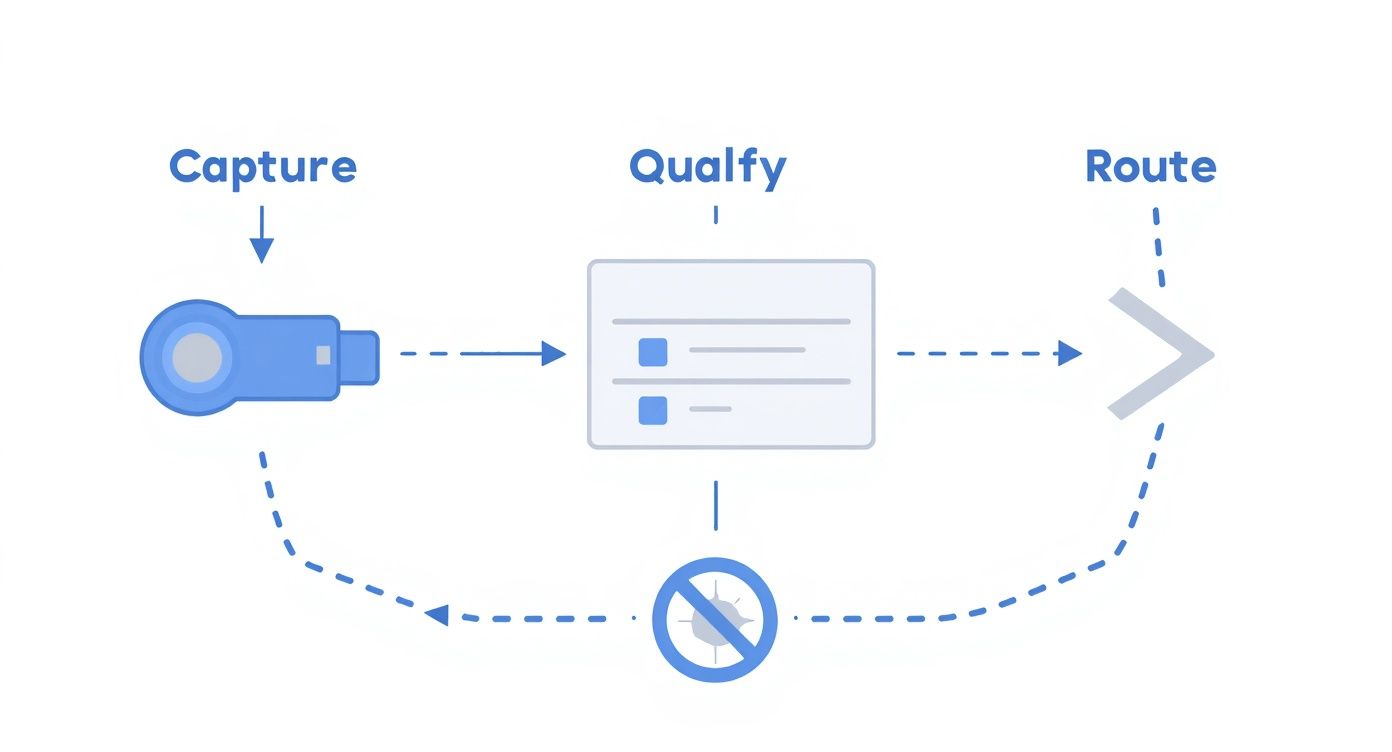
As you can see, automation isn't just about collecting contacts anymore. It’s about intelligently guiding the right contacts to the right place at the right time.
The Clear Advantages Over Traditional Methods
The difference between a static, rule-based system and an adaptive AI model is night and day. One is based on assumptions you made six months ago, while the other gets smarter with every single interaction.
Predictive scoring is about probability, not points. It answers the most important question for any sales team: "Based on everything we know, how likely is this specific lead to become a customer?" This shift in focus is a total game-changer.
To truly appreciate the jump in performance, it helps to see the two approaches side-by-side. For a deeper dive, you can explore the various Benefits of Predictive Lead Scoring.
Comparing Traditional vs AI-Powered Lead Scoring
This table breaks down the core differences, highlighting why an AI-driven approach is no longer just a "nice-to-have" but a competitive necessity.
| Feature | Traditional Lead Scoring | AI-Powered Lead Scoring |
|---|---|---|
| Accuracy | Relies on manual rules and assumptions, which are often inaccurate. | Uses historical data and machine learning to make highly accurate conversion predictions. |
| Adaptability | Static and rigid. Rules must be manually updated, which rarely happens. | Dynamic and self-optimizing. The model continuously learns and adjusts its scoring. |
| Efficiency | Sales reps waste time on poorly qualified leads due to flawed scoring. | Sales teams focus exclusively on high-potential leads, boosting productivity and morale. |
| Data Usage | Considers only a few basic engagement signals (e.g., email opens, page views). | Analyzes a massive array of complex data points for deeper, more reliable insights. |
Ultimately, adopting a predictive model means your sales team can finally stop chasing cold trails. They can pour their energy into engaging prospects who have already shown clear buying signals, leading to shorter sales cycles, higher conversion rates, and a much healthier revenue engine.
Personalizing Your Outreach at Scale with AI

Let's be honest: personalization is everything when it comes to breaking through the noise in someone's inbox. But who actually has the time to hand-craft a unique message for every single lead on their list? This is where AI stops being a buzzword and becomes a serious tool for driving revenue. It lets your team send messages that feel one-to-one, even when you're reaching out to hundreds of contacts.
We've all seen the old static templates with a [First Name] merge field. Prospects can spot them from a mile away. The modern approach is to use AI to analyze lead data and generate hyper-relevant copy for each person, automating the most grueling parts of prospecting without killing the human connection.
Crafting AI Prompts That Actually Get Results
The real magic behind effective AI outreach comes down to the quality of your prompts. If you give the AI a lazy, generic request, you're going to get a lazy, generic email back. But a detailed, context-rich prompt? That’s how you get compelling copy that speaks directly to a prospect’s world.
Think of your prompt as a creative brief you'd give to a human copywriter. The more context you provide, the better the final product. You need to feed the AI key details about your prospect and their company to generate something that genuinely resonates.
A solid prompt should always cover these bases:
- Who they are: "Write an email to the [Job Title] at [Company Name]."
- A unique hook: "Reference their recent funding announcement or the new feature they just launched."
- Your value prop: "Connect this event to how our helps companies like theirs [achieve a specific goal]."
-
- A clear call-to-action: "End with a low-friction question, like asking for their thoughts on [the topic]."
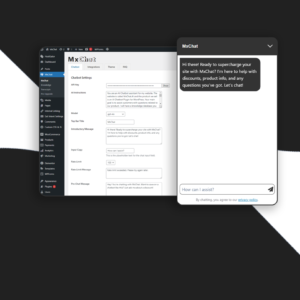
The best AI-generated outreach doesn't sound like AI at all. You’re using the tech to find the perfect conversation starter, which you can then quickly review and send with that final human touch.
A Real-World Example in Action
Let’s say you’re selling a project management tool. Your AI flags that a target marketing agency, "Creative Solutions Inc.," just snagged a major award for a national campaign. A weak, template-based email would completely miss this golden opportunity.
A smart, AI-powered approach uses this intel as the perfect icebreaker.
Here’s what a good prompt could look like:
"Draft a short, compelling LinkedIn connection request to the Head of Operations at Creative Solutions Inc. Congratulate them on winning the 'Campaign of the Year' award. Tie their success in managing complex campaigns to the value of our project management tool, which helps top agencies deliver award-winning work on time and under budget. Keep it under 300 characters."
The AI can then instantly spit out a message that feels personal, timely, and relevant, massively boosting your chances of getting a reply. Trying to do this level of customization manually for an entire list of leads is next to impossible.
Automating Research to Find Your Talking Points
Beyond just writing the messages, AI is a beast at handling the tedious research that has to happen before you even think about outreach. It can scan news articles, press releases, and social media profiles in seconds to unearth relevant talking points for your sales team.
You can set up an AI agent to monitor your target accounts for key buying signals, like:
- New Funding Rounds: A perfect time to pitch solutions that help manage rapid growth.
- Executive Hires: A new decision-maker is often more open to evaluating new tools.
- Company Expansion: Opening a new office signals an immediate need for operational support.
- Product Launches: A great opportunity to offer a complementary service or technology.
This automated intelligence is what fuels your personalization engine. The commercial adoption of this tech is exploding for good reason. As of 2025, generative AI has attracted $33.9 billion in global private investment, an 18.7% jump since 2023. This money is being used to build AI that can dynamically adjust the copy, timing, and channel of your outreach to maximize engagement. You can read the full Stanford AI Index report for a deeper dive.
Ultimately, this lets you stop sending generic email blasts and start having context-aware conversations. By turning raw data into compelling talking points, AI gives your sales team the ammo they need to build real rapport and book more meetings. And if you want to create even more structured engagements, our guide on how to boost conversions with chat funnels shows you how to guide prospects through a more defined journey.
Got Questions About AI Lead Generation? We've Got Answers.
As you think about bringing AI into your lead generation strategy, it's normal to have some questions. It can feel like a big step, but trust me, most of the common hurdles are easier to clear than you'd expect. Let's tackle some of the things that might be on your mind so you can move forward with confidence.
Often, the biggest hesitation isn't about the tech itself—it's about the practical side of things. Can we afford it? Does my team have the right skills? Will we scare off customers by sounding like a robot? These are all fair points, so let's dig in.
"Isn't AI Lead Gen Just for Big Companies?"
This is probably the biggest myth out there. While giant corporations were definitely the first ones to the party, the game has completely changed. Today, there’s a flood of affordable, easy-to-use AI platforms that have put this technology squarely in the hands of small and medium-sized businesses.
Many of these tools are built to grow with you. You can start small, maybe with a single AI chatbot or a basic email personalization tool, and then scale up as your business—and revenue—expands. For a small team, the time you save alone can be a massive leg up on the competition.
The thing to remember is this: a limited budget doesn't mean limited capability anymore. Modern AI tools are designed to give you a great return, even on a small scale, by taking over the tedious tasks that eat up your team's most valuable asset: time.
So really, it’s not about how big your company is. It’s about how much you want to work smarter. If you're tired of chasing down unqualified leads and manually sending follow-ups, AI is a very real solution, no matter your headcount.
"How Much Technical Skill Do We Actually Need?"
I hear this one a lot. The fear of a massive learning curve stops so many businesses before they even get started. The good news? The barrier to entry has never been lower. You absolutely do not need to be a data scientist or a coder to get this running.
Most modern AI marketing platforms are built for the everyday user, not a team of developers. They have clean, intuitive dashboards that make getting set up surprisingly simple.
- No-Code Setups: Many tools use simple drag-and-drop editors to build chatbot conversations or email campaigns. If you can build a flowchart, you can do this.
- Ready-to-Go Templates: You can often start with proven templates for common situations (like booking a demo or answering FAQs) and just tweak them to fit your brand's voice.
- Simple Integrations: Connecting these platforms to your existing CRM or email software is usually a guided, point-and-click process.
While you'll need a good handle on your marketing funnel and what your customers care about, the skills you need are strategic, not technical. If you can map out a solid sales process on a whiteboard, you have what it takes to configure an AI tool to bring it to life.
"Will AI Make Our Outreach Sound Robotic?"
This is such a valid concern. No one wants to swap genuine human connection for cold, generic automation. But here's the thing: the goal of modern AI isn't to eliminate the human touch—it's to help you deliver it to more people, more effectively.
Think of AI as a brilliant research assistant, not a replacement for your sales reps. Generative AI is fantastic at digging through data to find personalized conversation starters for each prospect. For instance, it might spot that a lead’s company was just featured in the news or that they recently posted on LinkedIn about a challenge your product solves.
The AI can then draft an outreach email that weaves in this custom insight. Your salesperson’s job is to review that draft, sprinkle in their own personality, and hit send. It’s the perfect blend: the speed of automation paired with the authenticity of a real person. That's a powerful combo.
"How Do I Even Measure the ROI on This?"
Measuring your return is everything, and with AI, it’s actually more direct than you might think. The trick is to compare a few key numbers from before and after you implement the AI to see the real-world impact.
Zero in on these three areas:
- Cost Per Lead (CPL): When automation is handling the initial prospecting and qualification, your cost to acquire a truly new lead should drop. Sometimes, significantly.
- Lead-to-Opportunity Conversion Rate: As your AI gets better at scoring leads, your sales team will spend their time talking to the right people. This means you should see a healthy bump in the percentage of leads that become real sales opportunities.
- Sales Cycle Length: By engaging prospects the moment they're interested and prioritizing the hottest leads, AI helps shrink the time it takes to get from "hello" to a signed deal.
At the end of the day, the proof is in your pipeline. A successful AI rollout will create a clear, measurable lift in qualified opportunities and—most importantly—in closed-won revenue.
Ready to turn your website traffic into qualified leads 24/7? With MxChat, you can build intelligent, no-code AI chatbots for your WordPress site in minutes. Stop letting valuable prospects slip away and start automating your lead capture and qualification today. Learn more and get MxChat now.


