8 Powerful Chatbot Use Cases to Implement in 2025
In 2025, the conversation around AI has shifted from 'if' to 'how.' Businesses are no longer just experimenting; they're strategically deploying AI agents to solve real-world problems, reduce operational costs, and create superior customer experiences. While the concept of a chatbot isn't new, the sophistication and accessibility of today's platforms have unlocked a vast array of practical applications that drive tangible results.
This article explores eight high-impact chatbot use cases delivering measurable ROI across key industries, from e-commerce to healthcare. We will move beyond generic descriptions to provide a deep strategic analysis of each scenario, offering actionable tactics you can implement immediately. For each example, we'll break down the strategy and show how a modern WordPress-native platform like MxChat can be the engine behind these transformations. You will learn how to leverage its powerful RAG technology and no-code builder to turn your website traffic into measurable business growth. Forget the hype; let's dive into the practical applications that are defining modern business communication and see how you can apply them.
1. Customer Support and Service Automation
One of the most powerful and widely adopted chatbot use cases is the automation of customer support and service. These AI-powered assistants act as the first line of defense, handling customer inquiries, resolving common issues, and providing round-the-clock support without needing human intervention.
This approach transforms customer service from a cost center into an efficient, scalable operation. Chatbots like MxChat can manage thousands of conversations simultaneously, answering frequently asked questions, guiding users through troubleshooting steps, and escalating complex issues to human agents with full conversational context. They integrate seamlessly with your knowledge base and CRM to deliver personalized, accurate responses.
Strategic Application and Benefits
The goal is to resolve high-volume, low-complexity queries instantly, freeing up human agents for high-value interactions. For example, H&M's chatbot helps customers find products and track orders, while KLM Royal Dutch Airlines' bot provides flight updates and booking confirmations across 13 languages. These applications significantly improve response times and customer satisfaction.
The core benefits include:
- 24/7 Availability: Offer instant support to customers in any time zone.
- Reduced Operational Costs: Lower the cost per interaction by automating routine tasks.
- Improved Agent Productivity: Allow human agents to focus on strategic, complex problems.
The following infographic highlights key data points that underscore the impact of automating customer support.
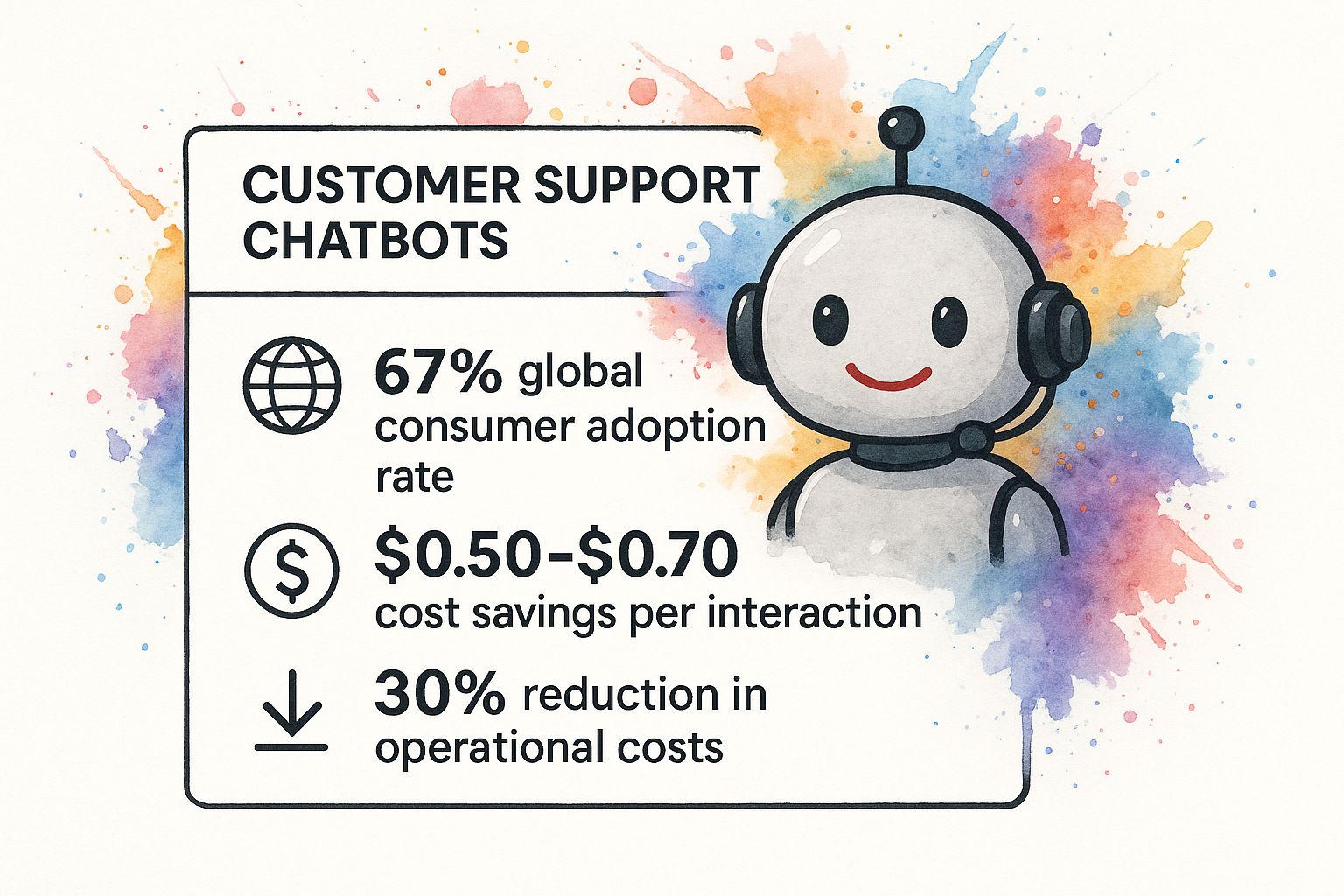
These metrics clearly show that implementing a chatbot for customer service is not just about enhancing the user experience; it's a strategic move that delivers substantial financial returns and operational efficiencies. By handling common queries, chatbots directly reduce the workload on support teams, leading to significant cost savings.
2. E-commerce and Sales Assistance
Another high-impact chatbot use case is transforming the online shopping experience through e-commerce and sales assistance. These AI-powered bots act as personal virtual shoppers, guiding customers from initial product discovery and consideration all the way through to a seamless checkout process.
This application turns passive website browsing into an interactive, conversational journey. Chatbots like MxChat can provide personalized product recommendations based on user behavior, answer questions about inventory and specifications, and even facilitate transactions directly within the chat window. They integrate with your product catalog and CRM to create a tailored shopping experience that drives sales and builds loyalty.
Strategic Application and Benefits
The primary goal is to replicate the helpful, in-store sales assistant experience online, proactively engaging customers to increase conversion rates and average order value. For instance, the 1-800-Flowers chatbot allows users to browse and purchase floral arrangements entirely within Facebook Messenger, while Amtrak's bot "Julie" successfully handles 5 million bookings a year, boosting sales by 25%.
The core benefits include:
- Increased Conversion Rates: Guide hesitant buyers and simplify the path to purchase.
- Higher Average Order Value: Proactively upsell and cross-sell relevant products.
- Enhanced Customer Experience: Provide instant, personalized shopping assistance 24/7.
The following video demonstrates how a chatbot can be integrated into an e-commerce platform to streamline the customer journey.
By making the shopping process conversational and intuitive, e-commerce chatbots remove friction and create a more engaging user experience. They are a powerful tool for any online store looking to boost sales and customer satisfaction. You can learn more about how WooCommerce chatbots enhance the customer experience and drive revenue.
3. Lead Generation and Qualification
Another high-impact chatbot use case is transforming your website into an automated lead generation engine. These conversational AI tools proactively engage website visitors, capture their interest, and qualify them as potential customers, ensuring you never miss an opportunity to grow your sales pipeline.
This strategy turns passive browsing into active engagement. Chatbots like MxChat can initiate conversations, ask targeted qualifying questions, collect essential contact information, and even schedule meetings directly on a sales representative's calendar. They operate 24/7, capturing and nurturing leads long after your human team has logged off for the day. This seamless process ensures that your sales team receives a steady stream of high-quality, pre-qualified leads with full conversational context.
Strategic Application and Benefits
The primary goal is to automatically identify and qualify high-intent visitors, moving them through the sales funnel faster. For example, Drift’s conversational marketing bots are famous for increasing lead generation for companies by engaging visitors in real time. Similarly, HubSpot's chatbot tool helps marketing agencies boost qualified leads by replacing static forms with interactive conversations.
The core benefits include:
- Increased Lead Volume: Proactively engage every site visitor to capture more potential leads.
- Improved Lead Quality: Automate the qualification process to filter and score leads effectively.
- Shortened Sales Cycles: Instantly connect qualified leads with sales reps or book meetings.
By implementing this chatbot use case, businesses can significantly improve their conversion rates and provide a more personalized journey for potential customers. To explore how AI can revolutionize your sales funnel, you can learn more about chatbot implementation strategies on mxchat.ai. This proactive approach not only fills your pipeline but also provides a superior, modern buying experience from the very first interaction.
4. Human Resources and Employee Support
Another impactful area where chatbot use cases are transforming operations is in human resources and internal employee support. HR chatbots act as digital assistants for the workforce, automating routine administrative tasks, answering policy questions, and streamlining key processes like onboarding and leave requests.
This application modernizes the employee experience by providing instant, on-demand access to crucial HR information. Instead of waiting for an HR representative to reply to an email, employees can get immediate answers 24/7. An intelligent assistant like MxChat can integrate with your HRIS and internal knowledge bases to deliver personalized, confidential, and accurate information, directly improving employee satisfaction and operational efficiency within the HR department.
Strategic Application and Benefits
The primary goal is to offload high-volume, repetitive inquiries from the HR team, allowing them to focus on more strategic initiatives like talent management, culture, and employee development. For example, Unilever's Una chatbot screens job candidates and successfully answers 90% of employee questions, while Overstock.com’s Mila bot manages a wide range of internal IT, facilities, and HR queries. This automation significantly reduces the administrative burden on HR staff.
The core benefits include:
- Instant Employee Self-Service: Provide immediate answers to questions about payroll, benefits, and company policies.
- Streamlined Onboarding: Guide new hires through initial paperwork, training modules, and company introductions.
- Reduced HR Workload: Automate tasks like leave requests, benefits enrollment, and policy clarifications.
By automating these fundamental processes, businesses can not only cut internal support costs but also create a more empowered and efficient workforce. A well-implemented HR chatbot becomes a go-to resource, improving overall employee engagement. You can learn more about how to enhance employee engagement with chatbots and see how MxChat facilitates this transformation.
5. Healthcare and Medical Assistance
Chatbots are revolutionizing the healthcare industry by providing patients with instant, accessible, and preliminary medical guidance. These AI assistants help with symptom checking, appointment scheduling, medication reminders, and patient triage, acting as a crucial first point of contact and improving the efficiency of healthcare delivery.
This application is particularly impactful in making healthcare more accessible and less intimidating. A well-designed chatbot like MxChat can be configured to guide users through a series of questions to assess their symptoms, provide reliable health information from vetted sources, and direct them to the appropriate level of care, all while ensuring HIPAA compliance and data security.
Strategic Application and Benefits
The primary goal is to empower patients and alleviate the strain on healthcare providers by handling initial inquiries and administrative tasks. For instance, Babylon Health’s AI-powered platform conducts preliminary health assessments, while Woebot offers cognitive behavioral therapy (CBT) techniques to support mental wellness. These tools make initial health support immediate and widely available.
The core benefits of this chatbot use case include:
- Improved Patient Access: Offer immediate assistance and information, reducing barriers to care.
- Reduced Administrative Burden: Automate appointment booking and medication reminders, freeing up staff.
- Efficient Patient Triage: Help patients understand the urgency of their symptoms and guide them to the right care setting.
Implementing a healthcare chatbot allows providers to manage patient flow more effectively and offer continuous support. It’s a strategic move to enhance patient engagement, improve outcomes, and streamline operations in a highly regulated environment.
6. Banking and Financial Services
Another high-impact chatbot use case is found within the banking and financial services sector. These secure AI assistants provide customers with instant access to their financial information, handle routine transactions, and offer personalized guidance, all while adhering to strict security protocols.
This application makes banking more convenient, accessible, and responsive. Advanced chatbots like MxChat can manage sensitive tasks such as balance inquiries, fund transfers, bill payments, and fraud alerts. By integrating with core banking systems, they deliver real-time, personalized support, effectively acting as a digital personal banker for every customer.
Strategic Application and Benefits
The primary goal is to automate routine banking tasks and empower customers with self-service capabilities, reserving human expertise for complex financial advice and sensitive issues. For example, Bank of America's Erica has successfully handled over one billion client requests, while Capital One's Eno proactively monitors accounts for unusual charges. These applications improve customer engagement and operational efficiency. Learn more about how these chatbot banking examples are revolutionizing customer support.
The core benefits include:
- Enhanced Security and Trust: Implement robust encryption and authentication to protect sensitive user data.
- 24/7 Account Access: Allow customers to manage their finances anytime, anywhere.
- Reduced Call Center Volume: Free up agents from handling repetitive inquiries like balance checks or transaction history.
By providing instant, secure, and personalized financial assistance, banking chatbots not only meet modern customer expectations but also create a more efficient and scalable service model. This strategic move helps financial institutions build stronger customer relationships and a significant competitive advantage.
7. Education and Learning Support
Another transformative chatbot use case is in the education sector, where AI assistants act as virtual tutors, teaching assistants, and administrative guides. These bots offer personalized learning paths, provide instant answers to student queries, and deliver course materials on demand, making education more accessible and scalable.
This application reshapes the traditional learning model by providing students with 24/7 academic and administrative support. Chatbots like MxChat can be integrated with a Learning Management System (LMS) to deliver interactive quizzes, practice exercises, and even facilitate conversational language practice. They handle high-volume administrative tasks, such as enrollment questions and scheduling, freeing up educators and staff to focus on teaching and student mentorship.
Strategic Application and Benefits
The primary goal is to provide immediate, personalized support that adapts to each student's unique learning pace and style. For instance, Georgia State University’s "Pounce" chatbot answers over 200,000 student questions annually, significantly improving student retention. Similarly, Duolingo’s bot offers conversational practice in dozens of languages, helping users apply their skills in a simulated, low-pressure environment.
The core benefits include:
- Personalized Learning: Tailor educational content and pace to individual student needs.
- Increased Accessibility: Provide on-demand academic and administrative support anytime, anywhere.
- Enhanced Engagement: Use interactive quizzes and conversational exercises to make learning more dynamic.
These applications demonstrate how chatbots can fill critical support gaps in education. By automating responses to common questions and offering personalized learning tools, they not only improve student outcomes but also allow educational institutions to operate more efficiently and allocate human resources to more impactful, high-touch interactions.
8. Marketing and Customer Engagement
Beyond support and sales, chatbots have emerged as a dynamic channel for marketing and customer engagement. These conversational AI tools create interactive, two-way dialogues that capture audience attention far more effectively than static ads or emails, making them a cornerstone of modern digital marketing strategies.
This approach uses conversational flows to deliver personalized content, run promotional campaigns, and gather valuable customer feedback. Chatbots like MxChat can engage users on your website, social media, and messaging apps, nurturing them from initial awareness to loyal advocacy. They transform passive browsing into an active, memorable brand experience that drives deeper connection and conversions.
Strategic Application and Benefits
The primary goal is to build relationships and guide users through the marketing funnel with personalized, engaging interactions. For instance, Sephora's chatbot on Kik not only provided makeup tips but also drove an 11% higher conversion rate by simplifying product discovery. Similarly, Casper's Insomnobot-3000 engaged late-night scrollers with lighthearted chats, brilliantly reinforcing its brand identity as the sleep company.
The core benefits include:
- Increased Engagement Rates: Interactive conversations hold user attention longer than passive content.
- Personalized Campaigns at Scale: Deliver tailored messages and offers to thousands of users simultaneously.
- Rich Customer Insights: Collect first-party data on customer preferences, pain points, and behavior through natural conversation.
By deploying a marketing chatbot, you can create a direct communication line with your audience, boosting brand loyalty and driving measurable results. It's a strategic way to cut through the noise and offer genuine value, turning prospects into customers and customers into fans.
Chatbot Use Cases: 8-Point Comparison Guide
| Use Case | Implementation Complexity 🔄 | Resource Requirements ⚡ | Expected Outcomes 📊 | Ideal Use Cases 💡 | Key Advantages ⭐ |
|---|---|---|---|---|---|
| Customer Support & Service Automation | High setup & ongoing training; complex NLP needed | Integration with CRM, ticketing, ML models | 24/7 support, reduced wait times, 30% cost reduction | High-volume customer service, multi-language support | Handles unlimited chats; consistent responses; data insights |
| E-commerce & Sales Assistance | Moderate; requires real-time inventory & payment integration | Product catalog integration; payment gateways | 20-40% conversion increase; reduces cart abandonment | Online retail, personalized shopping guidance | Personalized recommendations; upsell and cross-sell; operational hours extension |
| Lead Generation & Qualification | Moderate; designing flows, scoring models, CRM integration | Multi-channel deployment; customization tools | 50-70% more leads; 30-40% time savings for sales | B2B/B2C lead capture, sales funnel automation | 24/7 lead capture; immediate engagement; qualified leads forwarded |
| HR & Employee Support | Moderate; requires HRIS and security compliance | Integration with HR systems; privacy measures | 60-80% routine query handling; 12h/week saved HR time | Employee self-service; onboarding; policy queries | Improves employee satisfaction; reduces admin burden; consistent info delivery |
| Healthcare & Medical Assistance | High; strict regulatory requirements (HIPAA) | Secure data handling; validated medical algorithms | Immediate medical guidance; reduces ER visits; improves adherence | Patient triage; symptom checking; appointment scheduling | 24/7 medical info; anonymity support; accessibility in underserved areas |
| Banking & Financial Services | Very high; security-critical, complex integrations | Multi-factor auth; compliance with financial standards | 40-70% cost reduction; instant account support | Routine banking tasks; fraud detection; financial advice | Secure transactions; quick alerts; personalized financial insights |
| Education & Learning Support | Moderate; LMS integration; content curation | Content development; quiz and assessment tools | 20-30% engagement improvement; scalable tutoring | Homework help; personalized learning paths; admin tasks | Patient, personalized learning; administrative relief; global access |
| Marketing & Customer Engagement | Moderate; creative content development, multi-channel | CRM integration; content creation resources | 70-90% open rates; 10-25% conversion increase | Interactive campaigns; brand engagement; lead nurturing | High engagement rates; viral marketing potential; actionable insights |
Your Next Move: Implementing Your First Chatbot Use Case
We've explored a wide spectrum of powerful chatbot use cases, moving far beyond simple, automated replies. From revolutionizing customer support with 24/7 assistance to personalizing the e-commerce journey and streamlining HR processes, it's clear that AI-powered chatbots are no longer a futuristic concept but a practical, high-impact business tool. The strategic value lies not in deploying a bot for its own sake, but in pinpointing a specific, high-friction area in your business and applying automation with precision and purpose.
The common thread connecting all successful implementations is a deep understanding of the user's journey. Whether it's a customer seeking a refund, a potential lead asking about pricing, or an employee looking for benefits information, the goal is the same: provide immediate, accurate, and helpful answers. This strategic focus transforms a chatbot from a simple novelty into a core operational asset that boosts efficiency, enhances user satisfaction, and directly contributes to your bottom line.
Key Takeaways and Your Strategic Roadmap
To translate these ideas into action, let's distill the core principles into a clear roadmap. Your first steps should be deliberate and focused on achieving a measurable win.
- Identify the Biggest Pain Point: Don't try to solve everything at once. Analyze your support tickets, sales funnel data, or internal employee queries. Where is the most significant bottleneck? Is it repetitive support questions, lead qualification, or onboarding new hires? This is your starting point.
- Start with a Single, High-Impact Use Case: Choose one area from our list, such as automating Tier-1 customer support or building a lead-qualifying bot for your highest-traffic landing page. Mastering one application builds momentum and provides clear ROI data to justify further expansion.
- Map the Ideal Conversation Flow: Before building anything, outline the ideal user interaction. What questions will they ask? What information do they need? What is the desired outcome? This blueprint ensures your bot is genuinely helpful and guides users effectively.
- Ground Your AI in Your Business Data: The most effective chatbots are not generic. They are trained on your specific product documentation, knowledge base, policies, and brand voice. This ensures the responses are not only accurate but also perfectly aligned with your business identity.
Strategic Insight: Success with chatbot use cases is less about advanced coding and more about strategic implementation. A well-defined, data-grounded bot focused on a single business problem will always outperform a generic bot trying to do everything.
The Path Forward is Clear and Accessible
The era of needing a dedicated development team to leverage AI is over. Modern platforms have democratized access to this technology, empowering WordPress site owners, e-commerce managers, and small businesses to compete on a level playing field. The potential to enhance every digital touchpoint is immense, and the tools to do so are readily available.
By carefully selecting your first chatbot use case, you set the stage for a transformative shift in how your business operates. You're not just adding a widget to your site; you're building a scalable, tireless digital employee that works around the clock to serve your customers and grow your business. The time to start building that future is now.
Ready to bring these powerful chatbot use cases to life on your own website? With MxChat, you can build and deploy a custom AI chatbot trained on your business data in minutes, with no coding required and no recurring fees. Explore MxChat today and turn your strategic vision into a working reality.