ai chatbot for small business: Boost Efficiency and Revenue
Imagine having a new team member who works around the clock, never calls in sick, and has the answer to every customer question right on the tip of their tongue. That's not a far-fetched dream; it's exactly what an AI chatbot for a small business brings to the table. This isn't just a tool for the big players anymore—it's become essential for any business looking to grow and stay competitive.
Why Your Small Business Needs an AI Employee
If you're running a small business, you know the feeling of wearing too many hats. You're the CEO, the marketing director, the head of sales, and often, the entire customer service department rolled into one. It’s a constant balancing act, and sometimes, things fall through the cracks.
Picture this: a potential customer lands on your website late at night with a simple question. But you're asleep, and so is your team. They can't find the answer, so they click away, and just like that, a sale vanishes. This happens all the time. You feel stretched thin, knowing you can’t provide the instant, 24/7 support modern customers have come to expect. This is exactly where an AI chatbot comes in—not as just another piece of software, but as your most dependable employee.
Your Tireless Digital Assistant
Think of a chatbot as an assistant who happily handles all the routine questions that eat up your day. It’s on the job 24/7, making sure no customer is ignored and no lead is missed, no matter the hour. This frees you up to focus on the things that actually grow your business, like nurturing customer relationships and tackling complex projects.
Here’s how a chatbot can immediately change the way you work:
- Instantaneous Support: Customers get immediate answers to common questions about your hours, services, or shipping policies. No more waiting for an email reply.
- Lead Capture on Autopilot: The bot can greet visitors, ask a few qualifying questions, and collect their contact info, turning a casual browser into a warm lead—even at 2 AM.
- Automated Day-to-Day Tasks: From scheduling appointments to checking on an order status, a chatbot can manage simple workflows, cutting down on your team's manual workload. You can learn more about how to automate repetitive tasks in our detailed guide.
More Than Just Saving Money
The numbers speak for themselves. The global AI chatbot market is expected to surge to around $46–47 billion by 2029, and small businesses are a huge part of that growth. Companies that adopt this technology are seeing real savings—often tens of thousands of dollars a year—by boosting their efficiency and reducing the need for a large support staff.
To put it simply, here are some of the immediate ways a chatbot can benefit your business:
AI Chatbot Benefits at a Glance
| Benefit Area | Impact for Your Small Business |
|---|---|
| 24/7 Availability | Capture leads and answer questions after hours, on weekends, and on holidays. |
| Increased Efficiency | Automate repetitive queries, freeing up your team for more valuable, high-touch work. |
| Instant Responses | Improve customer satisfaction by eliminating wait times for common questions. |
| Lead Generation | Proactively engage website visitors and collect contact information for follow-up. |
| Cost Reduction | Handle a high volume of inquiries without the need to hire additional staff. |
A well-implemented chatbot doesn't just cut costs; it creates a better, smoother experience for your customers.
A great chatbot does more than just save you money—it elevates the entire customer experience. By delivering fast, accurate, and consistent service, it builds trust and loyalty, turning first-time visitors into lifelong fans.
At the end of the day, an AI chatbot levels the playing field. It gives your small business the power and resources of a much larger company, letting you deliver top-notch service and capture more leads without breaking the bank. It's the employee that lets you get back to focusing on your passion, knowing your customers are always in good hands.
How AI Chatbots Actually Understand Your Customers
To really get what an AI chatbot for a small business can do, you need to see how different it is from the old, basic bots. A simple chatbot is like a rigid phone menu—it shoves users down a fixed path with limited options, like "Press 1 for Sales, Press 2 for Support." It only gets specific keywords and completely freezes if you go off-script.
An AI chatbot, on the other hand, is more like a sharp sales assistant. It doesn't just clock what a customer types; it understands what they mean. It can handle typos, slang, and complicated questions because it's built to interpret human language, not just play a game of keyword match.
This knack for understanding and adapting is what turns a chatbot from a clunky tool into a genuine business asset.
The Brains Behind the Bot
So, how does an AI chatbot pull this off? It all comes down to two core technologies working in perfect sync. To really appreciate how AI chatbots understand your customers, you have to look at the core AI brain powering chatbots. This "brain" is fueled primarily by Natural Language Processing and Machine Learning.
Natural Language Processing (NLP): Think of NLP as the bot's ability to read and comprehend. It takes a customer's sentence, figures out the core intent (what they want), and pulls out the key details. This is why a customer can type "my order hasn't arrived" or "where is my package?" and the bot instantly knows they're looking for a shipping update.
Machine Learning (ML): This is the bot’s power to learn on the job. With every single conversation, the chatbot collects data on what works and what doesn't. It learns which answers solve problems and sharpens its responses over time, getting smarter and more effective without you having to manually tweak its script for every imaginable question.
A smart AI chatbot doesn't just follow rules; it learns from interactions. It's the difference between an employee who only reads from a manual and one who gains real expertise with every customer they help.
This cycle of continuous learning is what makes modern AI so powerful. It’s not a static program; it’s a dynamic system that gets better with use. This is especially true for advanced systems that use newer methods to stay accurate and relevant. For instance, some of the most capable chatbots now use a technique you can learn more about in our guide on what Retrieval-Augmented Generation is to pull answers directly from your company's own knowledge base.
From Words to Action
Let's walk through a real-world example of how these pieces fit together.
- A Customer Asks: A visitor on your e-commerce site types, "hey do u guys have the blue running shoes in a size 10??"
- NLP Gets to Work: The chatbot's NLP engine immediately deciphers the query. It ignores the casual "hey" and "u guys," corrects the typo, and isolates the key info: the product ("blue running shoes") and the specific attribute ("size 10").
- The Bot Finds an Answer: The AI then pings your store's inventory database to check for that exact product and size.
- A Helpful Response is Crafted: Instead of a flat "yes," the bot gives a helpful, conversational reply: "Yes, we do have the blue running shoes in a size 10! You can find them right here: [link to product]." It might even follow up with, "Would you like me to add them to your cart?"
This seamless flow—from understanding intent to finding information and taking action—is what a modern AI chatbot is all about. It turns a simple question into a potential sale, all without a human lifting a finger. This visual perfectly captures the core value of putting a system like this in place.
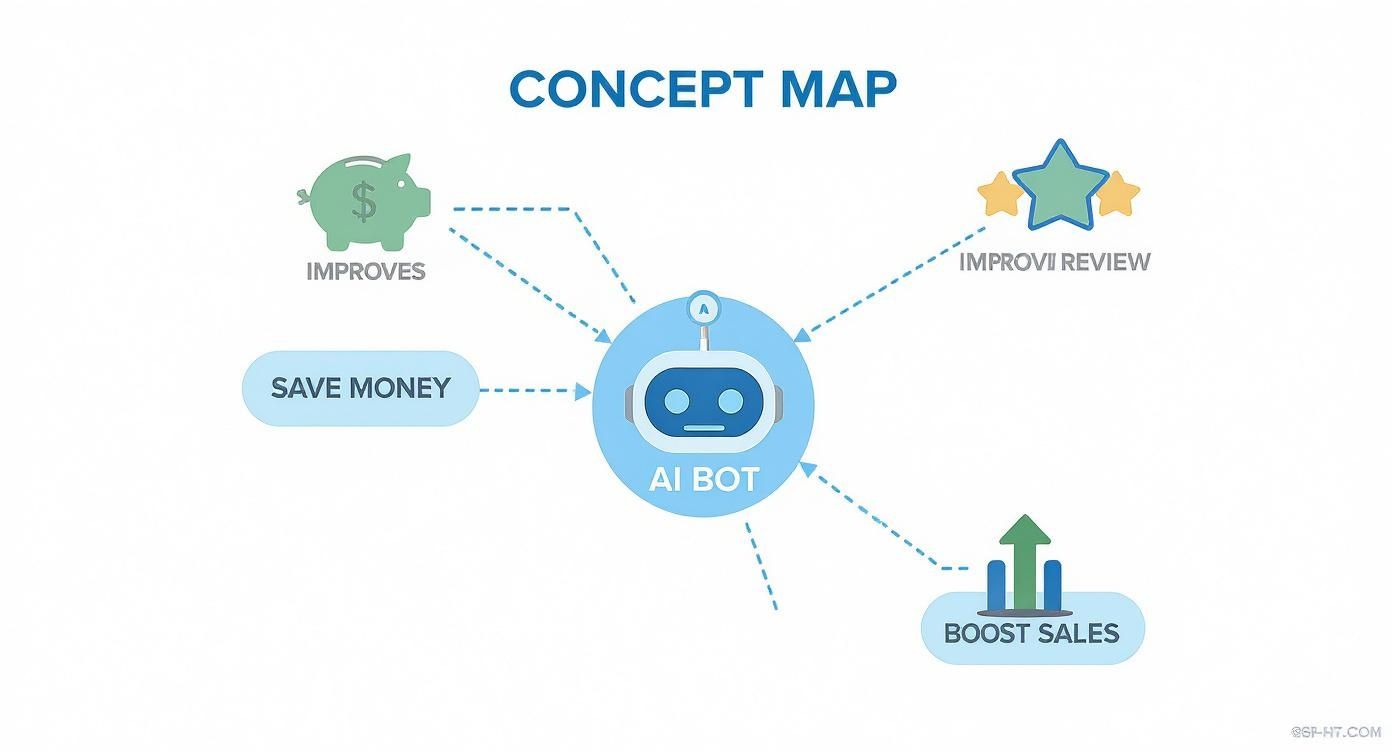
Ultimately, the infographic drives home the point that a chatbot isn't just a single-purpose tool. It's a central hub for boosting efficiency and growth across your entire business.
Key Features Your Business Chatbot Must Have
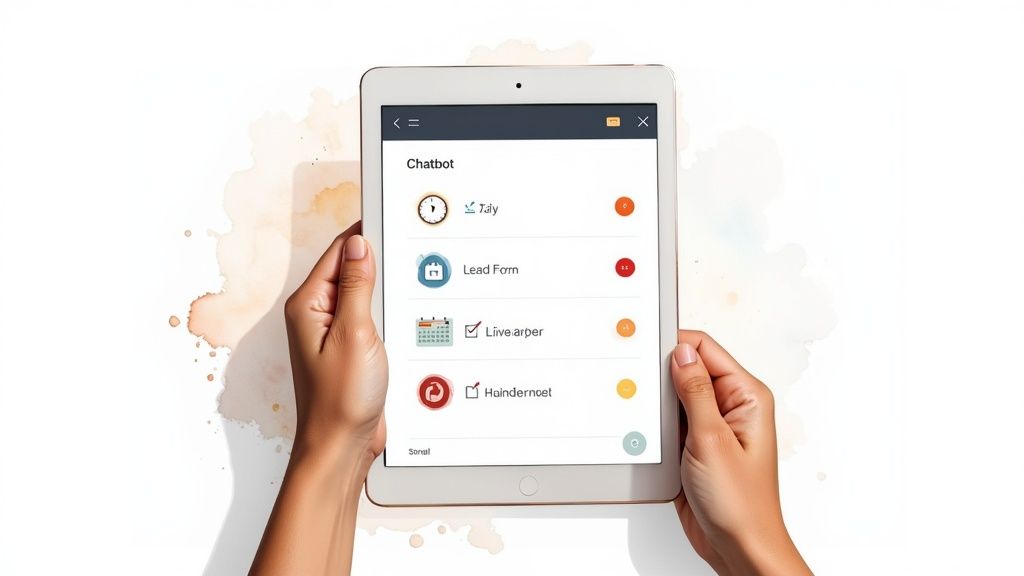
It’s one thing to understand how an AI chatbot thinks, but what it can do for your business is what really counts. When you’re looking for the right ai chatbot for small business, it’s not about finding the one with the most bells and whistles. It’s about zeroing in on the core features that will genuinely make your business more efficient and boost your bottom line.
Think of this as your must-have checklist. Not all chatbots are built the same; a basic bot might answer a simple FAQ, but a powerful AI assistant becomes a real part of your sales and support team. The right features can be the difference between a clunky, frustrating experience and a smooth conversation that actually leads to a sale.
Unwavering 24/7 Automated Support
Your doors might close at 5 PM, but your website never sleeps. A potential customer could be browsing your products late on a Tuesday night or first thing on a Sunday morning. Without someone there to help, their questions go unanswered, and you've likely lost them for good.
This is the most fundamental job of any business chatbot: to be your always-on, round-the-clock front desk. It ensures no lead ever falls through the cracks simply because of timing. It’s a huge reason why chatbot adoption has been so successful. In fact, 74% of businesses using them report positive experiences, often crediting the faster response times as a game-changer. You can dig into more stats on chatbot effectiveness from recent studies.
Intelligent Lead Qualification
A great chatbot doesn't just sit there waiting for questions—it actively helps you grow. Intelligent lead qualification is how the bot automatically identifies high-potential visitors and gathers their information. For a small team that can't possibly engage with every single person who lands on their homepage, this is a lifesaver.
Instead of a silent visitor, the chatbot starts a friendly, purposeful conversation:
- "Hey there! What brings you to our site today?"
- "Are you looking for help with a specific project, or just browsing?"
- "Perfect! Can I grab your name and email to send over some helpful info?"
Suddenly, a passive browser becomes an active lead. The bot collects their details and qualifies their needs, handing your sales team a warm, informed prospect to follow up with.
Seamless Appointment Scheduling
If you run a service-based business, a full calendar is a happy calendar. But the endless back-and-forth emails just to book one meeting? That's a massive time sink. A chatbot with built-in scheduling takes all of that friction away.
A chatbot that books appointments turns your website into a self-service hub. It empowers customers to take the next step on their own terms, cutting down your admin work while making the whole process smoother for them.
A visitor can see your availability, pick a time that works, and book a consultation right there in the chat window. The appointment then syncs directly to your calendar. This single feature not only frees up hours of your time but also captures people right when they are most interested in talking to you.
Smooth Live Chat Handover
Automation is incredible, but it's not a silver bullet. Some questions are just too complex, too sensitive, or simply need a human touch. That's why a seamless handover to a live person isn't just a nice-to-have; it's essential. This feature makes sure your bot is a helpful first stop, not a frustrating dead end. Our guide on the best chatbot for customer service dives deeper into why this human-AI partnership is so important.
The transition has to be effortless. When a query is beyond the bot's programming, it should be able to say, "That's a great question for one of my human colleagues. Let me connect you right now." It then instantly transfers the entire conversation—history and all—to a team member. This blend of AI efficiency and human expertise is what truly creates a standout customer experience.
Your Step-By-Step Chatbot Implementation Plan
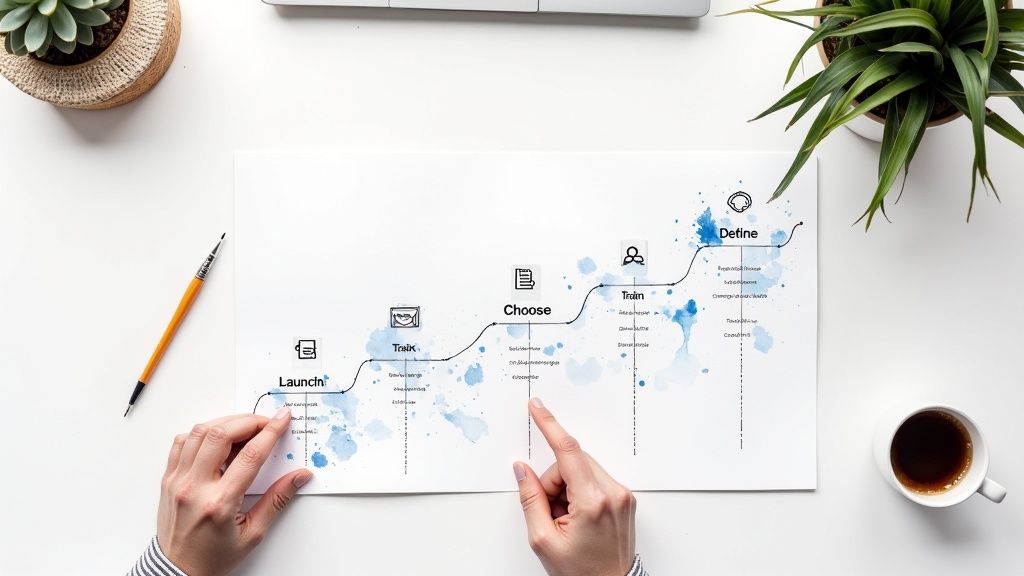
Putting an AI chatbot for small business to work doesn't have to be some complex, technical nightmare. With the right roadmap, it's actually a pretty straightforward and manageable project. This guide will walk you through the whole process, from the initial "what if?" to launching a fully functional digital assistant.
The best way to think about this isn't as building software, but as training a new team member. You have to clearly define their role, give them the right information, and show them how to talk to your customers.
Step 1: Define Your Primary Goal
Before you even glance at a single platform or feature list, you need to answer one crucial question: what's the single biggest problem I want this chatbot to solve?
Trying to make it a jack-of-all-trades right out of the gate is a surefire way to get frustrated. Instead, lock in on one clear, high-impact goal to start.
It could be something like:
- Slash repetitive questions: Is your team drowning in the same five questions over and over? Your goal is to automate those answers.
- Capture more leads: Are people visiting your site but leaving without a trace? The chatbot's job is to engage them and get their contact info.
- Book more appointments: If your sales cycle kicks off with a consultation, your bot's mission is to get those meetings on the calendar.
When you start with one specific mission, you create a focused project that delivers real, measurable results fast. That clarity makes every other step so much easier.
Step 2: Choose the Right Platform
With your goal clearly defined, it's time to pick your tool. For most small businesses, a no-code solution that’s easy to use and plays nicely with your website is the way to go.
You'll want a platform with a visual builder, which lets you design the chatbot's conversations without needing to write a single line of code. Tools like MxChat are built exactly for this, giving you intuitive controls so you can focus on the conversation, not the code. If you want to get into the nitty-gritty, our guide on how to build a chatbot is a great resource.
Step 3: Design a Natural Conversation
Here comes the fun part: designing the actual chat. The trick is to make your bot sound helpful and human, not like a clunky, rigid machine. Start by mapping out a simple conversational flow that directly supports the goal you set in step one.
Your chatbot’s personality is an extension of your brand. A friendly, slightly informal tone often works best, making visitors feel more comfortable and willing to engage.
Interestingly, while AI adoption among small businesses saw an 18% jump from 2024 to 2025, one of the biggest hurdles is still a lack of training. Roughly half of small firms using AI reported having zero formal training, which really shows why having a clear, simple implementation plan is so important for success.
Step 4: Train and Test Your Bot
Training is where you feed your chatbot the knowledge it needs to be useful. This means uploading your FAQs, product details, company info—anything a customer might ask about. The more context you give it, the smarter and more accurate its responses will be.
Once it's loaded up with information, it's testing time. Put it through its paces. Ask it tough questions, try to confuse it, and act just like a real customer would.
- Does it actually understand what you're asking?
- Are its answers on point and genuinely helpful?
- Does the conversation flow smoothly, or does it hit dead ends?
This is your chance to iron out all the wrinkles before your customers ever see it.
Step 5: Launch and Continuously Improve
And now, you're ready to go live! But the job isn't done. The best chatbots are the ones that keep learning and getting better.
Make a habit of checking the conversation logs. See what questions people are asking and identify where the bot might be getting stuck. Use that feedback to update its knowledge base and fine-tune its responses. Over time, your AI assistant will become an even more powerful asset for your business.
Common Chatbot Mistakes and How to Fix Them
An AI chatbot can be your best digital employee, working 24/7 to help customers and drive sales. But get it wrong, and it can become a major source of frustration, turning potential buyers away. Many small businesses fall into the same traps when they launch their first bot. The good news is, these pitfalls are easy to avoid once you know what to look for.
The most common mistake? Launching a bot with zero personality. When it spits out generic, robotic replies, it just feels cold and unhelpful. Remember, your chatbot is a direct reflection of your brand, and it needs to sound like it belongs.
Giving Your Bot a Brand Voice
A lifeless bot makes your entire business feel impersonal. The fix is to inject your brand's unique voice and tone directly into its script. Think about how you already talk to customers. Are you fun and playful on social media? Or more formal and professional? Your bot needs to match that energy.
Start by sketching out its persona. Maybe give it a name and a simple backstory that ties into your brand. From there, rewrite its basic greetings and responses to match this personality.
- Instead of: "How may I assist you?"
- Try: "Hey there! So glad you stopped by. What can I help you find today?"
This one little tweak instantly makes the interaction feel like a real conversation, not just a series of menu prompts. It's a simple change that completely transforms how customers see your brand.
Providing a Clear Escape Hatch
Another huge misstep is trapping users in a conversation loop with no way out. If someone has a tricky problem or just prefers talking to a real person, your bot should make that process seamless. Hiding the "talk to a human" button creates a ton of frustration and can easily lead to a lost customer.
Your goal is to solve the customer's problem as efficiently as possible. Sometimes, the most efficient solution is connecting them directly with a team member.
The solution couldn't be simpler: always provide a clear, visible option to connect with a live agent. This "escape hatch" isn't a sign of failure—it's a mark of great customer service. It shows you respect your customer's time and are ready to help, no matter what.
Failing to Keep Your Bot Updated
Finally, a classic "set it and forget it" mistake. Many businesses launch their chatbot and then never touch it again. Before long, it's providing outdated information on products, pricing, or company policies.
An AI chatbot for small business isn't a static tool; think of it as a living knowledge base that requires regular care. Giving out wrong information is often worse than providing no answer at all because it breaks trust.
Make it a habit to schedule regular check-ins. Once a month, take a look at your bot's conversation logs to see where it's getting stuck or what new questions are popping up. Then, update its knowledge base accordingly. This ensures your chatbot remains a reliable, accurate, and truly valuable asset for your business.
Got Questions About AI Chatbots? We've Got Answers.
Jumping into any new technology can bring up a few questions, and that's perfectly normal. Let's walk through some of the most common things small business owners ask when they're thinking about adding an AI chatbot to their toolkit.
What’s This Going to Cost Me?
Chatbot pricing can range from free, basic options all the way up to several hundred dollars a month for enterprise-level platforms. But it's better to think of it as an investment rather than just another bill.
A well-implemented chatbot can deliver a serious return on that investment. It works around the clock to capture leads, answer questions, and even drive sales, all while saving you and your team countless hours.
Do I Need to Be a Coder to Build One?
Not at all. The days of needing a developer to build a chatbot are long gone. Today's platforms are made for business users, featuring intuitive drag-and-drop builders and simple, no-code interfaces.
If you can sketch out a customer conversation on a piece of paper, you have all the technical skill you need to get a powerful AI assistant up and running.
It's a common myth that AI is just too complicated for smaller teams. The truth is, the tools have become incredibly user-friendly. In fact, 62% of small businesses say the biggest hurdle isn't technical skill, but simply not understanding how AI can benefit them.
Won't This Feel Robotic and Impersonal to My Customers?
Only if you build it that way! A thoughtfully designed chatbot can actually make your customer service better. People love getting instant answers, day or night, without having to wait.
The key is to inject your brand's personality into its tone and responses. And always, always make it easy for a customer to connect with a real person if they need to. That way, you get the efficiency of AI with the human touch that builds real relationships.
Ready to see how an AI assistant can help you engage customers and grow your business? With MxChat, you can get a powerful, no-code AI chatbot live on your WordPress site in just a few minutes. Start turning conversations into conversions today.