Gemini 4 Hydrogen Pricing: Tested on a WordPress Chatbot
Gemini 4 Hydrogen pricing on the Gemini API is $1.50 per million input tokens and $7.50 per million output tokens, with thinking tokens billed as output. Google released the model on 12 November 2026 as the low-cost member of the Gemini 4 family, at a little over a third of what Gemini 4 Carbon and Argon cost from 1 December. Batch and Flex requests cost half, Priority costs 80% more, and there is a rate-limited free tier.
A low rate card is only half of a bill. On 13 November 2026 we sent the same support-bot request from our own WordPress server to Gemini 4 Hydrogen at every thinking level and service tier it accepts, beside Gemini 3.8 Flash and Gemini 4 Carbon. We timed every answer, recorded the tokens and service tier Google reported, and checked each answer against our documentation.
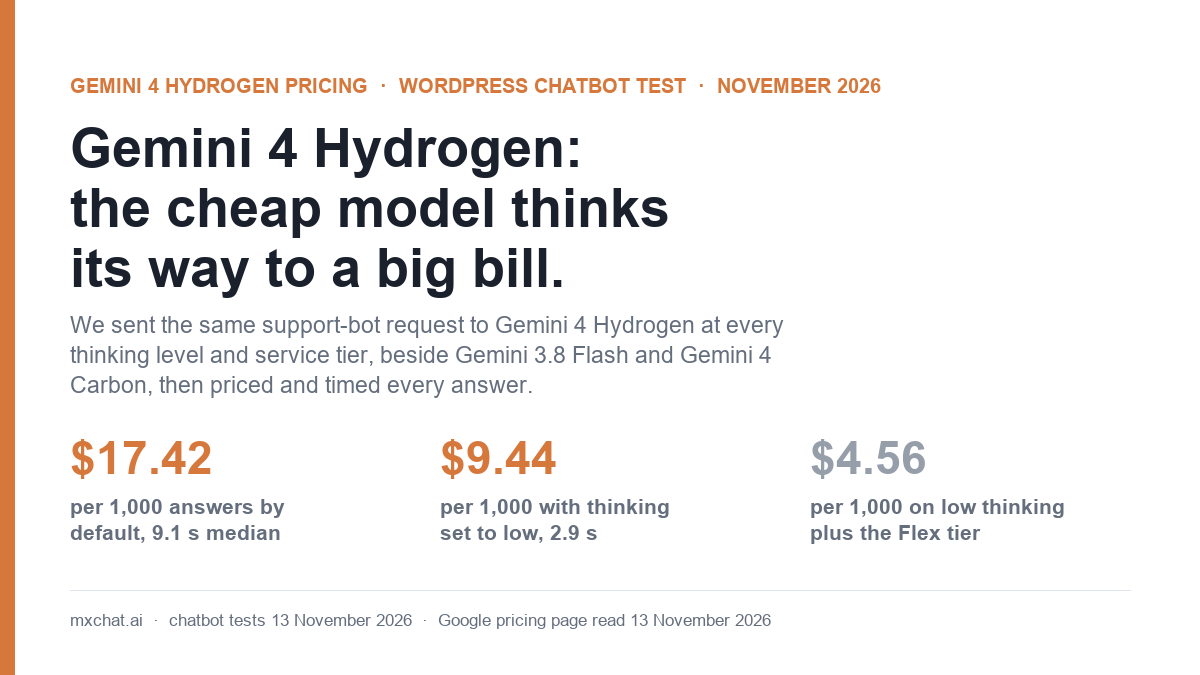
The short answer: left on its default setting, Hydrogen cost $17.42 per 1,000 answers and took a median of 9.1 seconds, because it spent about 1,380 hidden thinking tokens on every short support answer. That is more than Gemini 4 Carbon cost on its own default in our Carbon test two days earlier ($16.43), on a model priced at less than half of Carbon’s December rate. Set thinking to low and the same answers cost $9.44 in 2.9 seconds. Add the Flex tier and they cost $4.56. All 60 answers were correct.
Gemini 4 Hydrogen pricing: the rate card
These are the prices on Google’s Gemini API pricing page as we read it on 13 November 2026, per million tokens. The model ID is gemini-4-hydrogen. Unlike Carbon and Argon, Hydrogen has no introductory period: the price below is the price from day one, with no scheduled change.
| Tier | Input | Output (incl. thinking) | Cached input | Free tier |
|---|---|---|---|---|
| Standard | $1.50 | $7.50 | $0.075 | Yes, rate-limited |
| Batch | $0.75 | $3.75 | $0.0375 | No |
| Flex | $0.75 | $3.75 | $0.0375 | No |
| Priority | $2.70 | $13.50 | $0.135 | Yes, rate-limited |
Five details in the small print matter for a chatbot:
- Output includes thinking tokens. The reasoning the model does before it answers is billed at the output rate. Visitors never see it, but you pay for every token of it.
- Implicit caching only. Google applies cached-input pricing automatically when a request starts with a prefix it has seen recently. You cannot create an explicit cache on Hydrogen: the model list shows
generateContent,countTokensandbatchGenerateContent, but notcreateCachedContent, which Gemini 3.8 Flash still has. - Google Search grounding is 5,000 free requests a month, shared across all Gemini 3 and newer models, then $14 per 1,000. A single visitor question can trigger more than one search.
- Context window: 1,048,576 input tokens and 65,536 output tokens per request, per the model list our API key returned. Carbon and Argon cap output at 32,768.
- Free-tier data is used to improve Google’s products; paid-tier data is not. For a public support bot that may see order numbers or email addresses, that alone is a reason to use a paid key.
How Hydrogen compares with the rest of the lineup
Hydrogen sits between Flash and the two larger Gemini 4 models, and the gap moves twice in the next seven weeks.
| Model (Standard tier) | Input / output today | From 1 Dec 2026 | From 1 Jan 2027 |
|---|---|---|---|
| Gemini 3.8 Flash | $0.75 / $3.75 | $0.75 / $3.75 | $1.50 / $7.50 |
| Gemini 4 Hydrogen | $1.50 / $7.50 | $1.50 / $7.50 | $1.50 / $7.50 |
| Gemini 4 Argon | $2.00 / $10.00 | $4.00 / $20.00 | $4.00 / $20.00 |
| Gemini 4 Carbon | $2.00 / $10.00 | $4.00 / $20.00 | $4.00 / $20.00 |
From 1 January 2027, Gemini 3.8 Flash and Gemini 4 Hydrogen carry the same rate card. At that point the choice between them is no longer about price per token; it is about how many tokens each one spends per answer, which is what we measured.
How we tested it
The request was the one our own MxChat support bot sends: the site’s system prompt plus four knowledge-base passages of about 4,000 characters each, around 4,170 input tokens in total, followed by a visitor question. We used four real questions from our support inbox: WooCommerce order lookups, whether Pinecone is required for the knowledge base, human handoff to Slack or Telegram, and which API keys and models can be used.
- Calls went to the Gemini API
generateContentendpoint directly, with our site’s paid key, from our WordPress server in the US. No streaming, default temperature. - Eleven setups: Hydrogen at default, low, medium and high thinking, with
thinkingBudget: 0, and on the Flex and Priority tiers; Gemini 3.8 Flash at default and low; Gemini 4 Carbon at low. - Default and low on Hydrogen, Flex default and Flash default ran twice (8 answers each); the rest once (4 answers each). 60 answers in total, plus 9 short probe calls. The whole test cost about $0.58.
- Cost is the token counts Google returned, priced at the list rate for the tier Google said it served, with no cache discount unless stated. Google’s API reports tokens, not charges.
- Every answer was checked against our documentation for the one fact each question turns on.
What 1,000 answers cost
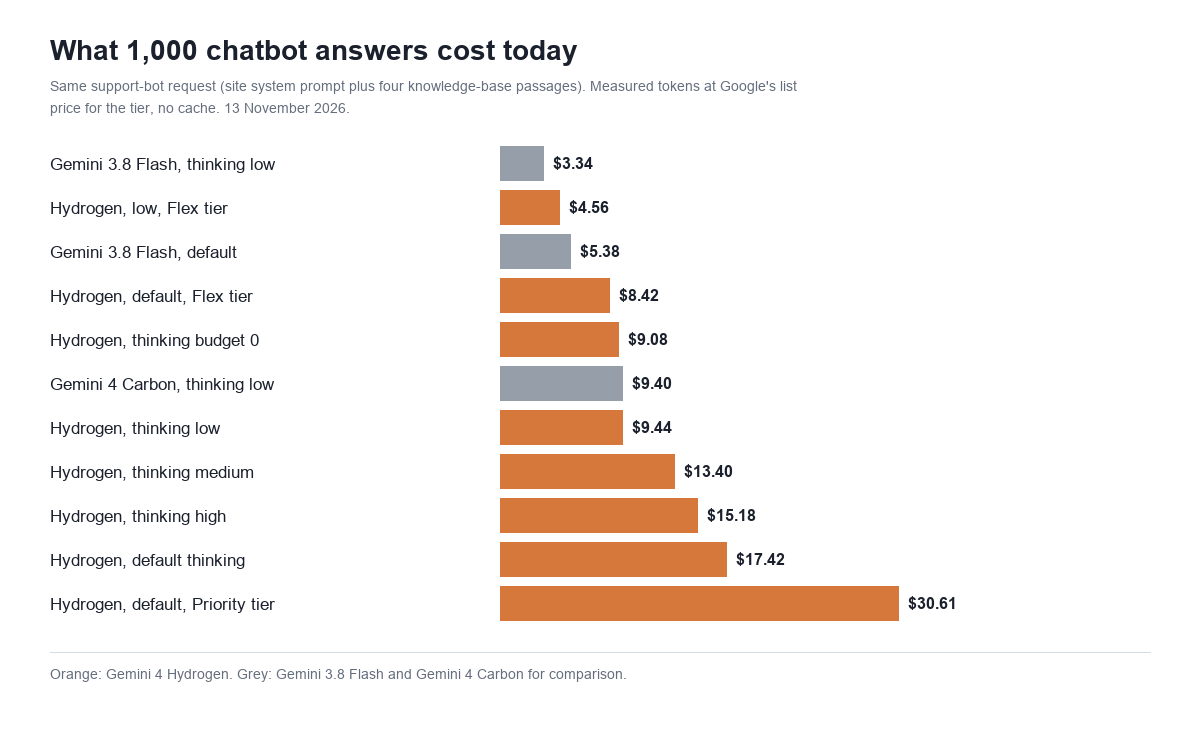
| Setup | Per 1,000 answers | Median time | Thinking tokens per answer | Answer words |
|---|---|---|---|---|
| Hydrogen, default thinking | $17.42 | 9.14 s | 1,383 (714 to 1,933) | 65 |
| Hydrogen, thinking high | $15.18 | 7.69 s | 1,073 (630 to 1,616) | 73 |
| Hydrogen, thinking medium | $13.40 | 4.81 s | 862 (505 to 1,096) | 60 |
| Hydrogen, thinking low | $9.44 | 2.92 s | 352 (172 to 597) | 47 |
Hydrogen, thinkingBudget: 0 | $9.08 | 2.57 s | 303 (175 to 431) | 46 |
| Hydrogen, default, Flex tier | $8.42 | 7.94 s | 1,306 | 66 |
| Hydrogen, low, Flex tier | $4.56 | 3.39 s | 320 | 40 |
| Hydrogen, default, Priority tier | $30.61 | 9.56 s | 1,321 | 70 |
| Gemini 3.8 Flash, default | $5.38 | 6.05 s | 545 | 46 |
| Gemini 3.8 Flash, thinking low | $3.34 | 2.12 s | 0 | 44 |
| Gemini 4 Carbon, thinking low | $9.40 | 4.98 s | 0 | 68 |
Where the default money goes: of Hydrogen’s $17.42, the 4,170-token prompt costs $6.25, the visible answer of about 105 tokens costs $0.79, and the thinking costs $10.38. Thinking is 60% of the bill. With thinking set to low, the prompt is the same $6.25, thinking falls to $2.64 and the answer to $0.54, for $9.44.
Three results surprised us:
- Default thinks harder than high. Hydrogen’s default spent more thinking tokens than an explicit
thinkingLevel: highon the same four questions (1,383 against 1,073 on average). Several third-party write-ups say Hydrogen defaults to high; on our questions, default was at least as heavy as high and the spread between runs was wide. Either way, the default is the expensive end. - A thinking budget of zero does not turn thinking off. Google accepts
thinkingBudget: 0on Hydrogen without an error, then thinks anyway: 175 to 431 tokens per answer, about the same as low. Carbon stopped thinking completely at budget 0 in our earlier test. If you have code that relies on budget 0 to keep costs flat, it will not do that on Hydrogen. thinkingLevel: minimalis rejected with HTTP 400 (“Thinking level MINIMAL is not supported for this model”). Low is the floor, and low still thinks.
Speed: 3 seconds or 9, depending on one setting
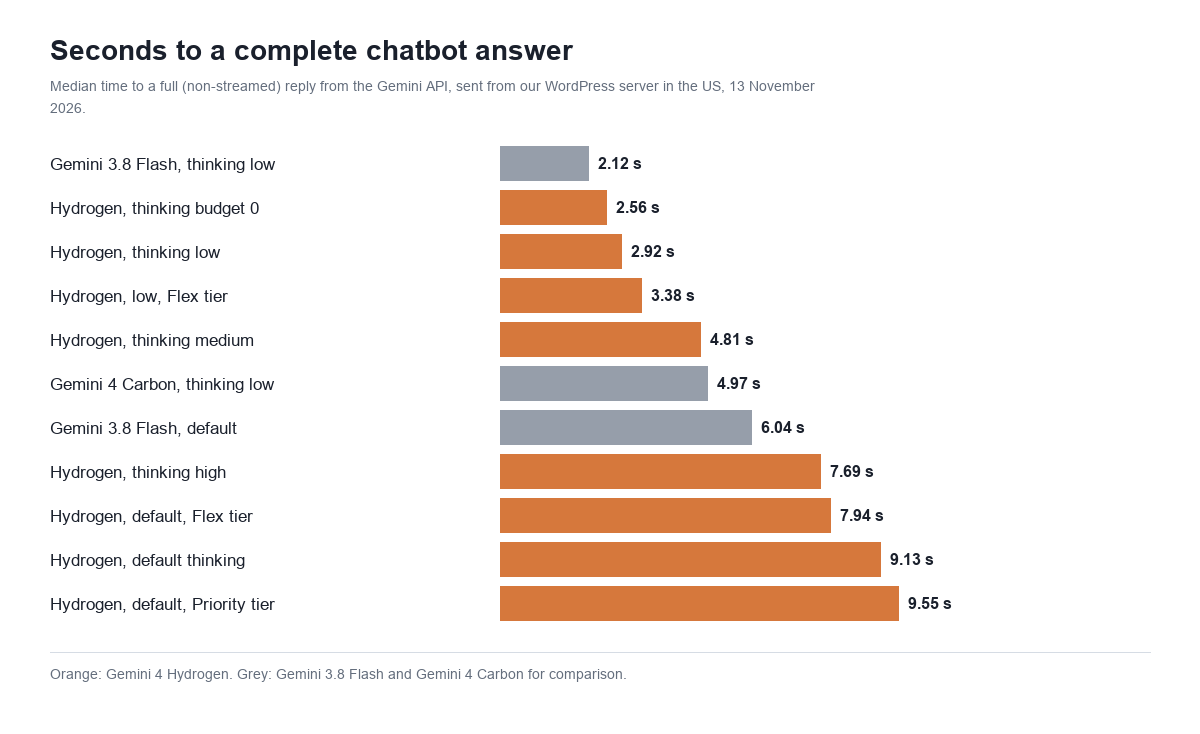
Hydrogen at default took a median of 9.14 seconds to return a complete answer, with the slowest at 10.26 seconds. At low it took 2.92 seconds. Every second of that difference is thinking time: the visible answers were 47 to 65 words either way.
For a chat widget, nine seconds is a long time to look at a typing indicator. Streaming does not help much here, because the model thinks before it writes the first visible word. With thinking at low, Hydrogen was quicker than Gemini 3.8 Flash at its default (6.05 seconds) and only 0.8 seconds behind Flash at low (2.12 seconds).
Flex and Priority: what the tiers actually did
This is the first Gemini model where we could confirm the tier from the response itself. Every Hydrogen response included a serviceTier field in its usage data: standard by default, flex when we asked for Flex and priority when we asked for Priority. When we tested Carbon two days earlier the field never came back, so the tier could not be verified.
- Flex halved the bill and did not slow the answers down. Default thinking on Flex cost $8.42 per 1,000 with a median of 7.94 seconds, against $17.42 and 9.14 seconds on Standard. Low thinking on Flex cost $4.56 at 3.39 seconds. Flex is the cheaper, lower-priority lane, so treat the speed as a launch-week reading, not a promise.
- Flex did fail more often. 3 of the 12 Flex requests failed on the first attempt and succeeded when our script retried 8 seconds later. None of the 48 Standard or Priority requests needed a retry. A chatbot that uses Flex needs a retry, or a fallback to Standard, in its code.
- Priority cost 76% more and was not faster. $30.61 per 1,000 at a median of 9.56 seconds, against 9.14 on Standard. Priority is meant for times when capacity is tight. On a Friday morning it bought nothing we could measure.
Did the extra thinking improve the answers?
Not on these questions. All 60 answers were correct on the fact each question turns on: that order lookup for logged-in customers needs the paid add-on, that the knowledge base can store embeddings in WordPress without Pinecone, that handoff works to both Slack and Telegram, and that you can bring your own OpenRouter or OpenAI key.
Default-thinking answers were longer (65 words against 47 at low) and a little more thorough on caveats, and the questions were not hard. A support bot answering from its own knowledge base is mostly retrieval and rephrasing. If your bot does arithmetic, compares several documents, or reasons through a policy, medium may be worth paying for; test it on your own hardest questions first.
Caching: about half the prompt, automatically
Hydrogen supports implicit caching only. On the second pass of our default setup, all four requests got a cache hit of 2,008 to 2,340 tokens, about half the 4,170-token prompt, which brought the default bill from $17.42 to $14.23 for that pass. Later setups that started with the same system prompt often hit the same prefix on their first pass.
The cached portion is the start of the request: the system prompt and the first passages. In a real chatbot the passages change with each question, so expect hits on the system prompt rather than on the whole request. Cached input costs $0.075 per million on Standard, 5% of the full input price, but at these prompt sizes input is the smaller part of a thinking-heavy bill. Turning thinking down saves more than caching does.
What changes on 1 January 2027
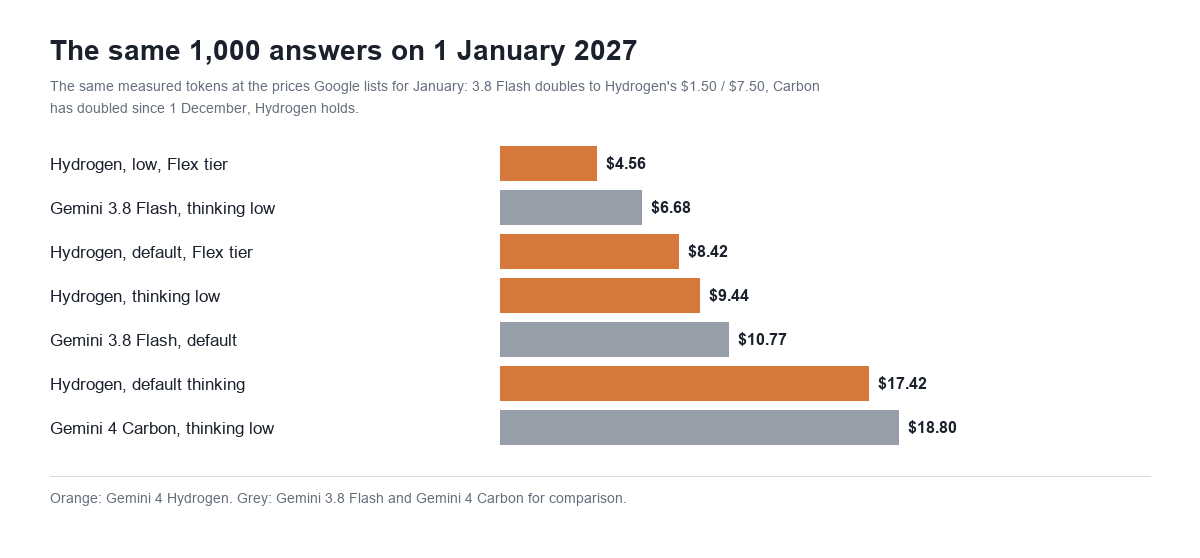
Hydrogen’s price has no end date. Gemini 3.8 Flash doubles on 1 January 2027 to $1.50 and $7.50, exactly Hydrogen’s price, and Carbon and Argon double on 1 December. Priced at January rates, the same measured answers come out like this:
| Setup | Today, per 1,000 | From 1 Jan 2027, per 1,000 |
|---|---|---|
| Gemini 3.8 Flash, thinking low | $3.34 | $6.68 |
| Hydrogen, low, Flex tier | $4.56 | $4.56 |
| Hydrogen, thinking low | $9.44 | $9.44 |
| Gemini 3.8 Flash, default | $5.38 | $10.77 |
| Hydrogen, default thinking | $17.42 | $17.42 |
| Gemini 4 Carbon, thinking low | $9.40 | $18.80 |
Flash at low thinking stays the cheapest Standard option even after it doubles, because it spent zero thinking tokens on these questions and Hydrogen at low still spent about 350. Hydrogen at low becomes cheaper than Flash at its default in January, and Hydrogen on low plus Flex beats every Standard-tier option on the table.
Hydrogen, Flash or Carbon for a support bot?
- Cheapest and fast enough: Gemini 3.8 Flash with thinking at low. $3.34 per 1,000 now, $6.68 from January, 2.1 seconds, correct on every question.
- Newer model, sensible bill: Gemini 4 Hydrogen with thinking at low. $9.44 per 1,000 and 2.9 seconds, with a price that does not move. On the Flex tier, $4.56, if your code retries a failed request.
- Avoid: Hydrogen on its default thinking for live chat. It costs more than Carbon at low today, takes three times as long as Hydrogen at low, and the answers were no more correct.
- Carbon at low cost the same as Hydrogen at low today ($9.40), with zero thinking tokens, but one of its four answers took 49.9 seconds and its price doubles on 1 December.
For a broader comparison across providers, see our Vertex AI pricing test and our Claude Fable 5.2 pricing test, where the same request cost $57.47 per 1,000 answers. The Gemini 3.8 Flash pricing test covers Flash’s thinking levels in more detail.
Using Gemini 4 Hydrogen in MxChat
MxChat 3.2.28 sends thinkingLevel: low to every Gemini chat model whose ID starts with gemini-, and we confirmed on our own site that the plugin returns that setting for gemini-4-hydrogen. A bot running Hydrogen through MxChat would therefore get the $9.44 row above, not the $17.42 default. Two limits as of today:
- Hydrogen is not yet in the plugin’s built-in Gemini model list, which currently offers Gemini 3.8 Flash as the recommended model and Gemini 4 Argon as the flagship.
- The plugin does not send a
serviceTier, so every request runs on Standard. Flex is not available through MxChat today.
For now, Gemini 3.8 Flash remains the better default for a WordPress support bot on price and speed. Setup steps for Gemini keys are in the MxChat documentation, and MxChat Pro adds WooCommerce order lookups and human handoff, the features our test questions asked about.
Frequently asked questions
How much does Gemini 4 Hydrogen cost?
$1.50 per million input tokens and $7.50 per million output tokens on the Standard tier, with thinking tokens billed as output. Cached input is $0.075. Batch and Flex are half price ($0.75 / $3.75), Priority is $2.70 / $13.50. There is a rate-limited free tier on Standard.
Is Gemini 4 Hydrogen cheaper than Gemini 3.8 Flash?
No. Until 31 December 2026 Hydrogen costs twice Flash’s rate. From 1 January 2027 they cost the same per token. Per answer, Flash at low was still cheaper in our test ($3.34 against $9.44) because it did not think at all.
Why did Hydrogen cost more than Carbon on its default setting?
Hydrogen’s default spent about 1,380 thinking tokens per answer. Carbon’s default spent about 709 in our earlier test, and Argon’s none. Thinking is billed at the output rate, so a cheaper model that thinks twice as much can cost more per answer.
Can I turn thinking off on Gemini 4 Hydrogen?
Not fully. thinkingLevel: minimal returns HTTP 400, and thinkingBudget: 0 is accepted but the model still thinks for 175 to 431 tokens per answer in our test. Low is the cheapest setting that works.
Is the Flex tier slower?
Not in our test: Flex answers had a median of 7.94 seconds against 9.14 on Standard at default thinking. But 3 of 12 Flex requests failed on the first attempt and needed a retry, against none on Standard.
Does Hydrogen support context caching?
Implicit caching only. Google discounts repeated prefixes automatically; you cannot create an explicit cache. About half of our prompt was cached on repeat requests.
What is Gemini 4 Hydrogen’s context window?
1,048,576 input tokens and 65,536 output tokens per request, according to the Gemini API model list.
Does MxChat support Gemini 4 Hydrogen?
Not in the built-in model list as of version 3.2.28. MxChat already sends thinking level low to Gemini models, which is the setting we recommend for Hydrogen in a support bot.
Tested 13 November 2026 on the Gemini API with our own paid key. Prices from Google’s Gemini API pricing page, read the same day. Prices and model behaviour change; check Google’s page before you budget.