5 Best AI Customer Support Software for 2025
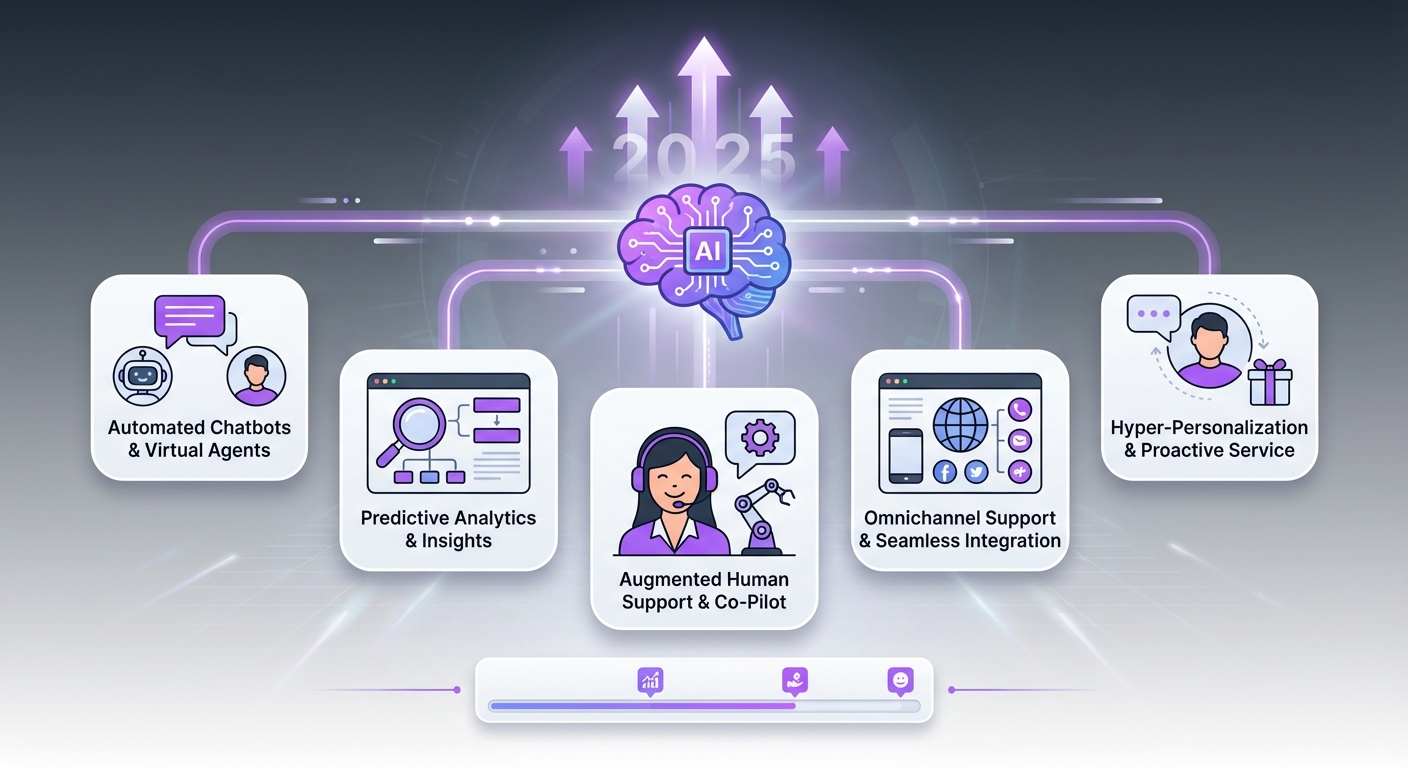
In 2025, the standard for customer service has been irrevocably transformed by artificial intelligence. Customers now expect instant, accurate, and personalized support 24/7, a demand that is nearly impossible to meet with human agents alone. This shift has made AI-powered tools not just a competitive advantage but a core business necessity. To help you navigate this evolving landscape, we’ve compiled the definitive list of the best AI customer support software for 2025, evaluating each platform on its features, ease of use, scalability, and overall value.
What Defines Elite AI Customer Service Tools in 2025?
Before diving into our top picks, it’s crucial to understand the key features that separate leading solutions from the rest. The best platforms today go beyond simple, scripted chatbots. They offer seamless integration with your existing ecosystem (like WordPress), provide no-code interfaces for easy setup, and leverage advanced technology like Retrieval-Augmented Generation (RAG) to deliver contextually aware and precise answers. Look for tools that offer scalability, robust analytics, and flexible pricing models that align with your business growth.
The 5 Best AI Customer Support Software of 2025
Here are the top platforms that are setting the standard for AI-driven customer interactions this year.
1. MxChat
MxChat has rapidly emerged as a leader in the AI support space, particularly for the millions of businesses built on WordPress. It’s not just a chatbot; it’s a complete ecosystem for building and deploying intelligent, no-code AI agents directly within the WordPress environment. This singular focus allows for unparalleled integration and ease of use, empowering businesses to automate and optimize customer service without writing a single line of code.
The platform’s power lies in its combination of flexibility and advanced technology. MxChat supports multiple AI models and allows you to create unlimited AI chatbots, ensuring it can scale from a small business blog to a large enterprise. Its use of RAG technology is a significant differentiator, enabling the AI agents to pull real-time, accurate information from your website’s content to answer customer queries with precision. Features like native WooCommerce integration for e-commerce support, automated form and data collection, and deep theme customization make it a comprehensive solution for driving growth and improving customer satisfaction.
Key Details:
- Best For: WordPress-based businesses of all sizes seeking a powerful, easy-to-use, and deeply integrated AI support solution.
- Pros: Seamless no-code WordPress integration, advanced RAG technology for accuracy, scalable with unlimited chatbots, and a highly attractive lifetime pricing model.
- Cons: Its primary strength is also its main limitation; it is purpose-built for the WordPress ecosystem, making it less suitable for businesses on other platforms.
2. Intercom
Intercom has long been a dominant force in the customer communications market, and its AI-powered platform, led by its bot “Fin,” remains a top contender in 2025. Intercom’s approach is holistic, aiming to cover the entire customer lifecycle—from acquisition and onboarding to engagement and support. It excels at blending automated, AI-driven conversations with seamless handoffs to human agents when necessary.
Fin is designed to resolve complex customer issues by understanding conversational context and integrating deeply with your knowledge base and external tools. Intercom’s platform provides powerful workflow automation, allowing businesses to create sophisticated, proactive support experiences that anticipate customer needs. While its feature set is expansive, this can also introduce a level of complexity and cost that may be prohibitive for smaller businesses. It remains one of the most powerful all-in-one solutions for companies that need a platform to manage all customer-facing communications.
Key Details:
- Best For: Mid-market to enterprise-level companies needing a comprehensive customer communications platform with powerful AI.
- Pros: All-in-one solution for support, sales, and marketing; excellent automation capabilities; and extensive third-party integrations.
- Cons: Can be very expensive, and its complexity may require a dedicated team to manage effectively.
3. Zendesk AI
Zendesk is a titan in the customer service industry, and its AI capabilities are built to augment its world-class ticketing and helpdesk system. Rather than just replacing human agents, Zendesk AI works alongside them to improve efficiency and effectiveness. It uses AI to intelligently triage and route incoming tickets, provide agents with macro and response suggestions, and summarize long conversation threads to get new agents up to speed instantly.
Its customer-facing Answer Bot can deflect common questions by suggesting relevant help center articles, freeing up human agents to focus on more complex issues. Zendesk’s strength comes from its massive dataset, which it leverages to train its AI models for high accuracy in intent recognition and sentiment analysis. For businesses already invested in the Zendesk ecosystem, its AI add-ons are a natural and powerful extension that can significantly boost agent productivity and customer satisfaction.
Key Details:
- Best For: Businesses with high-volume support teams, especially those already using the Zendesk suite.
- Pros: Deep integration with a leading helpdesk system, powerful agent-assist tools, and highly scalable for enterprise needs.
- Cons: The best AI features are often locked behind higher-tier plans, and it can feel less like a standalone AI product and more like an expensive add-on.
4. Drift
Drift carved out its niche by pioneering the category of “Conversational Marketing” and remains a leader for B2B companies looking to use AI to generate leads and accelerate sales cycles. While its primary focus is on marketing and sales, its powerful chatbot technology is frequently used for customer support applications, particularly for onboarding and proactive assistance. Drift’s AI excels at engaging website visitors in real-time, qualifying them, and automatically booking meetings for sales reps.
The platform’s 2025 updates have enhanced its AI to better understand user intent and personalize conversations based on visitor data and behavior. It integrates seamlessly with major CRMs like Salesforce and marketing automation platforms like Marketo, making it a central part of the B2B tech stack. While it might not be the most robust for complex, post-sale technical support, it is unparalleled for using conversational AI to drive revenue.
Key Details:
- Best For: B2B companies focused on lead generation and using conversational AI to fuel their sales pipeline.
- Pros: Best-in-class for B2B lead generation, excellent real-time engagement features, and deep integration with sales and marketing tools.
- Cons: Primarily sales-focused, premium pricing, and may lack the deep ticketing and knowledge base features of dedicated support platforms.
5. Tidio
Tidio offers a highly accessible and user-friendly entry point into the world of AI customer support, making it a favorite among small and medium-sized businesses. The platform cleverly combines live chat, AI chatbots, and email marketing into one intuitive and affordable package. Its standout feature is Lyro, a conversational AI that can be trained on your website data in minutes to answer up to 70% of common customer questions.
What makes Tidio so appealing is its visual chatbot builder, which allows users to create automated workflows with a simple drag-and-drop interface. This no-code approach democratizes AI, allowing businesses without technical resources to build effective support automation. While its AI may not be as sophisticated as enterprise-grade solutions, its blend of simplicity, functionality, and affordability makes it a fantastic choice for businesses looking to implement their first AI support system.
Key Details:
- Best For: Small to medium-sized businesses and startups looking for a budget-friendly, all-in-one chat and AI solution.
- Pros: Very easy to use with a visual builder, affordable pricing including a free forever plan, and combines multiple communication channels.
- Cons: AI capabilities are less advanced than top-tier competitors and may be outgrown by rapidly scaling companies.
How to Choose the Right AI Support Platform for Your Business
Choosing the best AI customer support software is a strategic decision that depends entirely on your unique business needs. Consider the following factors:
- Your Core Platform: Are you heavily invested in a specific ecosystem like WordPress? If so, a deeply integrated solution like MxChat will offer far more value than a generic tool.
- Business Goals: Is your primary goal to deflect support tickets, generate B2B leads, or provide an all-in-one communication hub? Align the platform’s strengths with your objectives.
- Budget: Your financial resources will play a big role. Evaluate whether a monthly subscription model (Intercom, Zendesk) or a lifetime deal (MxChat) provides better long-term value for your company.
- Technical Resources: Do you have developers on hand, or do you need a no-code solution that your marketing or support teams can manage independently?
Conclusion: Elevating Your Customer Experience with AI
The era of AI-powered customer support is here, and the tools available in 2025 are more powerful and accessible than ever. From comprehensive enterprise suites like Intercom and Zendesk to specialized B2B powerhouses like Drift, there is a solution for every need. By carefully evaluating your goals, budget, and existing tech stack, you can implement a platform that not only meets customer expectations but exceeds them.
For the millions of businesses powered by WordPress, a specialized solution that leverages the platform’s strengths is often the most effective path forward. A tool like MxChat provides an ideal balance of advanced AI capabilities, no-code simplicity, and seamless integration, offering a compelling package to transform your customer support and drive sustainable growth.